Elbow and Forearm Conditions Disability Benefits Questionnaire Completed Form Examples and Samples
Explore comprehensive examples of completed Elbow and Forearm Conditions Disability Benefits Questionnaires (DBQ). See how detailed medical information, including diagnoses, range of motion, flare-ups, and functional limitations, is accurately captured for VA disability claims. These samples demonstrate effective medical documentation for elbow and forearm conditions.
Elbow and Forearm Conditions Disability Benefits Questionnaire has a very complex Form Complexity Index of 100/100 — Instafill’s AI completes it in under a minute.
Form Complexity Index
Very Complex
100 / 100
| Fillable fields | 739 |
| Pages | 15 |
| Fields per page | 49 |
| Sections | 179 |
| Conditional rules | 558 |
| Tables & lists | 13 |
| Instruction pages | — |
| Instafill Form ID | IF-ELBOW-AND-FOREARM-CONDITIONS-DISABILITY-BENEFITS-Q |
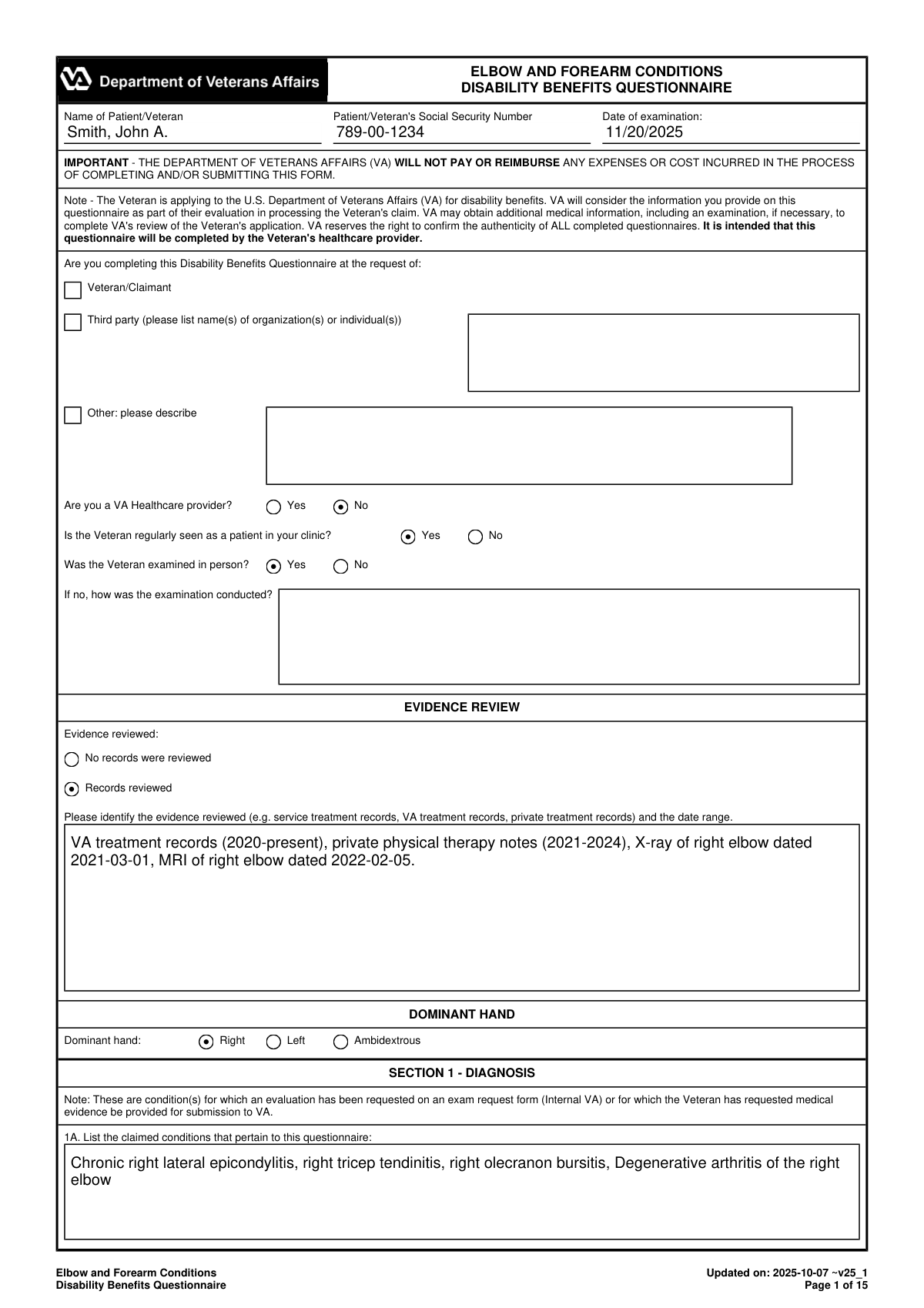
Elbow and Forearm Conditions Disability Benefits Questionnaire Example
How this form was filled:
Our AI extracted extensive medical details from a doctor's detailed dictation notes, including complex information about diagnoses, range of motion, flare-ups, and functional limitations, to automatically fill out this Elbow and Forearm Conditions Disability Benefits Questionnaire. This example demonstrates how our AI intelligently processes unstructured medical narratives.
Source document used: Doctor's Dictation Notes
Patient: Smith, John A.
DOB: 1980-05-12
SSN: 789-00-1234
Date of Visit: 2025-11-20

**Subjective:** Mr. Smith, a right-hand dominant veteran, presents today for a follow-up regarding his chronic right elbow and forearm pain. He reports the pain originated in late 2020 while on active duty, following repetitive tasks. He describes constant dull ache, exacerbated by lifting, gripping, and any repetitive arm movements. He experiences flare-ups approximately once a week, lasting 1-2 days, with pain intensity reaching 7/10. These flare-ups are typically triggered by heavy lifting or prolonged computer use and are somewhat relieved by rest and ice. He notes significant functional impairment during these episodes, making it hard to perform daily tasks. He struggles with tasks like turning doorknobs, lifting grocery bags, and using power tools. He reports using an elbow brace constantly, specifically for his right elbow, which provides some support during his work as a mechanic.

**Objective:**
Physical Exam: Right elbow ROM is abnormal. Left elbow ROM is normal.
Right Elbow: Active ROM: Flexion 130°, Extension 10°, Supination 70°, Pronation 65°. Pain is noted on all active movements. Passive ROM is congruent with active ROM, also eliciting pain. Pain is evident during weight-bearing, non-weight-bearing, active, and passive motions, and causes functional loss. No crepitus noted. Localized tenderness present over the lateral epicondyle, triceps insertion, and olecranon bursa, moderate severity, correlating with his diagnosed conditions.
Repetitive use testing of the right elbow performed, patient able to complete 3 repetitions. After 3 repetitions, ROM further diminished: Flexion 120°, Extension 15°, Supination 60°, Pronation 50°. These limitations are due to pain, weakness, and lack of endurance.

Veteran was not examined immediately after repeated use or during a flare-up. However, based on his statements and prior PT records (2021-2024), during repeated use over time, his estimated ROM would be: Flexion 110°, Extension 20°, Supination 55°, Pronation 45°. During flare-ups, estimated ROM would be: Flexion 100°, Extension 25°, Supination 50°, Pronation 40°. Other contributing factors to disability include swelling, weakened movement, and less movement than normal in the right elbow. Muscle atrophy of the right upper extremity noted 5cm above the elbow: normal side circumference 28 cm, atrophied side 26 cm. This is attributed to the claimed conditions. No ankylosis or other major impairments.

**Assessment:** Chronic right lateral epicondylitis (M77.11, diagnosed 2021-03-15), right tricep tendinitis (M76.01, diagnosed 2021-06-20), and right olecranon bursitis (M70.31, diagnosed 2022-01-10). These conditions significantly impact his ability to perform occupational tasks requiring grip strength, lifting, and repetitive arm motion.

**Evidence Reviewed:** VA treatment records (2020-present), private physical therapy notes (2021-2024), X-ray of right elbow dated 2021-03-01 showing mild degenerative changes. MRI of right elbow dated 2022-02-05 confirmed lateral epicondylitis, tricep tendinopathy, and olecranon bursitis with fluid. Degenerative arthritis of the right elbow is documented. No other significant diagnostic findings.

**Plan:** Continue physical therapy, consider steroid injection. Refer for DBQ completion. Dr. Emily R. White, Orthopedics, NPI 1234567890, License 54321 CA, 789 Medical Plaza, Anytown, CA 90210. Phone: (555) 123-4567, Fax: (555) 123-4568.
Information used to fill out the document:
- Patient Name: John A. Smith
- Social Security Number: 789-00-1234
- Date of Examination: 2025-11-20
- Dominant Hand: Right
- Claimed Conditions: Right Lateral Epicondylitis, Right Tricep Tendinitis, Right Olecranon Bursitis
- Diagnoses (Right Elbow): Lateral Epicondylitis (M77.11, 2021-03-15), Tricep Tendinitis (M76.01, 2021-06-20), Olecranon Bursitis (M70.31, 2022-01-10)
- Flare-ups: Weekly, severe pain (7/10), 1-2 days, triggered by heavy lifting/computer use, relieved by rest/ice, significant functional impairment
- Functional Loss Description: Difficulty with lifting objects, turning doorknobs, using tools
- Right Elbow Active ROM: Flexion 130°, Extension 10°, Supination 70°, Pronation 65° (pain on all)
- Right Elbow Muscle Atrophy: 5cm above elbow, Normal: 28 cm, Atrophied: 26 cm (due to claimed condition)
- Assistive Devices: Elbow Brace (Constant use for right elbow)
- Imaging Results: X-ray (2021-03-01): mild degenerative changes right elbow; MRI (2022-02-05): right lateral epicondylitis, tricep tendinopathy, olecranon bursitis with fluid.
- Examiner Details: Dr. Emily R. White, Orthopedics, NPI 1234567890, License 54321 CA, 789 Medical Plaza, Anytown, CA 90210, Phone (555) 123-4567, Fax (555) 123-4568
What this filled form sample shows:
- Accurately extracted multiple **specific diagnoses, ICD codes, and dates of diagnosis** for different conditions affecting the same body part.
- Parsed detailed **range of motion (ROM) measurements** for both active and estimated repetitive use/flare-up scenarios, including associated pain and limiting factors.
- Identified and summarized the veteran's self-reported **flare-up characteristics** (frequency, duration, severity, triggers, relief) and **functional limitations**.
- Extracted specific **muscle atrophy measurements** (normal vs. atrophied circumference) and their location.
- Correctly identified **assistive device use** and its application to the affected limb.
- Synthesized **imaging study details** and their findings to confirm degenerative arthritis and soft tissue pathologies.
Form specifications and details:
| Use Case: | Veteran's disability claim for chronic elbow and forearm conditions |
| Source Document: | Doctor's dictation notes from a follow-up visit |
| Categories: | disability forms, benefit forms, disability benefits forms |
| Created: | March 10, 2026 04:05 AM |