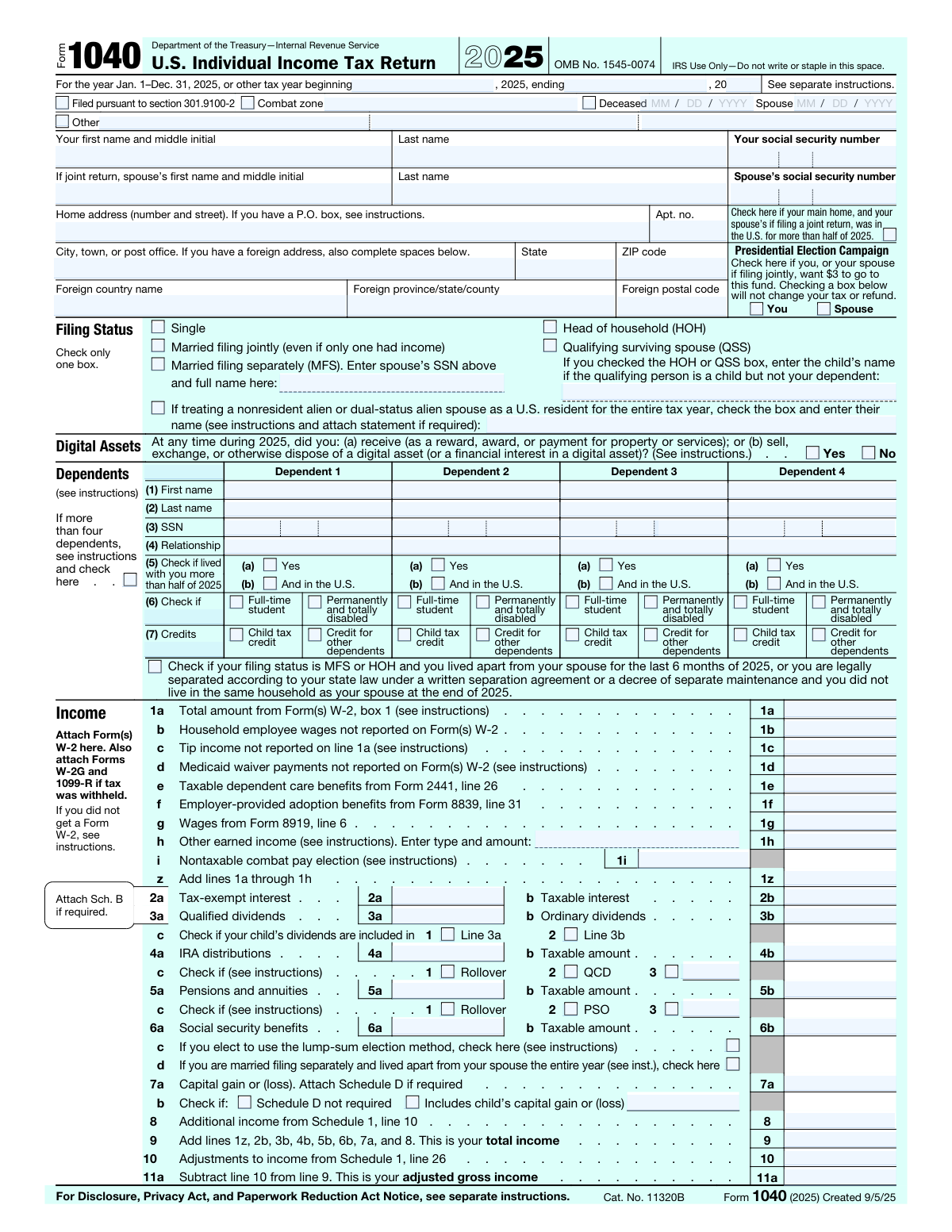
Yes! You can use AI to fill out Form 1040, U.S. Individual Income Tax Return
IRS Form 1040 is the cornerstone of the U.S. tax system, used by nearly all individual taxpayers to file their annual federal income tax return. It's essential for reporting all sources of income, claiming eligible deductions and credits, and determining whether you owe additional tax or are due a refund from the government. Today, this form can be filled out quickly and accurately using AI-powered services like Instafill.ai, which can also convert non-fillable PDF versions into interactive fillable forms.
Our AI automatically handles information lookup, data retrieval, formatting, and form filling.
It takes less than a minute to fill out Form 1040 using our AI form filling.
Securely upload your data. Information is encrypted in transit and deleted immediately after the form is filled out.
Form specifications
| Form name: | Form 1040, U.S. Individual Income Tax Return |
| Number of fields: | 227 |
| Number of pages: | 2 |
| Language: | English |
| Categories: | income forms, income tax forms, individual tax forms, tax forms |
Instafill Demo: How to fill out PDF forms in seconds with AI
How to Fill Out Form 1040 Online for Free in 2026
Are you looking to fill out a FORM 1040 form online quickly and accurately? Instafill.ai offers the #1 AI-powered PDF filling software of 2026, allowing you to complete your FORM 1040 form in just 37 seconds or less.
Follow these steps to fill out your FORM 1040 form online using Instafill.ai:
- 1 Navigate to Instafill.ai and upload your Form 1040, or select it from their library of tax forms.
- 2 Provide your personal information, including your name, Social Security Number, address, and filing status, letting the AI guide you to the correct fields.
- 3 Enter details about your spouse (if applicable) and any dependents you are claiming, including their names, SSNs, and relationship to you.
- 4 Input your income from all sources, such as W-2s, 1099s for interest and dividends, and any other earnings, following the AI's prompts for each line item.
- 5 Add any adjustments to income, deductions (standard or itemized), and tax credits you qualify for, allowing the AI to perform the necessary calculations.
- 6 Review the automatically calculated total tax, payments, and refund or amount owed, then provide your bank account information for direct deposit if you are due a refund.
- 7 Electronically sign and date the form, then download the completed document, ready for e-filing or mailing to the IRS.
Our AI-powered system ensures each field is filled out correctly, reducing errors and saving you time.
Why Choose Instafill.ai for Your Fillable Form 1040 Form?
Speed
Complete your Form 1040 in as little as 37 seconds.
Up-to-Date
Always use the latest 2026 Form 1040 form version.
Cost-effective
No need to hire expensive lawyers.
Accuracy
Our AI performs 10 compliance checks to ensure your form is error-free.
Security
Your personal information is protected with bank-level encryption.
Frequently Asked Questions About Form Form 1040
This form is the U.S. Individual Income Tax Return, likely Form 1040. It is used by individuals to report their annual income, claim deductions and credits, and calculate their tax liability or refund for the year.
You should have your Social Security numbers for yourself, your spouse, and any dependents. You will also need income documents like Forms W-2 and 1099, and records for any deductions or credits you plan to claim.
Your filing status is based on your marital situation on the last day of the tax year. The form provides five options: Single, Married Filing Jointly, Married Filing Separately, Head of Household (HOH), and Qualifying Surviving Spouse (QSS).
You must answer whether you received, sold, exchanged, or otherwise dealt with any digital assets, like cryptocurrency, during the tax year. This is a required question for all filers to help the IRS track virtual currency transactions.
The form has space to list four dependents. If you have more, check the box for 'More than four dependents' and attach a separate statement with the required information for each additional dependent as outlined in the form's instructions.
The Child Tax Credit is for qualifying children who meet specific age and residency tests. The Credit for Other Dependents is for dependents who do not qualify for the Child Tax Credit, such as older children or other relatives you support.
In the 'Refund' section, enter the amount you want refunded on line 35a, then provide your bank's routing number and your account number in the spaces provided. You must also indicate whether it is a checking or savings account.
If the taxpayer or spouse is deceased, you must check the 'Deceased' box at the top of the form and enter their date of death. A surviving spouse or personal representative may need to sign the return.
There is a 'Combat zone' checkbox near the top of the form. If you served in a designated combat zone, check this box and write in the name of the zone, as this may provide you with special tax benefits.
A Third-Party Designee is someone you authorize to discuss this specific tax return with the IRS. If you want to allow this, check 'Yes' in that section and provide the designee's name, phone number, and a 5-digit PIN they can use for identification.
Yes, services like Instafill.ai use AI to auto-fill form fields accurately and save time. This can help reduce manual data entry and potential errors when preparing your tax return.
You can use a service like Instafill.ai to upload the PDF. The platform makes the form interactive, allowing you to easily type in your information, sign electronically, and download the completed document.
If you have a non-fillable or 'flat' PDF, you can use a tool like Instafill.ai to convert it into an interactive, fillable form. Simply upload the document, and the software will automatically detect the fields for you to complete online.
Checking this box allows you to designate $3 of your tax payment to go to the Presidential Election Campaign Fund. It does not change your tax liability or the amount of your refund or payment due.
An IP PIN is a six-digit number assigned by the IRS to eligible taxpayers to help prevent identity theft. If the IRS sent you an IP PIN, you must enter it in the signature section when you file; otherwise, you can leave this field blank.
Compliance Form 1040
Validation Checks by Instafill.ai
1
Validates Social Security Number Format
This check ensures that the 'Primary taxpayer Social Security number', 'Spouse's social security number', and all 'Dependent Social Security number' fields are entered in a valid nine-digit format. The system should accept numbers with or without dashes but must confirm the presence of exactly nine digits. This is critical for the IRS to correctly identify taxpayers and their dependents, and failure to provide a valid SSN can result in processing delays or rejection of the return.
2
Ensures Filing Status and Spouse Information are Consistent
This validation verifies that if the filing status is 'Married filing jointly' or 'Married filing separately', the spouse's first name, last name, and Social Security number are provided. Conversely, if the filing status is 'Single' or 'Head of household', spouse information should generally be absent unless specific conditions apply (like MFS). This prevents logical inconsistencies and ensures all required information for a given filing status is captured, which is essential for correct tax calculation.
3
Verifies Dependent Count Matches Dependent Entries
This check cross-references the number entered in the 'Total dependents' field with the number of actual dependent sections that have been filled out. For example, if 'Total dependents' is '2', the system must verify that information for 'Dependent 1' and 'Dependent 2' is complete, and that no data is entered for 'Dependent 3' or 'Dependent 4'. This ensures data integrity and prevents mismatches between the summary count and the detailed dependent data.
4
Requires Qualifying Person for HOH or QSS Filing Status
This validation confirms that if the 'Head of household (HOH)' or 'Qualifying surviving spouse (QSS)' filing status is selected, the 'Qualifying person/child's name' field must be filled. These filing statuses offer significant tax advantages but are contingent on the taxpayer supporting a qualifying individual. Failure to provide the name of the qualifying person will result in the filing status being disallowed and the return being rejected or recalculated at a less favorable rate.
5
Validates Logical Relationship Between Ordinary and Qualified Dividends
This check ensures that the amount entered for 'Qualified dividends (Line 3a)' is not greater than the amount entered for 'Ordinary dividends (Line 3b)'. Qualified dividends are a subset of total ordinary dividends that are taxed at a lower rate, so they can never exceed the total. An error here indicates a misunderstanding of the dividend types and would lead to an incorrect tax calculation.
6
Validates Logical Relationship Between Total and Taxable IRA Distributions
This validation ensures that the 'Taxable amount of IRA distributions (line 4b)' is less than or equal to the 'IRA distributions (line 4a)'. The total distribution represents the gross amount withdrawn, while the taxable amount is the portion subject to income tax. The taxable portion cannot exceed the total withdrawal, and a failure of this check would lead to an incorrect calculation of total income and tax liability.
7
Ensures Refund Allocation Matches Overpayment Amount
This check verifies that the sum of the 'Refund to you (line 35a)' and the 'Amount applied to 2026 estimated tax (line 36)' is exactly equal to the 'Amount you overpaid (line 34)'. This ensures the taxpayer has accounted for the entire overpayment amount, leaving no portion unallocated. A mismatch would cause a processing error, as the IRS would not know how to distribute the refund.
8
Requires Date of Death When 'Deceased' Box is Checked
This validation confirms that if the 'Deceased' checkbox for the primary taxpayer is checked, the corresponding 'Deceased — date of death' field must contain a valid date. The same logic applies to the spouse's 'Deceased' checkbox and date of death field. This information is legally required for processing a final return for a deceased individual and is necessary for determining eligibility for certain tax rules.
9
Verifies Calculation of Adjusted Gross Income (AGI)
This check performs an arithmetic validation to ensure that 'Adjusted gross income (Line 11a)' is correctly calculated as 'Total income (Line 9)' minus 'Adjustments to income (Schedule 1, line 26)'. AGI is a critical figure that affects eligibility for numerous deductions and credits. An incorrect AGI value will cause cascading errors throughout the rest of the tax calculation, leading to an incorrect tax liability or refund.
10
Verifies Calculation of Taxable Income
This validation confirms that 'Taxable income (Line 15)' is correctly calculated by subtracting 'Total deductions (Line 14)' from 'Adjusted gross income (Line 11b)'. The check also enforces the rule that if the result is zero or less, the value entered must be '0'. This is the final income figure upon which tax is computed, so its accuracy is paramount for a correct return.
11
Prevents Mutual Selection of Dependent Credits
This check ensures that for any single dependent, the 'Child tax credit' checkbox and the 'Credit for other dependents' checkbox are not both selected. A dependent can qualify for one of these credits, but not both. Allowing both to be checked for the same person would lead to an incorrect and inflated credit amount, which would be rejected by the IRS.
12
Requires Completeness of Third-Party Designee Information
This validation ensures that if the 'Yes. Complete below.' box is checked in the 'Third Party Designee' section, then the 'Designee's name', 'Designee's phone number', and 'Designee's personal identification number (PIN)' fields are all filled out. Without this complete information, the IRS cannot act on the authorization to speak with the designated person. This check prevents incomplete authorizations that would be invalid.
13
Ensures Exclusivity of US vs. Foreign Address
This check verifies that a filer has not provided both a complete U.S. address (Street, City, State, ZIP) and a complete foreign address (Country, Province, Postal Code). A tax return should have only one primary mailing address. Having entries in both sets of fields is logically inconsistent and would create ambiguity for the tax authority, potentially delaying correspondence or refunds.
14
Validates Conditional Requirement for Preparer's Firm Information
This check ensures that if a paid preparer is used and the 'Self-employed' box is not checked, then the 'Firm's name', 'Firm's EIN', and 'Firm's street address' fields must be completed. This information is required by the IRS to identify the company responsible for preparing the return. Failure to provide this when required can result in penalties for the preparer and their firm.
15
Verifies Mutual Exclusivity of Overpayment and Amount Owed
This validation confirms that the 'Amount you overpaid (line 34)' and the 'Amount you owe (Line 37)' are mutually exclusive. If one of these fields has a value greater than zero, the other must be zero. A taxpayer cannot both owe money and be due a refund on the same return, so a failure of this check indicates a fundamental calculation error.
Common Mistakes in Completing Form 1040
Filers often enter a name or SSN that does not exactly match the information on their Social Security card. This can happen due to typos, using a nickname instead of a legal name, or name changes after marriage that haven't been updated with the Social Security Administration. An information mismatch is one of the most common reasons for an e-filed return to be rejected and can cause significant processing delays and issues with receiving refunds or tax credits.
Choosing the wrong filing status, such as claiming 'Head of Household' without meeting the strict requirements, is a frequent error. People may misunderstand the rules for being 'unmarried' or who qualifies as a 'qualifying person'. This mistake can lead to an incorrect tax calculation, resulting in overpayment, underpayment, and potential IRS notices, audits, and penalties. To avoid this, use the IRS's Interactive Tax Assistant or software that guides you through the determination process.
Transposing digits in the bank routing or account number is a simple but costly mistake when requesting a direct deposit for a refund. Filers may also forget to specify whether the account is for checking or savings. These errors will cause the refund to be significantly delayed, rejected by the bank, or, in the worst-case scenario, deposited into the wrong person's account. Always double-check these numbers against a check or official bank document before submitting.
Forgetting to list a dependent's SSN, misspelling their name, or entering the wrong birthdate can lead to the rejection of claimed credits like the Child Tax Credit. Another common error is failing to correctly check the boxes for each dependent, such as the one for 'Child tax credit' versus 'Credit for other dependents'. These mistakes result in processing delays, loss of valuable tax credits, and follow-up correspondence from the IRS. Using a tool like Instafill.ai can help by storing and accurately auto-filling this repetitive information.
Taxpayers sometimes forget to include income from all sources, such as a Form 1099-INT for bank interest, 1099-DIV for dividends, or 1099-NEC for freelance work. Even small amounts of unreported income can trigger an IRS CP2000 notice for an underpayment of tax. This results in having to pay the additional tax plus penalties and interest. To prevent this, gather all W-2s, 1099s, and other income statements before starting the return and systematically go through each one.
Even with calculators, manual addition and subtraction errors are common when calculating total income, adjusted gross income (AGI), or the final tax due or refund. An incorrect calculation on one line can create a cascade of errors throughout the form. While the IRS will usually correct math errors, it can delay your refund or change the amount you owe unexpectedly. Using tax software or an AI-powered tool like Instafill.ai eliminates this risk by performing all calculations automatically.
A tax return is not considered valid until it is signed and dated by the taxpayer (and their spouse, if filing jointly). Forgetting this final step is a surprisingly common mistake, especially with paper-filed returns. An unsigned return will not be processed by the IRS, which can lead to a failure-to-file penalty if the oversight isn't corrected before the deadline. Always perform a final review to ensure all signature lines are completed.
When reporting income from pensions or IRAs (Lines 4 and 5), people often mistakenly enter the total distribution amount (Line 4a/5a) into the 'taxable amount' field (Line 4b/5b). This happens when they don't account for non-taxable portions, such as a rollover or a return of non-deductible contributions. This error leads to overpaying taxes. Carefully read your Form 1099-R, which specifies the taxable amount, and check the 'Rollover' box if applicable to avoid this.
A filer may correctly determine they are eligible for the 'Head of Household' (HOH) filing status but then forget to enter the name of the qualifying child or relative in the designated space on the form. Without this information, the claim to HOH status is incomplete and will be disallowed by the IRS. This results in the IRS recalculating the tax liability using a less advantageous status (like 'Single'), leading to a higher tax bill and potential penalties.
The question at the top of the form asking about digital asset transactions is a point of confusion for many. Some people who only purchased and held cryptocurrency may incorrectly check 'Yes,' while others who received it as a gift or payment may incorrectly check 'No.' Answering this question incorrectly could draw unwanted scrutiny or be seen as a misrepresentation. It is crucial to read the instructions carefully to understand what constitutes a reportable transaction for the tax year.
Taxpayers living abroad often try to force their foreign address into the standard U.S. address fields for City, State, and ZIP code. The form has a separate, specific section for the foreign country, province, and postal code. Using the wrong fields can cause critical IRS correspondence to be lost or delayed. To ensure you receive notices, you must use the designated foreign address section and leave the U.S. State and ZIP fields blank.
When a filer has more than four dependents, they must check the designated box and attach a statement with the required information for the additional dependents. People often list the first four and forget to check this box, or they try to squeeze extra names onto the main form. This leads to the IRS not recognizing the additional dependents, disallowing any credits associated with them, and causing processing delays. If the form is a non-fillable PDF, a tool like Instafill.ai can convert it to a fillable version, making it easier to manage attachments and ensure all information is captured correctly.
Saved over 80 hours a year
“I was never sure if my IRS forms like W-9 were filled correctly. Now, I can complete the forms accurately without any external help.”
Kevin Martin Green
Your data stays secure with advanced protection from Instafill and our subprocessors

Robust compliance program
Transparent business model
You’re not the product. You always know where your data is and what it is processed for.
ISO 27001, HIPAA, and GDPR
Our subprocesses adhere to multiple compliance standards, including but not limited to ISO 27001, HIPAA, and GDPR.
Security & privacy by design
We consider security and privacy from the initial design phase of any new service or functionality. It’s not an afterthought, it’s built-in, including support for two-factor authentication (2FA) to further protect your account.
Fill out Form 1040 with Instafill.ai
Worried about filling PDFs wrong? Instafill securely fills form-1040-us-individual-income-tax-return forms, ensuring each field is accurate.