
Instafill.ai
7 days free
AI form filling · 17 fields · 3 pages · done in seconds

Yes! You can use AI to fill out Form 4868, Application for Automatic Extension of Time To File U.S. Individual Income Tax Return (2024)

Don't type 17 fields by hand. Tell our AI about yourself, or upload your W-2 or last year's return, and it fills every field in seconds. You check it, then download, print or sign.
7 days free, then $19.99/month · Cancel anytime
AI fills it, no typingEncrypted, never used to train AICancel in two clicks
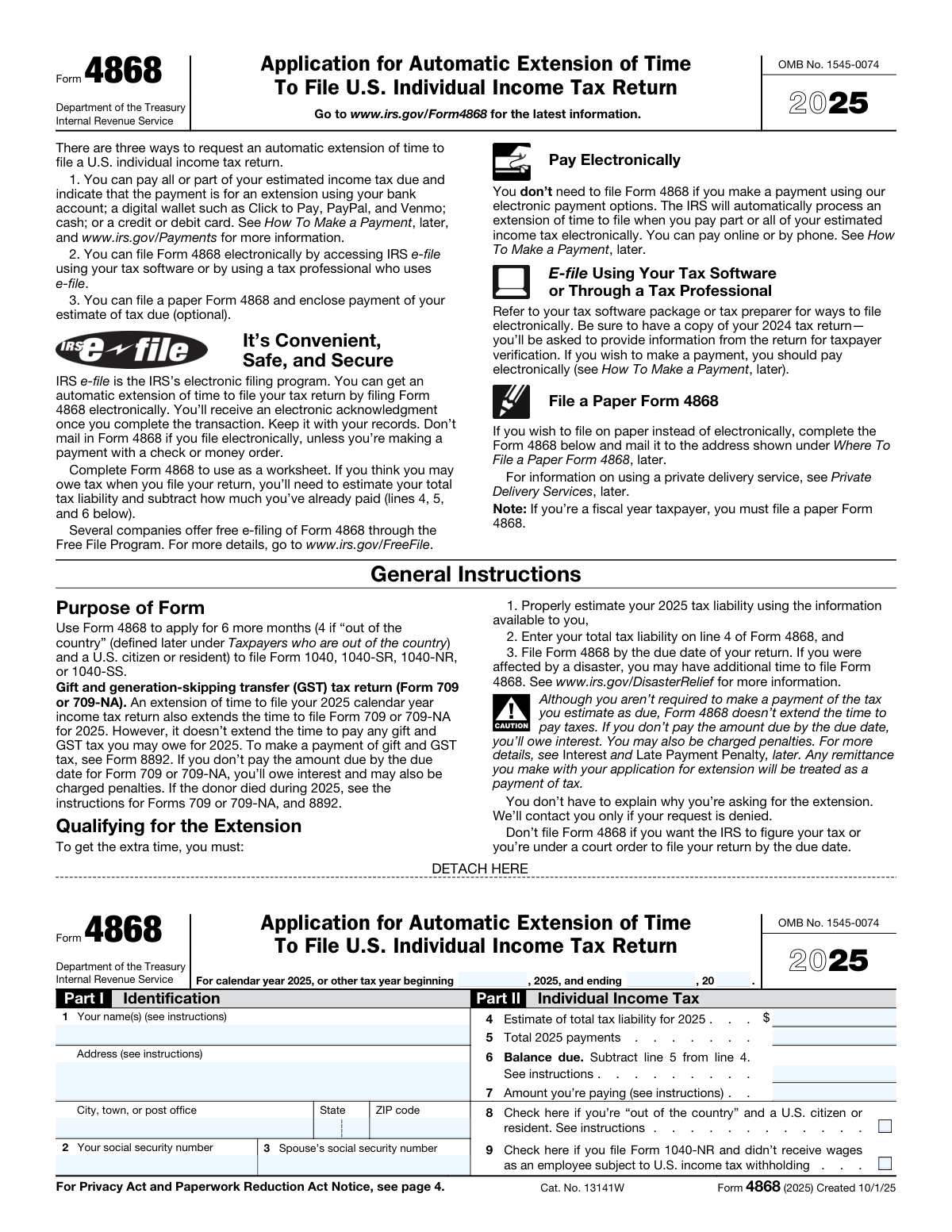
Form 4868, Application for Automatic Extension of Time To File U.S. Individual Income Tax Return (2024), page 1
Basic · 35/100Form Complexity Index

The AI does the filling. You just check it.

No typing into boxes, nothing to install.

Tell the AI about youAnswer a few questions in plain words, or upload your W-2 or last year's return. That is all the typing there is.
AI fills every field in secondsIt puts each answer in the right box on every page, checkboxes included.
Check it and downloadReview every field, change anything, then download, print or sign the PDF.

What this form asks for

The AI fills all of it, from your answers or your documents.

Form 4868, officially known as the Application for Automatic Extension of Time To File U.S. Individual Income Tax Return, is a document used by taxpayers to request additional time to file their tax returns. It grants an automatic 6-month extension, but it's important to note that it does not extend the time to pay any taxes owed. Filing this form is crucial for individuals who need more time to gather necessary documentation or for those who anticipate delays in filing their tax returns.
Fillable fields17
Pages3
Sections9
Form Complexity IndexBasic, 35/100

The AI checks your answers before you download

15 checks built for this form, so a wrong date or a missing answer is caught before anyone else sees it.

Ensures that the form is being filed for the correct tax year, specifically 2024, as indicated by the instructions.

The AI software ensures that the form is being filed for the correct tax year, specifically 2024, as indicated by the instructions. It verifies that the tax year mentioned on the form aligns with the current filing requirements. This check is crucial to prevent the submission of the form for an incorrect tax year, which could lead to processing delays or rejections. Additionally, it confirms that all references to the tax year within the form are consistent and accurate.

Verifies that the taxpayer's name and address are accurately entered in Part I—Identification, including both spouses' names and social security numbers if filing jointly.

The AI software verifies that the taxpayer's name and address are accurately entered in Part I—Identification. It ensures that the information matches the records held by the IRS, including both spouses' names and social security numbers if filing jointly. This validation is essential for the correct identification of the taxpayer(s) and to facilitate efficient processing of the extension request. It also checks for any discrepancies that might indicate potential errors or fraud.

Confirms that any changes in name or address have been properly notified to the Social Security Administration or updated using Form 8822, as required.

The AI software confirms that any changes in name or address have been properly notified to the Social Security Administration or updated using Form 8822, as required. It checks the consistency of the taxpayer's information with the latest records available to the IRS. This step is vital to ensure that all communications and refunds are sent to the correct address. It also helps in maintaining the accuracy of the taxpayer's records for future filings.

Checks that the total tax liability for 2024 is accurately estimated and entered on line 4 of Part II—Individual Income Tax.

The AI software checks that the total tax liability for 2024 is accurately estimated and entered on line 4 of Part II—Individual Income Tax. It ensures that the estimation is based on the taxpayer's income, deductions, and credits as per the latest tax laws. This validation is crucial for determining the correct amount of tax owed and for calculating any potential penalties or interest. It also helps in ensuring that the taxpayer is not underestimating their tax liability, which could lead to issues with the IRS.

Validates that total payments for 2024 are correctly entered on line 5 and that the balance due on line 6 is accurately calculated by subtracting line 5 from line 4.

The AI software validates that total payments for 2024 are correctly entered on line 5 and that the balance due on line 6 is accurately calculated by subtracting line 5 from line 4. It ensures that all payments made towards the 2024 tax liability, including estimated tax payments and withholding, are accurately recorded. This check is important for determining the correct balance due or refund amount. It also helps in identifying any discrepancies that might affect the taxpayer's financial obligations to the IRS.

Ensures that any payment made with the form is correctly entered on line 7 and that the appropriate boxes on lines 8 and 9 are checked if applicable.

The validation process ensures that any payment associated with Form 4868 is accurately recorded on line 7. It also verifies that the relevant boxes on lines 8 and 9 are marked correctly, if they apply to the taxpayer's situation. This step is crucial for accurately processing the extension request and any accompanying payment. It helps in avoiding delays or rejections due to incorrect or incomplete payment information.

And 9 more checks
  • Confirms that payments, if made, are correctly indicated as for an extension and that checks or money orders are made payable to 'United States Treasury' with the required details included.
  • Verifies that the form is filed through the correct method (electronically or paper) and that electronic filers receive an acknowledgment.
  • Checks that paper forms are mailed to the appropriate address based on the taxpayer's location and whether a payment is being made.
  • Ensures that a copy of the completed Form 4868 and any payment confirmation are kept for the taxpayer's records.
  • Confirms that the taxpayer understands that an extension to file is not an extension to pay and that interest and penalties may apply for unpaid amounts by the due date.
  • Validates that the taxpayer has not stapled or attached their payment to Form 4868, as instructed.
  • Checks that the taxpayer has indicated their filing status correctly, especially if they are out of the country or file Form 1040-NR without U.S. income tax withholding.
  • Ensures that the daytime phone number is included with the payment if paying by check or money order.
  • Verifies that the taxpayer has visited www.irs.gov/Form4868 for any additional detailed instructions or updates.

Let AI fill out your Form 4868

No typing. Every field filled in seconds, checked, ready to sign.

7 days free, then $19.99/month · Cancel anytime

How to Fill Out Form 4868 Online for Free in 2026

What the AI walks you through.

  1. Visit instafill.ai and select Form 4868.
  2. Enter your personal and tax information.
  3. Estimate your total tax liability and payments.
  4. Indicate if you're out of the country.
  5. Sign and date the form electronically.
  6. Check for accuracy and submit the form.

Common Mistakes in Completing Form 4868

The ones the AI is built to catch.

Incorrect or incomplete name and address in Part I
Filling out the name and address incorrectly or incompletely can lead to processing delays or the IRS being unable to contact you. Ensure that your name matches exactly what is on your Social Security card and that your address is current and complete. Double-check for typos or omissions before submitting. If you've recently moved, make sure to update your address with the IRS to avoid missing important correspondence.
Failing to include both spouses' names and SSNs if filing jointly
When filing jointly, both spouses' names and Social Security Numbers (SSNs) must be included on Form 4868. Omitting this information can result in processing errors or delays. Verify that both names are spelled correctly and that the SSNs are accurate. This ensures that the extension applies to both individuals and that the IRS can properly process your request.
Not updating name or address changes with SSA or via Form 8822
If you've changed your name or address, it's crucial to update this information with the Social Security Administration (SSA) or by filing Form 8822 with the IRS. Failure to do so can lead to mismatched records and potential issues with your tax return. Keeping your information current helps prevent delays in processing and ensures you receive any IRS communications. Always notify the IRS of any changes as soon as they occur.
Inaccurate estimation of total tax liability for the year
Accurately estimating your total tax liability is essential for determining if you need to make a payment with Form 4868. Underestimating can result in penalties and interest. Use your previous year's tax return as a guide and consider any significant changes in income or deductions. If unsure, consult a tax professional to help make a more accurate estimate.
Miscalculating total payments and balance due
Miscalculating your total payments and the balance due can lead to underpayment penalties. Carefully review all payments made throughout the year, including withholdings and estimated tax payments. Ensure that all figures are accurately entered on Form 4868. If you're unsure about your calculations, seeking assistance from a tax advisor can help avoid costly mistakes.
Omitting payment amount if paying with the form
A frequent oversight is failing to include the payment amount when submitting Form 4868 with a payment. This omission can delay the processing of your extension request. To avoid this, ensure that the payment amount is clearly indicated on the form. Double-check the form before submission to confirm that all required fields, including the payment amount, are accurately filled out. This step is crucial for the IRS to process your extension and payment correctly.
Not checking appropriate boxes for special conditions
Applicants often neglect to check the boxes that apply to their special conditions, such as being out of the country or serving in a combat zone. This can lead to misunderstandings about your eligibility for an extension. Carefully review the form to identify any boxes that pertain to your situation and ensure they are marked. Taking the time to accurately complete this section can prevent unnecessary delays or complications with your extension request.
Incorrect payment method or details for electronic payments
Errors in the payment method or details for electronic payments are common mistakes that can result in failed transactions. It's essential to verify that all payment information, including bank account numbers and routing numbers, are entered correctly. Additionally, ensure that the payment is directed to the correct IRS account for extension payments. Confirming these details before submission can help avoid payment processing issues.
Attaching payment to Form 4868 when mailing
Mailing a payment attached directly to Form 4868 is a mistake that can lead to processing delays. The IRS requires payments to be sent separately from the form to ensure proper handling. When mailing your payment, use the appropriate IRS payment voucher and send it to the designated address for payments. This separation helps the IRS process your payment and extension request more efficiently.
Failing to indicate payment is for an extension in electronic payments
When making electronic payments, it's crucial to specify that the payment is for a tax extension. Failure to do so can result in the payment being applied to your tax liability instead of the extension. During the electronic payment process, select the option that indicates the payment is for an extension. This ensures that your payment is correctly allocated towards extending your filing deadline, not towards any outstanding tax balance.
Misunderstanding that extension to file is not an extension to pay
A frequent misunderstanding is that an extension to file taxes also extends the deadline to pay any taxes owed. This is incorrect; taxes owed are still due by the original tax filing deadline. To avoid penalties and interest, ensure that any estimated taxes owed are paid by the original due date. Use the IRS's Direct Pay system or the Electronic Federal Tax Payment System (EFTPS) for timely payments. Keeping a record of the payment confirmation is also advisable for future reference.
Not making checks or money orders payable to 'United States Treasury'
When submitting a payment with Form 4868, it is crucial to make checks or money orders payable to the 'United States Treasury'. Failing to do so can result in processing delays or the payment not being credited to your account. Always double-check the payee information before sending your payment. Including your Social Security Number, daytime phone number, and '2024 Form 4868' on the payment can also help ensure it is applied correctly.
Omitting SSN, daytime phone number, or '2024 Form 4868' on payments
Omitting your Social Security Number, daytime phone number, or the notation '2024 Form 4868' on your payment can lead to processing delays. These details are essential for the IRS to accurately apply your payment to your tax account. Always include this information on the payment to avoid any issues. Additionally, consider using electronic payment methods that automatically include this information.
Mailing paper form to incorrect address based on location and payment
Mailing Form 4868 to the wrong address can delay the processing of your extension request. The correct mailing address depends on your state of residence and whether you are including a payment. Always verify the current mailing address on the IRS website or in the Form 4868 instructions before sending your form. Using certified mail or a delivery service that provides tracking can also help ensure your form is received.
Not keeping a copy of Form 4868 and payment confirmation
Failing to keep a copy of your submitted Form 4868 and payment confirmation can create difficulties if there are any questions or issues with your extension request. Always make copies of all documents sent to the IRS, including the form and any payment confirmation. Storing these copies in a safe place will provide you with a reference in case you need to verify your submission or payment with the IRS.
Failing to pay estimated tax due by the regular due date
A significant oversight when filing Form 4868 is not paying the estimated tax owed by the original due date of the tax return. This mistake can lead to penalties and interest on the unpaid amount, even if an extension is granted. To avoid this, taxpayers should calculate their estimated tax liability as accurately as possible and ensure payment is made by the regular due date. Utilizing the IRS's Electronic Federal Tax Payment System (EFTPS) can facilitate timely payments. Additionally, consulting with a tax professional can provide guidance on estimating taxes and making payments to prevent any potential penalties.

Frequently Asked Questions About Form 4868


Is it really free for 7 days?
Yes. You pay $0 today. Cancel before Nov 19 and you are never charged. Keep it, and it is $19.99 a month for 5 fills of your Form 4868.
Can I fill other forms too?
This plan is for your Form 4868: your own AI agent fills it as often as 5 times a month. To fill other forms and upload your own, choose a Professional plan from your account.
How do I cancel?
From your account, in two clicks, any time. No email, no call.
How does the AI fill out Form 4868?
You answer a few questions in plain words, or upload your W-2 or last year's return. The AI reads what you give it and puts each answer into the right field of Form 4868, on every page, in seconds. It checks the answers against the form's own rules, and you review and change anything before you download, print or sign.
What happens to my information?
It is encrypted in transit and at rest, and it is never used to train AI.
How complex is Form 4868 to fill out?
Form 4868 has a Form Complexity Index of 35 out of 100, in the basic tier: 17 fillable fields across 3 pages. Instafill.ai's AI fills it in under a minute, with every field there for you to review before you download.
What is Form 4868 used for?
Form 4868, Application for Automatic Extension of Time To File U.S. Individual Income Tax Return, is used by taxpayers who need more time to file their federal income tax returns. Filing this form grants an automatic 6-month extension, moving the filing deadline from April 15 to October 15. However, it's important to note that this extension applies only to the filing of the tax return, not to the payment of taxes owed.
How can I request an automatic extension of time to file my U.S. individual income tax return?
To request an automatic extension of time to file your U.S. individual income tax return, you must file Form 4868 with the IRS by the original due date of your tax return, typically April 15. You can file Form 4868 electronically through IRS e-file using tax software or a tax professional, or you can mail a paper form to the IRS. Additionally, making a payment with the IRS's Direct Pay system, the Electronic Federal Tax Payment System (EFTPS), or by credit or debit card also serves as a request for an extension.
What are the methods available for making a payment to request an extension using Form 4868?
There are several methods available for making a payment to request an extension using Form 4868: 1) IRS Direct Pay, which allows you to pay directly from your bank account; 2) The Electronic Federal Tax Payment System (EFTPS), which is a free service provided by the U.S. Department of the Treasury; 3) Credit or debit card payments through an IRS-approved payment processor; and 4) Mailing a check or money order with a paper Form 4868. It's important to ensure that your payment is made by the tax filing deadline to avoid penalties and interest.
Is it necessary to file Form 4868 if I make an electronic payment for my estimated tax due?
No, it is not necessary to file Form 4868 if you make an electronic payment for your estimated tax due. When you make an electronic payment and indicate that the payment is for an extension, the IRS automatically applies it as a request for an extension. You should keep a record of your payment confirmation as proof of your extension request. However, if you prefer to file Form 4868 for your records or to ensure clarity, you may still do so.
What is the deadline for filing Form 4868?
The deadline for filing Form 4868 is the same as the original due date of your tax return, which is typically April 15. If April 15 falls on a weekend or a holiday, the deadline is extended to the next business day. Filing Form 4868 by this date grants you an automatic 6-month extension to file your tax return, moving the deadline to October 15. Remember, this extension is for filing your return, not for paying any taxes you owe, which are still due by the original April 15 deadline to avoid penalties and interest.
Can I file Form 4868 electronically, and how?
Yes, you can file Form 4868 electronically. The IRS offers several options for electronic filing, including through IRS Free File, which is available on the IRS website, or through a tax professional who uses e-file. Additionally, you can use tax software that supports electronic filing of Form 4868. When filing electronically, you will need to provide the same information as you would on a paper form, including your personal information, an estimate of your total tax liability, and the amount you are paying, if any.
What should I do if I am out of the country and need an extension to file my U.S. individual income tax return?
If you are out of the country and need an extension to file your U.S. individual income tax return, you can still file Form 4868. The IRS allows U.S. citizens and resident aliens who are out of the country on the regular due date of their tax return to have an automatic 2-month extension to file their return and pay any amount due without requesting an extension. For an additional extension beyond the 2-month period, you must file Form 4868 by the extended due date. Be sure to indicate on the form that you are out of the country.
What are the consequences of not paying the estimated tax due by the regular due date?
If you do not pay the estimated tax due by the regular due date, you may be subject to penalties and interest on the unpaid amount. The IRS charges a failure-to-pay penalty, which is typically 0.5% of the unpaid taxes for each month or part of a month that the tax remains unpaid, up to a maximum of 25%. Additionally, interest is charged on the unpaid tax from the due date of the return until the date of payment. It's important to pay as much as you can by the due date to minimize these charges.
How do I estimate my total tax liability for Form 4868?
To estimate your total tax liability for Form 4868, you should review your previous year's tax return and consider any changes in your income, deductions, and credits for the current year. You can use the IRS Tax Withholding Estimator or consult tax preparation software to help calculate your estimated tax liability. It's important to make as accurate an estimate as possible to avoid underpayment penalties. If you're unsure, it may be helpful to consult with a tax professional.
What is the difference between the extension to file and the extension to pay taxes?
The extension to file, granted by filing Form 4868, gives you additional time to submit your completed tax return to the IRS. However, it does not extend the time to pay any taxes owed. Taxes are still due by the original due date of the return. If you expect to owe tax, you should estimate and pay as much as you can by the due date to avoid penalties and interest. The extension to file does not extend the time to pay; it only extends the time to file your return.
Can I still get an extension if I cannot pay the full amount of estimated tax due?
Yes, you can still get an extension by filing Form 4868 even if you cannot pay the full amount of estimated tax due. However, it's important to pay as much as you can to minimize penalties and interest. The extension is for filing your tax return, not for paying your taxes. You may still owe penalties and interest on any unpaid tax after the original due date.
What are the penalties for late payment and late filing?
The penalties for late payment and late filing include a failure-to-pay penalty and a failure-to-file penalty. The failure-to-pay penalty is typically 0.5% of your unpaid taxes for each month or part of a month after the due date, up to 25%. The failure-to-file penalty is usually 5% of your unpaid taxes for each month or part of a month that a return is late, up to 25%. If both penalties apply in the same month, the maximum penalty for that month is 5%. Additionally, interest is charged on taxes not paid by the due date, even if an extension to file is granted.
How do I report payments made with Form 4868 on my tax return?
Payments made with Form 4868 should be reported on your tax return when you file it. Include these payments in the total payments section of your tax return (Form 1040, 1040-SR, or 1040-NR). This ensures that the IRS applies your payment to your tax liability. Be sure to keep records of your payment for your own records and in case of any discrepancies.
What should I do if I change my name or address after filing Form 4868?
If you change your name or address after filing Form 4868, you should notify the IRS as soon as possible. You can do this by filing Form 8822, Change of Address, or by sending a written statement to the IRS office where you filed your last return. Include your full name, old and new addresses (or old and new names), Social Security Number (SSN), and signature. This ensures that the IRS can contact you and send any correspondence to the correct address.
Are there any special instructions for Form 1040-NR filers using Form 4868?
Form 1040-NR filers using Form 4868 should follow the same general instructions as other filers. However, nonresident aliens should ensure they understand their tax obligations and any treaties that may affect their tax situation. It's important to accurately estimate any tax due and make a payment with Form 4868 to avoid penalties and interest. Nonresident aliens should also be aware of any additional documentation that may be required when they file their final tax return.
What private delivery services can I use to send Form 4868 to the IRS?
The IRS accepts Form 4868 sent through certain private delivery services designated by the IRS. These services include, but are not limited to, DHL Express, FedEx, and UPS. It's important to use the correct IRS address for private delivery services, which may differ from the address used for USPS mail. Check the IRS website or the instructions for Form 4868 for the most current list of approved services and the correct addresses.
How do I make a payment using a check or money order with Form 4868?
To make a payment using a check or money order with Form 4868, make your payment payable to the 'United States Treasury.' Ensure your payment includes your name, address, Social Security number, daytime phone number, and the tax year for which the payment is being made. Attach the payment to Form 4868 and mail it to the appropriate IRS address provided in the form's instructions.
What is the maximum amount I can pay with a single check when using Form 4868?
There is no specified maximum amount you can pay with a single check when using Form 4868. However, ensure that the check is for the exact amount you wish to pay towards your estimated tax liability. If your payment is large, consider using electronic payment methods for convenience and security.
What should I do if I need more than 6 months to file my tax return?
Form 4868 grants an automatic 6-month extension to file your U.S. Individual Income Tax Return. If you need more than 6 months, you must file another extension request or file your tax return by the extended deadline. Note that additional extensions beyond the initial 6 months are not automatically granted and require a valid reason, such as being out of the country.
How can I claim credit for a payment made with Form 4868 on my tax return?
To claim credit for a payment made with Form 4868, include the amount of the payment on the appropriate line of your tax return when you file it. This payment is considered an estimated tax payment and will be applied to your total tax liability. Ensure you report the payment accurately to avoid discrepancies that could lead to IRS notices or adjustments to your tax account.
Encrypted in transit and at restNever used to train AIDelete your forms any time

Get your Form 4868 filled out by AI

$0 today. Cancel before Nov 19 and you pay nothing.

Other forms like this one

tax forms: W-9, Request for Taxpayer Identification Number and Certification, Form W-2, Wage and Tax Statement, Form 1040-X, Amended U.S. Individual Income Tax Return, Form 130, Taxpayer's Notice to Initiate an Appeal, Form 1040-C, U.S. Departing Alien Income Tax Return, Form 940, Employer’s Annual FUTA Tax Return, Form 720, Quarterly Federal Excise Tax Return, Form 982, Reduction of Tax Attributes, Form 4137, Social Security and Medicare Tax on Unreported Tip Income, Form 911, Request for Taxpayer Advocate Service Assistance, Form 8960, Net Investment Income Tax, Form 8959, Additional Medicare Tax, Form 8919, Uncollected Social Security and Medicare Tax, Form 8801, Credit for Prior Year Minimum Tax, Form 990-T, Exempt Org Business Income Tax Return, Form 945, Annual Return of Withheld Federal Income Tax, Form 5330, Return of Excise Taxes, Form FTB 3514, California Earned Income Tax Credit, Form 100, CA Corp Tax Return, Form 8288, U.S. Withholding Tax Return

individual tax forms: Form 1040-X, Amended U.S. Individual Income Tax Return, Form 1040-ES, Estimated Tax for Individuals, Form 1040, U.S. Individual Income Tax Return, Arizona Form 285-I, Individual Income Tax Disclosure/Representation Authorization Form, 2023 Form IL-1040-X, Amended Individual Income Tax Return (Illinois Department of Revenue), 2026 Form 1040-ES, Estimated Tax for Individuals, Form 1040, U.S. Individual Income Tax Return (2025), Form 1040-X, Amended U.S. Individual Income Tax Return, Form TC-40, Utah Individual Income Tax Return, ETA Form 9061, Work Opportunity Tax Credit Individual Characteristics Form (ICF), Form M1, Individual Income Tax, Form 1040, U.S. Individual Income Tax Return, Form OR-40, Oregon Individual Income Tax Return, Form 1040, U.S. Individual Income Tax Return, Form IL-1040-X, Amended Individual Income Tax Return, Form 1040-X, Amended U.S. Individual Income Tax Return, form-1040-us-individual-income-tax-return-2, Form W-7, Application for IRS Individual Taxpayer Identification Number, Form 4868, Application for Automatic Extension of Time To File U.S. Individual Income Tax Return (2025)

income forms: Form SSA-44, Medicare Income-Related Monthly Adjustment Amount - Life-Changing Event, Form 1040-X, Amended U.S. Individual Income Tax Return, Form 1040-C, U.S. Departing Alien Income Tax Return, Form 4137, Social Security and Medicare Tax on Unreported Tip Income, Form 8960, Net Investment Income Tax, Form 1042-S, Foreign Person’s U.S. Income, Form 990-T, Exempt Org Business Income Tax Return, Form 945, Annual Return of Withheld Federal Income Tax, Form 568, LLC Income Return, Form FTB 3514, California Earned Income Tax Credit, Form 1099-INT, Interest Income, Form 1120-S, U.S. Income Tax Return for an S Corporation, Form 1065, U.S. Return of Partnership Income, Form 1040, U.S. Individual Income Tax Return, Form FL-150, Income and Expense Declaration, Form 122A-1, Chapter 7 Statement of Current Monthly Income, Arizona Form 285-I, Individual Income Tax Disclosure/Representation Authorization Form, Form SSA-8000-BK, Application for Supplemental Security Income (SSI), Judicial Council of California Form FL-150, Income and Expense Declaration, Form 1120-S (2025), U.S. Income Tax Return for an S Corporation

income tax forms: Form 1040-X, Amended U.S. Individual Income Tax Return, Form 1040-C, U.S. Departing Alien Income Tax Return, Form 4137, Social Security and Medicare Tax on Unreported Tip Income, Form 8960, Net Investment Income Tax, Form 990-T, Exempt Org Business Income Tax Return, Form 945, Annual Return of Withheld Federal Income Tax, Form FTB 3514, California Earned Income Tax Credit, Form 1120-S, U.S. Income Tax Return for an S Corporation, Form 1040, U.S. Individual Income Tax Return, Arizona Form 285-I, Individual Income Tax Disclosure/Representation Authorization Form, Form 1120-S (2025), U.S. Income Tax Return for an S Corporation, Form 1120 (2025), U.S. Corporation Income Tax Return, 2023 Schedule IL-E/EIC, Illinois Exemption and Earned Income Tax Credit (Illinois Department of Revenue), 2023 Form IL-1040-X, Amended Individual Income Tax Return (Illinois Department of Revenue), Form APL-505, Taxpayer’s Earned Income Tax Credit Protest, Form 1120-H, U.S. Income Tax Return for Homeowners Associations, Form 1040, U.S. Individual Income Tax Return (2025), T2 Corporation Income Tax Return, Form 1040-X, Amended U.S. Individual Income Tax Return, Form TC-40, Utah Individual Income Tax Return

individual application forms: Guinness Sustainable Infrastructure Service Application Form for Individuals, Form 103A, Application for Individuals to Pay the Filing Fee in Installments, HomePlus Loan Application (Individuals) – China Banking Corporation (CBC), New licence application – Form 1–1 (IND), Application for an individual’s licence (Real estate agent, property auctioneer, resident letting agent, motor dealer, chattel auctioneer, field agent), Inherited IRA Application for Individual Beneficiaries, Individual 401(k) Account Application, Transamerica Life Insurance Company Individual Whole Life Insurance Application, Voya Investment Management Traditional, Roth, Rollover, and SEP Individual Retirement Account (IRA) Application and Adoption Agreement, Merrill AwardChoice® Individual Investor Account Application Form for U.S. Persons, Application Form: Individual Investor | Monthly Liquidity – Retail Hedge Fund, Fundrock Application Form: Individual Investor | Qualified Investor Hedge Fund, Application Form: Individual Investor | Qualified Investor Hedge Fund, Fundrock Application Form: Individual Investor | Monthly Liquidity – Qualified Investor Hedge Fund, Application Form: Individual Investor | Retail Hedge Fund, New York Life Investments Funds Individual Retirement Account Application and NYLIFE Securities LLC Investor Profile, BIR Form No. 1901, Application for Registration For Self-Employed (Single Proprietor/Professional), Mixed Income Individuals, Non-Resident Alien Engaged in Trade/Business, Estate and Trust, New Jersey Judiciary, Board on Continuing Legal Education, Individual Attorney Application for CLE Credit, Form DS-5504, Application for a U.S. Passport for Eligible Individuals: Correction, Name Change to Passport Issued 1 Year Ago or Less, and Limited Passport Replacement, Form VR-210, Application for Maryland Parking Placards/License Plates for Individuals with a Disability, Form W-7, Application for IRS Individual Taxpayer Identification Number

7 days free, then $19.99/month · Cancel anytime