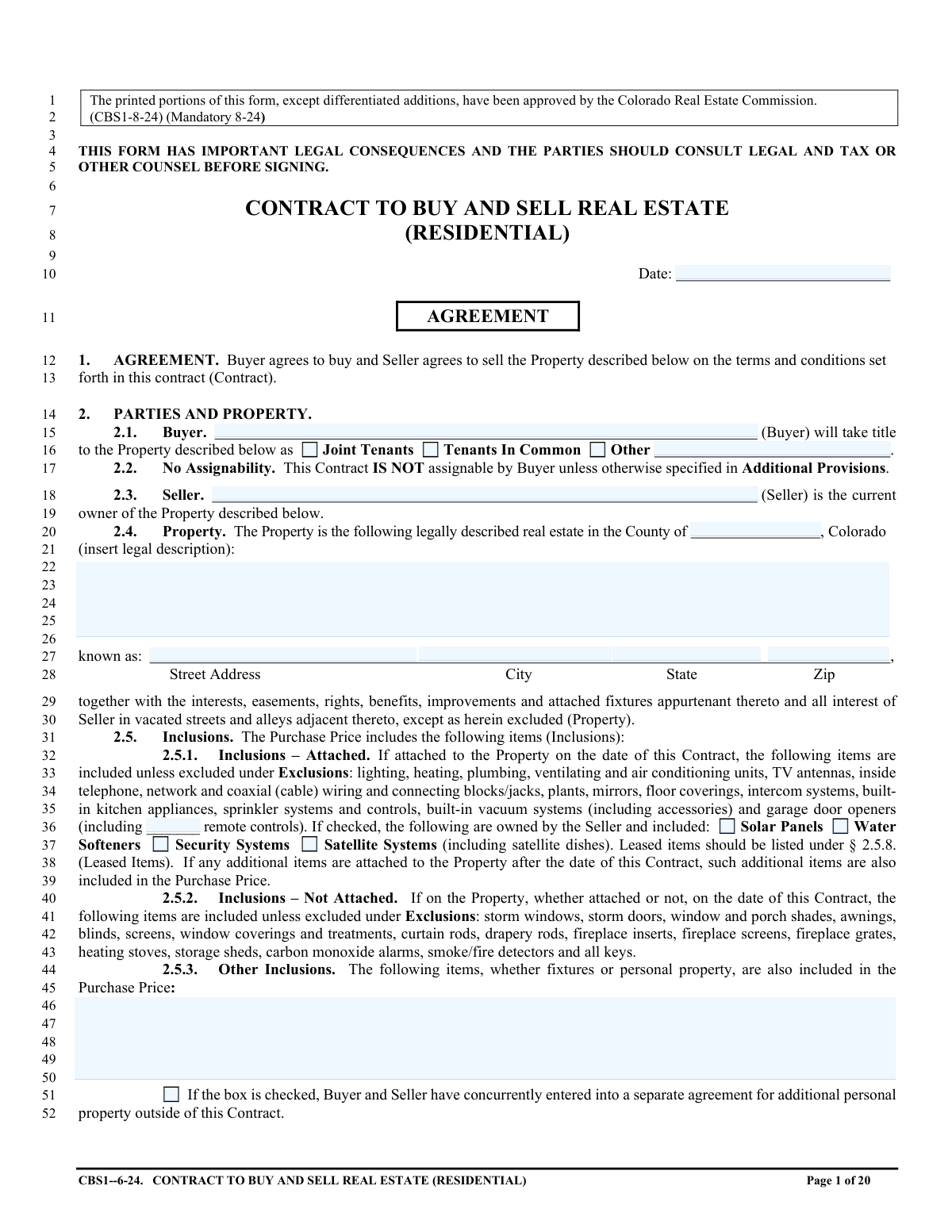
Yes! You can use AI to fill out Form CBS1-8-24, Contract to Buy and Sell Real Estate (Residential)
Form CBS1-8-24 is a legally binding contract approved by the Colorado Real Estate Commission for the purchase and sale of residential property. It details the agreement between the buyer and seller, covering critical aspects like purchase price, property description, deadlines, financing, and contingencies, making it a cornerstone of Colorado real estate transactions. Today, this form can be filled out quickly and accurately using AI-powered services like Instafill.ai, which can also convert non-fillable PDF versions into interactive fillable forms.
Our AI automatically handles information lookup, data retrieval, formatting, and form filling.
It takes less than a minute to fill out CBS1-8-24 using our AI form filling.
Securely upload your data. Information is encrypted in transit and deleted immediately after the form is filled out.
Form specifications
| Form name: | Form CBS1-8-24, Contract to Buy and Sell Real Estate (Residential) |
| Number of fields: | 315 |
| Number of pages: | 20 |
| Language: | English |
| Categories: | estate forms, NJ state forms, PA state forms, real estate forms, residential contract forms |
Instafill Demo: How to fill out PDF forms in seconds with AI
How to Fill Out CBS1-8-24 Online for Free in 2026
Are you looking to fill out a CBS1-8-24 form online quickly and accurately? Instafill.ai offers the #1 AI-powered PDF filling software of 2026, allowing you to complete your CBS1-8-24 form in just 37 seconds or less.
Follow these steps to fill out your CBS1-8-24 form online using Instafill.ai:
- 1 Navigate to Instafill.ai and upload the 'Contract to Buy and Sell Real Estate (Residential)' form or select it from their template library.
- 2 Use the AI-powered tool to automatically identify and label all fields, including party names, property details, and financial terms.
- 3 Enter the buyer's and seller's information, the legal description and address of the property, and the specific terms of the purchase price and financing.
- 4 Carefully complete the 'Dates, Deadlines and Applicability' table, as these dates are legally binding and critical to the transaction timeline.
- 5 Specify all inclusions, exclusions, financing conditions, appraisal provisions, and any additional provisions or attached documents that are part of the agreement.
- 6 Review all entered information for accuracy, then have the buyer and seller provide their signatures and the date in the designated signature blocks.
- 7 Securely download, save, and distribute the completed and signed contract to all parties, including brokers, lenders, and the closing company.
Our AI-powered system ensures each field is filled out correctly, reducing errors and saving you time.
Why Choose Instafill.ai for Your Fillable CBS1-8-24 Form?
Speed
Complete your CBS1-8-24 in as little as 37 seconds.
Up-to-Date
Always use the latest 2026 CBS1-8-24 form version.
Cost-effective
No need to hire expensive lawyers.
Accuracy
Our AI performs 10 compliance checks to ensure your form is error-free.
Security
Your personal information is protected with bank-level encryption.
Frequently Asked Questions About Form CBS1-8-24
This form, approved by the Colorado Real Estate Commission, is a legally binding agreement between a buyer and a seller for the purchase of a residential property. It outlines all the terms, conditions, deadlines, and financial details of the transaction.
Inclusions are items that are included in the purchase price, such as lighting fixtures, built-in appliances, and window coverings, as specified in section 2.5. Exclusions are specific items that the seller will be taking with them and are not part of the sale, which must be explicitly listed in section 2.6.
This table is a critical part of the contract that lists all the specific deadlines for key events like loan application, title review, inspections, and appraisal. Missing any of these deadlines can have significant legal and financial consequences, as time is of the essence.
If the buyer terminates the contract based on a right specified within the agreement (e.g., unsatisfactory inspection), the Earnest Money is typically returned to the buyer. If the buyer defaults, the seller may be entitled to keep the Earnest Money as liquidated damages, as detailed in sections 4.3 and 20.
A Seller Concession, detailed in section 4.2, is a dollar amount the seller agrees to credit to the buyer at closing. These funds can be used for various buyer expenses, such as closing costs, loan origination fees, or prepaid items, as long as the buyer's lender allows it.
If the appraised value is less than the purchase price, the buyer has several options under Section 6. The buyer may terminate the contract, object and attempt to negotiate a lower price with the seller, or choose to proceed with the purchase by paying the difference in cash.
According to section 10.3, if you find an unsatisfactory condition, you can either terminate the contract by the Inspection Termination Deadline or submit an Inspection Objection to the seller requesting repairs. If you and the seller cannot agree on a resolution by the Inspection Resolution Deadline, the contract will terminate.
The seller must provide you with the HOA's governing documents, financial documents, and insurance information by the Association Documents Deadline, as outlined in section 7.3. You have the right to review these and terminate the contract if you find anything unsatisfactory.
If the buyer defaults, the seller may be entitled to keep the earnest money and potentially sue for other damages or specific performance. If the seller defaults, the buyer can cancel the contract and get their earnest money back, or sue for damages or to force the sale to go through, as described in Section 20.
This contract has significant legal and tax implications, and real estate brokers cannot provide legal advice. Consulting an attorney or tax advisor is recommended to ensure you fully understand your rights, obligations, and the potential financial consequences of the transaction.
Yes, you can use AI-powered services to help complete this form accurately and efficiently. Tools like Instafill.ai use AI to auto-fill form fields, which can save time and reduce the chance of errors on complex documents like this.
To fill this form online, you can upload it to a platform like Instafill.ai. The service will identify the fields, and you can then type your information directly into the digital form, save your progress, and download the completed document.
If you have a non-fillable or 'flat' PDF, you can use a service like Instafill.ai to convert it into an interactive, fillable form. Simply upload the document, and the AI will automatically detect the fields, allowing you to fill it out on your computer.
Section 2.7 addresses water rights, which can be complex and owned separately from the land itself. It's crucial to understand what rights, if any, are being transferred with the property and consult with legal counsel specializing in water law if this is a concern.
Compliance CBS1-8-24
Validation Checks by Instafill.ai
1
Verifies Purchase Price Calculation Integrity
This check ensures that the sum of all financial items in the 'Price and Terms' table (§4.1), including Earnest Money, New Loan, and Cash at Closing, precisely equals the total Purchase Price. This is critical for financial accuracy and to ensure the transaction is properly funded without discrepancies. A mismatch would cause closing calculations to fail and indicates a fundamental error in the contract's financial terms.
2
Ensures Logical Chronological Order of Deadlines
This validation verifies that the dates entered in the 'Dates and Deadlines' table (§3.1) follow a logical chronological sequence. For instance, the 'Record Title Deadline' must occur before the 'Record Title Objection Deadline', and all interim deadlines must precede the 'Closing Date'. This prevents impossible timelines, ensures the contract workflow is achievable, and avoids automatic defaults due to illogical scheduling.
3
Validates Completeness of Buyer and Seller Identification
This check confirms that the full legal names for both the Buyer (§2.1) and Seller (§2.3) have been entered. These fields are fundamental to the contract's validity as they identify the primary parties to the agreement. Failure to provide this information would render the contract unenforceable and legally void from the outset.
4
Ensures Complete and Valid Property Identification
This validation ensures that both the legal description and the full street address (Street, City, State, Zip) for the property are provided in §2.4. A complete and accurate property description is essential for a clear and unambiguous contract, preventing disputes over the subject of the sale. An incomplete address or missing legal description could invalidate the title transfer and the entire contract.
5
Validates Closing and Possession Date Sequence
This validation ensures the 'Possession Date' (§40) is on or after the 'Closing Date' (§39). A buyer cannot legally take possession of a property before the closing has been completed and title has been transferred. An invalid sequence would create a contractual impossibility and legal complications regarding liability, insurance, and property access.
6
Confirms Earnest Money Holder is Specified
This check ensures that the name of the 'Earnest Money Holder' is specified in §4.3. This is a critical fiduciary requirement to identify the neutral third party responsible for safeguarding the Earnest Money deposit. Without a designated holder, the funds are at risk, and the contract lacks a key component for managing the deposit and potential disputes.
7
Validates FHA/VA Loan Selections and Related Fields
This check verifies that if the 'FHA' or 'VA' loan type box is checked in §4.5.3, the corresponding seller contribution amount for non-allowable costs is also filled in. These government-backed loan types have specific legal requirements and protections that must be explicitly addressed in the contract. Failure to complete these related fields can jeopardize the buyer's financing and the validity of the sale under FHA/VA guidelines.
8
Ensures Completeness of Loan Assumption Terms
This validation triggers if a buyer agrees to assume an existing loan (§4.6). It checks that all related financial fields, such as current payment amount, interest rate, and the maximum new payment limit, are completed. Incomplete information prevents the buyer from fully understanding the financial obligation they are undertaking and can lead to termination of the contract if the actual terms are unsatisfactory.
9
Validates 'Other' Conditional Field Completion
This check verifies that if an 'Other' checkbox is selected in various sections (e.g., §2.1 Tenancy, §4.5.3 Loan Type), the corresponding text field is filled with a specific description. This is important to properly define the parties' intent and avoid ambiguity. If the descriptive field is left blank, it creates an incomplete clause that can lead to disputes and legal challenges.
10
Ensures Acceptance Deadline is Valid and in the Future
This check ensures that the 'Acceptance Deadline Date' and 'Acceptance Deadline Time' (§27) are set in the future relative to the time the offer is created. An offer cannot be accepted after it has already expired. This validation prevents the creation of an offer that is immediately invalid and ensures the receiving party has a legitimate window of time to respond.
11
Verifies Deed Type Selection for Title Transfer
This validation verifies that one of the deed type checkboxes in §13 (Transfer of Title) is selected. The type of deed (e.g., General Warranty, Special Warranty) defines the level of guarantees the seller provides about the title. Failing to specify the deed type creates significant legal uncertainty about the title transfer process and the buyer's future rights.
12
Validates Conditional Sale Property Identification
This check ensures that if the contract is made conditional upon the sale of the buyer's property (§10.7), the common name or address of that property is entered. This information is crucial for the seller to understand the nature and risk of the contingency. Leaving this blank makes the contingency clause vague and potentially unenforceable.
13
Checks for Mutually Exclusive Selections
This validation ensures that for fields with mutually exclusive options, only one is selected. For example, in §2.5.5 and §2.5.8, the buyer can either 'Will' or 'Will Not' assume debt, but not both. This check prevents contradictory terms within the contract, which would create ambiguity and make the clause unenforceable.
14
Validates Numerical and Monetary Field Formats
This check confirms that all fields intended for monetary values (e.g., Purchase Price in §4.1, Seller Concession in §4.2) or numerical counts (e.g., number of remotes in §2.5.1) contain only valid numerical data. This is essential for accurate financial calculations and to prevent processing errors. Non-numerical data in these fields would render financial clauses nonsensical and halt the transaction.
Common Mistakes in Completing CBS1-8-24
In §2.4, parties often enter only the street address, omitting the required legal description (e.g., lot, block, subdivision). This mistake happens because the legal description is not as readily available as the street address. An incomplete or incorrect legal description can create title transfer issues and, in worst-case scenarios, may render the contract unenforceable. To avoid this, the full legal description should be copied exactly from the seller's deed or a preliminary title report. AI-powered tools like Instafill.ai can help by cross-referencing property data to ensure the legal description is accurate and complete.
Parties frequently fail to explicitly list all items they intend to include or exclude in §2.5 and §2.6, assuming items like smart home devices, custom window treatments, or high-end appliances are standard. This leads to major disputes during the final walk-through when a buyer finds an expected item removed. To prevent this, every item of value or significance that is not explicitly pre-listed should be written into the appropriate section. If the form is a non-fillable PDF, a tool like Instafill.ai can convert it into a fillable version, making it easier to add these crucial details.
Sellers often forget to disclose that items like solar panels, water softeners, or security systems are leased (§2.5.8) or have an outstanding loan (§2.5.5). This can result in the buyer unknowingly inheriting a lease or financial obligation, or the seller breaching the contract by being unable to convey the item free and clear. Sellers must meticulously list all such items and their status, and buyers must carefully review and approve the terms. Using a guided form-filling process can prompt users to consider and properly document these complex items.
The 'Dates and Deadlines' grid in §3.1 is the operational heart of the contract, yet parties often set unrealistic timelines or leave fields blank. Per §3.2, leaving a deadline blank deletes the entire corresponding clause, which could inadvertently waive a party's right to inspection or title review. Setting deadlines that are too short can force a party into default. All dates should be carefully calculated with input from lenders, inspectors, and title companies to ensure they are achievable.
In §2.1, buyers must select a form of tenancy, such as 'Joint Tenants' or 'Tenants In Common,' but often do so without understanding the significant legal and estate-planning consequences of their choice. This decision affects inheritance rights and how the property can be sold or refinanced. An incorrect selection can lead to complex legal issues in the event of a death or dispute between owners. Buyers should always consult with a legal or tax professional before making this selection.
The financial table in §4.1 requires that the sum of Earnest Money, New Loan, and other financing equals the total Purchase Price, with the 'Cash at Closing' amount being the final balancing figure. Simple arithmetic errors here are common and can cause significant problems with loan applications and closing disclosures. This can delay closing while the contract is amended and re-approved by the lender. Using a tool like Instafill.ai with built-in validation can prevent these calculation errors by automatically ensuring the table balances correctly.
In Colorado, water rights are a critical component of property value, yet the detailed sections in §2.7 are often overlooked or filled out incorrectly. Sellers may fail to provide the correct legal description for deeded water rights or the required Well Permit number. This can lead to the buyer not receiving the water access they anticipated or facing legal hurdles with the Division of Water Resources after closing. These sections require careful attention to detail and verification against official records.
Section 15 contains numerous checkboxes to allocate closing costs, association fees, and taxes between the buyer and seller. Parties often leave these blank, assuming a 'standard' practice exists, which leads to disputes at the closing table. Each fee, such as the 'Closing Services Fee' (§15.2) or 'Record Change Fee' (§15.3.2), must be explicitly assigned to avoid last-minute disagreements and potential closing delays. A thorough review of these sections during contract negotiation is essential.
Section 20.1 defaults to 'Liquidated Damages,' meaning the seller's sole remedy is to keep the earnest money if the buyer defaults. If a seller wishes to retain the right to sue for 'Specific Performance' (forcing the buyer to complete the purchase), they must check the box in §20.1.1. Many sellers are unaware of this choice and lose significant legal leverage by not actively selecting their preferred remedy during contract formation.
Parties sometimes use nicknames or incomplete legal names in §2.1 (Buyer) and §2.3 (Seller). Title companies, lenders, and county recorders require full, accurate legal names that match government-issued identification and existing title documents. Using an incorrect name requires a contract amendment and can delay the entire transaction while documents are corrected and re-signed. AI-powered form fillers like Instafill.ai can help by storing and accurately populating full legal names across all necessary documents, reducing the risk of this type of data entry error.
Saved over 80 hours a year
“I was never sure if my IRS forms like W-9 were filled correctly. Now, I can complete the forms accurately without any external help.”
Kevin Martin Green
Your data stays secure with advanced protection from Instafill and our subprocessors

Robust compliance program
Transparent business model
You’re not the product. You always know where your data is and what it is processed for.
ISO 27001, HIPAA, and GDPR
Our subprocesses adhere to multiple compliance standards, including but not limited to ISO 27001, HIPAA, and GDPR.
Security & privacy by design
We consider security and privacy from the initial design phase of any new service or functionality. It’s not an afterthought, it’s built-in, including support for two-factor authentication (2FA) to further protect your account.
Fill out CBS1-8-24 with Instafill.ai
Worried about filling PDFs wrong? Instafill securely fills form-cbs1-8-24-contract-to-buy-and-sell-real-estate-residential forms, ensuring each field is accurate.