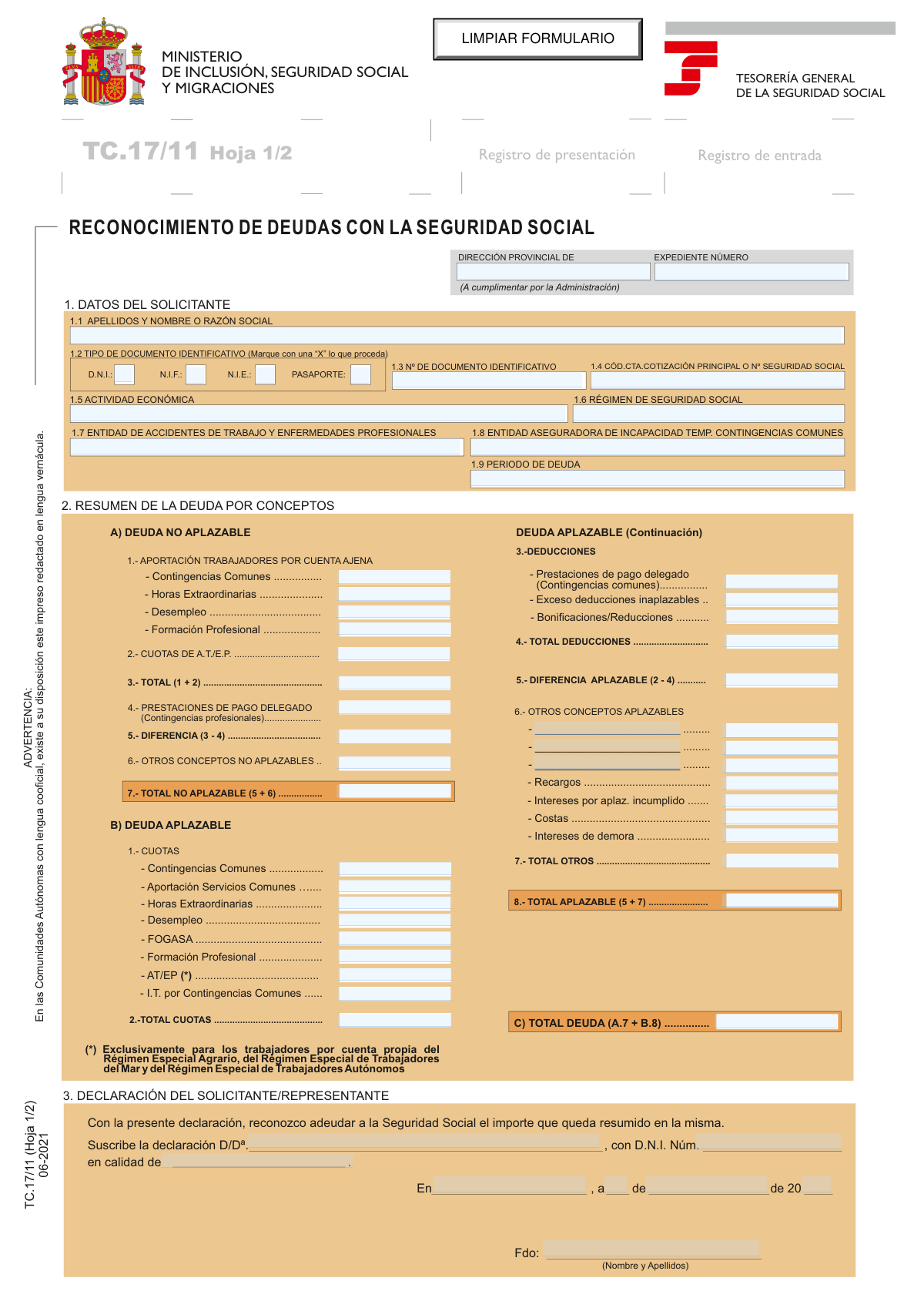
Yes! You can use AI to fill out TC. 17/11, Reconocimiento de Deudas con la Seguridad Social
Form TC. 17/11, "Reconocimiento de Deudas con la Seguridad Social," is a legal declaration in Spain where an individual or company formally acknowledges outstanding debts owed to the Social Security system. This acknowledgment is a mandatory prerequisite for requesting a deferment or installment plan for the payment of said debts, detailing both deferrable and non-deferrable amounts. Today, this form can be filled out quickly and accurately using AI-powered services like Instafill.ai, which can also convert non-fillable PDF versions into interactive fillable forms.
Our AI automatically handles information lookup, data retrieval, formatting, and form filling.
It takes less than a minute to fill out TC. 17/11 using our AI form filling.
Securely upload your data. Information is encrypted in transit and deleted immediately after the form is filled out.
Form specifications
| Form name: | TC. 17/11, Reconocimiento de Deudas con la Seguridad Social |
| Number of fields: | 108 |
| Number of pages: | 3 |
| Language: | English |
| Categories: | Seguridad Social forms |
Instafill Demo: How to fill out PDF forms in seconds with AI
How to Fill Out TC. 17/11 Online for Free in 2026
Are you looking to fill out a TC. 17/11 form online quickly and accurately? Instafill.ai offers the #1 AI-powered PDF filling software of 2026, allowing you to complete your TC. 17/11 form in just 37 seconds or less.
Follow these steps to fill out your TC. 17/11 form online using Instafill.ai:
- 1 Navigate to Instafill.ai, search for Form TC. 17/11, and upload your document or select the template to begin.
- 2 Enter the applicant's identification details in Section 1, including full name or company name, ID number (DNI/NIE/NIF), and Social Security contribution account code.
- 3 Provide details about your economic activity, Social Security regime, insurance entities for work accidents and temporary disability, and the specific period of the debt.
- 4 Carefully itemize the debt in Section 2, separating non-deferrable amounts (Part A) from deferrable amounts (Part B), including all relevant contributions, quotas, and deductions.
- 5 Calculate and enter the subtotals for each section and the final total debt by summing the total non-deferrable and total deferrable amounts.
- 6 Complete the declaration in Section 3 by providing the declarant's name, ID number, capacity (e.g., representative), and the place and date of signing.
- 7 Review all entered information for accuracy, then securely download your completed Form TC. 17/11, ready for submission to the Tesorería General de la Seguridad Social.
Our AI-powered system ensures each field is filled out correctly, reducing errors and saving you time.
Why Choose Instafill.ai for Your Fillable TC. 17/11 Form?
Speed
Complete your TC. 17/11 in as little as 37 seconds.
Up-to-Date
Always use the latest 2026 TC. 17/11 form version.
Cost-effective
No need to hire expensive lawyers.
Accuracy
Our AI performs 10 compliance checks to ensure your form is error-free.
Security
Your personal information is protected with bank-level encryption.
Frequently Asked Questions About Form TC. 17/11
The TC. 17/11 form, 'Reconocimiento de Deudas con la Seguridad Social', is used to formally acknowledge a debt owed to the Spanish Social Security system. It is a mandatory document that must be submitted when requesting a deferral or installment plan for paying off this debt.
Any individual (like a self-employed worker) or company that has an outstanding debt with Social Security and wishes to apply for a payment deferral must complete this form. It serves as an official admission of the debt you are asking to postpone.
'Deuda No Aplazable' (Non-Deferrable Debt) includes contributions withheld from employees and contributions for work-related accidents, which legally cannot be postponed. 'Deuda Aplazable' (Deferrable Debt) refers to other debts like employer contributions, surcharges, and interest, for which you can request a payment plan.
Typically, the Social Security Administration (Tesorería General de la Seguridad Social) will provide you with the detailed debt amounts. In many cases, the administration will give you the form already pre-filled with this information for you to review and sign.
The 'Hoja Resumen' is only required if your debt is spread across multiple contribution account codes (códigos de cuenta de cotización) or different Social Security regimes. If all your debt is under a single identifier and regime, you do not need to complete this summary sheet.
Signing the form acknowledges the debt for the purpose of the deferral request, but it does not waive your right to dispute the amount. The form's instructions clarify that if you take action and the debt amount is officially modified, your payment plan will be adjusted accordingly.
This form must be submitted together with your formal application for a debt deferral. Failure to include it will result in the dismissal of your deferral request.
You will need to provide your full name or company name, your identification document number (DNI, NIF, NIE), your main Social Security contribution code or number, and the period to which the debt applies.
Yes, a legal representative can sign the declaration, but they must specify the capacity in which they are signing (e.g., 'representante legal'). They must also be properly accredited as your representative with the Social Security Administration.
Yes, services like Instafill.ai use AI to accurately auto-fill form fields from your saved data, which can save you time and help prevent errors. This is particularly useful for entering recurring information like your name, ID number, and Social Security code.
You can upload the PDF of the TC. 17/11 form to Instafill.ai. The platform will make the document interactive, allowing you to easily type your information into the correct fields, save your progress, and download the completed form.
You can use a service like Instafill.ai, which can convert flat, non-fillable PDFs into interactive, fillable forms. Simply upload your TC. 17/11 PDF, and the tool will make it easy for you to complete online.
The total debt is calculated by adding the 'Total No Aplazable' (from section A.7) and the 'Total Aplazable' (from section B.8). This final figure in section C represents the complete amount you are acknowledging you owe.
Compliance TC. 17/11
Validation Checks by Instafill.ai
1
Exclusive Identification Document Selection
This check ensures that exactly one checkbox from the 'Tipo de documento identificativo' section (D.N.I., N.I.F., N.I.E., Pasaporte) is selected. It is crucial for correctly identifying the applicant and applying the appropriate format validation to their ID number. If zero or more than one option is selected, the form submission should be rejected as the applicant's identity cannot be unambiguously determined.
2
Spanish Identification Number Format Validation
Validates that the 'Número de documento identificativo' conforms to the official format of the selected document type (D.N.I., N.I.E., or N.I.F.). For example, a D.N.I. must have 8 digits followed by a letter. This validation prevents data entry errors and ensures the provided ID is legally valid and can be cross-referenced in government databases, preventing processing delays or rejections.
3
Applicant Name/Business Name Completeness
Verifies that the 'Apellidos y nombre o Razón social' field is not empty. This field is fundamental for identifying the individual or legal entity acknowledging the debt. A missing name makes the entire debt recognition document legally void and unprocessable.
4
Social Security/Contribution Account Code Format
Ensures the 'Cód.Cta.Cotización Principal o Nº Seguridad Social' field is filled and follows the correct structure for a Spanish Social Security Number or Contribution Account Code. These codes are essential for linking the debt to the correct contributor's account within the Social Security system. An invalid or missing code would prevent the debt from being correctly registered and processed.
5
Debt Period Logical Consistency
Checks that the 'Periodo de deuda' field contains a valid date or date range that is not in the future. The debt period must logically precede the date of the declaration. This prevents nonsensical submissions and ensures the acknowledged debt corresponds to a past period of liability.
6
Calculation of Total Non-Deferrable Contributions (A.3)
This check verifies that the value in field 'A.3. TOTAL (1 + 2)' is the precise sum of all 'Aportación trabajadores' fields (A.1) and the 'Cuotas de A.T./E.P.' field (A.2). This is a critical subtotal for calculating the non-deferrable debt portion. A miscalculation here would lead to an incorrect final debt amount and could cause legal or financial discrepancies.
7
Calculation of Non-Deferrable Difference (A.5)
Validates that the amount in 'A.5. DIFERENCIA (3 - 4)' is the correct result of subtracting the 'Prestaciones de pago delegado' (A.4) from the 'Total' (A.3). This calculation is a key step in determining the base non-deferrable amount. An error would propagate through the rest of the non-deferrable debt calculation, making the final totals incorrect.
8
Calculation of Total Non-Deferrable Debt (A.7)
This validation ensures that the 'A.7. TOTAL NO APLAZABLE (5 + 6)' field accurately reflects the sum of the 'Diferencia' (A.5) and 'Otros conceptos no aplazables' (A.6). This is the final, critical total for the non-deferrable part of the debt. Failure to validate this sum would result in an incorrect debt recognition and could lead to compliance issues.
9
Calculation of Total Deferrable Quotas (B.2)
Verifies that the 'B.2. TOTAL CUOTAS' field is the correct sum of all individual quota amounts listed in section B.1 (Contingencias Comunes, Desempleo, FOGASA, etc.). This total is the starting point for calculating the deferrable debt. An incorrect sum would invalidate the entire deferrable debt calculation.
10
Calculation of Total Deferrable Deductions (B.4)
Ensures the 'B.4. TOTAL DEDUCCIONES' field is the correct sum of all deduction items in section B.3 (Bonificaciones, Exceso deducciones, Prestaciones). Correctly calculating total deductions is vital for determining the net deferrable amount. An error here would lead to an incorrect deferrable balance.
11
Calculation of Total Deferrable Amount (B.8)
This check validates that the 'B.8. TOTAL APLAZABLE (5 + 7)' field is the correct sum of the 'Diferencia aplazable' (B.5) and 'Total Otros' (B.7). This represents the final amount of debt that the applicant is requesting to defer payment on. An incorrect total would misrepresent the applicant's request and the terms of the potential payment plan.
12
Grand Total Debt Calculation (C)
This is a crucial cross-sectional check that verifies the 'C) TOTAL DEUDA' is the exact sum of 'A.7 TOTAL NO APLAZABLE' and 'B.8 TOTAL APLAZABLE'. This final figure represents the total acknowledged debt and is the most important value on the form. If this calculation is incorrect, the entire form is invalid as it misstates the total liability.
13
Declarant Information Completeness
Verifies that the declarant's name ('D/Dª.'), ID number ('con D.N.I. Núm.'), and their capacity ('en calidad de') are all provided in Section 3. These fields are legally required to make the declaration binding. Missing information would render the signature and the entire declaration invalid and unenforceable.
14
Signing Date Validity
Ensures the date of signing ('día', 'mes', 'año') constitutes a valid calendar date and is not set in the future. The signing date establishes the legal moment of debt recognition. An invalid or future date would make the document's legal standing questionable and could lead to its rejection.
15
Consistency between Applicant and Declarant
Checks if the declarant's capacity ('en calidad de') is 'titular' or 'solicitante', and if so, whether the declarant's name and ID match the applicant's details in Section 1. If the capacity is 'representante', it ensures the details do not match, implying a separate legal representative. This prevents ambiguity about who is legally acknowledging the debt.
Common Mistakes in Completing TC. 17/11
A frequent error is incorrectly categorizing debt as 'Aplazable' (deferrable) when it is 'No Aplazable' (non-deferrable). This often happens with employee contributions (aportación de trabajadores), which employers collect but fail to remit. These funds are never eligible for deferral, and misclassifying them will lead to the rejection of the associated payment plan request and significant processing delays. Always verify against official guidance which concepts are strictly non-deferrable before filling out Section A.
The form requires multiple manual calculations to determine subtotals and totals in sections A, B, and C. Simple arithmetic mistakes when summing up contributions, applying deductions, or calculating the final total debt are extremely common. An incorrect calculation invalidates the entire debt recognition, forcing the administration to return the form for correction. To avoid this, double-check all calculations or use a calculator; AI-powered tools like Instafill.ai can perform these calculations automatically to ensure accuracy.
Entering an incorrect 'Código de cuenta de cotización' (CCC) or 'Número de Seguridad Social' (NUSS) is a critical mistake. These long numerical codes are unique identifiers, and even a single-digit error can cause the debt recognition to be rejected or misapplied to the wrong account. Similarly, errors in the DNI/NIF/NIE number can halt the process. Carefully transcribe these numbers from official documents to prevent identification failures and processing delays.
Applicants often focus on the principal debt (cuotas) and forget to include accrued penalties, such as 'Recargos' (surcharges) and 'Intereses de demora' (default interest) in Section B. This results in an incomplete declaration that understates the total amount owed. The Social Security administration will have to recalculate the correct total, delaying the approval of any related deferment request. It is essential to obtain an up-to-date debt statement from the administration to ensure all concepts are included.
The form includes a 'Hoja Resumen' (page 2) that must be completed if the debt spans multiple contribution accounts ('identificadores') or different Social Security Regimes. Many applicants overlook this instruction and only submit the first page, leading to an incomplete application. This omission will cause the administration to return the paperwork, requiring the applicant to fill out a separate form for each debt source and then consolidate them onto the summary sheet, significantly delaying the process.
The declaration section is often filled out incorrectly, which can invalidate the legal recognition of the debt. Common mistakes include the signatory forgetting to specify their 'calidad de' (capacity, e.g., administrator, legal representative), or the name and ID number on the declaration not matching the person who actually signs. If a representative is signing, they must have already proven their power of attorney, or the form will be rejected. This section must be completed with precision to be legally binding.
In field 1.9, 'Período de deuda', applicants sometimes enter vague information like 'last year' or fail to specify both the start and end months for a multi-month debt. The instructions require specifying the first and last month (and year) of the debt period. An ambiguous entry forces the administration to seek clarification, which delays the entire process of recognizing the debt and processing a deferral request.
The form asks for two separate insurance entities: the one for Work Accidents (field 1.7) and the one for Temporary Disability from common contingencies (field 1.8). Applicants frequently get these confused, enter the same entity for both when they are different, or leave one blank. This incorrect information can cause issues with the proper allocation and management of the debt record. It's important to consult company records to identify the correct 'Mutua' or 'Entidad Gestora' for each coverage type during the specified debt period.
In Section B, applicants may incorrectly claim deductions for 'Bonificaciones/Reducciones' (bonuses/reductions) that they are no longer entitled to due to late payment. Another common error is miscalculating the amount of 'Prestaciones de pago delegado' (delegated payment benefits) that can be offset. These errors lead to an incorrect 'Total Aplazable' amount, which will be flagged and corrected by the administration, delaying the resolution of the debt.
The form explicitly states it should be filled out by machine or with capital letters, and the 'LIMPIAR FORMULARIO' button indicates it is a fillable PDF. However, users often print it and fill it out with illegible handwriting, leading to data entry errors by the administration. If the form is only available as a non-fillable PDF, using a tool like Instafill.ai can convert it into an interactive, fillable version, ensuring all entries are clear, properly formatted, and legible, thus preventing processing errors.
Saved over 80 hours a year
“I was never sure if my IRS forms like W-9 were filled correctly. Now, I can complete the forms accurately without any external help.”
Kevin Martin Green
Your data stays secure with advanced protection from Instafill and our subprocessors

Robust compliance program
Transparent business model
You’re not the product. You always know where your data is and what it is processed for.
ISO 27001, HIPAA, and GDPR
Our subprocesses adhere to multiple compliance standards, including but not limited to ISO 27001, HIPAA, and GDPR.
Security & privacy by design
We consider security and privacy from the initial design phase of any new service or functionality. It’s not an afterthought, it’s built-in, including support for two-factor authentication (2FA) to further protect your account.
Fill out TC. 17/11 with Instafill.ai
Worried about filling PDFs wrong? Instafill securely fills tc-1711-reconocimiento-de-deudas-con-la-seguridad-social forms, ensuring each field is accurate.