Fill out charitable account forms
with AI.
Charitable account forms are essential administrative tools for individuals and organizations looking to manage their philanthropic giving through formal financial structures. This category encompasses a variety of documents used to facilitate tax-advantaged donations, such as establishing donor-advised funds or authorizing the transfer of securities. These forms are vital because they ensure that charitable contributions are executed according to IRS regulations, allowing donors to maximize their impact while maintaining clear records for tax purposes.
By continuing, you acknowledge Instafill's Privacy Policy and agree to get occasional product update and promotional emails.
About charitable account forms
Typically, these forms are used by retirees, financial planners, and individual donors during tax season or year-end planning. For example, individuals aged 70½ or older often need specific documentation to execute a Qualified Charitable Distribution (QCD) from an IRA, which allows them to donate directly to a charity and satisfy their Required Minimum Distribution without increasing their taxable income. Others may use these forms to move assets between brokerage accounts and charitable gift accounts to fund long-term philanthropic goals.
Managing these financial documents manually can be tedious and requires high precision to avoid processing delays. Tools like Instafill.ai use AI to fill these charitable forms in under 30 seconds, handling sensitive data accurately and securely to streamline your giving process.
Every form on this page can be completed without typing. Instafill is form filling software that reads a PDF and fills it for you — including flat and scanned documents that carry no fillable fields at all.
Forms in This Category
The forms in this category have a median Form Complexity Index of 46/100 (Moderate), measured across 7 forms by field count, input difficulty, length, conditional logic and structure. See how it is calculated.
- Enterprise-grade security & data encryption
- 99%+ accuracy powered by AI
- 1,000+ forms from all industries
- Complete forms in under 60 seconds
How to Choose the Right Form
Selecting the correct charitable account form depends primarily on the type of account you are giving from and whether you are establishing a new fund or distributing assets from an existing one.
Opening or Funding a Donor-Advised Fund
If you are looking to manage your philanthropy through a dedicated fund, use these forms to get started or add capital:
- Vanguard Charitable Open a Philanthropic Account: Choose this form to establish a brand-new donor-advised fund with Vanguard Charitable. It allows you to name advisors and set up investment strategies for your future giving.
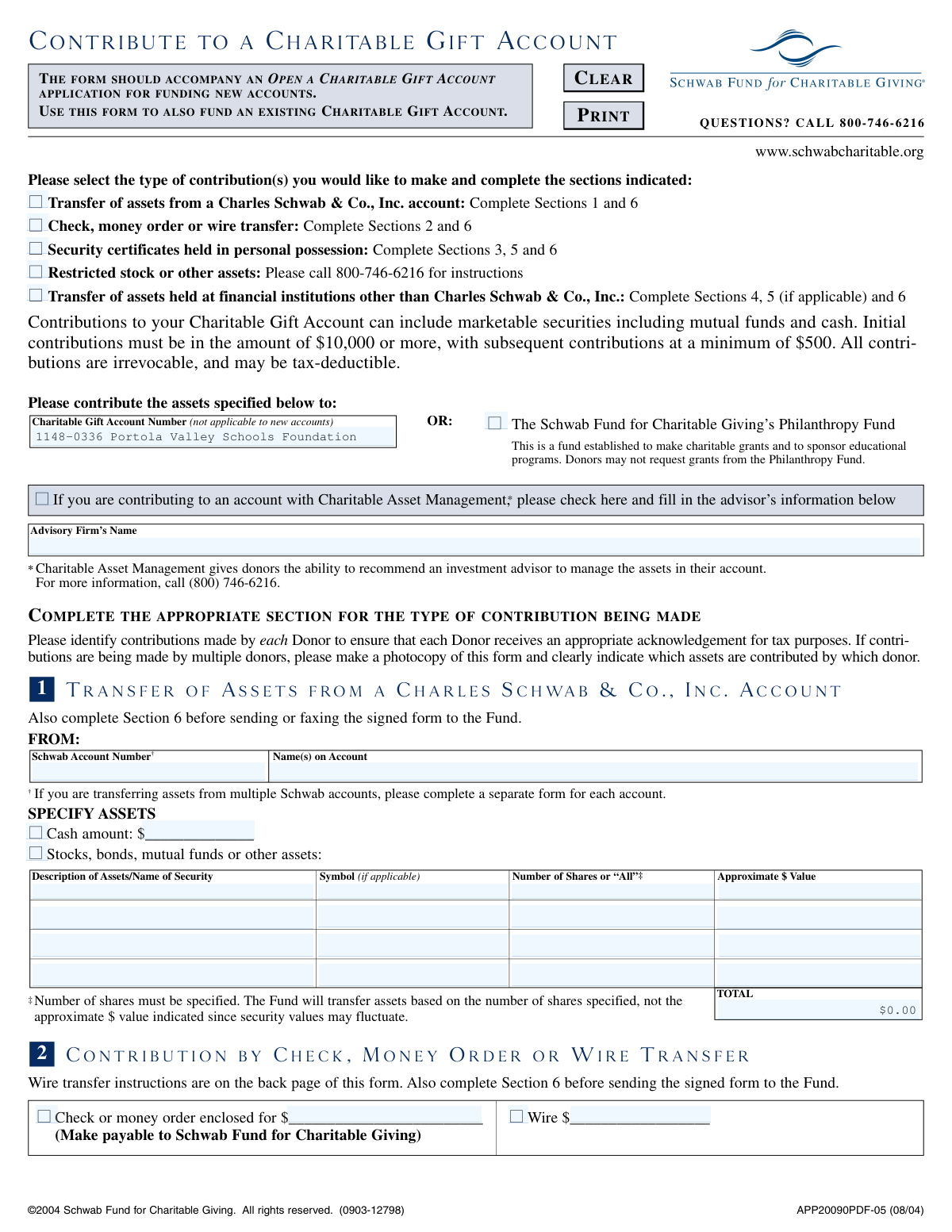
- Contribute to a Charitable Gift Account: Use this Schwab-specific form to make an irrevocable contribution of cash or securities into an existing Schwab donor-advised fund.
Qualified Charitable Distributions (QCDs) from an IRA
If you are age 70½ or older, you can satisfy your Required Minimum Distribution (RMD) tax-free by giving directly from your IRA. The form you need depends on where your IRA is held:
- TIAA Accounts: TIAA offers several specific documents depending on the account type. Use the Request for a Qualified Charitable Distribution (QCD) from a Brokerage Individual Retirement Account (IRA) (Form F41205) if your assets are in a brokerage account. For standard retirement accounts, use the Request for a Charitable Distribution from an Individual Retirement Account (IRA) (Form F11185) or the Request for qualified charitable distribution from individual retirement account for TIAA Trust, N.A. accounts.
- General IRA Accounts: For other institutions, the Individual Retirement Account (IRA) — Qualified Charitable Distribution Form provides the standard authorization needed to transfer funds directly to a charity.
Transferring Specific Assets
If you need to move specific holdings like stocks or mutual funds without selling them first, use the Transfer of Assets Out - Partial Account or Charitable Gift Transfers. This Schwab form is designed for "in-kind" transfers, allowing you to move assets from your Schwab account to a charitable organization at a different financial institution.
Form Comparison
| Form | Primary Purpose | Eligible Participant | Key Benefit |
|---|---|---|---|
| Contribute to a Charitable Gift Account | Add assets to an existing or new Schwab donor-advised fund. | Individuals making irrevocable contributions to Schwab Charitable. | Immediate tax deduction and potential for tax-free growth. |
| Individual Retirement Account (IRA) — Qualified Charitable Distribution Form | Directly transfer funds from an IRA to a qualified charity. | IRA owners aged 70½ or older. | Satisfies Required Minimum Distributions without increasing taxable income. |
| Request for a Charitable Distribution from an Individual Retirement Account (IRA) | Authorize TIAA to send IRA funds directly to a charity. | TIAA IRA account holders. | Reduces taxable income by excluding the distribution amount. |
| Request for a Qualified Charitable Distribution (QCD) from a Brokerage Individual Retirement Account (IRA) | Request tax-free donations from a TIAA brokerage retirement account. | TIAA brokerage IRA holders aged 70½ or older. | Efficiently manages RMD obligations through direct charitable giving. |
| Request for qualified charitable distribution from individual retirement account | Authorize TIAA Trust to make direct charitable distributions. | TIAA Trust, N.A. account holders. | Facilitates tax-free giving directly from trust-managed retirement accounts. |
| Transfer of Assets Out - Partial Account or Charitable Gift Transfers | Move specific assets like stocks or bonds to external accounts. | Charles Schwab account holders. | Allows in-kind donations to avoid paying capital gains taxes. |
| Vanguard Charitable Open a Philanthropic Account | Establish a new donor-advised fund and name advisors. | Individuals or organizations starting a Vanguard philanthropic account. | Centralizes charitable giving with professional investment options. |
Tips for charitable account forms
Before completing a distribution form, ensure the receiving organization is a qualified 501(c)(3) or equivalent entity. Providing the correct Tax ID (EIN) for the charity is essential to ensure the transaction qualifies for the intended tax benefits.
When filling out transfer or contribution forms, ensure the account numbers and names match your brokerage or bank statements exactly. Even minor discrepancies in account titles or numbers can lead to rejected requests and significant processing delays.
Filling out complex financial documents manually is time-consuming and prone to errors. AI-powered tools like Instafill.ai can complete these forms in under 30 seconds with high accuracy, ensuring your data stays secure throughout the entire process.
Most contributions to donor-advised funds or charitable gift accounts are irrevocable once the form is processed. Double-check the asset amounts and the specific fund designations before submission, as these transfers cannot be reversed.
If you are using a Qualified Charitable Distribution to satisfy a Required Minimum Distribution, submit your forms well before the year-end deadline. Financial institutions often experience high volume in December, so early filing ensures your donation counts for the current tax year.
Always save a digital or physical copy of the signed form and the confirmation of the transfer for your personal records. These documents are vital for substantiating tax deductions or proving that a distribution was made directly from an IRA to a charity.
Frequently Asked Questions
These forms facilitate the transfer of assets from personal financial accounts, such as IRAs or brokerage accounts, to charitable organizations or donor-advised funds. They ensure that the movement of funds is documented correctly for tax purposes and that the financial institution follows the account holder's specific instructions.
Generally, individuals who are age 70½ or older can use these forms to direct a tax-free donation from their IRA to a qualified charity. This process allows donors to support a cause while potentially satisfying their annual Required Minimum Distribution (RMD) without increasing their taxable income.
You should use a donor-advised fund (DAF) form, like those from Vanguard or Schwab, if you want to contribute assets to a managed fund for future grant-making. If you are looking to send money directly from a retirement account to a specific charity to meet tax requirements, an IRA Qualified Charitable Distribution form is the correct choice.
Yes, many of the forms in this category are designed specifically to help IRA owners meet their RMD obligations through charitable giving. By directing the distribution to a qualified 501(c)(3) organization, the amount is excluded from your adjusted gross income, providing a tax advantage.
You will typically need your account number, the legal name of the receiving charity, and their federal tax ID number (EIN). If you are transferring specific securities, you should also have the ticker symbols and the number of shares or the dollar amount you wish to donate.
Completed forms should generally be submitted to the financial institution that holds your assets, such as Schwab, TIAA, or Vanguard. Most institutions accept these documents via secure online upload, fax, or standard mail, depending on their specific security protocols.
Yes, you can use AI tools like Instafill.ai to complete these forms quickly and accurately. The AI can extract necessary data from your source documents and place it into the correct fields, ensuring that complex account numbers and charitable details are entered without manual errors.
When using AI-powered services like Instafill.ai, these forms can often be filled out in under 30 seconds. The technology streamlines the process by identifying the required fields and populating them automatically, which is much faster than typing the information by hand.
Yes, 'Transfer of Assets Out' forms allow for in-kind transfers, meaning you can move stocks or mutual funds directly to a charity's account. This method is often preferred because it allows the donor to avoid capital gains taxes that would have been incurred if the assets were sold before donating.
Many forms for opening or managing donor-advised funds include sections for establishing a succession plan. This allows you to designate individuals who will manage the account and continue your philanthropic legacy after your lifetime.
Glossary
- Form Complexity Index
- Instafill’s 0–100 measure of how much effort a form takes to complete, calculated deterministically from the form’s own structure rather than estimated. It combines the number of fillable fields (the largest factor), how difficult those fields are to complete based on their type, the number of pages that contain fields, the amount of conditional “fill-only-if” logic, and how many sections the form is divided into, then adds modifiers for tables and repeating lists, bundled instruction pages, and dense page layouts. A higher score means the form is harder to fill out by hand. The forms in this category have a median Form Complexity Index of 46/100 (Moderate). See exactly how it is calculated.
- Qualified Charitable Distribution (QCD)
- A direct transfer of funds from an IRA to an eligible charity that counts toward the owner's distribution requirements without being taxed as income.
- Required Minimum Distribution (RMD)
- The minimum amount the IRS requires retirement account holders to withdraw each year once they reach a specific age, currently 73.
- Donor-Advised Fund (DAF)
- A private fund, such as a Schwab Charitable Gift Account, where donors make tax-deductible contributions and then recommend grants to charities over time.
- Irrevocable Contribution
- A permanent donation of assets that cannot be returned or refunded to the donor once the transfer is complete.
- In-Kind Transfer
- The transfer of assets like stocks, bonds, or mutual funds directly to a charity without selling them first, avoiding potential capital gains taxes.
- Qualified Charitable Organization
- A non-profit entity that meets IRS 501(c)(3) requirements, making it eligible to receive tax-deductible donations and QCDs.