Fill out disability claim forms
with AI.
Disability claim forms are the essential bridge between a medical condition and the financial support needed during recovery or long-term illness. These documents serve as the formal request for benefits from private insurance companies or government agencies like the Department of Veterans Affairs. They are critical because they document the onset of a condition, the specific medical restrictions, and the impact on an individual's ability to work. Accurate completion is vital for determining eligibility and ensuring that policyholders or veterans receive the premium waivers or disability payments they are entitled to.
By continuing, you acknowledge Instafill's Privacy Policy and agree to get occasional product update and promotional emails.
About disability claim forms
These forms are typically required by individuals who have suffered an injury, illness, or chronic condition that prevents them from performing their job duties. Whether you are a veteran filing a Claim for Disability Insurance Benefits (VA Form 29-357) or a policyholder needing an Attending Physician’s Statement for a private insurer, the process involves gathering clinical evidence and professional assessments. Because these situations are often stressful and time-sensitive, having the right documentation ready can significantly reduce delays in the adjudication of a claim.
Dealing with complex medical terminology and multi-page documents can be overwhelming when you are focusing on your health. Tools like Instafill.ai use AI to fill these forms in under 30 seconds, handling data accurately and securely to streamline the application process. By automating the data entry portion of these claims, you can ensure that the information is presented clearly and professionally, allowing you to submit your documentation with confidence.
Every form on this page can be completed without typing. Instafill is form filling software that reads a PDF and fills it for you — including flat and scanned documents that carry no fillable fields at all.
Forms in This Category
The forms in this category have a median Form Complexity Index of 66/100 (Complex), measured across 5 forms by field count, input difficulty, length, conditional logic and structure. See how it is calculated.
- Enterprise-grade security & data encryption
- 99%+ accuracy powered by AI
- 1,000+ forms from all industries
- Complete forms in under 60 seconds
How to Choose the Right Form
Choosing the right disability claim form depends primarily on who your insurance provider is and your current role in the application process—whether you are the policyholder or the treating medical professional. Use the guide below to identify which document fits your current situation.
For Veterans with Government Life Insurance
If you are a veteran holding a Government Life Insurance policy and have become totally disabled, you will need to use VA Form 29-357, Claim for Disability Insurance Benefits. This form is specifically designed for:
- Claiming Benefits: Requesting disability insurance benefits and a waiver of premiums.
- Eligibility Requirements: Veterans who became disabled before the age of 65.
- Comprehensive Reporting: The form includes both Part I (for the veteran) and Part II (for the medical professional), making it a complete package for the VA to evaluate disability onset and work history.
For Private Policyholders (Assurity Life Insurance)
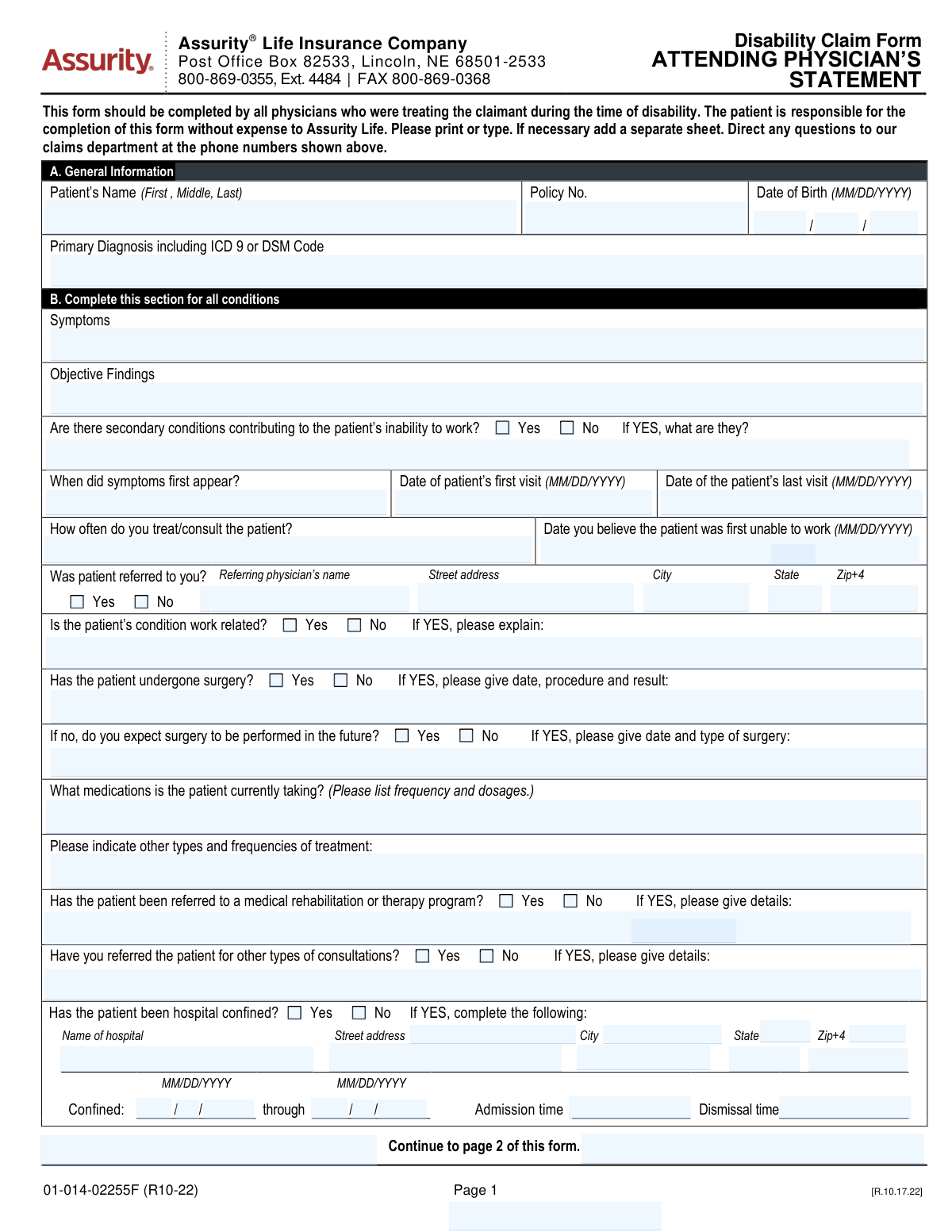
If your coverage is through a private carrier rather than the government, you will likely need the Assurity Life Insurance Company Disability Claim Form — Attending Physician’s Statement. Unlike general application forms, this specific document is:
- Physician-Focused: It must be completed by the attending or treating doctor who cared for the patient during the period of disability.
- Clinical in Nature: It is used to capture specific medical data, including ICD-9/DSM diagnoses, medication history, and objective findings.
- Work Limitation Assessment: This is the correct form if you need a professional medical evaluation of work restrictions and return-to-work timing to justify a private claim.
Quick Selection Summary
- Select VA Form 29-357 if you are a veteran filing a claim against a government-issued policy to stop paying premiums or receive monthly benefits.
- Select the Assurity Attending Physician’s Statement if you are a healthcare provider documenting a patient's limitations, or a policyholder instructed by Assurity to have your doctor verify your medical condition.
Form Comparison
| Form | Primary Purpose | Filer/Signatory | Key Documentation |
|---|---|---|---|
| Assurity Life Insurance Company Disability Claim Form — Attending Physician’s Statement | Medical substantiation for private insurance disability claims. | Completed by the attending physician or treating medical professional. | ICD diagnoses, treatment history, and physical limitations assessment. |
| VA Form 29-357, Claim for Disability Insurance Benefits (Government Life Insurance) | Benefit claims and premium waivers for veteran life insurance. | Signed by the veteran policyholder and a licensed practitioner. | Disability onset date, work history, and medical reports. |
| VA Form 29-357, Claim for Disability Insurance Benefits (Government Life Insurance) | Requests disability benefits and insurance premium refunds for veterans. | The insured veteran and a hospital official or physician. | Medical basis of disability and Social Security award evidence. |
Tips for disability claim forms
Many disability forms, such as the Assurity or VA medical statements, require detailed input from your treating doctor. Provide the physician with the form early to ensure they have ample time to document diagnoses, ICD codes, and specific work restrictions accurately.
Consistency is key when reporting the date your disability began across multiple documents. Discrepancies between your personal claim and the physician's statement can lead to processing delays or requests for additional clarification from the insurer or the VA.
Filling out complex disability forms can be overwhelming, but AI-powered tools like Instafill.ai can complete these forms in under 30 seconds with high accuracy. Your sensitive data stays secure during the process, providing a practical and fast solution for managing multiple claims.
For VA forms specifically, having supporting documents like Social Security disability award letters or hospital discharge summaries ready can streamline the application. Including these as evidence helps substantiate the medical report provided by your practitioner.
Avoid general statements about being unable to work and instead focus on specific functional limitations. Detailing exactly how a condition prevents you from performing job duties helps the claims examiner understand the severity and duration of the disability.
Ensure that all sections requiring signatures—both yours and your physician's—are completed before submission. Missing signatures or failing to acknowledge mandatory fraud notices is a common mistake that can result in the immediate return of your claim.
Disability claims often involve long-term correspondence and potential appeals. Keep a digital or physical copy of every completed form and supporting document to ensure you can reference exactly what was submitted if the insurer asks for follow-up information.
Frequently Asked Questions
These forms are used to request financial benefits or premium waivers when an individual is unable to work due to a medical condition. They provide insurance providers or government agencies with the necessary medical evidence and work history to evaluate a claim's eligibility.
Most disability claims require a multi-part approach where the claimant provides personal and employment details, while a licensed physician completes a medical statement. For example, both the Assurity and VA forms in this category have specific sections for an attending physician or licensed practitioner to document clinical findings and work restrictions.
The correct form depends on your specific insurance policy or veteran status. If you have private coverage through Assurity Life Insurance Company, you use their clinical statement; if you hold Government Life Insurance as a veteran, you would typically use VA Form 29-357.
You should generally file as soon as your disability prevents you from working or once you meet the waiting period defined in your policy. Filing promptly helps ensure that benefits are processed without unnecessary delays and that premium waivers are applied as early as possible.
Beyond the claim form itself, you may need to provide hospital records, treatment histories, or a Social Security disability award letter. These documents help substantiate the severity of your condition and the specific date that your disability began.
Yes, you can fill out disability claim forms using AI tools like Instafill.ai. These tools accurately extract data from your source documents and place it into the correct fields, ensuring that complex medical and personal details are handled correctly without manual entry.
Filling out these forms online with AI typically takes under 30 seconds. The AI automates the data entry process by pulling information from your existing records, which significantly reduces the time spent on manual typing and minimizes potential errors.
A missing physician's statement will usually result in a claim being denied or significantly delayed. Insurance providers and the VA require professional medical certification to verify the diagnosis, treatment plan, and specific work restrictions that constitute a disability.
Yes, this category includes forms for both private carriers and government programs. It is important to select the form that matches your specific coverage provider to ensure your claim is routed to the correct processing office for review.
Completed forms should be submitted directly to the entity managing your policy, such as a VA regional office or the private insurance company's claims department. Many organizations now allow for digital submission or faxing to speed up the initial review process.
Glossary
- Form Complexity Index
- Instafill’s 0–100 measure of how much effort a form takes to complete, calculated deterministically from the form’s own structure rather than estimated. It combines the number of fillable fields (the largest factor), how difficult those fields are to complete based on their type, the number of pages that contain fields, the amount of conditional “fill-only-if” logic, and how many sections the form is divided into, then adds modifiers for tables and repeating lists, bundled instruction pages, and dense page layouts. A higher score means the form is harder to fill out by hand. The forms in this category have a median Form Complexity Index of 66/100 (Complex). See exactly how it is calculated.
- Attending Physician’s Statement (APS)
- A medical report completed by your primary doctor that provides clinical evidence of your condition and its impact on your ability to work.
- Total Disability
- A specific classification where an individual's condition prevents them from performing the essential duties of their occupation or any gainful employment.
- Waiver of Premium
- A provision in an insurance policy that allows the insured to stop paying premiums while they are disabled, while keeping the coverage active.
- Onset Date
- The specific date when a disability first began or became severe enough to prevent you from working, used to determine benefit eligibility.
- ICD/DSM Codes
- Standardized medical and psychological classification systems used by doctors to provide precise diagnostic information on insurance claim forms.
- Functional Limitations
- Specific physical or mental restrictions identified by a physician, such as the inability to lift weight or sit for long periods, that affect work performance.
- Government Life Insurance (GLI)
- Specialized life insurance programs managed by the Department of Veterans Affairs specifically for service members and veterans.
- Social Security Disability Award Letter
- An official document confirming you have been approved for federal disability benefits, which can serve as supporting evidence for private or VA claims.