Fill out IRA beneficiary forms
with AI.
IRA beneficiary forms are essential legal documents used to determine who inherits the assets in your retirement accounts after your passing. Because these designations often supersede instructions left in a general will, they serve as a primary pillar of a comprehensive estate plan. Properly completing these forms ensures that funds from Traditional, Roth, SEP, or SIMPLE IRAs are transferred directly to your chosen heirs or organizations, which helps your estate avoid the lengthy and expensive probate process.
By continuing, you acknowledge Instafill's Privacy Policy and agree to get occasional product update and promotional emails.
About IRA beneficiary forms
These forms are typically needed by account holders who want to establish or update their primary and contingent beneficiaries, as well as by the beneficiaries themselves when it comes time to claim and distribute inherited assets. Whether you are designating a spouse on a Charles Schwab or Fidelity account or a charitable organization is processing a distribution from a Vanguard or Merrill Lynch IRA, accurate documentation is required to comply with tax laws and financial regulations. Tools like Instafill.ai use AI to fill these forms in under 30 seconds, ensuring that your sensitive information is handled accurately and securely while eliminating the need for tedious manual entry.
Every form on this page can be completed without typing. Instafill is form filling software that reads a PDF and fills it for you — including flat and scanned documents that carry no fillable fields at all.
Forms in This Category
The forms in this category have a median Form Complexity Index of 53/100 (Moderate), measured across 10 forms by field count, input difficulty, length, conditional logic and structure. See how it is calculated.
| Form Name | Pages | FCI | |
|---|---|---|---|
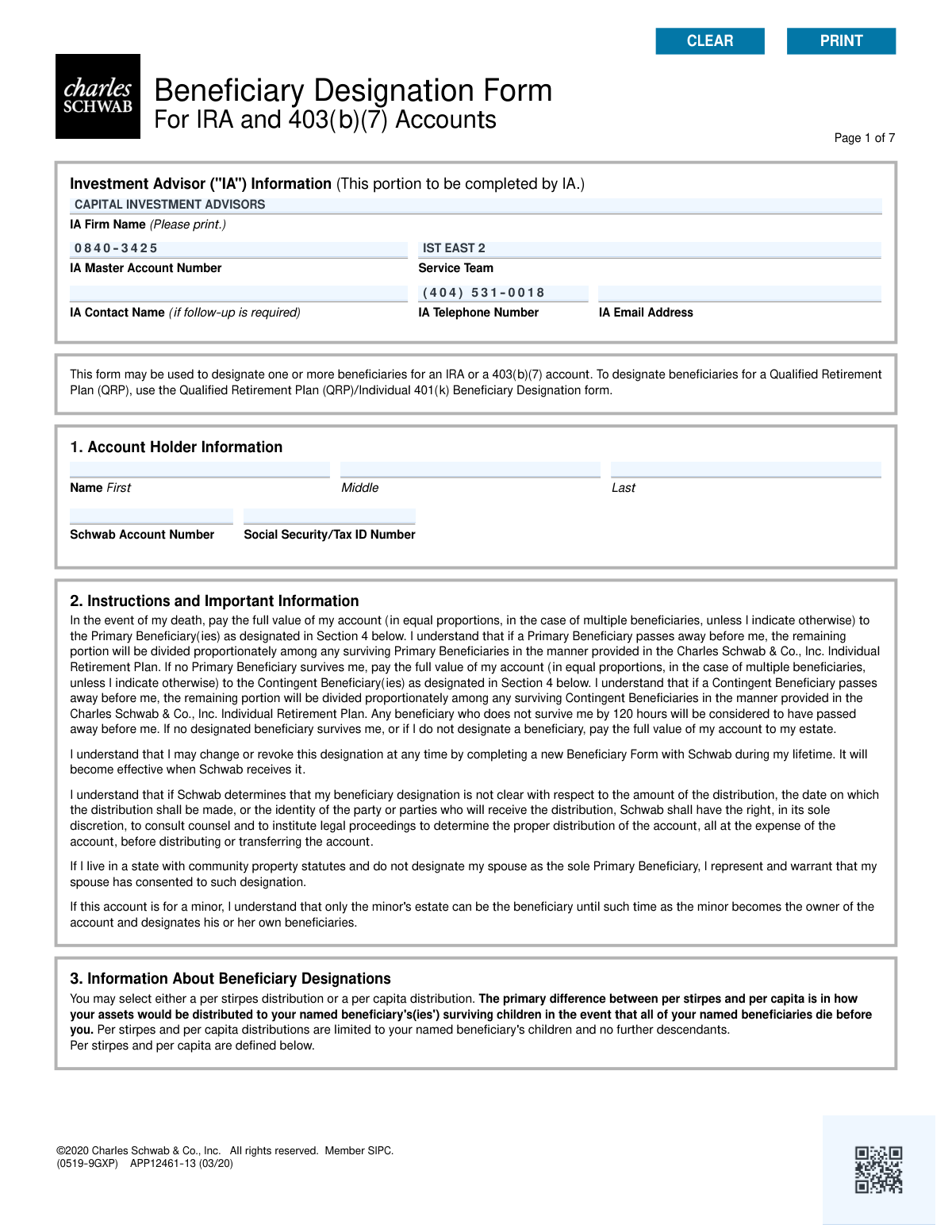
| 1. | Beneficiary Designation Form For IRA and 403(b)(7) Accounts | 1 | – |
| 2. | Fidelity Advisor IRA Beneficiary Designation | 1 | Basic 44 |
| 3. | Fidelity IRA Beneficiary Distribution — Charity, Foundation, or a University | 1 | Moderate 53 |
| 4. | IRA Beneficiary Designation Form | 1 | – |
| 5. | IRA Distribution to Charitable Beneficiary | 1 | – |
| 6. | IRA Distribution to Charitable Beneficiary | 1 | – |
| 7. | IRA/HSA Beneficiary Designation | 1 | Moderate 46 |
| 8. | IRA/IRRA®/ROTH IRA/SEP/SRA Beneficiary Distribution Form | 1 | Moderate 54 |
| 9. | Pershing LLC IRA Designation of Beneficiary | 1 | Moderate 61 |
| 10. | TIAA Trust, N.A. IRA Beneficiary Designation | 1 | – |
- Enterprise-grade security & data encryption
- 99%+ accuracy powered by AI
- 1,000+ forms from all industries
- Complete forms in under 60 seconds
How to Choose the Right Form
Selecting the correct IRA beneficiary form depends on whether you are an account holder planning your estate or a beneficiary seeking to claim inherited funds. These forms are generally specific to the financial institution where the assets are held.
Setting Up or Updating Beneficiaries
If you are the current owner of a retirement account, you need a designation form to ensure your assets bypass probate and reach your heirs directly. Choose the form that matches your brokerage:
- Charles Schwab: Use the Beneficiary Designation Form For IRA and 403(b)(7) Accounts for standard IRAs or employer-sponsored 403(b) plans.
- Fidelity: Use the Fidelity Advisor IRA Beneficiary Designation or the IRA/HSA Beneficiary Designation if you are also managing a Health Savings Account.
- Pershing or TIAA Trust: Select the Pershing LLC IRA Designation of Beneficiary or the TIAA Trust, N.A. IRA Beneficiary Designation respectively.
- General Use: If your specific provider is not listed, the generic IRA Beneficiary Designation Form serves as a legal template for specifying primary and contingent heirs.
Claiming Inherited Assets as an Individual
If you have inherited an account and need to withdraw funds or move them to a beneficiary IRA, you must use a distribution form. The IRA/IRRA®/ROTH IRA/SEP/SRA Beneficiary Distribution Form (provided by Merrill Lynch) is designed for this purpose, allowing you to specify tax withholding and payment methods.
Forms for Charities and Institutions
Retirement assets left to non-profits or educational institutions require specialized documentation to handle the unique tax status of the recipient:
- Charitable Entities: Use the IRA Distribution to Charitable Beneficiary (Form DIRDISTVBA) for Vanguard accounts or the general IRA Distribution to Charitable Beneficiary form.
- Universities and Foundations: The Fidelity IRA Beneficiary Distribution — Charity, Foundation, or a University form is specifically designed for domestic entities to establish inherited accounts for liquidation.
Form Comparison
| Form | Primary Purpose | Who Files It | Included Accounts |
|---|---|---|---|
| Beneficiary Designation Form For IRA and 403(b)(7) Accounts | Formally designate primary and contingent beneficiaries for estate planning. | The current account holder. | IRA and 403(b)(7) accounts held with Charles Schwab. |
| Fidelity Advisor IRA Beneficiary Designation | Assign heirs to inherit retirement assets upon the owner's death. | The current account holder. | Fidelity Advisor IRAs (Traditional, Roth, SIMPLE, SEP). |
| Fidelity IRA Beneficiary Distribution — Charity, Foundation, or a University | Establish an inherited IRA to receive and liquidate assets. | Domestic charities, foundations, or universities named as beneficiaries. | Inherited Fidelity IRAs. |
| IRA Beneficiary Designation Form | Specify who receives funds, acting as a 'second will' for assets. | The current account holder. | Standard Individual Retirement Accounts (IRA). |
| IRA Distribution to Charitable Beneficiary | Formally request the transfer of funds from a deceased owner. | Designated charitable organizations. | Vanguard Individual Retirement Accounts (IRA). |
| IRA Distribution to Charitable Beneficiary — Form DIRDISTVBA | Claim inheritance and provide specific liquidation and payment instructions. | Non-profit organizations or charities. | Vanguard Brokerage IRAs. |
| IRA/HSA Beneficiary Designation | Designate or update beneficiaries to avoid probate for retirement assets. | The current account holder. | Traditional, Roth, SEP IRAs, and Health Savings Accounts (HSA). |
| IRA/IRRA®/ROTH IRA/SEP/SRA Beneficiary Distribution Form | Request distribution of funds and specify tax withholding amounts. | The inheriting beneficiary after the owner's death. | Merrill Lynch retirement accounts including IRA, Roth, and SEP. |
| IRA/IRRA®/Roth IRA/SEP/SRA Beneficiary Distribution Form | Select distribution type, method, and make crucial tax elections. | The inheriting beneficiary. | Merrill Lynch IRA, Roth IRA, SEP, and SRA accounts. |
| Pershing LLC IRA Designation of Beneficiary | Ensure assets are distributed according to the holder's wishes. | The current account holder. | Pershing LLC Individual Retirement Accounts. |
| TIAA Trust, N.A. IRA Beneficiary Designation | Formally designate primary and contingent heirs for the account. | The current account owner. | TIAA Trust, N.A. Individual Retirement Accounts. |
Tips for IRA beneficiary forms
To avoid mid-form delays, ensure you have the full legal names, Social Security numbers, dates of birth, and current addresses for all beneficiaries. Having this data ready is the most effective way to prevent errors and ensure the financial institution can locate your heirs quickly.
A common mistake is only naming primary beneficiaries. By also naming contingent (secondary) beneficiaries, you provide a clear backup plan if your primary beneficiaries predecease you, which helps your estate avoid the costly and lengthy probate process.
When dividing assets among multiple people or charities, double-check that the assigned percentages for each group (primary and contingent) add up to exactly 100%. Financial institutions will often reject forms with mathematical errors or ambiguous 'equal shares' language.
AI-powered tools like Instafill.ai can complete these complex IRA forms in under 30 seconds with high accuracy. This is a major time-saver for those managing multiple accounts, and your sensitive financial data stays secure throughout the automated filing process.
Beneficiary designations are legal contracts that typically supersede instructions left in a last will and testament. Ensure your designations are updated after major life events like marriage, divorce, or the birth of a child to prevent assets from going to an unintended person.
Decide if you want assets to follow a 'per stirpes' or 'per capita' distribution. Specifying 'per stirpes' ensures that if a beneficiary passes away before you, their share goes to their children rather than being redistributed among the other surviving beneficiaries.
After submitting your form, save a digital and physical copy. Storing these designations alongside your latest IRA statements helps your executors or family members identify exactly which institutions hold your assets and who is entitled to receive them.
Frequently Asked Questions
These forms allow an IRA account holder to legally name the individuals or entities that will inherit the account balance upon their death. They are essential for estate planning because the designations on these forms typically override instructions left in a will or living trust, ensuring assets are distributed according to your specific wishes.
You should select the form provided by the specific financial institution where the account is held, such as Charles Schwab, Fidelity, or Vanguard. Each firm has its own legal requirements and internal processing systems, so using the correct proprietary form is necessary for the request to be valid and processed without delay.
A designation form is used by the account owner to name who should receive the assets in the future. In contrast, a distribution form is used by the beneficiary after the owner has passed away to request the actual transfer, liquidation, or payout of those inherited funds.
Yes, you can use AI-powered services to simplify the process of completing these complex documents. AI tools like Instafill.ai can fill these forms in under 30 seconds, accurately extracting and placing data from source documents to ensure all fields are correctly populated.
While manual entry can be time-consuming and prone to errors, modern digital tools make the process much faster. Using an AI-driven platform like Instafill.ai allows you to complete these forms in under 30 seconds by automatically mapping your information into the required fields.
Yes, most IRA providers allow you to name domestic charities, foundations, or universities as beneficiaries. Some institutions, like Vanguard or Fidelity, provide specialized forms specifically for charitable distributions to handle the unique tax and legal requirements of non-profit entities.
It is wise to update these forms after major life events such as marriage, divorce, the birth of a child, or the death of a previously named beneficiary. Financial experts generally recommend reviewing your designations every few years to ensure they still align with your current estate plan.
Yes, naming a beneficiary allows the retirement assets to pass directly to the designated person or entity by operation of contract, bypassing the probate court. This usually results in a faster transfer of funds and reduced legal fees for your heirs.
A primary beneficiary is the first person or entity in line to receive the account assets upon your death. A contingent beneficiary serves as a backup and will only receive the assets if all primary beneficiaries have predeceased you or disclaimed their interest in the account.
Once the form is filled out and signed, it must be submitted to the financial institution that holds the IRA. Most companies allow for digital uploads through a secure account portal, while others may require the form to be mailed or delivered to a local branch office.
Glossary
- Form Complexity Index
- Instafill’s 0–100 measure of how much effort a form takes to complete, calculated deterministically from the form’s own structure rather than estimated. It combines the number of fillable fields (the largest factor), how difficult those fields are to complete based on their type, the number of pages that contain fields, the amount of conditional “fill-only-if” logic, and how many sections the form is divided into, then adds modifiers for tables and repeating lists, bundled instruction pages, and dense page layouts. A higher score means the form is harder to fill out by hand. The forms in this category have a median Form Complexity Index of 53/100 (Moderate). See exactly how it is calculated.
- Primary Beneficiary
- The first person or entity designated to receive the assets in an IRA upon the account holder's death.
- Contingent Beneficiary
- A secondary beneficiary who receives the IRA assets only if all primary beneficiaries have died before the account holder.
- Inherited IRA
- A new account established by a beneficiary to receive assets from a deceased person's retirement plan while maintaining the tax-deferred status of the funds.
- Per Stirpes
- A legal term meaning 'by the branch' that ensures if a beneficiary dies before the account holder, their share passes to their own children rather than being split among other survivors.
- Spousal Consent
- A requirement in community property states where a spouse must sign the form if the account holder names someone else as the primary beneficiary.
- Required Minimum Distribution (RMD)
- The mandatory minimum amount that a beneficiary must withdraw from an inherited IRA each year to comply with IRS tax regulations.
- Medallion Signature Guarantee
- A special certification stamp provided by a financial institution that verifies the identity and authority of the person signing the distribution form.
- Per Capita
- A distribution method where the IRA assets are divided equally among the surviving named beneficiaries, regardless of whether a deceased beneficiary had children.