
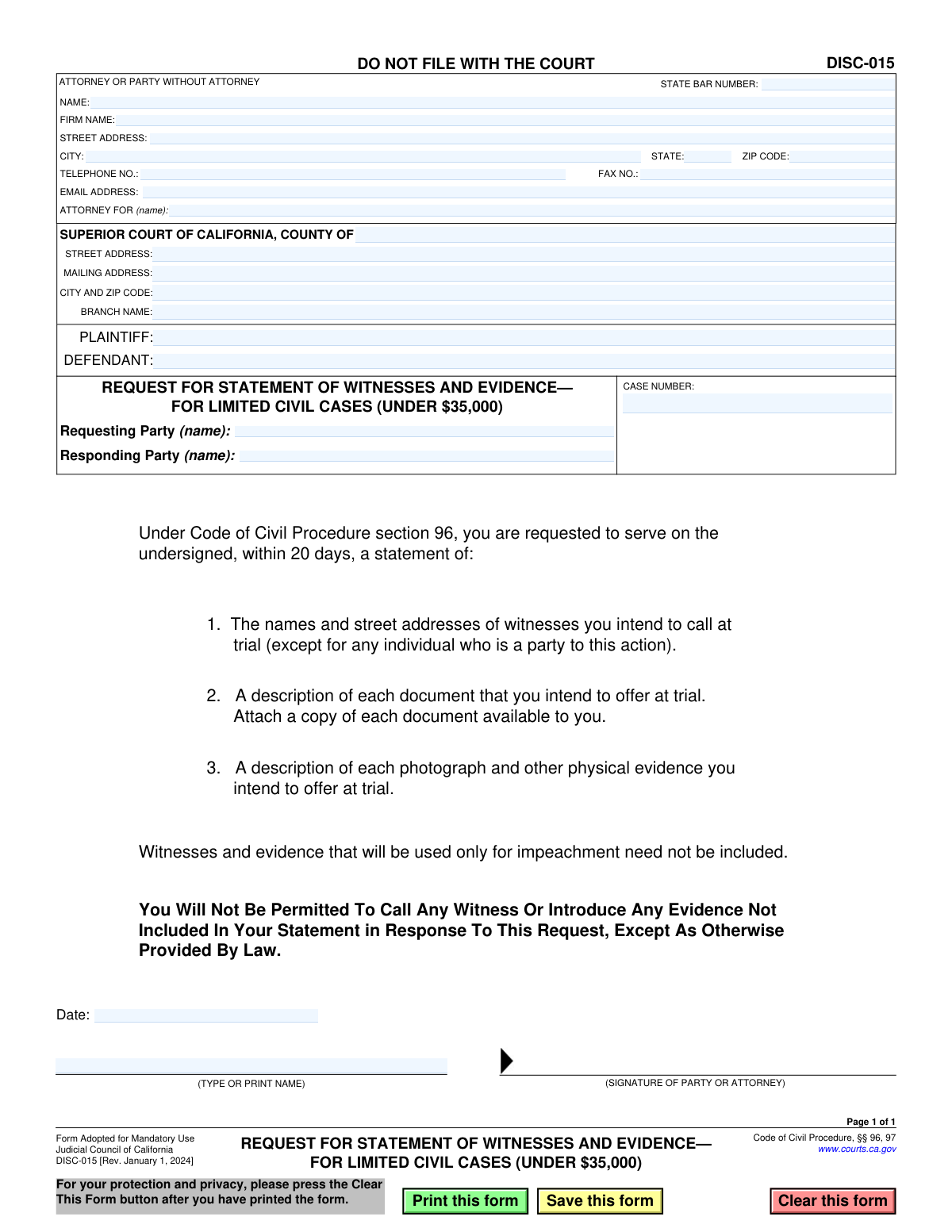
Yes! You can use AI to fill out Form DISC-015, Request for Statement of Witnesses and Evidence—For Limited Civil Cases (Under $35,000)
Don't type 28 fields by hand. Tell our AI about yourself, or upload a document you already have, and it fills every field in seconds. You check it, then download, print or sign.
The AI does the filling. You just check it.
No typing into boxes, nothing to install.
What this form asks for
The AI fills all of it, from your answers or your documents.
The AI checks your answers before you download
14 checks built for this form, so a wrong date or a missing answer is caught before anyone else sees it.
This check verifies that the 'STATE BAR NUMBER' field, if provided, contains only numeric characters. This is important for correctly identifying and verifying the status of an attorney with the State Bar of California. If an attorney is representing a party, an invalid number can lead to rejection or delays in processing.
Ensures the 'NAME' field in the 'ATTORNEY OR PARTY WITHOUT ATTORNEY' section is not empty. This field identifies the primary individual responsible for the document, whether they are an attorney or a self-represented party. Failure to provide this name makes the document's origin ambiguous and invalid for legal service.
Validates that the 'STREET ADDRESS', 'CITY', 'STATE', and 'ZIP CODE' fields are all completed for the filing party. A complete and accurate address is legally required for proper service of court documents and communication between parties. An incomplete address can invalidate the request and cause significant delays in the legal process.
This check ensures the 'ZIP CODE' field contains a valid 5-digit or 9-digit (ZIP+4) numeric format. Correct formatting is essential for mail delivery of legal notices and documents. An incorrectly formatted ZIP code could result in returned mail and missed deadlines.
Verifies that the 'EMAIL ADDRESS' field, if filled, conforms to a standard email format (e.g., '[email protected]'). As courts increasingly rely on electronic service and communication, a valid email address is critical for timely receipt of information. An invalid format would prevent electronic communication and could be grounds for rejecting the form.
This validation confirms that the 'CASE NUMBER' field is not empty. The case number is the unique identifier for the lawsuit within the court system, and its absence makes it impossible to associate the document with the correct legal action. A missing case number will result in the document being rejected or lost.
And 8 more checks
- Plaintiff and Defendant Name Completeness
- Requesting and Responding Party Identification
- Logical Party Conflict Check
- Date Field Validation
- Signatory Name Presence
- Signatory Name Consistency
- Attorney Representation Consistency
- Court County Presence
Let AI fill out your DISC-015
No typing. Every field filled in seconds, checked, ready to sign.
How to Fill Out DISC-015 Online for Free in 2026
What the AI walks you through.
- Visit Instafill.ai and upload your PDF or select California Form DISC-015 from the template library.
- Provide your information as the 'Attorney or Party Without Attorney,' including your name, address, and contact details.
- Enter the court information, including the county and branch, followed by the names of the plaintiff, defendant, and the case number.
- Specify the names of the 'Requesting Party' (yourself or your client) and the 'Responding Party.'
- The body of the request is standard legal text based on Code of Civil Procedure section 96; no data entry is required in this section.
- Date the form, type your name, and use the AI tool to add a legally binding digital signature or prepare the form for manual signing.
- Review all entered details for accuracy, then download the completed form to serve on the opposing party as instructed (do not file with the court).
Common Mistakes in Completing DISC-015
The ones the AI is built to catch.
Improperly Filing the Request with the Court
Confusing 'Requesting Party' and 'Responding Party'
Forgetting to Sign or Date the Form
Entering an Incorrect or Incomplete Case Number
Mistaking the Request Form for the Response
Using Illegible Handwriting on a Printed Form
Incomplete Attorney or Party Contact Information
Using the Form for an Inappropriate Case Type
Failing to Properly 'Serve' the Document
Incorrectly Identifying the Court Branch
Frequently Asked Questions About DISC-015
Is it really free for 7 days?
Can I fill other forms too?
How do I cancel?
How does the AI fill out DISC-015?
What happens to my information?
How complex is DISC-015 to fill out?
What is the purpose of Form DISC-015?
Who needs to fill out this form?
Do I file this form with the court?
How long does the other party have to respond to this request?
What happens if I receive this form and don't respond, or I forget to list a witness?
What information do I need to provide in my response to this request?
Do I need to list the plaintiff or defendant as a witness?
What is 'impeachment' evidence and do I have to list it?
Do I have to provide actual copies of the documents I intend to use?
Can I use AI tools to help me fill out Form DISC-015?
How can I fill out this form online?
The PDF version of this form I have is not fillable. What can I do?
Who is the 'Requesting Party' and who is the 'Responding Party'?
Get your DISC-015 filled out by AI
$0 today. Cancel before Nov 1 and you pay nothing.
Other forms like this one
California state forms: Judicial Council of California Form DE-111, Petition for Probate (Probate—Decedents Estates), DS 1891, Applicant/Vendor Disclosure Statement (State of California Department of Developmental Services), Judicial Council of California Form DE-120, Notice of Hearing—Decedent's Estate or Trust, Judicial Council of California Form DE-120, Notice of Hearing—Decedent's Estate or Trust, Murrieta Police Department Citizen Complaint Form (California Penal Code § 148.6 Advisory Statement), California Department of Social Services, Sworn Statement, State of California Department of Transportation California Civil Rights Laws Certification, State of California Department of Transportation Darfur Contracting Act Certification, Form DOT ADM-0077, State of California Department of Transportation, Contract Requirements, State of California Department of Transportation Subcontractor List, State of California Department of Transportation, Certified DVBE Summary, Bidder Declaration GSPD-05-105, State of California Level of Care Rate Determination Protocol Matrix, State of California Accessible Form, State of California Form SOC 321, Request for Order and Consent - Paramedical Services, State of California Darfur Contracting Act Certification, State of California Department of Veterans Affairs COMMERCIALLY USEFUL FUNCTION (CUF) CERTIFICATION FORM, Form ADR-100, Statement of Agreement or Nonagreement, Civil Appeal Case Information Statement, Form APP-014, Appellant's Proposed Statement on Appeal (Unlimited Civil Case)
California court forms: Judicial Council of California Form SC-105, Request for Court Order and Answer (Small Claims), Judicial Council of California Form SC-120, Defendant’s Claim and ORDER to Go to Small Claims Court (Small Claims), Judicial Council of California Form SER-001, Request for Sheriff to Serve Court Papers, Judicial Council of California Form SER-001, Request for Sheriff to Serve Court Papers, Affidavit for Collection of Personal Property California Probate Code Section 13100, Form POS-040, Proof of Service—Civil, Declaration of Facts of Death (California Superior Court), declaration-of-marriage-for-court-proceeding-california-family-law, ADOPT-200, Adoption Request, ADOPT-200, Stepparent Adoption Request, ADOPT-210, Adoption Agreement, ADOPT-310, Contact After Adoption Agreement, Judicial Council of California Form ADOPT-200, Adoption Request, Form ADR-107, Mediation Attendance Sheet, Form ADR-110, Order Appointing Referee, Form ADR-109, Stipulation or Motion for Order Appointing Referee, Form ADR-102, Request for Trial De Novo After Judicial Arbitration, Form ADR-108, Referee's Report (Code Civ. Proc., §§ 638, 639), Form ADR-106, Petition to Confirm, Correct, or Vacate Contractual Arbitration Award, Form ADR-104, Rejection of Award and Request for Trial After Attorney-Client Fee Arbitration
civil court forms: Petition for Leave to Proceed In Forma Pauperis (Court of Common Pleas of Lehigh County, Pennsylvania, Civil Division), Designation of Record on Appeal (Civil) (Maricopa County Justice Courts, Arizona) (Form APP 8150-702), Certificate of Service (Civil Court Claim), Pfändungs- und Überweisungsbeschluss (Garnishment and Transfer Order) – German Civil Enforcement Court Form, AOPC 308A, Civil Complaint, Form MC 03, Answer, Civil, Form POS-040, Proof of Service—Civil, ONTARIO Form 8: Application (General), Form ATJ 601.9, Application for Waiver of Court Fees (Civil), Nevada Justice / Municipal Civil Court Cover Sheet, Form MC 01, Summons, Form MC 10, Judgment, Civil, Form MC 99, Motion and Affidavit to Set Aside Default (Civil), Form MC 281a, Civil Mediator Application, Ex Parte Motion and Order to Renew Civil Judgment, AO 88B, Subpoena to Produce Documents, Information, or Objects or to Permit Inspection of Premises in a Civil Action, Form APP-031A, Application for Extension of Time to File Brief (Civil Case), Civil Appeal Case Information Statement, Form APP-014, Appellant's Proposed Statement on Appeal (Unlimited Civil Case), form-app-015-respondents-proposed-corrections-toadditions-to-appellants-proposed-settled-statement-unlimited-civil-case
Let AI fill out your DISC-015
Your trial starts once a card is added. You pay nothing before Nov 1.
Our AI already knows this form, all 28 fields of it. Skip the typing: tell it about yourself, or upload what you have, and it fills the whole form in seconds.
- AI fills every field on the form, checkboxes included
- No typing into boxes: answer a few questions, or upload a document you already have, an old copy of this form, a photo of a document
- The AI checks the answers; you review and change anything before you download
- Download the finished PDF, print it, or sign it online
- Encrypted, and never used to train AI
Cancel before Nov 1 and you pay nothing.
A card is needed to start the trial. Cancel in two clicks from your account.
Terms · Privacy