Yes! You can use AI to fill out Official Form 106E/F, Schedule E/F: Creditors Who Have Unsecured Claims
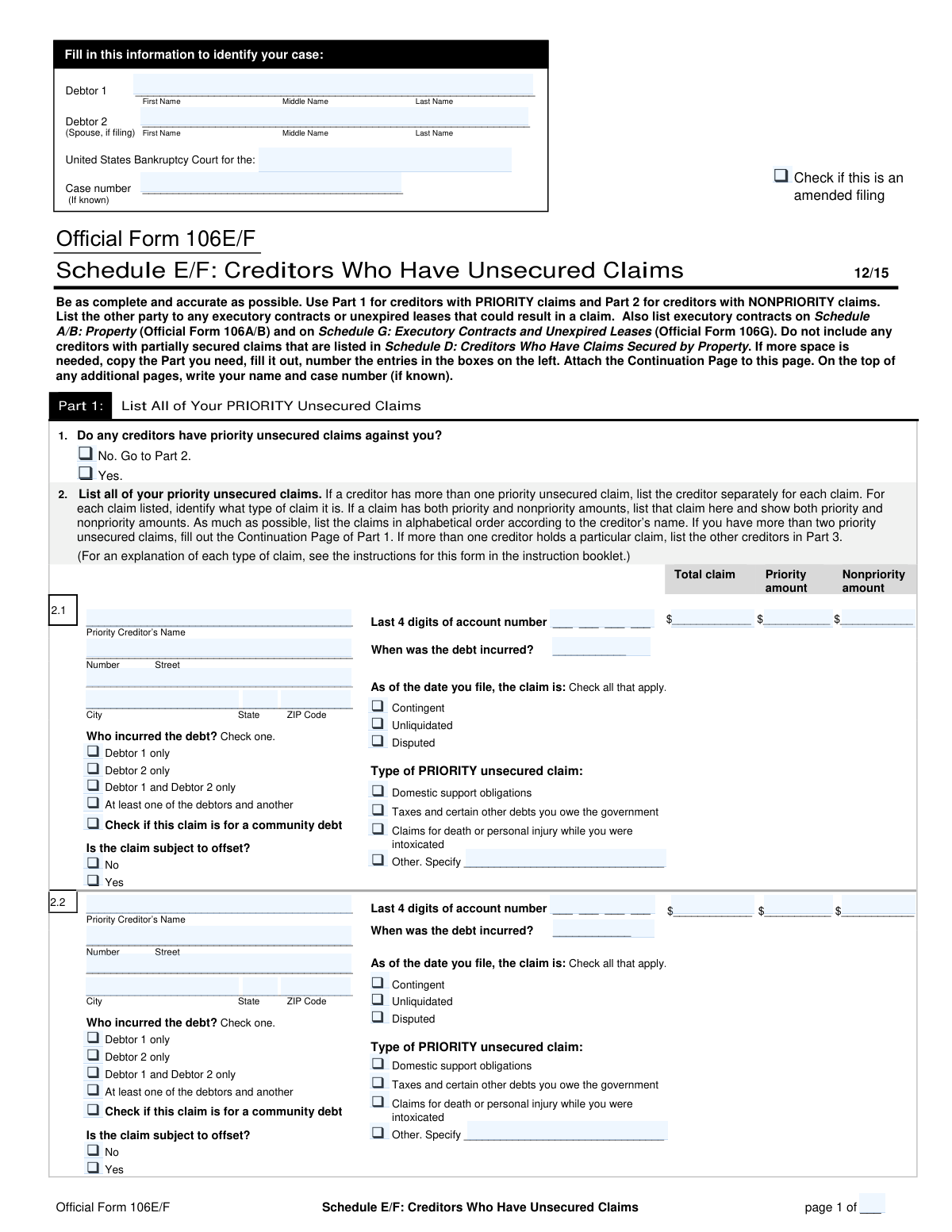
Official Form 106E/F, Schedule E/F, is a critical document filed in a United States bankruptcy case to list all of a debtor's unsecured debts. It separates claims into two categories: priority (like taxes and domestic support) and nonpriority (like credit cards and personal loans), ensuring proper notification and treatment of creditors under the bankruptcy plan. Today, this form can be filled out quickly and accurately using AI-powered services like Instafill.ai, which can also convert non-fillable PDF versions into interactive fillable forms.
Our AI automatically handles information lookup, data retrieval, formatting, and form filling.
It takes less than a minute to fill out Official Form 106E/F using our AI form filling.
Securely upload your data. Information is encrypted in transit and deleted immediately after the form is filled out.
Form specifications
| Form name: | Official Form 106E/F, Schedule E/F: Creditors Who Have Unsecured Claims |
| Number of pages: | 6 |
| Filled form examples: | Form Official Form 106E/F Examples |
| Language: | English |
| Categories: | VA claim forms, credit forms, SEC forms |
Instafill Demo: How to fill out PDF forms in seconds with AI
How to Fill Out Official Form 106E/F Online for Free in 2026
Are you looking to fill out a OFFICIAL FORM 106E/F form online quickly and accurately? Instafill.ai offers the #1 AI-powered PDF filling software of 2026, allowing you to complete your OFFICIAL FORM 106E/F form in just 37 seconds or less.
Follow these steps to fill out your OFFICIAL FORM 106E/F form online using Instafill.ai:
- 1 Navigate to Instafill.ai and upload or select the Official Form 106E/F.
- 2 Provide the debtor's information, including name(s), court district, and case number at the top of the form.
- 3 In Part 1, use the AI assistant to list all priority unsecured claims, entering each creditor's name, address, account details, claim amount, and type of claim.
- 4 In Part 2, list all nonpriority unsecured claims, providing the same detailed information for each creditor as required.
- 5 Complete Part 3 if there are other parties to notify about a debt, such as a collection agency, linking them to the original creditor listed in Part 1 or 2.
- 6 The AI will help you review and total the amounts for each claim type in Part 4, ensuring accuracy for statistical reporting.
- 7 Carefully review the entire completed schedule for accuracy and completeness before downloading, printing, or submitting it as part of your bankruptcy filing.
Our AI-powered system ensures each field is filled out correctly, reducing errors and saving you time.
Why Choose Instafill.ai for Your Fillable Official Form 106E/F Form?
Speed
Complete your Official Form 106E/F in as little as 37 seconds.
Up-to-Date
Always use the latest 2026 Official Form 106E/F form version.
Cost-effective
No need to hire expensive lawyers.
Accuracy
Our AI performs 10 compliance checks to ensure your form is error-free.
Security
Your personal information is protected with bank-level encryption.
Frequently Asked Questions About Form Official Form 106E/F
This form is used in a bankruptcy case to list all your creditors who have unsecured claims, which are debts not backed by collateral. It provides the court with a complete picture of who you owe money to and the nature of each debt.
Anyone filing for bankruptcy (the debtor) must complete and file Schedule E/F as part of their bankruptcy petition. You are required to list all your unsecured creditors, even if you intend to continue paying them.
Part 1 is for priority claims, which are special debts like child support or recent taxes that are paid first by law. Part 2 is for nonpriority claims, which include most other debts like credit cards, medical bills, and personal loans.
List the original creditor in Part 1 or Part 2, and then list the collection agency in Part 3, 'List Others to Be Notified.' This ensures both parties receive legal notice of your bankruptcy filing.
A 'contingent' claim depends on a future event, an 'unliquidated' claim is one where the exact amount owed is not yet known, and a 'disputed' claim is one you disagree with. Check all boxes that apply for each debt.
You should list the entire claim in Part 1. The form provides separate fields to enter the total claim amount, the specific priority amount, and the remaining nonpriority amount for that single debt.
The form includes continuation pages for both Part 1 and Part 2. You can copy the necessary continuation page, fill it out with your additional creditors, and attach it to the main form.
Use Part 3 to list any additional parties, such as a collection agency or a creditor's attorney, that need to be notified about a debt you already listed in Part 1 or 2. This ensures all relevant parties are included in the bankruptcy proceedings.
Part 4 is a summary section used for statistical reporting purposes by the court. You simply total the amounts of each type of claim you listed in Parts 1 and 2 and enter the sums on the appropriate lines.
You will need the full name and mailing address for each creditor, the last 4 digits of the account number, the date the debt was incurred, and the total amount you owe. Having recent billing statements on hand can be very helpful.
Yes, AI-powered services like Instafill.ai can help you fill out this form accurately and efficiently. These tools can auto-fill your information, reducing the time spent on paperwork and helping to minimize errors.
Simply upload the Schedule E/F form to the Instafill.ai platform. The AI will make all the fields interactive, allowing you to easily type in your creditor information, check boxes, and save or print the completed document.
If you have a flat, non-fillable PDF, you can use a service like Instafill.ai to instantly convert it into an interactive, fillable form. This allows you to type your information directly into the fields instead of filling it out by hand.
Compliance Official Form 106E/F
Validation Checks by Instafill.ai
1
Priority Claim Amount Consistency
This check verifies that for each priority claim listed in Part 1, the sum of the 'Priority amount' and the 'Nonpriority amount' equals the 'Total claim' amount. This is crucial for accurate financial reporting and ensures the debt is correctly categorized. If the amounts do not add up, the filing may be considered inaccurate, leading to rejection or requests for correction.
2
Conditional Completion of Part 1
This validation ensures that if the user answers 'Yes' to question 1 ('Do any creditors have priority unsecured claims against you?'), then at least the first priority claim entry (2.1) is filled out completely. Answering 'Yes' without providing any claim details makes the form incomplete and unusable. Failure to provide details will prevent the user from proceeding, as it creates a logical contradiction in the filing.
3
Conditional Requirement for 'Other' Claim Type Specification
This check confirms that whenever an 'Other. Specify' checkbox is selected for a claim type in Part 1 or Part 2, the corresponding text field for the description is not left blank. This is important for the court and trustees to understand the nature of the debt. If the specification is missing, the filing lacks necessary detail and will be flagged as incomplete.
4
Format Validation for 'Last 4 digits of account number'
This validation ensures that any 'Last 4 digits of account number' field contains exactly four numeric digits. This specific format is required for proper identification of accounts while protecting the debtor's full account information. An incorrect format could lead to misidentification of the debt or rejection of the schedule.
5
Date Format and Plausibility for 'When was the debt incurred?'
This check verifies that the 'When was the debt incurred?' field contains a valid date in a recognized format (e.g., MM/DD/YYYY) and that the date is not in the future. The date of incurrence is legally significant for determining the status of a claim. An invalid or future date would be a logical error and would require correction before the form can be accepted.
6
Part 4 Priority Summary Calculation
This validation ensures that the value entered in Part 4, line 6e ('Total') is the correct sum of the amounts from lines 6a, 6b, 6c, and 6d. This summary provides a quick overview of total priority debts for the court. A miscalculation here indicates a significant error in the form's summary section and must be corrected for the statistical data to be valid.
7
Part 4 Nonpriority Summary Calculation
This validation ensures that the value entered in Part 4, line 6j ('Total') is the correct sum of the amounts from lines 6f, 6g, 6h, and 6i. This summary is used for statistical reporting and provides a total of all nonpriority unsecured claims. If the total is incorrect, it undermines the integrity of the financial summaries presented to the court.
8
Cross-Validation of Part 1 Claims and Part 4 Summary
This check confirms that the total amount for each claim type in Part 4 (e.g., line 6a 'Domestic support obligations') matches the sum of all claims of that specific type listed throughout Part 1. This ensures consistency between the detailed claim list and the summary totals. Discrepancies suggest either a miscategorization of a claim or a calculation error, requiring a full review of Part 1.
9
Part 3 Reference Line Number Validity
This validation verifies that for any entry in Part 3 ('Others to Be Notified'), the specified 'Line' number corresponds to a valid, existing claim entry in the selected Part (Part 1 or Part 2). This link is essential for associating a notification party (like a collection agency) with the correct original creditor. An invalid reference would mean legal notices might not be sent correctly, jeopardizing the bankruptcy process.
10
Debtor 2 Dependency Check
This check ensures that if any claim is marked as incurred by 'Debtor 2 only' or 'Debtor 1 and Debtor 2 only', the 'Debtor 2' name fields at the top of the form are filled out. It is a logical impossibility to assign a debt to a non-existent debtor. This validation prevents incomplete or logically flawed submissions in joint filings.
11
Completeness of Individual Claim Entries
This validation ensures that if a creditor's name is provided for any claim in Part 1 or Part 2, then all other required fields for that entry (full address, total amount, debt incurrence date, and selections for 'Who incurred the debt?' and 'Type of claim') are also completed. A partially filled claim entry is insufficient for legal notification and processing. The system should flag the specific incomplete entry and prevent submission until all required data is present.
12
ZIP Code Format Validation
This check verifies that all ZIP Code fields throughout the form adhere to a valid format, either 5 digits or 9 digits (ZIP+4, e.g., 12345 or 12345-6789). Correctly formatted ZIP codes are essential for the mail delivery of legal notices to creditors. An invalid format will cause a validation failure to ensure the address is correct and deliverable.
13
Exclusive Selection for Debt Incurrer
This validation ensures that for each claim, exactly one option is selected from the 'Who incurred the debt?' checklist. Selecting none or multiple options would create ambiguity regarding liability for the debt. The form requires a clear, single choice to properly assign responsibility for each listed claim.
14
Exclusive Selection for Claim Type
This check verifies that for each claim listed in Part 1 or Part 2, exactly one 'Type of claim' checkbox is selected. The legal treatment of a claim depends heavily on its type (e.g., taxes vs. student loans). Selecting multiple types for a single claim entry would be ambiguous and legally problematic, so the form must enforce a single selection.
Common Mistakes in Completing Official Form 106E/F
Filers often misclassify debts, listing a nonpriority credit card bill in Part 1 (Priority) or a priority tax debt in Part 2 (Nonpriority). This happens due to a misunderstanding of complex bankruptcy definitions. Incorrect classification can lead to improper debt treatment, objections from the trustee, and failure to discharge debts correctly. To avoid this, carefully review the definitions for each claim type in the instruction booklet or consult a legal professional.
A frequent error is listing a collection agency in Part 1 or 2 as the primary creditor, instead of the original creditor. The form requires listing the original creditor first, and then listing the collection agency in Part 3 with a reference to the original debt. This mistake occurs because the collection agency is the most recent point of contact, but failing to notify the original creditor can result in the debt not being discharged. Always trace the debt back to the original company and list both parties in their correct sections.
Part 4 requires filers to categorize and sum up all the claims listed in Parts 1 and 2, which is highly prone to manual calculation errors. These mistakes happen due to the complexity and volume of information being totaled. While for statistical purposes, significant discrepancies can trigger scrutiny from the court and require filing a costly amendment. To prevent this, use a calculator and double-check all totals, or use an AI-powered tool like Instafill.ai which can perform these calculations automatically to ensure accuracy.
For priority claims in Part 1, filers must break down the 'Total claim' into its 'Priority amount' and 'Nonpriority amount', but often they only list the total. This is common with tax debts, where some years may be priority and others nonpriority. This error can cause the court to misinterpret the portion of debt that receives priority payment, negatively impacting the case outcome. Always verify if a single debt has both components and list them accurately.
Filers frequently fail to check the boxes for 'Contingent,' 'Unliquidated,' or 'Disputed' when appropriate, because these legal terms are confusing. For example, a pending lawsuit against the debtor represents a claim that is both contingent (depends on the outcome) and unliquidated (amount is not yet set). Incorrectly classifying a claim can lead to legal challenges from the creditor and affect how the debt is handled. It is crucial to understand these definitions or seek legal advice when unsure.
Debtors sometimes forget to list all their debts or provide an incomplete or outdated address for a creditor. This can happen through simple oversight or poor record-keeping, especially for small or old debts. The consequence is severe: if a creditor is not listed or cannot be notified due to a bad address, the debt may not be discharged, and the debtor will still be liable for it after bankruptcy. To avoid this, gather all bills and review your credit reports thoroughly for a complete list of creditors and their current addresses.
When listing a collection agency or co-creditor in Part 3, the form requires referencing the exact line number (e.g., 2.1, 4.3) of the original creditor from Part 1 or 2. Filers often forget this reference or enter the wrong line number. This breaks the legal link between the parties, potentially causing the notice to be ineffective for the party listed in Part 3. Always fill out Parts 1 and 2 first, then carefully cross-reference the line numbers when completing Part 3.
The instructions explicitly state not to include secured creditors, which should be on Schedule D, but people often mistakenly list car loans or mortgages here. This stems from a misunderstanding of the difference between debts backed by collateral (secured) and those that are not (unsecured). This error creates contradictory schedules that will be questioned by the trustee and require amendment, causing delays and confusion about the debtor's intentions for the property. Carefully separate debts into the correct schedules before filling out the forms.
When using continuation pages for additional creditors, filers often forget to write their name, case number, and page numbers (e.g., 'page 2 of 5') on each additional sheet. This is a simple oversight when focusing on the complex creditor details. If these un-labeled pages become separated, the court clerk cannot properly assemble the filing, which can lead to rejection of the documents or incomplete records. Make it a habit to fill out the header and footer on every single page.
In a joint case, it is critical to correctly check who incurred the debt: 'Debtor 1 only,' 'Debtor 2 only,' or 'Debtor 1 and Debtor 2 only.' People often get this wrong, especially when distinguishing between a joint account holder and an authorized user. This error can affect which debtor remains liable for a non-dischargeable debt and how community property is treated. Review original account agreements to confirm liability before checking the box.
When the exact amount of a debt is unknown, filers may write 'Unknown' or leave the amount blank. While this is sometimes unavoidable, it should be paired with checking the 'Unliquidated' box to properly classify the debt. Failing to do so can lead to the claim being treated as zero, which could result in the debt not being discharged. If an amount is truly unknown, you must check the 'Unliquidated' box and provide a best-faith estimate if possible.
Many court forms are distributed as flat, non-fillable PDFs, forcing filers to print them and fill them out by hand. This often leads to illegible handwriting, data entry errors, and calculation mistakes in summary sections. These issues can cause the court clerk to reject the filing or misinterpret crucial information. To avoid this, use a service like Instafill.ai that can convert any non-fillable PDF into an intelligent, fillable form, allowing for clean, typed entries and automated validation.
Saved over 80 hours a year
“I was never sure if my IRS forms like W-9 were filled correctly. Now, I can complete the forms accurately without any external help.”
Kevin Martin Green
Your data stays secure with advanced protection from Instafill and our subprocessors

Robust compliance program
Transparent business model
You’re not the product. You always know where your data is and what it is processed for.
ISO 27001, HIPAA, and GDPR
Our subprocesses adhere to multiple compliance standards, including but not limited to ISO 27001, HIPAA, and GDPR.
Security & privacy by design
We consider security and privacy from the initial design phase of any new service or functionality. It’s not an afterthought, it’s built-in, including support for two-factor authentication (2FA) to further protect your account.
Fill out Official Form 106E/F with Instafill.ai
Worried about filling PDFs wrong? Instafill securely fills official-form-106ef-schedule-ef-creditors-who-have-unsecured-claims forms, ensuring each field is accurate.



