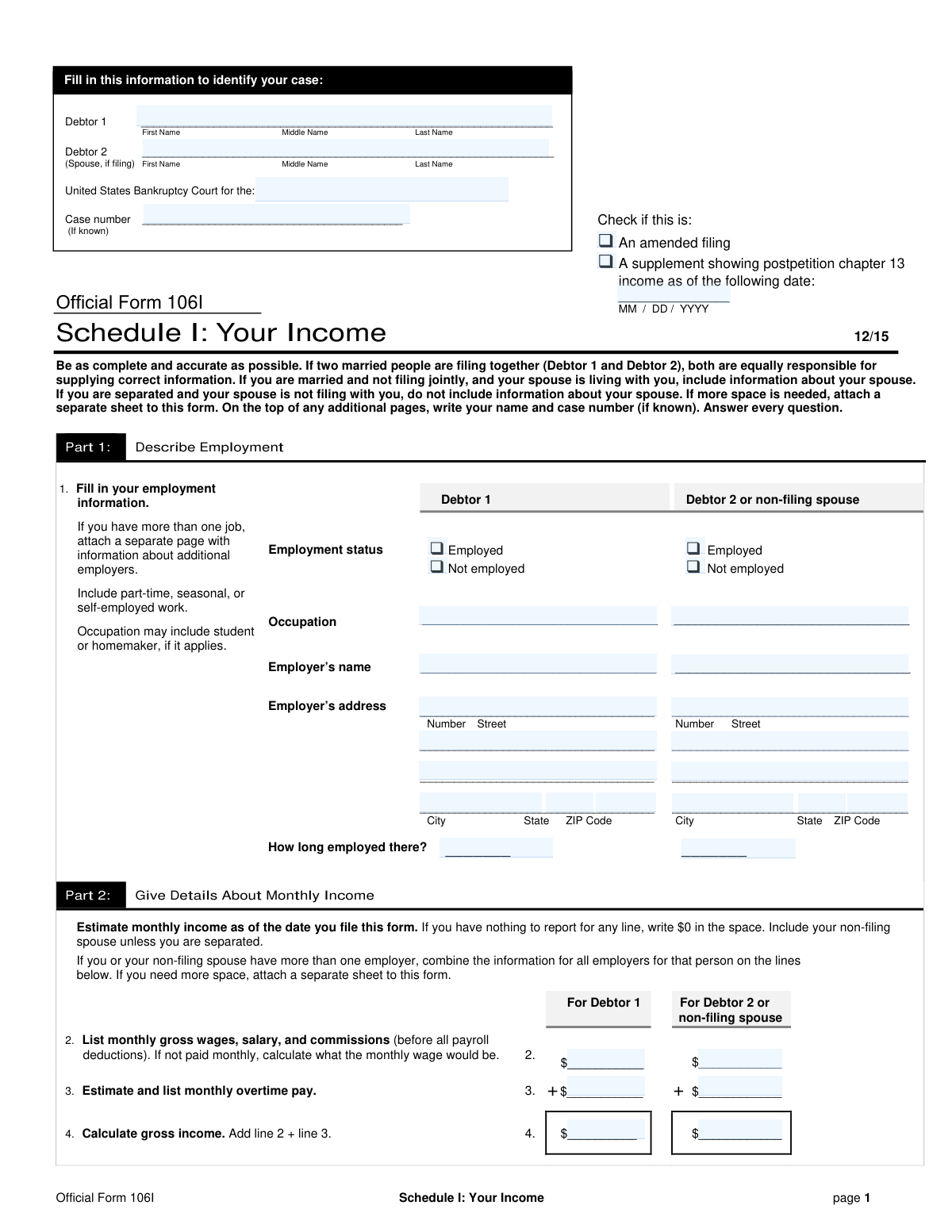
Yes! You can use AI to fill out Official Form 106I, Schedule I: Your Income

Official Form 106I, Schedule I: Your Income, is a fundamental component of a bankruptcy filing that requires debtors to disclose their complete monthly income. This includes wages, salaries, commissions, as well as income from businesses, government assistance, pensions, and other sources for both the debtor and their spouse. The information provided is vital for the court and trustee to assess the debtor's financial stability and determine the appropriate course of action for the bankruptcy case. Today, this form can be filled out quickly and accurately using AI-powered services like Instafill.ai, which can also convert non-fillable PDF versions into interactive fillable forms.
Form 106I / Schedule I is part of the income forms category on Instafill.
Our AI automatically handles information lookup, data retrieval, formatting, and form filling.
It takes less than a minute to fill out Form 106I / Schedule I using our AI form filling.
Securely upload your data. Information is encrypted in transit and deleted immediately after the form is filled out.

Form specifications

Form name: Official Form 106I, Schedule I: Your Income
Number of fields: 91
Number of pages: 2
Language: English
main-image

Instafill Demo: How to fill out PDF forms in seconds with AI

How to Fill Out Form 106I / Schedule I Online for Free in 2026

Are you looking to fill out a FORM 106I / SCHEDULE I form online quickly and accurately? Instafill.ai offers the #1 AI-powered PDF filling software of 2026, allowing you to complete your FORM 106I / SCHEDULE I form in just 37 seconds or less.
Follow these steps to fill out your FORM 106I / SCHEDULE I form online using Instafill.ai:
  1. 1 Navigate to Instafill.ai and upload your Form 106I (Schedule I) document, or select it from their library of official forms.
  2. 2 Use the AI assistant to accurately fill in the case identification details, including the court district, case number, and debtor names.
  3. 3 Provide employment information for both Debtor 1 and Debtor 2 (if applicable). The AI will guide you to enter gross wages, salaries, and overtime pay.
  4. 4 Detail all monthly payroll deductions, such as taxes, insurance, retirement contributions, and union dues. Instafill.ai's smart fields will help calculate totals automatically.
  5. 5 List all other sources of income, including rental income, interest, dividends, social security, and any other regular payments received.
  6. 6 Review the auto-calculated totals for monthly income and combined income to ensure all information is correct. The AI will flag any potential inconsistencies.
  7. 7 Once you've verified all the information, securely e-sign the document and download the completed, ready-to-file Schedule I.

Our AI-powered system ensures each field is filled out correctly, reducing errors and saving you time.

Why Choose Instafill.ai for Your Fillable Form 106I / Schedule I Form?

Speed

Complete your Form 106I / Schedule I in as little as 37 seconds.

Up-to-Date

Always use the latest 2026 Form 106I / Schedule I form version.

Cost-effective

No need to hire expensive lawyers.

Accuracy

Our AI performs 10 compliance checks to ensure your form is error-free.

Security

Your personal information is protected with bank-level encryption.

Frequently Asked Questions About Form Form 106I / Schedule I

This form, officially known as Schedule I: Your Income, is a required document in a bankruptcy case. Its purpose is to provide a detailed, monthly breakdown of your income from all sources to the court and your creditors.

Debtor 1 is the primary individual filing for bankruptcy. If you are married and filing for bankruptcy jointly with your spouse, your spouse will be listed as Debtor 2.

Yes, you must report the income of a non-filing spouse in the 'Debtor 2 or Non-Filing Spouse' columns. This is required for the court to get a complete picture of your household's financial situation.

Gross wages (Line 3) is your total salary or pay before any deductions are taken out. Take-home pay (Line 7) is your net pay, which is the amount you actually receive after deductions like taxes, insurance, and retirement contributions are subtracted.

If you are self-employed, check the 'Employed' box and write 'Self-employed' as the employer name. You should then report your net monthly income from your business, profession, or farm on line 8a.

An 'amended filing' is used to correct errors or update information on a Schedule I you have already filed. A 'supplement' is typically filed in a Chapter 13 case to report income earned after the initial filing date.

If your income is irregular, you should calculate an average monthly income based on the last several months. The goal is to provide a figure that accurately represents your typical monthly earnings.

This line is for any money you regularly receive from others to help pay for household expenses. This includes contributions from a roommate, partner, or family member for things like rent, utilities, or food.

You must disclose any expected changes to your income because it can affect your eligibility for bankruptcy or the terms of your repayment plan. Be sure to provide a clear explanation for any anticipated raises, job changes, or other events affecting your income.

If you are completing this form as part of your initial bankruptcy petition, you can leave the case number field blank. The court will assign a case number once your paperwork is officially filed.

Mandatory contributions are amounts you are required to pay into a retirement plan as a condition of your employment. Voluntary contributions are optional amounts you choose to contribute, such as to a 401(k) or IRA.

Yes, services like Instafill.ai use AI to auto-fill form fields accurately and save time. This can help reduce errors and make the process of completing complex forms much faster.

To fill out the form online, upload the PDF to the Instafill.ai platform. The AI will make all the fields interactive, allowing you to easily type in your information or use auto-fill features to complete the document.

If you have a flat or scanned PDF, you can use a tool like Instafill.ai. It is designed to convert non-fillable PDFs into interactive forms that you can easily complete and save online.

Compliance Form 106I / Schedule I
Validation Checks by Instafill.ai

1
Mutually Exclusive Employment Status
This check ensures that for each debtor, only one of the 'Employed' or 'Not employed' checkboxes is selected. Selecting both is a logical contradiction that makes the employment section impossible to interpret correctly. If validation fails, the user must be prompted to choose only one status to accurately reflect their employment situation.
2
Conditional Requirement for Employment Details
Verifies that if the 'Employed' checkbox is selected for a debtor, then their 'Occupation', 'Employer Name', 'Employer Address', and 'Length of Employment' fields are all filled. This information is mandatory for employed individuals to assess their financial stability and income sources. A failure would trigger an error requiring the user to complete the missing employment information.
3
Gross Income Calculation (Line 4)
This validation confirms that the 'Total Monthly Gross Income' (Line 4) for each debtor correctly equals the sum of their 'Monthly Gross Wages/Salary/Commissions' and 'Monthly Overtime Pay'. This is a critical calculation for establishing the baseline income. If the sum is incorrect, the form is arithmetically flawed and must be corrected to ensure all subsequent calculations are accurate.
4
Total Payroll Deductions Calculation (Line 6)
Ensures that the 'Total payroll deductions' (Line 6) for each debtor is the precise sum of all individual deduction amounts listed from line 5a through 5h. This check is vital for accurately determining the total amount withheld from a debtor's pay. An incorrect total would lead to a miscalculation of take-home pay and must be flagged for correction.
5
Net Take-Home Pay Calculation (Line 7)
This check validates that the 'Total Monthly Take-Home Pay' (Line 7) is correctly calculated by subtracting 'Total payroll deductions' (Line 6) from 'Total Monthly Gross Income' (Line 4). This figure represents the debtor's actual net pay, a cornerstone of the entire financial statement. If the calculation is wrong, the user must correct the input values or the total to proceed.
6
Total Other Income Calculation (Line 9)
Verifies that the 'Total Other Income' (Line 9) for each debtor is the sum of all income sources listed from line 8a through 8h. This ensures all non-employment income is correctly aggregated. An error in this sum would misrepresent the debtor's full financial picture and must be corrected.
7
Total Monthly Income Calculation (Line 10)
This validation confirms that the 'Monthly Income' (Line 10) for each debtor is the sum of their 'Total Monthly Take-Home Pay' (Line 7) and their 'Total Other Income' (Line 9). This is a key summary figure representing all available monthly income. A discrepancy would indicate a fundamental error in the form's financial summary and requires immediate correction.
8
Combined Monthly Income Calculation (Line 12)
Ensures that the 'Combined Monthly Income' (Line 12) is the sum of the 'Line 10 Total Monthly Income' and the 'Other Regular Contributions to Expenses' (Line 11). This final income figure represents the total household income available to cover expenses. An incorrect total would invalidate the budget analysis in Schedule J, so it must be accurate.
9
Conditional 'Other Deductions' Description
This check ensures that if a monetary value is entered in the 'Other Deductions Amount' field (line 5h) for either debtor, the corresponding 'Other Deductions Description' field must not be empty. This is important for transparency and to justify the deduction. If the description is missing, the user should be prompted to explain the nature of the deduction.
10
Conditional 'Other Monthly Income' Description
Verifies that if an amount is entered in the 'Other Monthly Income Amount' field (line 8h) for either debtor, the 'Other Monthly Income Description' field is also filled out. This context is necessary for the court to understand all sources of income. A failure would require the user to provide a description for the specified income.
11
Conditional 'Expected Change' Explanation
This validation checks that if the 'Yes' box is checked for 'Expected Increase/Decrease After Filing' (Line 13), the 'Explanation' text field is not left blank. The court requires an explanation for any anticipated changes to income or expenses. If the explanation is missing, the form is incomplete and the user must provide the required details.
12
Conditional Postpetition Supplement Date
Ensures that the 'Postpetition Income Supplement Date' field is populated with a valid date if and only if the 'A supplement showing postpetition Chapter 13 income' checkbox is selected. This date is critical for establishing the effective date of the supplemental information. If the box is checked but the date is missing, or vice-versa, the filing is ambiguous and must be corrected.
13
Case Identification Completeness
This check verifies that the 'Debtor 1 Full Name' and 'Case number' fields are not empty. These fields are the primary identifiers for the legal case and the individual filing. Submitting a form without this core information would make it impossible to process or file correctly, so it must be flagged as a critical error.
14
Employer ZIP Code Format
Validates that the 'Debtor 1 Employer ZIP Code' and 'Debtor 2 Employer ZIP Code' fields contain a valid U.S. ZIP code format (either 5 digits like '12345' or 9 digits like '12345-6789'). This ensures the address data is properly structured and usable for mailings or verification. An invalid format should be rejected, prompting the user to enter a correct ZIP code.
15
Debtor 2 Name Requirement for Joint Data
This check ensures that if any financial data (income, deductions, employment details) is entered for Debtor 2, the 'Debtor 2 Full Name' field must be completed. It is illogical to have financial details for an unnamed party in a joint filing. If Debtor 2 data exists without a name, the user must be prompted to provide the full legal name.

Common Mistakes in Completing Form 106I / Schedule I

Confusing Gross Income with Net (Take-Home) Pay

Filers often enter their net (take-home) pay in fields asking for 'Monthly Gross Wages.' Gross income is the total amount earned before any deductions like taxes or insurance are taken out. This mistake significantly understates income, leading to inaccurate calculations for disposable income and potential rejection of the filing or questions from the trustee. Always refer to the 'gross pay' amount on your pay stub, not the final deposit amount, to ensure accuracy.

Incorrectly Calculating Monthly Income from Other Pay Periods

Many people are paid weekly or bi-weekly and make errors when converting this to a monthly figure. A common mistake is simply multiplying a bi-weekly paycheck by two. The correct method is to multiply the bi-weekly gross pay by 26 (pay periods in a year) and then divide by 12. This error leads to an incorrect representation of monthly income, which is the basis for the entire form. To avoid this, use the proper formula or use a tool that automates this calculation based on your pay frequency.

Failing to Itemize Payroll Deductions

The form requires filers to break down payroll deductions into specific categories like taxes, insurance, retirement contributions, and union dues (Lines 5a-5h). A frequent error is lumping all deductions into one category or leaving some blank. This lack of detail can raise red flags for the trustee and may require an amendment. It's crucial to use your pay stub to list each deduction on its corresponding line to provide a clear and accurate financial picture.

Omitting or Misreporting 'Other' Income Sources

Filers often forget to report all sources of income beyond their primary job, such as part-time gig work, rental income, Social Security benefits, or regular financial support from family members (Lines 8 and 11). All regular income, even if it's non-taxable or from a non-filing spouse, must be disclosed. Omitting income can be considered a false statement under penalty of perjury and can jeopardize the bankruptcy case. Carefully review all potential income streams and report them accurately.

Using Incomplete or Informal Employer Information

When providing employer details, people may use abbreviations (e.g., 'WM' for Walmart), nicknames, or incomplete addresses. Legal forms require the full, official name and complete physical address of the employer for verification purposes. Incomplete information can cause delays as the court or trustee may need to request clarification. Always use the full legal name of the business as it would appear on official documents.

Misclassifying Retirement Contributions

The form distinguishes between mandatory (Line 5b) and voluntary (Line 5c) retirement contributions, as well as loan repayments (Line 5d). Filers often confuse these, for example, listing a voluntary 401(k) contribution as mandatory. This distinction is critical because the treatment of these funds can differ in bankruptcy proceedings. Review your plan documents to correctly classify each contribution, as this affects the calculation of your disposable income.

Arithmetic Errors in Calculated Totals

This form requires several manual calculations to sum up totals for gross income (Line 4), deductions (Line 6), take-home pay (Line 7), and other income (Line 9). Simple addition and subtraction mistakes are extremely common and can cascade through the entire document, resulting in an inaccurate financial summary. Double-check all calculations before filing. Using a fillable PDF with auto-calculation features or an AI tool like Instafill.ai can eliminate these manual errors.

Incorrectly Reporting Business or Rental Income

For income from a business, profession, or rental property (Line 8a), the form specifically asks for the 'net' income, which is revenue minus operating expenses. A common mistake is to report the gross revenue without subtracting expenses, which significantly overstates actual income. This can lead to an incorrect assessment of your ability to pay. You must calculate your monthly net profit from these activities and report that figure.

Leaving the 'Non-Filing Spouse' Column Blank

Even if a spouse is not filing for bankruptcy jointly, their income and payroll deductions must be reported in the 'Debtor 2/Non-filing Spouse' column if they contribute to household expenses. Many filers mistakenly leave this column empty, providing an incomplete picture of the household's financial situation. This omission can lead to the dismissal of the case. All household income must be disclosed to determine eligibility and disposable income.

Ignoring Conditional Fields and Explanations

The form contains several conditional fields, such as requiring a description for 'Other Deductions' (Line 5h) or an explanation for expected income changes (Line 13). Filers often enter a monetary amount but forget the required description, or check 'Yes' to an expected change without explaining why. This incomplete data requires follow-up and can delay the case. Always ensure that if you check a box or enter an amount that requires an explanation, you provide the corresponding information.

Entering Incorrect Case Identification Information

Mistakes in the case identification section, such as entering the wrong case number or selecting the incorrect Bankruptcy Court District, are common, especially on amended or supplemental filings. An incorrect case number can cause the document to be misfiled or rejected entirely, leading to missed deadlines. Always verify the exact court district and double-check the case number against official court notices before submitting the form. AI-powered tools like Instafill.ai can help by saving and correctly populating this data across multiple forms.
Saved over 80 hours a year

“I was never sure if my IRS forms like W-9 were filled correctly. Now, I can complete the forms accurately without any external help.”

Kevin Martin Green

Your data stays secure with advanced protection from Instafill and our subprocessors

Robust compliance program

Transparent business model

You’re not the product. You always know where your data is and what it is processed for.

ISO 27001, HIPAA, and GDPR

Our subprocesses adhere to multiple compliance standards, including but not limited to ISO 27001, HIPAA, and GDPR.

Security & privacy by design

We consider security and privacy from the initial design phase of any new service or functionality. It’s not an afterthought, it’s built-in, including support for two-factor authentication (2FA) to further protect your account.

Fill out Form 106I / Schedule I with Instafill.ai

Worried about filling PDFs wrong? Instafill securely fills official-form-106i-schedule-i-your-income-1 forms, ensuring each field is accurate.