Fill out divorce forms
with AI.
Divorce forms are essential legal documents used to formalize the end of a marriage and manage the complex distribution of shared responsibilities and assets. Beyond the initial petition, many of these forms focus on the technical execution of a divorce decree, particularly regarding financial accounts and long-term savings. Proper documentation is vital to ensure that the division of property aligns with legal requirements and court orders, protecting both parties from future disputes or administrative errors.
By continuing, you acknowledge Instafill's Privacy Policy and agree to get occasional product update and promotional emails.
About divorce forms
These forms are typically used by individuals, legal professionals, and financial advisors during the final stages of a divorce or legal separation. For example, specific forms are required to transfer assets from retirement accounts like IRAs or educational accounts like 529 plans to ensure compliance with IRS regulations. Whether you are navigating specific family law requirements or managing the transfer of investment accounts, having the correct paperwork is necessary to ensure that asset transfers are processed correctly as non-reportable and non-taxable events.
Managing the volume of paperwork required during a legal separation can be overwhelming and time-consuming. Tools like Instafill.ai use AI to fill these forms in under 30 seconds, ensuring that data is handled accurately and securely to streamline the administrative process.
Every form on this page can be completed without typing. Instafill is form filling software that reads a PDF and fills it for you — including flat and scanned documents that carry no fillable fields at all.
Forms in This Category
The forms in this category have a median Form Complexity Index of 42/100 (Basic), measured across 4 forms by field count, input difficulty, length, conditional logic and structure. See how it is calculated.
| Form Name | Pages | FCI | |
|---|---|---|---|
| 1. | Fidelity Advisor Transfer Due to Divorce—IRA | 4 | Basic 42 |
| 2. | Form 12.995(c), Safety-Focused Parenting Plan | 14 | Complex 67 |
| 3. | IRA/IRRA®/Roth IRA/SEP/SRA Divorce Transfer Instruction Form | 1 | Basic 33 |
| 4. | Transfer Due to Divorce — IRA/HSA/529 | 1 | Basic 33 |
- Enterprise-grade security & data encryption
- 99%+ accuracy powered by AI
- 1,000+ forms from all industries
- Complete forms in under 60 seconds
How to Choose the Right Form
Navigating the division of assets during a legal separation or divorce requires more than just standard family law forms; it requires specific financial documents to ensure transfers are handled as non-taxable events. When choosing a form from this list, your selection depends primarily on the type of account you hold and whether you work with a dedicated financial advisor.
For Multiple Asset Types (IRA, HSA, or 529)
If you need to transfer assets from a Health Savings Account (HSA) or a 529 College Savings Plan in addition to a standard IRA, you should use the Transfer Due to Divorce — IRA/HSA/529 form. This is the most versatile document in this category, covering:
- Traditional, Roth, SEP, and SIMPLE IRAs.
- Fidelity HSAs.
- Fidelity 529 college savings accounts.
Using this form ensures compliance with IRS Sections 408(d)(6) and 223(f)(7), protecting both parties from unintended tax liabilities or early withdrawal penalties by ensuring the transaction is coded as a non-reportable transfer.
For Advisor-Managed Retirement Accounts
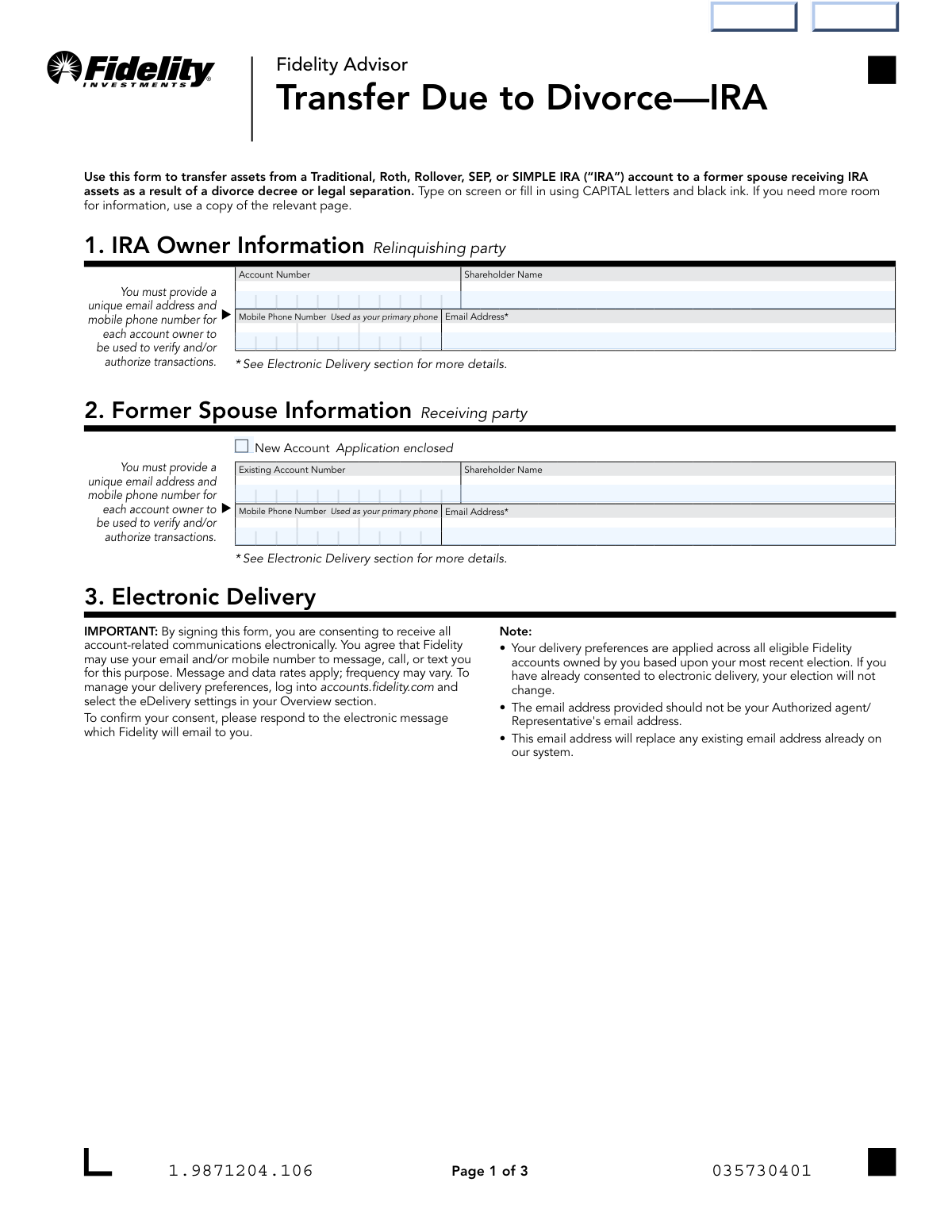
If your retirement assets are held within a Fidelity Advisor account rather than a self-managed retail account, you must use the specific Fidelity Advisor Transfer Due to Divorce—IRA Form. Unlike the standard retail forms, this version is tailored for accounts managed through a professional financial intermediary.
- Best for: Traditional, Roth, Rollover, SEP, or SIMPLE IRAs that are part of the Fidelity Advisor program.
- Note: This form focuses specifically on retirement accounts and may not be appropriate for those trying to move HSA or 529 funds.
Essential Requirements for All Forms
Regardless of which document you choose, the process requires specific supporting documentation to satisfy california court forms or other state-specific legal requirements:
- Divorce Decree: You will need a copy of the judge-signed decree or legal separation order clearly outlining the asset split.
- Dual Signatures: These forms typically require signatures from both the account owner (relinquishing party) and the ex-spouse (receiving party).
- Account Matching: The receiving party must generally have an account of the same type (e.g., Roth to Roth) to receive the transfer without tax consequences.
Form Comparison
| Form | Asset Types Covered | Account Platform | Key Requirements |
|---|---|---|---|
| Transfer Due to Divorce — IRA/HSA/529 | IRAs, HSAs, and 529 college savings accounts | Standard Fidelity retail accounts | Signatures from both parties and judge-signed divorce decree |
| Fidelity Advisor Transfer Due to Divorce—IRA Form | Traditional, Roth, Rollover, SEP, and SIMPLE IRAs | Fidelity Advisor managed accounts | Certified divorce decree and potentially a new account application |
| Transfer Due to Divorce — IRA/HSA/529 | Fidelity IRAs, HSAs, and 529 college savings plans | Standard Fidelity retail accounts | Court-ordered divorce decree or legal separation agreement |
| Fidelity Advisor Transfer Due to Divorce—IRA | Specifically Traditional, Roth, SEP, and SIMPLE IRAs | Fidelity Advisor managed accounts | IRS-compliant court order and letter of acceptance from custodian |
Tips for divorce forms
When transferring assets from an IRA, HSA, or 529 plan, the receiving account must typically be the same type of account to maintain tax-advantaged status. Verify that the recipient has an active account of the same classification before initiating the transfer to prevent the transaction from being rejected by the custodian.
Financial institutions require a copy of the judge-signed divorce decree or legal separation order to process asset divisions. Ensure you have a clear, digital copy of the specific pages outlining the division of these accounts to submit alongside your forms to avoid processing delays.
Most asset transfer forms require signatures from both the relinquishing account owner and the receiving party. Coordinating this step early can prevent long delays in processing, especially if the relationship between parties is strained or communication is limited.
To avoid unintended IRS penalties, ensure the form is filled out to indicate the transfer is pursuant to a divorce decree under Section 408(d)(6). Double-checking this classification ensures the movement of funds is treated as a non-reportable and non-taxable event.
Dealing with complex financial paperwork during a divorce is stressful, but AI-powered tools like Instafill.ai can complete these forms in under 30 seconds with high accuracy. Your sensitive financial data stays secure throughout the process, providing a massive time-saver for those managing multiple legal documents.
A single incorrect digit in an IRA or HSA account number can cause the entire transfer request to be flagged or denied. Cross-reference all account numbers against your latest financial statements before final submission to ensure a smooth transition of assets.
Frequently Asked Questions
These forms are designed to facilitate the court-ordered division and transfer of financial assets, such as IRAs, HSAs, and 529 plans, from one spouse to another following a divorce. Using these specific documents ensures that the transfer is recognized by the financial institution and complies with IRS regulations. This process helps prevent the transaction from being flagged as a taxable distribution or a premature withdrawal.
The Fidelity Advisor forms are specifically intended for accounts that are managed through a professional financial advisor or intermediary. If your IRA or investment account is self-managed directly through the institution, you should typically use the standard transfer forms. Checking your most recent account statement will usually indicate whether your account is managed by an advisor.
Withdrawing funds directly from an IRA or HSA to pay an ex-spouse can trigger significant income taxes and early withdrawal penalties. By using these formal transfer documents, the transaction is coded as a 'transfer incident to divorce' under IRS guidelines. This keeps the transfer non-reportable and non-taxable, preserving the tax-advantaged status of the assets for both parties.
Most financial institutions require a certified copy of the divorce decree or a legal separation agreement signed by a judge alongside the completed form. This documentation must explicitly state how the specific accounts are to be divided. In some cases, the receiving spouse may also need to provide a letter of acceptance if the funds are being moved to a different financial institution.
Yes, these forms generally require signatures from both the relinquishing party (the current account owner) and the receiving party (the ex-spouse). This ensures that both individuals acknowledge the transfer and provide the necessary account details for the transaction to be processed correctly. Some forms may also require a Medallion Signature Guarantee depending on the value of the assets being moved.
Yes, these forms are applicable for both final divorce decrees and formal legal separation orders. As long as there is a court-approved document outlining the division of assets, these forms can be used to execute the transfer. It is important that the legal order meets the requirements of the Internal Revenue Code to ensure the transfer remains tax-free.
Yes, you can use AI tools like Instafill.ai to complete these documents quickly and accurately. These tools can extract relevant data from your source documents and place it into the correct fields in under 30 seconds. This significantly reduces the risk of manual entry errors that could lead to the form being rejected by the financial institution.
Filling out these forms manually can be a slow process due to the precise account information and legal details required. However, using AI-powered services like Instafill.ai allows you to complete the entire process in less than 30 seconds. This speed helps you move forward with the asset division process without unnecessary delays.
These forms cover a wide range of IRA types, including Traditional, Roth, Rollover, SEP, and SIMPLE IRAs. It is important to select the form that matches the specific account type being divided to ensure compliance with the relevant tax laws. Each type of IRA may have slightly different reporting requirements during a divorce transfer.
If the receiving spouse does not have an existing account, they may need to open a new account of the same type to receive the assets. The transfer forms often include a section for new account applications or require information for an external custodian. Ensuring the accounts are of the same type is critical to maintaining the tax-deferred status of the funds.
Glossary
- Form Complexity Index
- Instafill’s 0–100 measure of how much effort a form takes to complete, calculated deterministically from the form’s own structure rather than estimated. It combines the number of fillable fields (the largest factor), how difficult those fields are to complete based on their type, the number of pages that contain fields, the amount of conditional “fill-only-if” logic, and how many sections the form is divided into, then adds modifiers for tables and repeating lists, bundled instruction pages, and dense page layouts. A higher score means the form is harder to fill out by hand. The forms in this category have a median Form Complexity Index of 42/100 (Basic). See exactly how it is calculated.
- Divorce Decree
- A formal court order that legally terminates a marriage and outlines the specific division of assets, debts, and other responsibilities between the two parties.
- Legal Separation
- A court-ordered arrangement where a married couple remains legally married but lives apart and follows specific legal terms regarding property division and financial support.
- Relinquishing Party
- The spouse who currently owns the financial account and is surrendering some or all of the assets to their former spouse as required by the court.
- IRC Section 408(d)(6)
- The specific internal revenue code regulation that allows for the tax-free transfer of IRA interests from one spouse to another during a divorce or legal separation.
- Non-reportable Event
- A financial transaction that does not need to be reported as a taxable distribution to the IRS, provided it is executed according to a valid divorce decree.
- Custodian
- The financial institution, such as Fidelity, that is responsible for holding the assets and ensuring the transfer complies with legal and tax regulations.
- HSA (Health Savings Account)
- A tax-advantaged savings account used for medical expenses that can be transferred between spouses during a divorce without incurring tax penalties.
- 529 College Savings Plan
- A tax-advantaged investment account designed for education savings that may be divided or transferred to an ex-spouse's account as part of a settlement.