Fill out education savings forms
with AI.
Education savings forms are the administrative backbone of tax-advantaged accounts designed to help families prepare for future college costs. These documents facilitate the management of 529 plans and other educational investment vehicles, ensuring that funds are correctly allocated for tuition, room and board, and other qualified expenses. Because these accounts carry specific tax implications, maintaining accurate documentation is essential for maximizing benefits and avoiding unintended penalties or tax liabilities.
By continuing, you acknowledge Instafill's Privacy Policy and agree to get occasional product update and promotional emails.
About education savings forms
Account owners—typically parents, grandparents, or guardians—need these forms during various stages of the education lifecycle. Whether you are opening a new account to begin a long-term investment or submitting a withdrawal request to pay for an upcoming semester, precise paperwork is required. Notable examples include beneficiary change forms, which allow families to transfer funds between siblings, and account maintenance forms used to update personal or banking information. Having these documents in order ensures that the transition from saving to spending is seamless when a student is ready to pursue their degree.
Navigating the complexities of financial paperwork can be time-consuming, but tools like Instafill.ai use AI to fill these forms in under 30 seconds while ensuring data is handled accurately and securely. This practical solution streamlines the process, allowing families to spend less time on manual data entry and more time focusing on their educational goals.
Every form on this page can be completed without typing. Instafill is form filling software that reads a PDF and fills it for you — including flat and scanned documents that carry no fillable fields at all.
Forms in This Category
The forms in this category have a median Form Complexity Index of 47/100 (Moderate), measured across 11 forms by field count, input difficulty, length, conditional logic and structure. See how it is calculated.
| Form Name | Pages | FCI | |
|---|---|---|---|
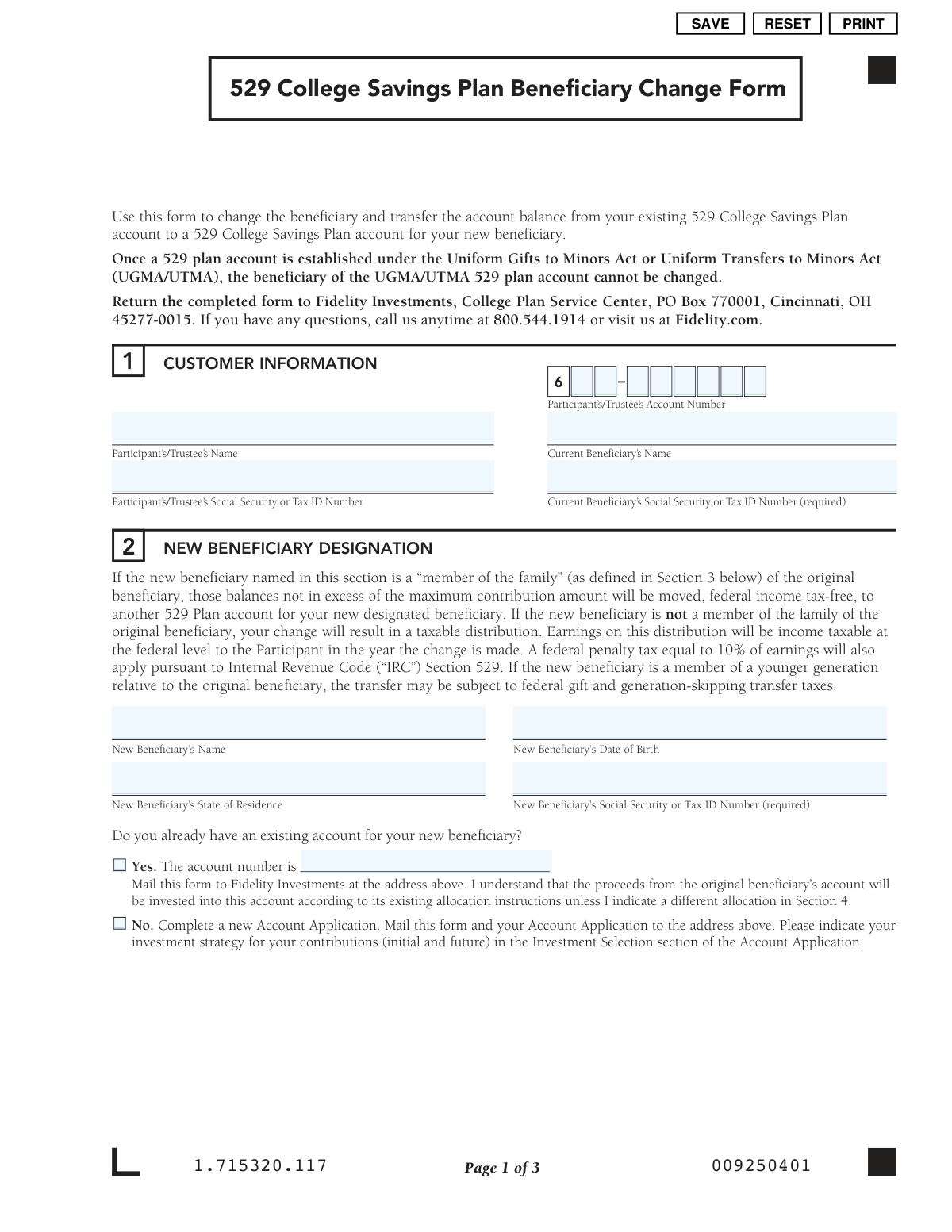
| 1. | 529 College Savings Plan Beneficiary Change Form | 1 | Basic 40 |
| 2. | Bright Directions 529 Beneficiary Change Form | 1 | Moderate 47 |
| 3. | CollegeAdvantage Direct 529 Savings Plan Beneficiary Change Form | 1 | Moderate 52 |
| 4. | Fidelity Institutional 529 College Savings Plan Beneficiary Change | 1 | – |
| 5. | Fidelity Institutional CHET Advisor 529 Plan New Account Application | 1 | Complex 65 |
| 6. | IAdvisor 529 Plan Certification of Authorized Individual(s) | 1 | Basic 33 |
| 7. | Merrill Lynch 529 College Savings Plan Withdrawal Request Form | 1 | Moderate 48 |
| 8. | Nest 529 Beneficiary Change Form | 1 | Basic 40 |
| 9. | NextGen 529 Client Direct Series Incoming Rollover Form | 1 | Basic 36 |
| 10. | TOMORROW'S SCHOLAR® Account Maintenance Form | 1 | Moderate 50 |
| 11. | Tomorrow's Scholar® Withdrawal Request Form | 1 | Basic 45 |
- Enterprise-grade security & data encryption
- 99%+ accuracy powered by AI
- 1,000+ forms from all industries
- Complete forms in under 60 seconds
How to Choose the Right Form
Navigating education savings accounts requires precision, as the wrong paperwork can lead to unintended tax consequences. To select the correct form, first identify your specific 529 plan provider and the type of transaction you need to perform.
Changing the Student (Beneficiary)
If you are transferring funds from one student to another (such as from an older sibling to a younger one), you must use a plan-specific beneficiary change form. These documents ensure the transfer meets IRS "member of the family" rules to avoid penalties. Choose the form that matches your provider:
- Bright Directions 529 Beneficiary Change Form
- Nest 529 Beneficiary Change Form
- CollegeAdvantage Direct 529 Savings Plan Beneficiary Change Form (for Ohio-based plans)
- Fidelity Institutional 529 College Savings Plan Beneficiary Change
- 529 College Savings Plan Beneficiary Change Form (for general use or smaller regional plans)
Accessing Funds or Moving Assets
When it is time to pay for tuition or qualified expenses, you will need a withdrawal request. Use the Merrill Lynch 529 College Savings Plan Withdrawal Request Form or the Tomorrow's Scholar® Withdrawal Request Form to initiate a distribution. If you are consolidating your education savings by moving money from a different 529 or a Coverdell account, use the NextGen 529 Client Direct Series Incoming Rollover Form.
Account Setup and Administration
For those just starting their savings journey or managing existing account details, look to these administrative forms:
- New Accounts: Use the Fidelity Institutional CHET Advisor 529 Plan New Account Application to open a new plan.
- Updates: The TOMORROW'S SCHOLAR® Account Maintenance Form is used for updating bank info, personal details, or designating a successor owner.
- Corporate Governance: If the account is owned by a corporation or partnership, the IAdvisor 529 Plan Certification of Authorized Individual(s) is required to designate who has the legal authority to manage the investments.
Form Comparison
| Form | Purpose | Primary Action | Key Requirements |
|---|---|---|---|
| 529 College Savings Plan Beneficiary Change Form | Transfers the account balance to a new designated beneficiary. | Beneficiary Change | Personal details and relationship status of both beneficiaries. |
| Bright Directions 529 Beneficiary Change Form | Updates the beneficiary for a Bright Directions 529 account. | Beneficiary Change | New beneficiary Social Security number and relationship to owner. |
| CollegeAdvantage Direct 529 Savings Plan Beneficiary Change Form | Reassigns Ohio CollegeAdvantage funds to an eligible family member. | Beneficiary Change | Selection of full or partial balance transfer amount. |
| Fidelity Institutional 529 College Savings Plan Beneficiary Change | Modifies the designated beneficiary for Fidelity-managed institutional plans. | Beneficiary Change | Participant signature and new beneficiary identification details. |
| Fidelity Institutional CHET Advisor 529 Plan New Account Application | Establishes a new CHET Advisor 529 tax-advantaged savings account. | Account Opening | Financial advisor information and initial investment selection. |
| IAdvisor 529 Plan Certification of Authorized Individual(s) | Appoints individuals authorized to manage corporate or group accounts. | Authorization | Corporate resolution or partnership agreement for account management. |
| Merrill Lynch 529 College Savings Plan Withdrawal Request Form | Requests distributions for education expenses or Roth IRA rollovers. | Fund Distribution | Withdrawal amount and specified payment delivery instructions. |
| Nest 529 Beneficiary Change Form | Changes the designated beneficiary for a NEST 529 plan. | Beneficiary Change | Proof of family relationship to avoid tax penalties. |
| NextGen 529 Client Direct Series Incoming Rollover Form | Consolidates assets from other 529 or Coverdell savings plans. | Asset Transfer | Current account statements and liquidation authorization details. |
| TOMORROW'S SCHOLAR® Account Maintenance Form | Updates personal, banking, or investment preferences on existing accounts. | Account Update | Current account number and specific modification requests. |
| Tomorrow's Scholar® Withdrawal Request Form | Initiates one-time or recurring distributions for educational expenses. | Fund Distribution | Tax withholding selection and recipient bank information. |
Tips for education savings forms
When submitting a beneficiary change form, ensure the new recipient is a qualified family member under IRS guidelines. Transferring funds to an unrelated individual may treat the change as a non-qualified withdrawal, potentially triggering federal income taxes and penalties.
When requesting a withdrawal, specify whether funds should be sent to the account owner, the student, or the school directly. Direct payments to educational institutions or the beneficiary can often simplify tax reporting and help clarify that funds were used for qualified higher education costs.
If you are moving assets between different 529 plans or from a Coverdell ESA, ensure the transaction is completed within the required 60-day window. Keep a copy of the liquidation statement from your previous provider to accurately document the principal and earnings portions of the rollover.
Use account maintenance forms to name a successor owner who will manage the account if the original owner passes away. Without a designated successor, the account could be subject to probate, which may delay the availability of funds for the student's tuition.
Incorrect identification numbers are the primary reason for form processing delays or rejections. Always cross-reference your latest account statement with your form entries to ensure that all Social Security and account numbers are perfectly accurate before signing.
AI-powered tools like Instafill.ai can complete these education savings forms in under 30 seconds with high accuracy. Your data stays secure during the process, providing a fast and reliable way to handle multiple beneficiary changes or withdrawal requests without manual data entry.
If you have consistent tuition or housing expenses, use maintenance forms to establish a Systematic Withdrawal Plan rather than filing individual requests. This automates the payment process for future semesters, saving you significant administrative time throughout the academic year.
Frequently Asked Questions
These forms are used to manage tax-advantaged accounts, primarily 529 plans, designed to help families save for future education costs. They allow account owners to perform essential tasks such as opening new accounts, changing beneficiaries, requesting withdrawals for tuition, and updating personal information.
Typically, the account owner or participant who established the plan is the person required to sign and submit these documents. In cases where the account is owned by a corporation or an investment club, a designated authorized individual must complete the forms on behalf of the organization.
You should use this form if the original student no longer needs the funds—perhaps because they have graduated or received a scholarship—and you wish to transfer the savings to another eligible family member. This process ensures the funds remain within a tax-advantaged environment while being redirected to a new recipient.
Generally, if the new beneficiary is a 'member of the family' as defined by the IRS, the transfer is not considered a taxable event. However, changing the beneficiary to someone outside of the family may be treated as a non-qualified withdrawal, which could trigger income taxes and additional penalties.
To access your savings, you must submit a Withdrawal Request Form to your specific plan provider, such as Merrill Lynch or Tomorrow's Scholar. You can typically choose to have the funds sent directly to the account owner, the beneficiary, or the educational institution to pay for qualified expenses like tuition and room and board.
This form authorizes the transfer of assets from one 529 plan or a Coverdell Education Savings Account into a different 529 plan. It is a vital document for consolidating multiple savings accounts or moving funds to a plan with more favorable investment options or lower fees.
Yes, AI tools like Instafill.ai can fill out these forms in under 30 seconds by accurately extracting data from your source documents and placing it into the required fields. This technology helps ensure that complex financial forms are completed quickly and with high accuracy.
While manual entry can take significant time and effort, using an AI-powered service like Instafill.ai allows you to complete these forms in less than 30 seconds. Once filled, you simply need to review, sign, and submit the document to your plan administrator for processing.
These forms generally require the account owner's identification details, the specific account number, and clear instructions on what needs to be updated. This might include changing your bank account for contributions, updating your mailing address, or designating a successor owner for the account.
This form is used by non-individual account owners, such as corporations or partnerships, to legally name the people permitted to manage the account. It establishes who has the authority to execute trades, request withdrawals, and make other critical financial decisions for the 529 plan.
Under certain conditions, account owners can now use withdrawal or rollover forms to transfer unused 529 funds into a Roth IRA for the beneficiary. This process is subject to specific lifetime limits and account age requirements, so it is important to check the current IRS guidelines before filing.
Glossary
- Form Complexity Index
- Instafill’s 0–100 measure of how much effort a form takes to complete, calculated deterministically from the form’s own structure rather than estimated. It combines the number of fillable fields (the largest factor), how difficult those fields are to complete based on their type, the number of pages that contain fields, the amount of conditional “fill-only-if” logic, and how many sections the form is divided into, then adds modifiers for tables and repeating lists, bundled instruction pages, and dense page layouts. A higher score means the form is harder to fill out by hand. The forms in this category have a median Form Complexity Index of 47/100 (Moderate). See exactly how it is calculated.
- 529 Plan
- A tax-advantaged savings plan sponsored by a state or state agency designed to encourage saving for future education costs for a designated beneficiary.
- Beneficiary
- The individual for whom the education savings account is established and who will use the funds to pay for their qualified education expenses.
- Qualified Higher Education Expenses (QHEE)
- Specific costs such as tuition, fees, books, and room and board that are eligible for tax-free withdrawals from a 529 or other education savings account.
- Rollover
- The process of moving funds from one education savings account to another, such as from a Coverdell ESA to a 529 plan, without incurring taxes or penalties.
- Successor Owner
- A person named on the account who will take over management and ownership of the funds if the primary account owner dies or becomes incapacitated.
- Member of the Family
- An IRS-defined group of relatives—including siblings, children, and cousins—to whom a beneficiary change can be made without triggering a taxable event.
- Non-qualified Withdrawal
- Any distribution from an education savings plan that is not used for qualified expenses, which is generally subject to income tax and a 10% federal penalty.
- Systematic Withdrawal Plan (SWP)
- A feature that allows account owners to schedule automatic, recurring payments from their account to a school or individual at regular intervals.