Fill out electronic funds transfer forms
with AI.
Electronic Funds Transfer (EFT) forms are the backbone of modern financial transactions, enabling the secure movement of money between bank accounts without the need for paper checks. These documents, which include ACH forms and payment authorization forms, are essential for establishing direct deposits, recurring payments, and wire transfers. By formalizing the agreement between a payer, a payee, and their respective financial institutions, these forms ensure that sensitive banking data is handled correctly and that funds reach their destination reliably.
By continuing, you acknowledge Instafill's Privacy Policy and agree to get occasional product update and promotional emails.
About electronic funds transfer forms
This category of banking forms is frequently used by a wide range of individuals and entities. For instance, healthcare providers often use the CMS-588 to receive Medicare reimbursements, while investors might use a Schwab MoneyLink or Fidelity EFT authorization to move funds between brokerage and personal accounts. Whether you are a business owner setting up vendor payments or an individual automating your monthly savings, these forms provide the legal and technical framework required to link different financial platforms and automate your cash flow.
Completing these forms accurately is critical, as a single digit error in a routing or account number can lead to significant delays or failed transfers. Tools like Instafill.ai use AI to fill these forms in under 30 seconds, ensuring that your data is handled securely and accurately. This technology streamlines the process by placing your information precisely into the PDF, saving time for both individuals and administrative professionals who handle high volumes of financial paperwork.
Every form on this page can be completed without typing. Instafill is form filling software that reads a PDF and fills it for you — including flat and scanned documents that carry no fillable fields at all.
Forms in This Category
The forms in this category have a median Form Complexity Index of 41/100 (Basic), measured across 9 forms by field count, input difficulty, length, conditional logic and structure. See how it is calculated.
- Enterprise-grade security & data encryption
- 99%+ accuracy powered by AI
- 1,000+ forms from all industries
- Complete forms in under 60 seconds
How to Choose the Right Form
Choosing the right Electronic Funds Transfer (EFT) form depends primarily on whether you are setting up personal investment transfers, managing healthcare reimbursements, or authorizing a general business payment.
Healthcare and Government Reimbursements
If you are a medical provider or supplier, you must use specific government-mandated forms to receive electronic payments:
- Form CMS-588, Electronic Funds Transfer (EFT) Authorization Agreement: Use this for standard Medicare enrollment to ensure reimbursements are deposited directly into your business account.
- Form CMS-588 for Accountable Care Organizations: Select this version specifically if you are part of an ACO participating in Medicare shared savings programs.
- eMedNY Electronic Funds Transfer Authorization Form (EMEDNY-701101): This is the required document for New York State Medicaid providers to authorize direct deposits.
Investment and Brokerage Accounts
To link your brokerage account with a personal bank account for withdrawals, deposits, or recurring transfers, choose the form associated with your specific financial institution:
- Schwab MoneyLink® Electronic Funds Transfer Form: Use this for Charles Schwab accounts to establish standing authorizations or on-request transfers.
- Fidelity Electronic Funds Transfer (EFT) Authorization: Select this or the Fidelity Investments Electronic Funds Transfer (EFT) Authorization Form to automate transfers between Fidelity and external banks.
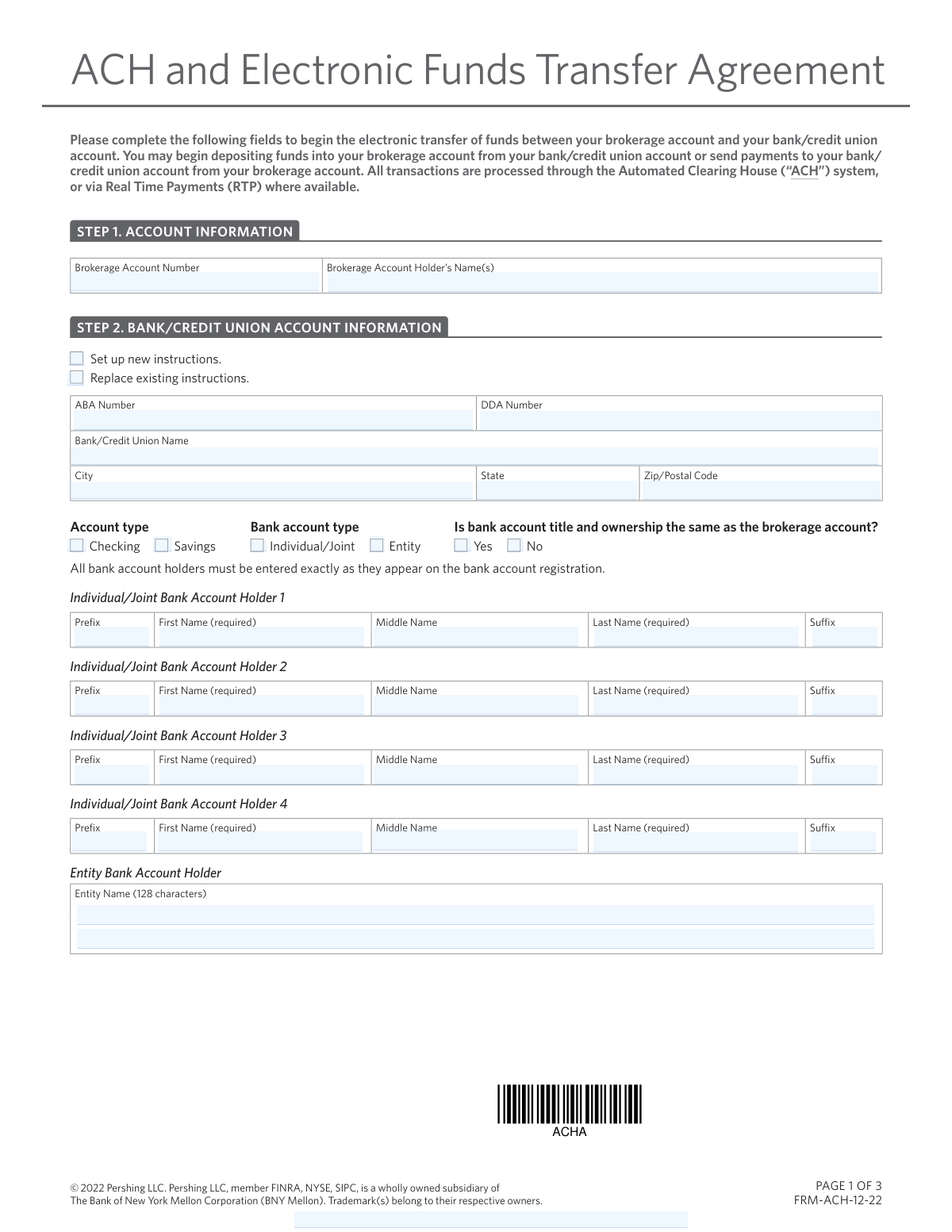
- ACH and Electronic Funds Transfer Instructions and Agreement: Choose this form if you hold a brokerage account through Pershing LLC to establish ACH and Real Time Payment (RTP) instructions.
General Business and Payment Authorization
If you are not working with a major brokerage or a government healthcare program, you may need a more general document:
- Electronic Funds Transfer (EFT) Form: This is a versatile template used to provide routing and account numbers to any organization that needs to send you payments directly, effectively replacing paper checks.
When filling out any of these forms, ensure you have your bank’s routing number and your account number ready. Most forms in this category also require a voided check or a formal bank letter to verify the account details.
Form Comparison
| Form | Primary Purpose | Target Entity | Key Requirements |
|---|---|---|---|
| ACH and Electronic Funds Transfer Instructions and Agreement | Links brokerage accounts with bank accounts for ACH and RTP payments. | Pershing LLC brokerage account holders. | Requires brokerage and external bank account details with owner signatures. |
| CMS-588 Electronic Funds Transfer (EFT) Authorization Agreement Checklist | Ensures all documentation is complete for Medicare EFT enrollment. | Medicare providers, clinics, and sole proprietors. | Must include a voided check or official bank letter for verification. |
| Electronic Funds Transfer (EFT) Authorization | Sets up standing instructions for moving money between Fidelity and banks. | Fidelity account holders managing personal or third-party transfers. | Requires external bank routing numbers and account holder authorization. |
| Electronic Funds Transfer (EFT) Form | General authorization for an organization to send direct electronic payments. | Individuals or businesses receiving payments from a specific entity. | Standard banking details including routing and account numbers are required. |
| eMedNY Electronic Funds Transfer Authorization Form (EMEDNY-701101) | Authorizes direct deposit of New York Medicaid payments to providers. | New York State Medicaid providers and group practices. | Requires checking or savings account details for secure Medicaid reimbursement. |
| Fidelity Investments Electronic Funds Transfer (EFT) Authorization Form | Automates routine transfers between Fidelity accounts and external financial institutions. | Fidelity personal and eligible retirement account holders. | May require a Medallion signature guarantee for certain transfer types. |
| Form CMS-588, Electronic Funds Transfer (EFT) Authorization Agreement | Mandatory form for receiving Medicare reimbursements directly into a bank. | Healthcare providers and suppliers enrolling with Medicare. | Requires authorized official signature and bank account verification documents. |
| Form CMS-588, Electronic Funds Transfer (EFT) Authorization Agreement for Accountable Care Organizations | Facilitates electronic payment of shared savings for Medicare programs. | Accountable Care Organizations (ACOs) participating in Medicare. | Includes legal entity info, TIN, and specific tax status details. |
| Schwab MoneyLink® Electronic Funds Transfer Form | Establishes standing authorization for electronic transfers to or from Schwab. | Charles Schwab clients and authorized investment advisors. | Valid for one-time or recurring transfers from U.S. bank accounts. |
Tips for electronic funds transfer forms
The most frequent cause for EFT rejection is a simple typo in the banking details. Always verify these digits against a voided check or an official bank statement to ensure your funds are routed to the correct destination.
Many EFT forms, such as the CMS-588, require an accompanying voided check or a bank letter on official letterhead. Having these documents scanned and ready for upload will prevent significant delays in the approval of your authorization.
AI-powered tools like Instafill.ai can complete these complex banking forms in under 30 seconds with high accuracy. This is a massive time-saver for those managing multiple accounts, and your sensitive data stays completely secure during the process.
Ensure the person signing the form is the authorized official recognized by the institution or agency. Note that some brokerage forms may require a Medallion Signature Guarantee for high-value transfers, which must be obtained in person at a financial institution.
Be specific about whether you are authorizing a one-time transfer, a recurring payment, or a standing authorization for future use. Mislabeling the transfer type can lead to unintended recurring withdrawals or the failure of a necessary one-time payment.
Mistakenly selecting 'Checking' instead of 'Savings' (or vice versa) is a common error that causes electronic transfers to bounce. Confirm the specific account classification with your bank before finalizing the form to ensure seamless processing.
Always save a copy of the completed authorization form and any submission receipts for your records. These documents are essential for troubleshooting with your bank if a transfer is delayed or if you need to update your banking instructions later.
Frequently Asked Questions
These forms serve as a legal authorization for a financial institution or organization to move money electronically between bank accounts. They are commonly used to set up direct deposits, recurring bill payments, or to link brokerage accounts with personal checking accounts for seamless transfers.
Healthcare providers, clinics, and suppliers should use Form CMS-588, the Electronic Funds Transfer (EFT) Authorization Agreement. This form is mandatory for Medicare enrollment and ensures that reimbursements are deposited directly into the provider's business bank account.
EFT is a broad umbrella term that covers all types of electronic money transfers, while ACH (Automated Clearing House) refers to a specific network used for domestic batch processing. In practice, most banking and payment authorization forms use these terms interchangeably when setting up direct deposits or withdrawals.
Yes, AI tools like Instafill.ai can fill out these complex financial forms in under 30 seconds. The AI accurately extracts your banking and personal data from source documents and places it into the correct fields, ensuring the form is legible and error-free.
Most institutions require a voided check or an official bank letter on the financial institution's letterhead to verify the routing and account numbers. Providing this documentation is a standard security measure to prevent errors in funds routing and to protect against fraud.
To link these accounts, you will need to fill out a specific authorization form, such as the Schwab MoneyLink® form or the Fidelity EFT Authorization form. These documents establish standing instructions, allowing you to move money back and forth without needing to submit a new request every time.
While manual entry can take 10 to 15 minutes and carries the risk of typos in critical account numbers, using an AI-powered service like Instafill.ai can complete the process in less than 30 seconds. This technology automates the data entry process by accurately mapping your information to the PDF fields.
A Medallion signature guarantee is a special certification stamp provided by a financial institution that confirms the validity of a signature. While not required for all EFT forms, some brokerage firms like Fidelity may require it for specific types of third-party transfers or high-value accounts.
The form must be signed by an authorized official, such as a CEO, CFO, or a legally designated representative who has the authority to manage the organization's finances. For government-related forms like the CMS-588, the signer must typically match the individual listed on the entity's official enrollment records.
Yes, most electronic funds transfer forms include checkboxes to indicate if you are establishing a new account, changing existing bank information, or canceling an authorization. It is generally recommended to keep your old account open until you have confirmed that the first transfer has successfully reached the new account.
Glossary
- Form Complexity Index
- Instafill’s 0–100 measure of how much effort a form takes to complete, calculated deterministically from the form’s own structure rather than estimated. It combines the number of fillable fields (the largest factor), how difficult those fields are to complete based on their type, the number of pages that contain fields, the amount of conditional “fill-only-if” logic, and how many sections the form is divided into, then adds modifiers for tables and repeating lists, bundled instruction pages, and dense page layouts. A higher score means the form is harder to fill out by hand. The forms in this category have a median Form Complexity Index of 41/100 (Basic). See exactly how it is calculated.
- ACH (Automated Clearing House)
- A national electronic network used by financial institutions to process batches of credit and debit transactions, such as direct deposits and automated bill payments.
- ABA Routing Number
- A nine-digit code printed on checks that identifies a specific bank or financial institution during an electronic funds transfer.
- Standing Instructions
- A permanent authorization kept on file that allows a financial institution to execute recurring or on-demand transfers between accounts without requiring new paperwork for every transaction.
- Medallion Signature Guarantee
- A special certification stamp used by financial institutions to verify that a signature is authentic and that the signer has the legal authority to transfer securities or large sums of money.
- PECOS (Provider Enrollment, Chain, and Ownership System)
- The official online Medicare enrollment system where healthcare providers must be registered before they can authorize electronic reimbursements via the CMS-588 form.
- RTP (Real-Time Payments)
- A modern banking network that clears and settles funds instantly, 24/7, providing an alternative to the traditional multi-day ACH settlement process.
- ACO (Accountable Care Organization)
- A group of doctors, hospitals, and other healthcare providers who come together voluntarily to give coordinated high-quality care to their Medicare patients.
- NPI (National Provider Identifier)
- A unique 10-digit identification number issued to healthcare providers in the United States, which is required on most government-related electronic payment forms.