Fill out financial transfer forms
with AI.
Financial transfer forms are the essential paperwork required to move assets between financial institutions, update account ownership, or consolidate investment portfolios. Whether you are shifting funds from a 529 plan to a new brokerage or initiating a trustee-to-trustee transfer for an inherited IRA, these documents provide the legal authorization necessary to ensure assets are moved securely and titled correctly. Because these forms often involve sensitive tax-advantaged accounts, accurate documentation is vital to avoid unnecessary penalties or processing delays.
By continuing, you acknowledge Instafill's Privacy Policy and agree to get occasional product update and promotional emails.
About financial transfer forms
Individuals typically encounter these forms during significant life transitions or when seeking better management of their wealth. For instance, a beneficiary may need to move assets into an Inherited IRA, or a young adult might need to take ownership of a custodial account after reaching the age of majority. Investors also use these forms to move assets "in-kind" between major firms like J.P. Morgan or TD Ameritrade, allowing them to consolidate their holdings without the need to liquidate their positions first. Tools like Instafill.ai use AI to fill these forms in under 30 seconds, handling the data accurately and securely to save you time on administrative tasks.
By streamlining the data entry process, you can ensure that complex requirements—such as specific delivery instructions for mutual funds or securities—are met with precision. This allows for a smoother transition of your financial legacy and investment strategy, ensuring your assets are positioned exactly where they need to be with minimal manual effort.
Every form on this page can be completed without typing. Instafill is form filling software that reads a PDF and fills it for you — including flat and scanned documents that carry no fillable fields at all.
Forms in This Category
The forms in this category have a median Form Complexity Index of 47/100 (Moderate), measured across 10 forms by field count, input difficulty, length, conditional logic and structure. See how it is calculated.
| Form Name | Pages | FCI | |
|---|---|---|---|
| 1. | 529 Plan Account Transfer Form | 1 | Basic 34 |
| 2. | Computershare Alternative Investment Product Transfer Request | 1 | Complex 65 |
| 3. | Custodial Account – Transfer of Ownership Form | 1 | Basic 30 |
| 4. | Inherited IRA Transfer of Assets/ Direct Rollover Form | 1 | Basic 40 |
| 5. | Inherited IRA Transfer of Assets/Direct Rollover | 1 | Basic 45 |
| 6. | J.P. Morgan Securities LLC Account Transfer Request | 1 | Complex 64 |
| 7. | Outgoing Partial Asset/Gifting Transfer Authorization Letter | 1 | Moderate 47 |
| 8. | RL360 Asset Transfer Form | 1 | – |
| 9. | TD Ameritrade Institutional Account Transfer Form | 1 | Moderate 52 |
| 10. | TIAA Brokerage Incoming Managed Account Transfer Form (F11319) | 1 | – |
- Enterprise-grade security & data encryption
- 99%+ accuracy powered by AI
- 1,000+ forms from all industries
- Complete forms in under 60 seconds
How to Choose the Right Form
Selecting the correct financial transfer form depends primarily on the type of account you are moving, the reason for the transfer, and the specific institution receiving the assets. Use the categories below to identify the document that fits your needs.
Retirement and Inheritance Transfers
If you have recently inherited retirement assets and need to move them into a beneficiary account, look for forms specific to your financial provider. Use the Inherited IRA Transfer of Assets/ Direct Rollover Form if you are moving funds to Voya Investment Management, or the Inherited IRA Transfer of Assets/Direct Rollover for transfers to Impax. These forms ensure that the assets remain correctly titled to comply with IRS inheritance regulations.
General Brokerage and Asset Consolidation
When consolidating multiple portfolios into a single managed account, choose the form corresponding to your new firm:
- J.P. Morgan Securities LLC Account Transfer Request: Use this to move cash or securities from another institution into a J.P. Morgan account.
- TD Ameritrade Institutional Account Transfer Form: Select this for moving stocks, bonds, or mutual funds into a TD Ameritrade account.
- TIAA Brokerage Incoming Managed Account Transfer Form (F11319): Best for clients moving external investments into a TIAA-managed brokerage account.
- RL360 Asset Transfer Form: Use this if you need to grant Power of Attorney to RL360 to facilitate the transfer of securities into your investment plan.
Education and Custodial Accounts
For transfers involving minors or education savings, specific legal documents are required:
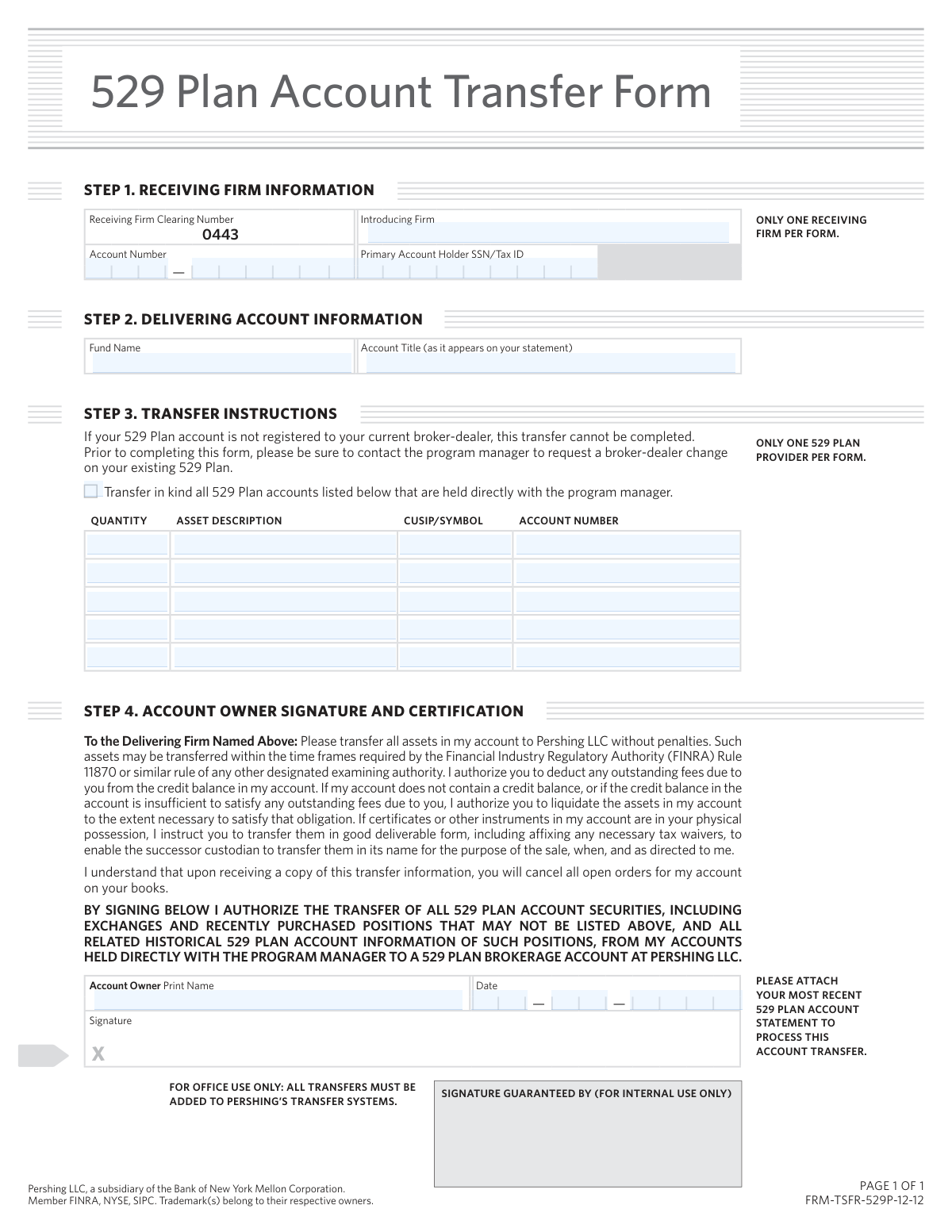
- 529 Plan Account Transfer Form: Use this to authorize the transfer of assets from an existing college savings plan to a Pershing LLC brokerage account.
- Custodial Account – Transfer of Ownership Form: Choose this when a minor reaches the age of majority and needs to transfer assets from a UTMA/UGMA or Minor IRA into their own name.
Specialized Transfers and Gifting
If you are not performing a standard account-to-account move, consider these specialized options:
- Outgoing Partial Asset/Gifting Transfer Authorization Letter: Use this Merrill-specific form to gift securities or move a portion of a non-retirement account to another institution without liquidating assets.
- Computershare Alternative Investment Product Transfer Request: Select this (form E426UTR) for transferring stocks or alternative investments to a new owner due to a private sale, gift, or legal name change.
Form Comparison
| Form | Primary Purpose | Asset Type | Typical Scenario |
|---|---|---|---|
| 529 Plan Account Transfer Form | Authorize transfer of education savings to a Pershing account | 529 college savings plan assets | Consolidating education funds or switching investment firms |
| Computershare Alternative Investment Product Transfer Request | Formally request the transfer of securities to a new owner | Stocks or alternative investment products | Private sales, gifting, inheritances, or legal name changes |
| Custodial Account – Transfer of Ownership Form | Move assets to a former minor reaching legal age | UTMA/UGMA, Minor IRA, or Minor Roth IRA | Terminating custodianship once the minor reaches adulthood |
| Inherited IRA Transfer of Assets/ Direct Rollover Form | Move inherited retirement funds into a Voya Inherited IRA | Deceased participant's retirement plan assets | Beneficiaries managing and retitling inherited retirement accounts |
| Inherited IRA Transfer of Assets/Direct Rollover | Facilitate movement of beneficiary assets into an Impax IRA | Retirement account assets from a deceased participant | Managing inherited funds according to legal and financial regulations |
| J.P. Morgan Securities LLC Account Transfer Request | Initiate asset transfer from external firms into J.P. Morgan | Cash, securities, or mutual funds | Consolidating multiple investment accounts under one provider |
| Outgoing Partial Asset/Gifting Transfer Authorization Letter | Authorize partial transfer or gifting of assets from Merrill | Non-retirement brokerage assets (e.g., CMA) | Gifting specific securities in-kind without liquidating them |
| RL360 Asset Transfer Form | Grant Power of Attorney to transfer assets into plan | Stocks, shares, or other financial securities | Authorizing the institution to manage the transfer process |
| TD Ameritrade Institutional Account Transfer Form | Request transfer of assets to TD Ameritrade Institutional | Stocks, bonds, or mutual funds | Consolidating external brokerage or bank assets into one account |
| TIAA Brokerage Incoming Managed Account Transfer Form (F11319) | Move external investments into a TIAA managed account | Stocks, mutual funds, or retirement plan assets | Transitioning to a managed portfolio for professional oversight |
Tips for financial transfer forms
Double-check account numbers and the exact name of the delivering institution before submitting. A single transposed digit or an incorrect branch code can cause a transfer to be rejected, leading to weeks of processing delays.
Decide if you want to transfer your actual stocks and mutual funds 'in-kind' or sell them and move the cash. Moving in-kind avoids potential tax consequences from selling, but you must ensure the receiving firm is capable of holding those specific assets.
AI-powered tools like Instafill.ai can complete these financial transfer forms in under 30 seconds with high accuracy. Your sensitive financial data stays secure during the process, providing a practical and fast solution for managing multiple account transfers.
Ensure the name on your new account matches the name on the existing account exactly. If one account is listed as 'John D. Smith' and the other as 'John Smith,' the transfer may be flagged or denied by the sending firm's compliance department.
Keep a copy of your most recent statement from the delivering firm nearby while filling out the transfer request. This ensures you have the correct clearing numbers and asset descriptions required for a successful, error-free move.
Some high-value transfers or specific brokerage firms require a Medallion Signature Guarantee rather than a standard notary. Review the form's instructions early so you have time to visit a participating financial institution to obtain this specialized stamp.
When dealing with inherited retirement assets, ensure the form correctly identifies the deceased participant and your relationship to them. Proper titling is essential to maintain the tax-deferred status of the account and to comply with IRS distribution rules.
Frequently Asked Questions
Financial transfer forms are legal documents used to authorize the movement of assets—such as cash, stocks, bonds, or mutual funds—from one financial institution or account to another. They ensure that the change in custodianship or ownership is documented correctly for legal, tax, and regulatory purposes.
The specific form you need depends on the destination of the assets and the type of account involved. For example, if you are moving funds into a college savings plan, you would use a 529 Plan Transfer Form, whereas moving assets from a deceased relative's account would require an Inherited IRA Transfer form.
Using a formal transfer form allows for 'in-kind' transfers or direct rollovers, which can help you avoid liquidating assets or triggering unnecessary tax penalties. This is particularly important for retirement or tax-advantaged accounts where a manual withdrawal could be viewed as a taxable distribution.
Yes, you can use AI tools like Instafill.ai to complete these forms quickly and accurately. The AI can extract data from your current account statements and automatically place it into the correct fields on the transfer form, ensuring all account numbers and institution details are precise.
When using AI-powered services, you can complete complex financial transfer forms in under 30 seconds. The technology handles the data entry by pulling information from your source documents, which significantly reduces the time spent on manual typing and verification.
Most forms require your personal identification, the account number at the delivering institution, the name of the firm currently holding the assets, and a detailed list of the specific securities or the total cash amount you wish to move. You will also need the details of the receiving account.
Generally, the receiving institution initiates the transfer once they receive your completed and signed form. You submit the paperwork to the company where you want the assets to go, and they coordinate with the delivering firm to move the assets on your behalf.
An 'in-kind' transfer means your investments, such as specific stocks or mutual funds, are moved exactly as they are without being sold. This allows you to maintain your market positions and avoid the transaction costs or tax consequences associated with selling and rebuying securities.
Many financial institutions require a Medallion Signature Guarantee for high-value transfers or when changing account ownership. This is a special certification stamp provided by a bank or brokerage that confirms the signature on the form is genuine and the signer has the authority to move the assets.
When a minor reaches the legal age of majority, a Transfer of Ownership form is typically used to move the assets from the custodian's control into a new account in the former minor's name. This officially terminates the custodianship and gives the young adult full control over the assets.
While direct transfers between similar account types (like a 401k to an IRA) are usually non-taxable, errors in paperwork can lead to tax issues. It is important to use the correct form and ensure it is filled out accurately to maintain the tax-deferred status of your investments.
Yes, most institutions provide specific forms or sections within a form for 'partial' transfers. This allows you to specify exactly which securities or how much cash you want to move while keeping the remaining assets in the original account.
Glossary
- Form Complexity Index
- Instafill’s 0–100 measure of how much effort a form takes to complete, calculated deterministically from the form’s own structure rather than estimated. It combines the number of fillable fields (the largest factor), how difficult those fields are to complete based on their type, the number of pages that contain fields, the amount of conditional “fill-only-if” logic, and how many sections the form is divided into, then adds modifiers for tables and repeating lists, bundled instruction pages, and dense page layouts. A higher score means the form is harder to fill out by hand. The forms in this category have a median Form Complexity Index of 47/100 (Moderate). See exactly how it is calculated.
- Delivering Firm
- The financial institution, such as a bank or brokerage, that currently holds your assets and will be sending them to a new account provider.
- In-Kind Transfer
- A process where assets like stocks, bonds, or mutual funds are moved to a new account exactly as they are, without being sold for cash first.
- Trustee-to-Trustee Transfer
- A method of moving retirement funds directly between two financial institutions so that the account holder never receives the money, preventing tax penalties.
- Direct Rollover
- The movement of retirement savings from an employer-sponsored plan, like a 401(k), directly into an IRA or another eligible retirement plan.
- Medallion Signature Guarantee
- A special certification stamp used by financial institutions to confirm that a signature is authentic and the person has the legal authority to transfer securities.
- Inherited IRA
- An account opened to receive assets from a deceased person's retirement plan, which is subject to specific tax and withdrawal rules for beneficiaries.
- UTMA/UGMA
- Acronyms for the Uniform Transfers to Minors Act and Uniform Gifts to Minors Act, which allow adults to manage assets for a minor until they reach adulthood.
- Age of Majority
- The legal age, usually 18 or 21 depending on the state, at which a minor becomes an adult and gains full control over their custodial account assets.