Fill out IRA transfer forms
with AI.
IRA transfer forms are the essential paperwork required to move retirement assets between financial institutions or account types without triggering unintended tax penalties. These documents facilitate trustee-to-trustee transfers or direct rollovers, ensuring the IRS recognizes the movement of funds as a non-taxable event. Properly executed forms preserve the tax-advantaged status of your savings, whether you are consolidating multiple accounts for easier management or moving funds to a new custodian like Fidelity, TIAA, or Merrill.
By continuing, you acknowledge Instafill's Privacy Policy and agree to get occasional product update and promotional emails.
About IRA transfer forms
Individuals typically encounter these forms during major life transitions or when optimizing their financial strategy. For instance, beneficiaries often use specific transfer instruction forms to move assets from a deceased participant's account into an Inherited IRA. Additionally, these documents are critical in legal separations; specialized divorce financial forms allow for the equitable division of retirement assets between former spouses as stipulated by a court decree. In these sensitive situations, accurate documentation is vital to comply with legal requirements and avoid unnecessary tax liabilities.
Navigating the technical details of these documents can be overwhelming, but tools like Instafill.ai use AI to fill these forms in under 30 seconds with high accuracy and security. This allows you to handle complex retirement paperwork efficiently, ensuring your data is processed correctly while saving significant time during the administrative process.
Every form on this page can be completed without typing. Instafill is form filling software that reads a PDF and fills it for you — including flat and scanned documents that carry no fillable fields at all.
Forms in This Category
The forms in this category have a median Form Complexity Index of 42/100 (Basic), measured across 9 forms by field count, input difficulty, length, conditional logic and structure. See how it is calculated.
| Form Name | Pages | FCI | |
|---|---|---|---|
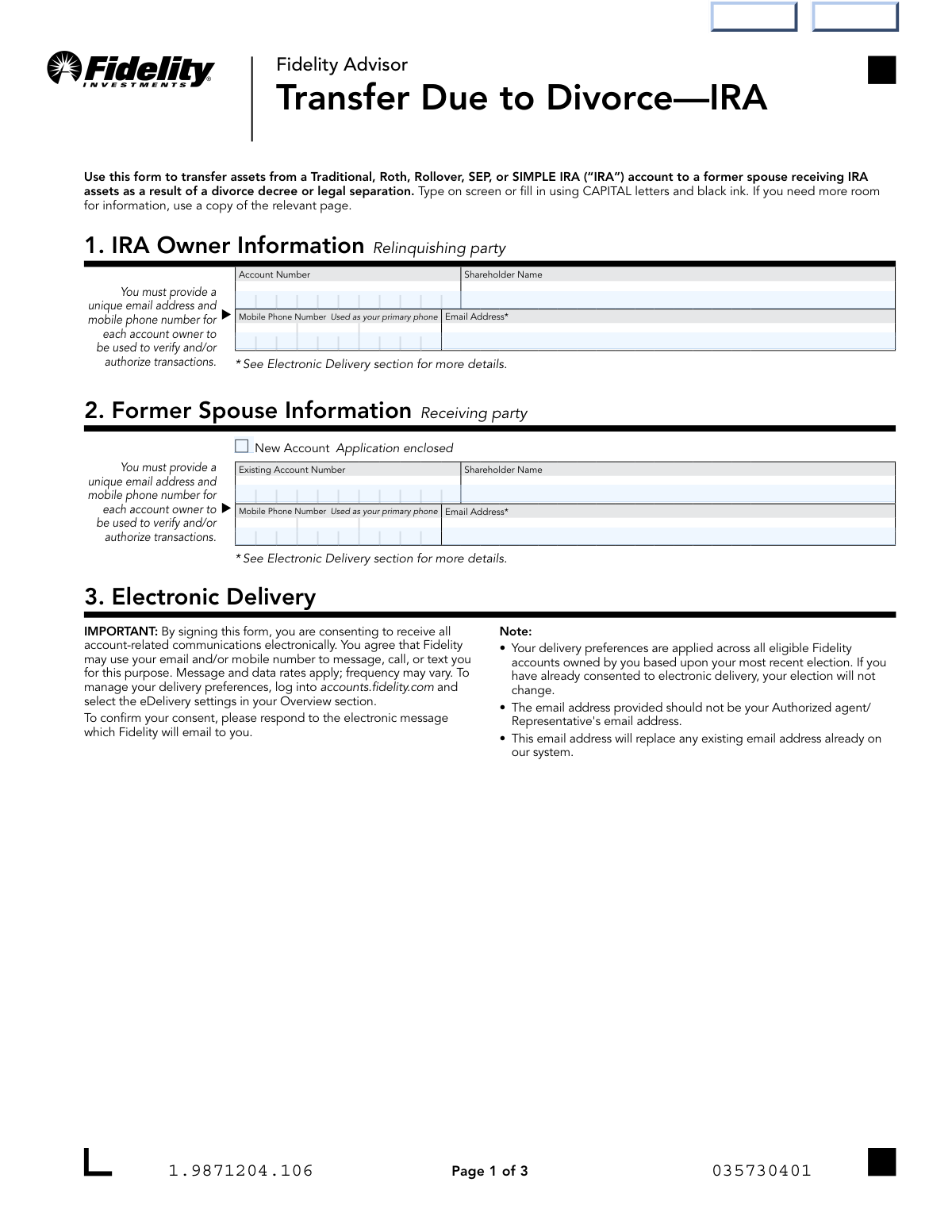
| 1. | Fidelity Advisor Transfer Due to Divorce—IRA | 4 | Basic 42 |
| 2. | Frequently Asked Questions: Transferring to an Empower Premier IRA | 1 | – |
| 3. | Inherited IRA Transfer of Assets/ Direct Rollover Form | 1 | Basic 40 |
| 4. | Inherited IRA Transfer of Assets/Direct Rollover | 1 | Basic 45 |
| 5. | IRA/IRRA®/Roth IRA/SEP/SRA Divorce Transfer Instruction Form | 1 | Basic 33 |
| 6. | Merrill Inherited IRA Transfer Instruction Form | 1 | Complex 68 |
| 7. | TIAA IRA Transfer or Rollover Authorization | 1 | – |
| 8. | TIAA Trust, N.A. Private Asset Management, Request for a Direct Transfer From IRA Contracts | 1 | – |
| 9. | Transfer Due to Divorce — IRA/HSA/529 | 1 | Basic 33 |
- Enterprise-grade security & data encryption
- 99%+ accuracy powered by AI
- 1,000+ forms from all industries
- Complete forms in under 60 seconds
How to Choose the Right Form
Selecting the correct IRA transfer form depends primarily on the life event triggering the move—such as a divorce, an inheritance, or a simple change in financial providers. Using the right form ensures the transaction remains non-taxable and compliant with IRS regulations.
Transfers Due to Divorce or Legal Separation
If you are dividing retirement assets as part of a court-ordered settlement, you must use a form specific to divorce to avoid early withdrawal penalties.
- Fidelity Accounts: Use the Fidelity Advisor Transfer Due to Divorce—IRA or the Fidelity Advisor Transfer Due to Divorce—IRA Form for standard retirement accounts. If you also need to move health savings or education funds, choose the Transfer Due to Divorce — IRA/HSA/529 form.
- Merrill Lynch Accounts: Use the IRA/IRRA®/Roth IRA/SEP/SRA Divorce Transfer Instruction Form to authorize the movement of assets to a former spouse’s account.
Inherited IRA Transfers
When you are the beneficiary of a deceased account holder, you must move assets into a properly titled Inherited IRA.
- Voya Investment Management: Select the Inherited IRA Transfer of Assets/ Direct Rollover Form to move funds from a retirement plan into a Voya Inherited IRA.
- Impax: Use the Inherited IRA Transfer of Assets/Direct Rollover form for beneficiary transfers to Impax accounts.
- Merrill: The Merrill Inherited IRA Transfer Instruction Form is required for beneficiaries to establish and fund a new Inherited IRA using assets from a decedent’s account.
General Transfers and Consolidation
If you are simply moving your own funds between institutions to consolidate your savings, look for general authorization forms.
- TIAA: Use the TIAA IRA Transfer or Rollover Authorization to bring outside assets into TIAA. To move funds from an existing TIAA Private Asset Management account to another provider, use the TIAA Trust, N.A. Private Asset Management, Request for a Direct Transfer From IRA Contracts.
- Empower: If you are transitioning to the Empower platform, review the Frequently Asked Questions: Transferring to an Empower Premier IRA to understand the specific requirements for your account type.
Form Comparison
| Form | Primary Purpose | Target User | Account Types Covered | Key Requirements |
|---|---|---|---|---|
| Fidelity Advisor Transfer Due to Divorce—IRA | Facilitates asset transfer to a former spouse per divorce decree. | Former spouses involved in a legal separation or divorce. | Traditional, Roth, Rollover, SEP, and SIMPLE IRAs. | Requires a divorce decree or legal separation agreement. |
| Fidelity Advisor Transfer Due to Divorce—IRA Form | Ensures non-taxable transfer of IRA assets between former spouses. | Relinquishing owner and the receiving former spouse. | Traditional, Roth, Rollover, SEP, and SIMPLE IRAs. | Certified divorce decree and new account application/acceptance letter. |
| Frequently Asked Questions: Transferring to an Empower Premier IRA | Provides guidance on moving funds to the Empower platform. | Existing IRA Smart account holders transitioning to Empower. | Empower Premier IRA and IRA Smart accounts. | Information on investment transitions and beneficiary data. |
| Inherited IRA Transfer of Assets/ Direct Rollover Form | Moves assets from a deceased participant's account to a beneficiary. | Beneficiaries of a deceased retirement plan participant. | Retirement plan accounts moving to Inherited IRAs. | Correct titling of the new Inherited IRA account. |
| Inherited IRA Transfer of Assets/Direct Rollover | Facilitates trustee-to-trustee transfer of inherited retirement funds. | Beneficiaries managing inherited retirement assets at Impax. | Inherited IRAs and various retirement plan accounts. | Compliance with legal and financial inheritance regulations. |
| IRA/IRRA®/Roth IRA/SEP/SRA Divorce Transfer Instruction Form | Authorizes non-taxable asset transfer under IRC Section 408(d)(6). | Merrill Lynch account holders and their former spouses. | IRA, IRRA, Roth IRA, SEP, and SRA accounts. | Legal authorization based on a divorce settlement. |
| Merrill Inherited IRA Transfer Instruction Form | Directs transfer of assets from a decedent to a beneficiary. | Beneficiaries of deceased IRA or Roth IRA owners. | IRA, Roth IRA, SEP, and SRA accounts. | Copy of death certificate and decedent/beneficiary details. |
| TIAA IRA Transfer or Rollover Authorization | Consolidates external retirement assets into a TIAA IRA. | Individuals moving funds from another financial provider. | 401(k), 403(b), and other external IRA accounts. | Permission to initiate direct transfer from external provider. |
| TIAA Trust, N.A. Private Asset Management, Request for a Direct Transfer From IRA Contracts | Requests direct transfer of funds from TIAA to another IRA. | Existing TIAA Investment Solutions IRA contract holders. | Internal TIAA IRAs or external IRA destinations. | Correct identification of relinquishing and receiving IRA contracts. |
| Transfer Due to Divorce — IRA/HSA/529 (Fidelity) | Enables court-ordered transfer across multiple account types. | Ex-spouses dividing assets under a court order. | IRA, HSA, and 529 college savings accounts. | Signatures from both parties and judge-signed divorce decree. |
| Transfer Due to Divorce — IRA/HSA/529 | Divides diverse financial assets to prevent unintended tax liabilities. | Former spouses following a divorce or legal separation. | Traditional/Roth IRAs, Fidelity HSAs, and 529 accounts. | Stipulations from a divorce decree or legal separation agreement. |
Tips for IRA transfer forms
When moving IRA assets, ensure you choose a direct trustee-to-trustee transfer rather than a distribution to yourself. This method ensures the funds move directly between financial institutions, preventing the IRS from treating the transfer as a taxable event or a premature withdrawal.
For transfers resulting from a divorce, most custodians require a certified copy of the divorce decree or a Qualified Domestic Relations Order (QDRO). Having these legal documents ready before you start filling out the forms will help you accurately provide the required court-ordered details.
Ensure the receiving account is the same tax classification as the original account, such as moving a Roth IRA to another Roth IRA. Attempting to transfer assets between incompatible account types can lead to immediate tax liabilities or the rejection of your application by the custodian.
AI-powered tools like Instafill.ai can complete these complex IRA and divorce financial forms in under 30 seconds with high accuracy. Your sensitive financial data stays secure during the process, providing a reliable way to manage multiple forms during a stressful legal or financial transition.
When processing a transfer as a beneficiary, you will almost always be required to submit a certified copy of the decedent's death certificate. Digitizing this document beforehand allows you to quickly fulfill the requirements of inherited IRA forms and avoid back-and-forth with the investment firm.
Minor typos in account or routing numbers are a leading cause of transfer delays. Always keep your most recent statements from both the relinquishing and receiving institutions on hand to verify that every digit is entered correctly on the form.
Many divorce-related transfer forms require the signatures of both the original account owner and the receiving former spouse. Review the signature section early to determine if you need to coordinate with your ex-spouse or their legal counsel to ensure the document is fully executed before submission.
Frequently Asked Questions
These forms are used to move retirement assets from one financial institution to another or between individual accounts without triggering a taxable event. They ensure the movement of funds is recorded correctly with the IRS, preserving the tax-advantaged status of your retirement savings.
You need this specific form when a divorce decree or legal separation agreement mandates the division of IRA assets between former spouses. Using the correct form ensures the transaction complies with IRS Section 408(d)(6), which allows the transfer to be treated as a non-taxable event.
Yes, AI tools like Instafill.ai can fill out these forms in under 30 seconds by accurately extracting and placing data from your source documents. This helps minimize manual entry errors and ensures that complex account information is mapped correctly to the PDF fields.
Most financial institutions require a certified copy of the divorce decree or the specific court order outlining the asset division. Additionally, the receiving spouse may need to submit a new account application if they do not already have an existing account with that custodian.
An inherited IRA transfer form is specifically for beneficiaries moving assets from a deceased individual's account into a new Inherited IRA. These forms require information about the decedent and usually must be accompanied by a death certificate to verify the legal right to the assets.
Completing these forms manually can take quite some time due to the technical details required, but AI-powered services can generate a ready-to-sign document in under 30 seconds. This significantly speeds up the process of consolidating accounts or settling financial obligations.
In a trustee-to-trustee transfer, the funds move directly between financial institutions, which is generally simpler and has fewer tax risks. A rollover involves the assets being paid out to you first, requiring you to deposit them into a new account within a specific 60-day window to avoid penalties.
Typically, both the original account owner (the relinquishing party) and the former spouse (the receiving party) must sign the document. This ensures both parties acknowledge the asset movement as dictated by their legal settlement.
Some comprehensive transfer forms, such as those from Fidelity, are designed to handle IRAs, Health Savings Accounts (HSAs), and 529 College Savings Plans simultaneously. You should check the specific form's instructions to see which account types are supported.
Generally, you submit the completed form to the receiving firm (the institution where the money is going). They will then contact the current custodian to initiate the transfer of assets on your behalf.
Glossary
- Form Complexity Index
- Instafill’s 0–100 measure of how much effort a form takes to complete, calculated deterministically from the form’s own structure rather than estimated. It combines the number of fillable fields (the largest factor), how difficult those fields are to complete based on their type, the number of pages that contain fields, the amount of conditional “fill-only-if” logic, and how many sections the form is divided into, then adds modifiers for tables and repeating lists, bundled instruction pages, and dense page layouts. A higher score means the form is harder to fill out by hand. The forms in this category have a median Form Complexity Index of 42/100 (Basic). See exactly how it is calculated.
- Trustee-to-Trustee Transfer
- The process of moving retirement funds directly from one financial institution to another without the account owner receiving the money. This method is used to ensure the transfer remains non-taxable and is not reported as a distribution to the IRS.
- Direct Rollover
- A transaction where retirement assets are moved from an employer-sponsored plan, like a 401(k), directly into an IRA. This prevents the mandatory 20% federal tax withholding that occurs if the funds are paid directly to the individual.
- IRC Section 408(d)(6)
- The specific part of the tax code that allows for the tax-free transfer of an IRA between spouses or former spouses during a divorce. It ensures the transfer is treated as a change in ownership rather than a taxable withdrawal.
- Inherited IRA
- An account opened by a beneficiary to receive assets from a deceased person's retirement plan. These accounts are subject to specific IRS rules regarding when and how the money must be withdrawn, depending on the relationship to the deceased.
- Custodian
- The financial institution, such as a bank or brokerage firm, that is responsible for holding the assets and managing the administrative requirements of an IRA. In a transfer, you typically deal with both a 'relinquishing' and a 'receiving' custodian.
- Letter of Acceptance (LOA)
- A formal document provided by the receiving financial institution confirming they are willing to accept the assets being transferred. This is often required by the current account holder's firm before they will release the funds.
- SEP IRA
- A Simplified Employee Pension plan used by small business owners and self-employed individuals to contribute to their own and their employees' retirement. These are subject to different contribution limits than standard IRAs but follow similar transfer rules.
- SIMPLE IRA
- A retirement plan for small businesses with 100 or fewer employees that allows for both employer and employee contributions. Transfers from these accounts often have a mandatory two-year waiting period from the date of the first contribution before they can be moved to a different IRA type.