Fill out payroll forms
with AI.
Payroll forms are essential for documenting compensation, taxes, and labor law compliance. In the construction and public works sectors, these forms ensure transparency and verify that workers are receiving fair wages according to federal or state regulations. They act as a formal record of hours worked, gross pay, and deductions, serving as a critical bridge between employers, employees, and government agencies to ensure all labor standards are met.
By continuing, you acknowledge Instafill's Privacy Policy and agree to get occasional product update and promotional emails.
About payroll forms
Contractors and subcontractors working on federally funded or state-assisted projects typically encounter these requirements most frequently. For example, federal projects often require Form WH-347 to satisfy the Davis-Bacon and Related Acts, while specific state projects might require documentation like New Jersey’s Form MW-562. These forms are mandatory for maintaining compliance during weekly reporting cycles, and failing to submit accurate data can lead to significant legal penalties, debarment, or project delays.
Managing these repetitive documents can be a heavy administrative burden, especially when dealing with complex calculations for overtime and fringe benefits. Tools like Instafill.ai use AI to fill these payroll forms in under 30 seconds, ensuring data is handled accurately and securely without the manual effort of traditional data entry. This allows project managers and administrative staff to focus on their core operations while maintaining a reliable record of their employment tax and wage obligations.
Every form on this page can be completed without typing. Instafill is form filling software that reads a PDF and fills it for you — including flat and scanned documents that carry no fillable fields at all.
Forms in This Category
The forms in this category have a median Form Complexity Index of 73/100 (Complex), measured across 8 forms by field count, input difficulty, length, conditional logic and structure. See how it is calculated.
| Form Name | Pages | FCI | |
|---|---|---|---|
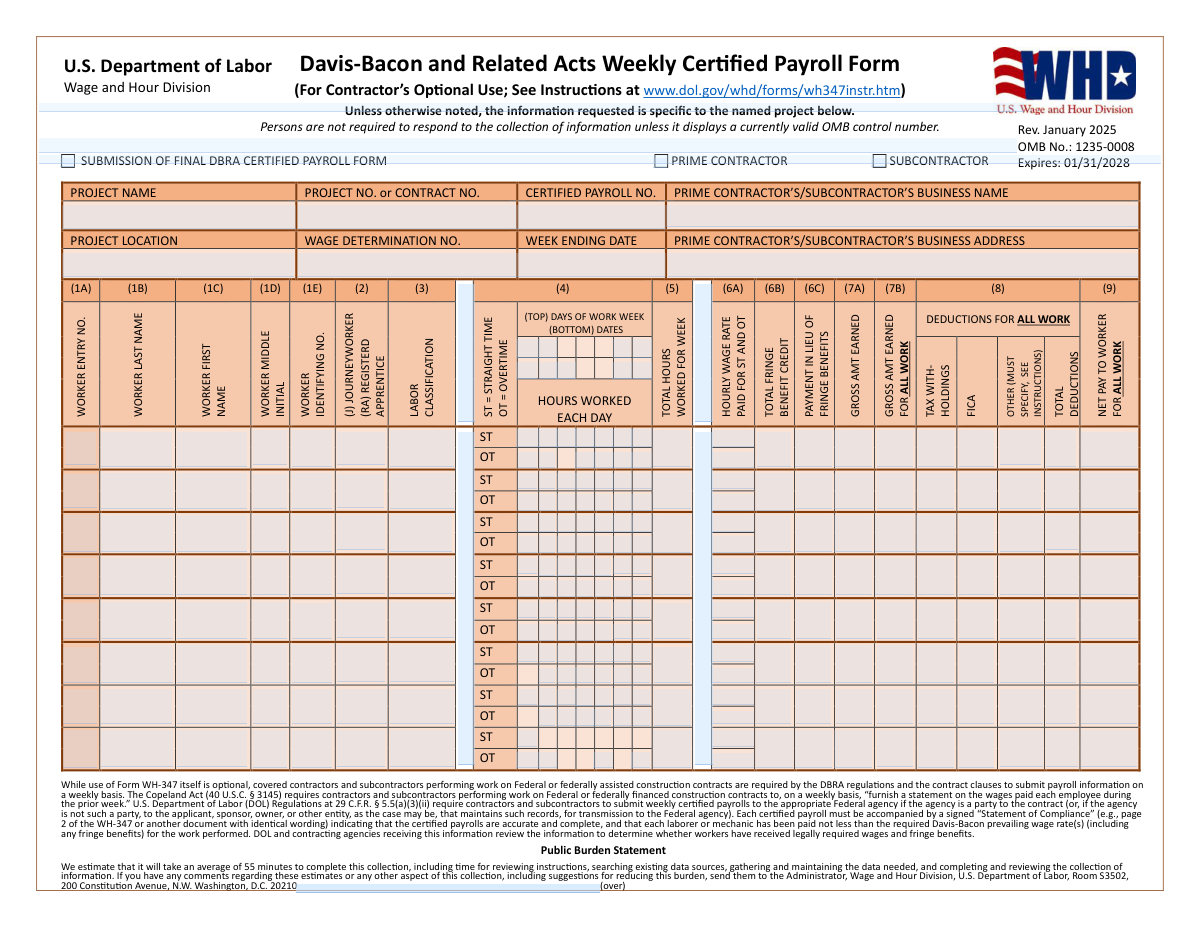
| 1. | Davis-Bacon and Related Acts Weekly Certified Payroll Form (Form WH-347) | 2 | Complex 73 |
| 2. | Form DE 4, Employee’s Withholding Allowance Certificate (Rev. 56) | 4 | Moderate 46 |
| 3. | Form F11182, Direct Deposit Authorization | 1 | – |
| 4. | Form W-2, Wage and Tax Statement | 11 | Very Complex 82 |
| 5. | Form WH-347, Davis-Bacon and Related Acts Weekly Certified Payroll Form | 2 | Complex 68 |
| 6. | NJ Department of Labor & Workforce Development Form MW-562, Payroll Certification for Public Works Projects (Contractor and Subcontractor’s Weekly and Final Certification) | 2 | Complex 79 |
| 7. | Standard Form 1187, Request for Payroll Deductions for Labor Organization Dues | 1 | Basic 29 |
| 8. | Form WH-347, Payroll for Contractors | 2 | Complex 76 |
- Enterprise-grade security & data encryption
- 99%+ accuracy powered by AI
- 1,000+ forms from all industries
- Complete forms in under 60 seconds
How to Choose the Right Form
Navigating payroll compliance is essential for contractors and subcontractors working on public works projects. Choosing the right form depends primarily on whether your project is funded by federal authorities or specific state agencies.
Federal Construction Projects (Davis-Bacon Act)
If you are working on a federally financed or assisted construction contract, you are required to submit weekly certified payroll reports to ensure compliance with the Davis-Bacon and Related Acts (DBRA).
- Form WH-347 (Payroll for Contractors): This is the primary U.S. Department of Labor form. It is used to report wages, work classifications, and fringe benefits. It includes the mandatory "Statement of Compliance" required by federal law.
- Davis-Bacon and Related Acts Weekly Certified Payroll Form: This is a specific version of the WH-347. You should select this if your contract explicitly requires documentation under the DBRA or the Copeland Act to verify that workers are receiving the prevailing wage.
State-Specific Projects (New Jersey)
State-funded projects often require different documentation than federal ones. It is vital to use the form specific to the jurisdiction where the work is performed to avoid penalties.
- NJ Form MW-562 (Payroll Certification for Public Works Projects): This form is mandatory for contractors and subcontractors working on public works in New Jersey. It ensures compliance with the New Jersey Prevailing Wage Act. Unlike the federal forms, this document specifically captures identifiers required by the NJ Department of Labor & Workforce Development, such as specific state work classifications and apprentice registration status.
Quick Selection Tips
1. Check the Funding: If the money comes from a federal agency, use Form WH-347. If the project is New Jersey state-funded, use Form MW-562.
2. Verify the Contract: Your contract or the project's contracting officer will usually specify if "Certified Payroll" is required.
3. Ensure Accuracy: Because these forms are legal certifications subject to civil and criminal penalties, using Instafill.ai to accurately calculate deductions and net wages can help prevent costly filing errors.
Form Comparison
| Form | Jurisdiction | Primary Purpose | Filing Frequency | Governing Law |
|---|---|---|---|---|
| Form WH-347, Payroll for Contractors | Federal | Reports wages paid to employees on federally assisted construction contracts. | Weekly | Davis-Bacon and Related Acts (DBRA) |
| NJ Department of Labor & Workforce Development Form MW-562, Payroll Certification for Public Works Projects (Contractor and Subcontractor’s Weekly and Final Certification) | New Jersey (State) | Documents wage payments for state-level public works projects and contracts. | Weekly and Final | New Jersey Prevailing Wage Act |
| Davis-Bacon and Related Acts Weekly Certified Payroll Form (Form WH-347) | Federal | Certified payroll reporting to verify federal wage protection compliance. | Weekly | Davis-Bacon and Related Acts and contract clauses |
| Form WH-347, Davis-Bacon and Related Acts Weekly Certified Payroll Form | Federal | Optional template for detailing hours, wage rates, and fringe benefits. | Weekly | Copeland Act and Davis-Bacon and Related Acts |
Tips for payroll forms
Double-check that the employee work classifications used on Form WH-347 match the specific prevailing wage determinations for your project contract. Using incorrect titles or classifications is a frequent compliance error that can lead to audits or delays in payment.
Most public works contracts require certified payroll forms to be submitted within seven days after the regular payment date of the payroll period. Establishing a routine for these weekly filings prevents a backlog of paperwork and ensures continuous compliance with the Davis-Bacon Act.
When filling out payroll certifications, clearly separate the hourly basic rate from fringe benefit contributions. If benefits are paid into a plan rather than as cash, ensure you have the documentation to prove these contributions meet the required thresholds.
A payroll report is not legally 'certified' without the accompanying Statement of Compliance. Ensure the authorized representative signs this section to attest that the information is correct and that no unauthorized deductions have been made from worker pay.
Keep copies of all submitted payroll forms and related records for at least three years after the completion of the contract. These documents are essential for defending against potential wage disputes or during routine inspections by the Department of Labor.
Managing weekly reporting for multiple employees can be time-consuming and prone to manual entry errors. AI-powered tools like Instafill.ai can complete these forms in under 30 seconds with high accuracy, and your data stays secure throughout the entire process.
Carefully itemize all deductions, such as taxes, insurance, or union dues, to ensure they are legally permissible. Accurate net pay calculations are critical because any discrepancy between hours worked and the final check amount can trigger a red flag for labor investigators.
Frequently Asked Questions
Certified payroll forms are used by contractors and subcontractors to document that they are paying their workers the prevailing wage and fringe benefits required by law. These forms serve as a compliance record for government agencies to ensure fair labor practices on public works and federally funded construction projects.
Form WH-347 is primarily required for contractors and subcontractors working on federally financed or assisted construction contracts. It helps fulfill reporting obligations under the Davis-Bacon and Related Acts, ensuring all laborers are compensated according to federal wage determinations.
For most projects subject to the Davis-Bacon Act or state prevailing wage laws, payroll certifications must be submitted on a weekly basis. Each submission usually covers one work week and must be provided to the contracting agency within a specific timeframe after the payroll period ends.
Federal forms like WH-347 apply to projects funded by the U.S. government, while state forms like NJ MW-562 are specific to state-funded public works. While they capture similar data—such as hours worked and wage rates—contractors must ensure they use the specific form required by the jurisdiction overseeing the project.
Yes, you can use AI tools like Instafill.ai to complete complex payroll forms accurately and efficiently. These tools can extract data from your source documents and place it directly into the form fields, significantly reducing the manual effort required for weekly reporting.
Failure to submit required payroll certifications can lead to serious consequences, including the withholding of contract payments and project delays. In some cases, willful falsification or repeated non-compliance can result in civil or criminal penalties, as well as debarment from future government contracts.
Using traditional manual methods, these forms can take a significant amount of time to complete each week. However, AI-powered services like Instafill.ai can fill these forms in under 30 seconds by accurately extracting and placing data from your existing payroll records or source documents.
Yes, both federal and state certified payroll forms require detailed information regarding the fringe benefits paid to employees. This includes contributions to health insurance, retirement plans, and other approved benefits to ensure the total compensation package meets the prevailing wage requirements.
Form WH-347 is specifically for projects subject to the Davis-Bacon and Related Acts. While the Department of Labor provides this form as a template, contractors may sometimes use alternative formats as long as they include all required information and a signed Statement of Compliance.
Typically, these forms are submitted directly to the contracting agency or the prime contractor overseeing the project. It is important to check the specific contract requirements, as some agencies may require electronic submission through a specific portal or software.
You will need to provide the name and identification of each worker, their work classification, the number of hours worked each day, and their rate of pay. Additionally, the form must show gross wages, specific deductions, net pay, and a certification signature from an authorized company representative.
Glossary
- Form Complexity Index
- Instafill’s 0–100 measure of how much effort a form takes to complete, calculated deterministically from the form’s own structure rather than estimated. It combines the number of fillable fields (the largest factor), how difficult those fields are to complete based on their type, the number of pages that contain fields, the amount of conditional “fill-only-if” logic, and how many sections the form is divided into, then adds modifiers for tables and repeating lists, bundled instruction pages, and dense page layouts. A higher score means the form is harder to fill out by hand. The forms in this category have a median Form Complexity Index of 73/100 (Complex). See exactly how it is calculated.
- Certified Payroll
- A weekly report submitted by contractors on government-funded projects that details employee wages, hours, and benefits to ensure compliance with labor laws.
- Prevailing Wage
- The minimum hourly rate of pay and fringe benefits that must be paid to workers on public works projects as determined by federal or state government.
- Davis-Bacon and Related Acts (DBRA)
- Federal laws requiring contractors and subcontractors on federally funded construction projects to pay laborers and mechanics at least the local prevailing wages.
- Statement of Compliance
- A mandatory certification accompanying certified payroll reports where the employer legally attests that the reported wage information is accurate and lawful.
- Fringe Benefits
- Additional compensation provided to employees beyond their hourly wage, such as health insurance and retirement plans, which are often required on public projects.
- Work Classification
- The specific job title or trade category assigned to a worker that determines the specific prevailing wage rate they must be paid.
- Wage and Hour Division (WHD)
- The office within the U.S. Department of Labor that administers and enforces federal labor laws, including the Davis-Bacon Act and WH-347 reporting.
- Copeland Act
- A federal law that prohibits contractors on government projects from forcing employees to return any part of their wages and requires the submission of weekly payroll records.