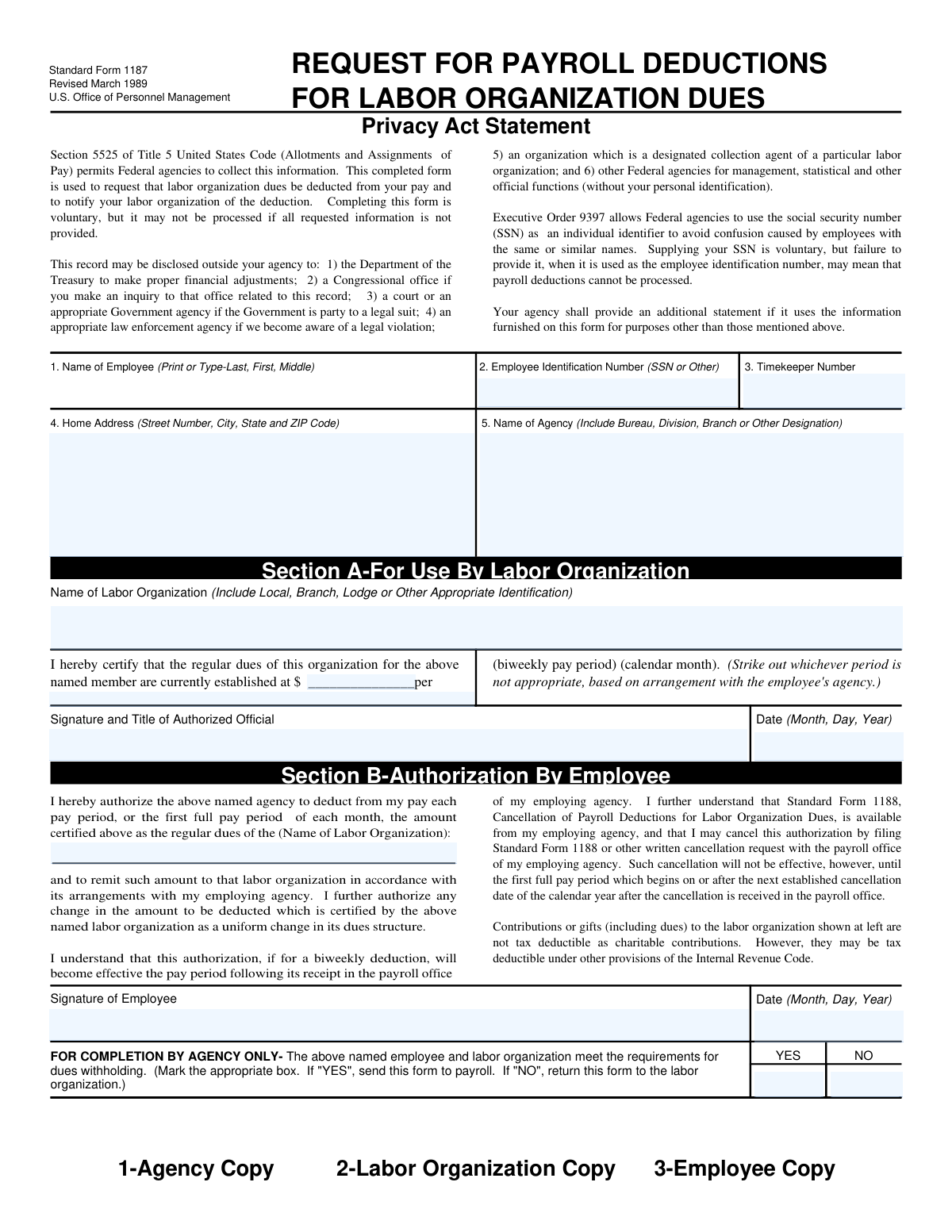
Yes! You can use AI to fill out Standard Form 1187, Request for Payroll Deductions for Labor Organization Dues
Standard Form 1187, Request for Payroll Deductions for Labor Organization Dues, is the official document federal employees use to authorize automatic payroll deductions for their union dues. It serves as a formal agreement between the employee, their employing agency, and the labor organization, ensuring that dues are collected and remitted correctly. Today, this form can be filled out quickly and accurately using AI-powered services like Instafill.ai, which can also convert non-fillable PDF versions into interactive fillable forms.
Our AI automatically handles information lookup, data retrieval, formatting, and form filling.
It takes less than a minute to fill out SF 1187 using our AI form filling.
Securely upload your data. Information is encrypted in transit and deleted immediately after the form is filled out.
Form specifications
| Form name: | Standard Form 1187, Request for Payroll Deductions for Labor Organization Dues |
| Number of pages: | 1 |
| Language: | English |
| Categories: | payroll forms, labor forms |
Instafill Demo: How to fill out PDF forms in seconds with AI
How to Fill Out SF 1187 Online for Free in 2026
Are you looking to fill out a SF 1187 form online quickly and accurately? Instafill.ai offers the #1 AI-powered PDF filling software of 2026, allowing you to complete your SF 1187 form in just 37 seconds or less.
Follow these steps to fill out your SF 1187 form online using Instafill.ai:
- 1 Navigate to Instafill.ai and upload or select the SF 1187 form.
- 2 Allow the labor organization representative to complete Section A, providing the employee's details, the organization's name, and the certified dues amount.
- 3 As the employee, complete Section B by providing your signature and the date to authorize the payroll deduction.
- 4 Use the AI-powered tool to ensure all personal and agency information, such as your Employee ID/SSN and home address, is entered accurately.
- 5 Review the entire form for completeness and accuracy before the labor organization submits it to your employing agency's payroll office.
- 6 Once the agency completes its certification, download and save a final copy for your records and share it with the labor organization.
Our AI-powered system ensures each field is filled out correctly, reducing errors and saving you time.
Why Choose Instafill.ai for Your Fillable SF 1187 Form?
Speed
Complete your SF 1187 in as little as 37 seconds.
Up-to-Date
Always use the latest 2026 SF 1187 form version.
Cost-effective
No need to hire expensive lawyers.
Accuracy
Our AI performs 10 compliance checks to ensure your form is error-free.
Security
Your personal information is protected with bank-level encryption.
Frequently Asked Questions About Form SF 1187
This form is used by federal employees to authorize their employing agency to deduct labor organization (union) dues directly from their paycheck and send the funds to the union.
A representative from the labor organization completes Section A, and the employee who wishes to have dues deducted completes and signs the authorization in Section B.
Providing your SSN is voluntary. However, if your agency uses it as your employee ID, failing to provide it may prevent your payroll deduction request from being processed.
Your Timekeeper Number is assigned to you by your agency for payroll and timekeeping purposes. You can typically find it on your pay stubs or other official agency documents.
By signing this form, you authorize your agency to automatically adjust the deduction amount whenever your labor organization certifies a uniform change in its dues structure.
Once completed by both the labor organization and the employee, the form should be submitted to the payroll office of your employing agency for processing.
The deductions will become effective in the pay period immediately following the one in which the completed form is received by your agency's payroll office.
To cancel your dues deduction, you must obtain and file Standard Form 1188, 'Cancellation of Payroll Deductions for Labor Organization Dues,' with your agency's payroll office.
Dues are not tax-deductible as charitable contributions. However, they may be deductible under other provisions of the Internal Revenue Code, so you should consult a tax professional.
Section A must be completed and signed by an authorized official of the labor organization, who certifies the correct amount for the member's regular dues.
After you submit the form, your employing agency will complete this section to certify whether you and the labor organization meet the requirements for dues withholding before approving the deduction.
Yes, services like Instafill.ai use AI to accurately auto-fill your personal information into form fields, which can save you time and help prevent errors.
You can upload the SF 1187 PDF to the Instafill.ai platform. Their service will make the form fillable online, allowing you to quickly enter your information before downloading the completed document.
If you have a flat, non-fillable PDF, you can use a service like Instafill.ai. It can convert the document into an interactive, fillable form that you can easily complete on your computer.
Compliance SF 1187
Validation Checks by Instafill.ai
1
Dues Amount Consistency Across Sections
This check verifies that the 'Regular Dues Amount' entered by the labor organization in Section A is identical to the 'Regular Dues Amount' entered by the employee in Section B. This is critical to ensure the employee is authorizing the exact amount certified by the labor organization. If the amounts do not match, the form is considered invalid and cannot be processed, as there is a discrepancy in the authorized deduction amount.
2
Logical Signature Date Sequence
Validates that the 'Employee Signature Date' in Section B is on or after the 'Date of Signature' from the authorized official in Section A. This sequence is important because the employee should only authorize the deduction after the labor organization has officially certified the dues amount. A form where the employee's signature predates the organization's certification is logically inconsistent and should be rejected for correction.
3
Employee Identification Number Format
This check validates the format of the 'Employee Identification Number'. If a Social Security Number (SSN) is provided, it must conform to the ###-##-#### structure. Proper formatting is essential for matching the employee to the correct payroll record and avoiding identification errors. Failure to provide a correctly formatted ID could result in the inability to process the payroll deduction.
4
Completeness of Section A (Labor Organization)
Ensures that all required fields within Section A are filled out by the labor organization, including the organization's name, dues amount, pay period, and the authorized official's signature and date. This section serves as the official certification from the union, and incomplete information makes the request invalid. An incomplete Section A will cause the form to be returned to the labor organization for completion before it can be forwarded to the employee or agency.
5
Completeness of Section B (Employee Authorization)
Verifies that the employee has completed all necessary fields in Section B, including the dues amount, their signature, and the date of signature. The employee's explicit authorization is a legal requirement for deducting funds from their pay. If any part of Section B is missing, the authorization is incomplete and the deduction cannot be legally processed.
6
Dues Amount Numerical Format
This validation confirms that the 'Regular Dues Amount' in both Section A and Section B is a valid, positive numerical value, typically in a currency format (e.g., 25.50). The check prevents non-numeric characters or negative values from being entered, which would cause calculation errors in the payroll system. An invalid format will halt processing and require correction.
7
Agency Certification Exclusivity
This check ensures that for the 'Agency Certification' section, either 'YES' or 'NO' is marked, but not both, and not neither. This field is the final determination by the employing agency on whether the request meets requirements. An ambiguous or missing selection makes the agency's decision unclear, preventing the form from being routed correctly to either payroll (for YES) or back to the labor organization (for NO).
8
Home Address Structure Validation
Validates that the 'Home Address' field is complete and properly structured, containing a street number/name, city, state, and a valid 5-digit or 9-digit ZIP code. A complete and accurate address is necessary for mailing correspondence, such as confirmation notices or other official documents, to the employee. An incomplete or malformed address could lead to failed communication and will flag the form for review.
9
Dues Pay Period Selection
This check verifies that the 'Dues Pay Period' field contains a valid, expected value, such as 'biweekly pay period' or 'calendar month'. The form instructs the user to strike out the inappropriate option, so this check ensures a single, valid period is specified for the deduction frequency. An ambiguous or invalid pay period would make it impossible for the payroll system to know when to perform the deduction.
10
Date Field Format and Validity
Ensures that all date fields on the form ('Date of Signature' in Section A and 'Employee Signature Date' in Section B) are in a standard, parseable format (e.g., MM/DD/YYYY) and represent a valid calendar date. Consistent and valid date formatting is crucial for record-keeping, auditing, and enforcing rules related to effective dates and cancellation periods. An invalid date format will cause a processing error and require manual correction.
11
Agency Name Specificity Check
This validation ensures the 'Name of Agency' field includes not just the top-level department but also the specific 'Bureau, Division, Branch or Other Designation' as requested. This level of detail is critical for routing the form to the correct internal payroll office within a large government agency. A generic agency name could lead to significant delays or misrouting of the deduction request.
12
Employee Name Format
This check verifies that the 'Name of Employee' field is provided in the specified 'Last, First, Middle' format. Adhering to this format is important for accurate data entry and matching the employee to their official record in the payroll and HR systems. An incorrectly formatted name increases the risk of misidentification, especially in large organizations with employees who have similar names.
Common Mistakes in Completing SF 1187
Employees often enter their name in a conversational order (e.g., 'First Last') instead of the required 'Last, First, Middle' format specified on the form. This mismatch can slow down processing as payroll staff must manually search for the employee's record, potentially delaying the first deduction. To prevent this, carefully follow the format instructions; using an AI form-filling tool like Instafill.ai can also help by automatically structuring data into the correct format based on field labels.
Applicants frequently use common acronyms or provide only the top-level agency name, omitting the required Bureau, Division, or Branch. This lack of detail can cause the form to be misrouted within a large government department, leading to significant delays or rejection. Always provide the complete organizational hierarchy as it appears on your pay stub or official records to ensure the form reaches the correct payroll office.
An employee might enter their Social Security Number when the agency uses a different primary ID for payroll, or they may simply transpose digits. An incorrect ID is a primary reason for processing failure, as automated systems cannot match the form to an employee record. Always verify the correct ID number from an official pay stub to avoid rejection.
The labor organization representative sometimes lists the national union name but forgets to include the specific Local, Branch, or Lodge number. This ambiguity can cause dues to be sent to the wrong entity or be rejected by the payroll office for being incomplete. The form must include the full, specific name of the local chapter to ensure proper and timely remittance of dues.
In Section A, the certifying official must strike out either 'biweekly pay period' or 'calendar month' to indicate the deduction frequency. Forgetting to do so creates ambiguity that halts processing until clarification is received from the union. This simple oversight requires the form to be returned, delaying the entire process.
A missing signature or date from either the employee in Section B or the union official in Section A is a critical error that immediately invalidates the authorization. This is a common oversight made in haste, which always results in the form being returned for completion. Double-checking for all required signatures and dates before submission is essential to avoid this process-stopping mistake.
When the form is filled out by hand, illegible writing for names, numbers, or agency details is a frequent cause of errors. A payroll clerk may misinterpret a digit in an ID number or a name, leading to a failed submission or incorrect data entry. To eliminate this risk, it is best to use a fillable PDF; if one is not available, a tool like Instafill.ai can convert the flat PDF into a fillable version, ensuring all entries are typed and clear.
Many employees are unaware of their Timekeeper Number or consider it non-essential, so they leave the field blank. However, for some agencies, this number is a key identifier for payroll processing and its absence can cause the form to be flagged or rejected. Employees should consult their pay stub or supervisor to find this number and ensure all identification fields are completed accurately.
The dues amount certified by the labor organization in Section A must be the current, correct rate. If the union official uses an outdated form or information, the wrong amount will be deducted from the employee's pay. This creates a financial discrepancy that requires administrative correction for the employee, union, and agency.
Employees sometimes provide an incomplete home address, such as forgetting an apartment number or using an incorrect ZIP code. While it may not always stop the deduction, an incorrect address on file can cause issues with mailings from the agency or labor organization. To avoid this, enter your full, USPS-verified mailing address; AI-powered tools like Instafill.ai can autofill and validate addresses to ensure accuracy.
Saved over 80 hours a year
“I was never sure if my IRS forms like W-9 were filled correctly. Now, I can complete the forms accurately without any external help.”
Kevin Martin Green
Your data stays secure with advanced protection from Instafill and our subprocessors

Robust compliance program
Transparent business model
You’re not the product. You always know where your data is and what it is processed for.
ISO 27001, HIPAA, and GDPR
Our subprocesses adhere to multiple compliance standards, including but not limited to ISO 27001, HIPAA, and GDPR.
Security & privacy by design
We consider security and privacy from the initial design phase of any new service or functionality. It’s not an afterthought, it’s built-in, including support for two-factor authentication (2FA) to further protect your account.
Fill out SF 1187 with Instafill.ai
Worried about filling PDFs wrong? Instafill securely fills standard-form-1187-request-for-payroll-deductions-for-labor-organization-dues forms, ensuring each field is accurate.