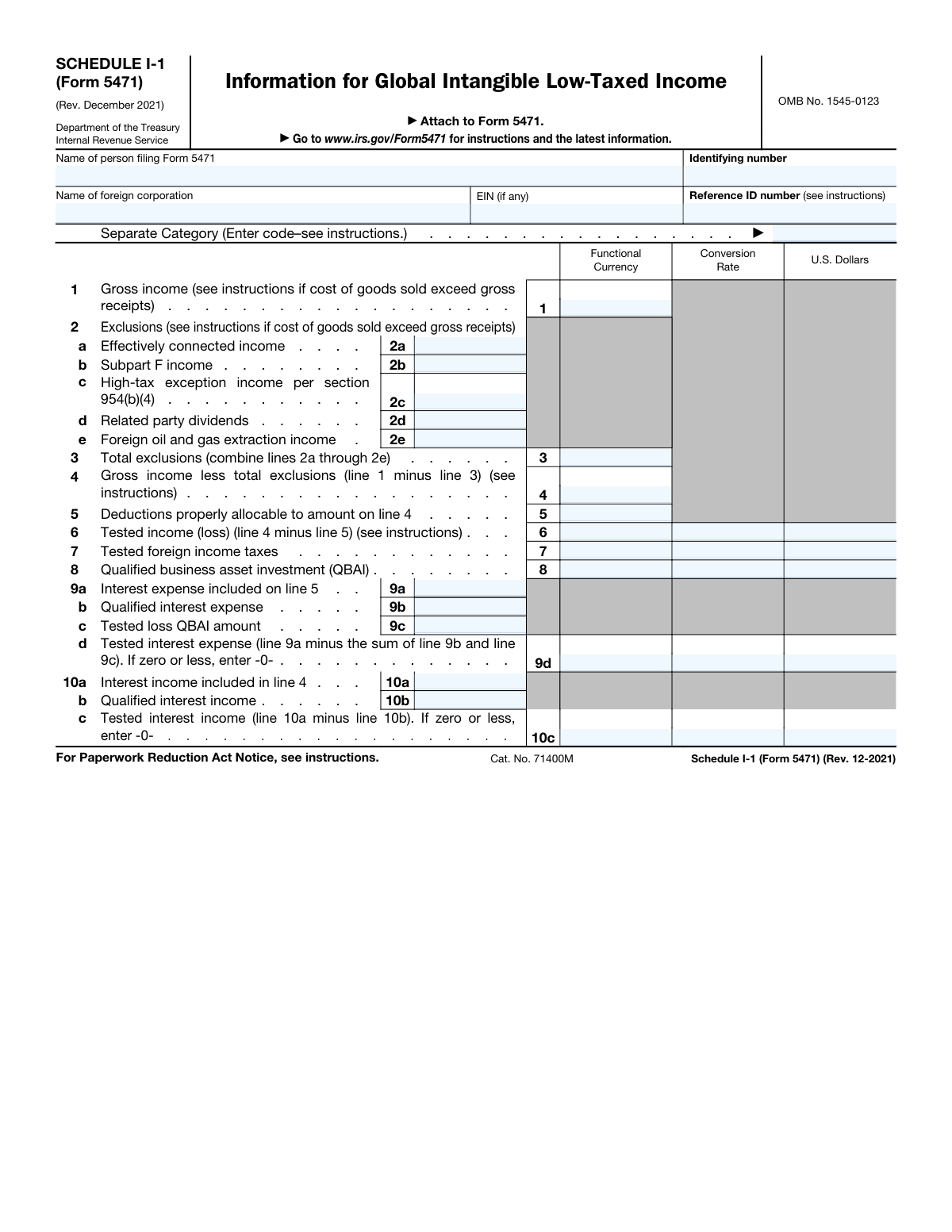
Yes! You can use AI to fill out Schedule I-1 (Form 5471), Information for Global Intangible Low-Taxed Income
Schedule I-1 (Form 5471) is a supplement to Form 5471, filed by U.S. shareholders of certain foreign corporations. Its primary purpose is to determine the corporation's tested income or loss and related items necessary for calculating the shareholder's Global Intangible Low-Taxed Income (GILTI) inclusion. This involves detailing gross income, specific exclusions, allocable deductions, and foreign taxes paid. Today, this form can be filled out quickly and accurately using AI-powered services like Instafill.ai, which can also convert non-fillable PDF versions into interactive fillable forms.
Schedule I-1 (Form 5471) is part of the
income forms, income tax forms and tax forms categories on Instafill.
Our AI automatically handles information lookup, data retrieval, formatting, and form filling.
It takes less than a minute to fill out Schedule I-1 (Form 5471) using our AI form filling.
Securely upload your data. Information is encrypted in transit and deleted immediately after the form is filled out.
Form specifications
| Form name: | Schedule I-1 (Form 5471), Information for Global Intangible Low-Taxed Income |
| Number of fields: | 35 |
| Number of pages: | 1 |
| Language: | English |
More forms in Income forms
Instafill Demo: How to fill out PDF forms in seconds with AI
How to Fill Out Schedule I-1 (Form 5471) Online for Free in 2026
Are you looking to fill out a SCHEDULE I-1 (FORM 5471) form online quickly and accurately? Instafill.ai offers the #1 AI-powered PDF filling software of 2026, allowing you to complete your SCHEDULE I-1 (FORM 5471) form in just 37 seconds or less.
Follow these steps to fill out your SCHEDULE I-1 (FORM 5471) form online using Instafill.ai:
- 1 Navigate to Instafill.ai and upload or select the Schedule I-1 (Form 5471).
- 2 Provide the identification details for the person filing and the foreign corporation, including names, identifying numbers, and reference IDs.
- 3 Enter the foreign corporation's gross income and all applicable exclusions, such as Subpart F income and high-tax exception income.
- 4 Input the deductions that are properly allocable to the gross income to allow the AI to calculate the tested income or loss.
- 5 Provide figures for tested foreign income taxes and Qualified Business Asset Investment (QBAI), including functional currency amounts and conversion rates.
- 6 Detail interest expenses and income to determine the tested interest expense and income amounts.
- 7 Review all AI-populated fields, verify the currency conversions and calculations, and then finalize the form to attach to your Form 5471 filing.
Our AI-powered system ensures each field is filled out correctly, reducing errors and saving you time.
Why Choose Instafill.ai for Your Fillable Schedule I-1 (Form 5471) Form?
Speed
Complete your Schedule I-1 (Form 5471) in as little as 37 seconds.
Up-to-Date
Always use the latest 2026 Schedule I-1 (Form 5471) form version.
Cost-effective
No need to hire expensive lawyers.
Accuracy
Our AI performs 10 compliance checks to ensure your form is error-free.
Security
Your personal information is protected with bank-level encryption.
Frequently Asked Questions About Form Schedule I-1 (Form 5471)
Schedule I-1 is used to calculate a controlled foreign corporation's (CFC) tested income or loss, which is a key component for determining a U.S. shareholder's Global Intangible Low-Taxed Income (GILTI).
U.S. persons who are shareholders of a controlled foreign corporation and are required to file Form 5471 must complete and attach Schedule I-1 to report information related to GILTI.
You must report financial figures in the foreign corporation's primary operating currency (functional currency) and then convert them to U.S. dollars using the specified conversion rate. This ensures consistent and accurate reporting for U.S. tax purposes.
Tested income or loss is calculated by taking the CFC's gross income (line 1), subtracting specific exclusions like Subpart F income (line 3), and then subtracting deductions properly allocable to that income (line 5).
QBAI represents the average adjusted basis of the CFC's tangible property used in its trade or business. This figure is used in the broader GILTI calculation to determine a deemed return on tangible assets.
The Separate Category Code, which classifies the income, must be found in the official IRS instructions for Form 5471. You should always refer to the latest instructions to ensure you are using the correct code.
Schedule I-1 is not filed by itself. It must be attached to your completed Form 5471, which is then filed as part of your main income tax return.
You will need the foreign corporation's detailed financial statements, including gross income, a breakdown of income types for exclusions, details of deductions, and information on its tangible assets to calculate QBAI.
The Reference ID Number is a unique identifier you may need to assign to the foreign corporation, especially for electronic filing purposes. Consult the Form 5471 instructions to determine if it is required for your specific filing situation.
Yes, services like Instafill.ai use AI to accurately auto-fill form fields from your existing data. This can save significant time and help reduce errors on complex international tax forms.
Simply upload the Schedule I-1 PDF to the Instafill.ai platform. The AI will make the form interactive, allowing you to fill it out directly or connect your data sources to auto-populate the required information instantly.
If your PDF is not interactive, you can use a tool like Instafill.ai. It can convert flat, non-fillable PDFs into intelligent, fillable forms that you can complete and save online.
Tested Interest Expense is the net interest expense allocable to the GILTI calculation, while Tested Interest Income is the net interest income included in it. Both are calculated by subtracting qualified interest amounts from the respective totals.
Compliance Schedule I-1 (Form 5471)
Validation Checks by Instafill.ai
1
Filer Identifying Number Format
This check validates that the 'Filer Identifying Number' is in a valid Social Security Number (SSN) or Employer Identification Number (EIN) format, which is typically 9 digits. Correct identification is crucial for the IRS to associate the form with the correct taxpayer's account. A failure in this validation could lead to processing delays or rejection of the filing.
2
Required Filer and Corporation Names
This validation ensures that the 'Name of person filing Form 5471' and 'Name of foreign corporation' fields are not empty. These names are fundamental identifiers for the filer and the subject of the report. Missing names would render the form useless, as it would be impossible to determine who filed it or which corporation it pertains to.
3
Foreign Corporation EIN Dependency
This check verifies that if the 'Foreign Corporation EIN' field is populated, the 'Name of foreign corporation' field must also be populated. An EIN cannot be reported without the corresponding entity's name. An orphaned EIN would cause data integrity issues and prevent proper entity matching.
4
Separate Category Code Validity
This validation confirms that the 'Separate Category' code entered matches one of the valid codes specified in the official IRS instructions for Form 5471. Using a valid code is essential for the correct classification and tax treatment of the foreign corporation's income. An invalid code would result in miscategorization and potential tax calculation errors.
5
Line 3 Total Exclusions Calculation
This check verifies that the value on Line 3, 'Total exclusions', is the exact sum of the values entered on lines 2a through 2e. This is a critical arithmetic check to ensure the subtotal of all income exclusions is calculated correctly. An error here would cascade, making all subsequent calculations on the form incorrect.
6
Line 4 Gross Income Calculation
This validation ensures that the value on Line 4, 'Gross income less total exclusions', is equal to the value on Line 1 minus the value on Line 3. This calculation determines the adjusted gross income figure used in subsequent steps. A discrepancy would indicate a mathematical error and invalidate the resulting tested income amount.
7
Line 6 Tested Income Calculation
This check validates that the value on Line 6, 'Tested income (loss)', is correctly calculated as the value on Line 4 minus the value on Line 5. This is the final calculation to determine the tested income or loss, a key figure for GILTI purposes. An incorrect value would lead to a misstatement of taxable income.
8
Line 9d Tested Interest Expense Calculation and Floor
This validation confirms that Line 9d is calculated as Line 9a minus the sum of Line 9b and Line 9c, and that the result is not negative. The form instructions explicitly state to enter '-0-' if the calculation results in a value less than zero. This check prevents negative interest expense, which is not permissible, and ensures compliance with the form's rules.
9
Line 10c Tested Interest Income Calculation and Floor
This check ensures that Line 10c is calculated as Line 10a minus Line 10b, and that the result is not negative. As with Line 9d, the form requires a floor of zero for this value. This validation is important for accurately determining the tested interest income component without allowing it to be negative.
10
Line 9a vs. Line 5 Logical Check
This validation checks that the amount on Line 9a, 'Interest expense included on line 5', is not greater than the amount on Line 5, 'Deductions properly allocable'. Since interest expense is a component of the total deductions, it cannot logically exceed the total. A failure indicates a data entry or fundamental accounting error.
11
Line 10a vs. Line 4 Logical Check
This validation ensures that the amount on Line 10a, 'Interest income included in line 4', is not greater than the amount on Line 4, 'Gross income less total exclusions'. Interest income is a component of gross income, so the part cannot be larger than the whole. This check catches logical inconsistencies in the reported income figures.
12
Currency Conversion Accuracy for Line 7
This check verifies that the 'U.S. Dollars' amount on Line 7 is the mathematical product of the 'Functional Currency' amount and the 'Conversion Rate' for that line. This is crucial for ensuring that foreign tax amounts are translated to U.S. dollars correctly for reporting and credit purposes. An incorrect conversion could lead to an improper foreign tax credit claim.
13
Conditional Population of Line 9d
This check ensures that the currency, conversion rate, and U.S. dollar fields for Line 9d are only populated if the calculated value is greater than zero. The field instructions state this dependency, and this validation enforces that rule. It prevents the entry of conversion data for a zero or non-existent value, maintaining form cleanliness and integrity.
14
Conditional Population of Line 10c
This validation verifies that the currency, conversion rate, and U.S. dollar fields for Line 10c are only populated if the calculated value (Line 10a minus Line 10b) is greater than zero. This enforces the conditional logic described in the field details. This prevents extraneous data entry and ensures the form is completed according to its specific instructions.
Common Mistakes in Completing Schedule I-1 (Form 5471)
Filers often use an incorrect exchange rate, such as a year-end rate when an average annual rate is required, or apply different rates inconsistently across the form. This fundamental error leads to inaccurate U.S. dollar figures, misstating income, and potentially causing an incorrect tax liability. To avoid this, filers must carefully consult the IRS instructions for the specific rate required for each item and apply it consistently, or use tools that can automate these conversions.
Many lines, such as Line 3 (Total exclusions) and Line 6 (Tested income), are derived from calculations of previous lines. Manual data entry and calculation are highly susceptible to simple arithmetic errors that cascade and invalidate the entire form. An incorrect calculation of tested income can lead to an improper GILTI inclusion and potential penalties. Using tax software or an AI-powered tool like Instafill.ai, which performs these calculations automatically, can eliminate these errors.
The 'Separate Category Code' is a critical field for foreign tax credit purposes, but it is often filled incorrectly or left blank. Filers may guess the code or fail to consult the Form 5471 instructions to find the correct one corresponding to the foreign corporation's income type. An incorrect code can lead to miscalculation of the foreign tax credit limitation and incorrect tax reporting. Always reference the latest IRS instructions to determine the appropriate code.
The form's three-column layout for 'Functional Currency', 'Conversion Rate', and 'U.S. Dollars' frequently causes confusion. A common mistake is to inadvertently enter U.S. dollar values into the 'Functional Currency' column or vice versa. This data entry error skews all subsequent calculations and renders the form's financial data meaningless. Double-checking each column's heading before entering data is crucial to ensure accuracy.
Lines 9d and 10c explicitly instruct the filer to 'enter -0-' if the calculated result is zero or less. Filers often ignore this and enter the actual negative number, write 'N/A,' or leave the field blank, which can cause automated processing issues for the IRS. Following the explicit formatting instructions for all fields is essential for a smoothly processed return. AI-powered form fillers like Instafill.ai can automatically apply these formatting rules.
The exclusions on lines 2a-2e (e.g., Subpart F income, high-tax exception) are complex tax concepts that are easily misinterpreted. A common mistake is failing to correctly identify all income that qualifies for an exclusion, or incorrectly claiming an exclusion for income that doesn't qualify. This directly impacts the 'Tested income' on Line 6, leading to either an overpayment or underpayment of tax on GILTI.
Filers often leave the 'Foreign Corporation EIN' field blank, assuming the entity does not have one since it is foreign. However, a foreign corporation may have been assigned a U.S. Employer Identification Number for various past or current U.S. activities, and it must be included if it exists. Omitting a required EIN can delay processing and trigger inquiries from the IRS, so it is important to verify if one has ever been issued.
Qualified Business Asset Investment (QBAI) is frequently calculated incorrectly. A common error is using the year-end value of tangible property instead of the required average of the adjusted basis for each of the four quarters of the tax year. This mistake can significantly distort the QBAI figure, which in turn affects the net deemed tangible income return and the final GILTI inclusion amount. To avoid this, filers must maintain and use quarterly asset records for the calculation.
Fields like Line 9d and 10c have specific conditions for entry, such as 'Fill only if '10a' minus '10b' is greater than zero'. Filers may not perform the preliminary calculation and either fill the field incorrectly with a zero or leave it blank when it should be filled. This indicates a failure to follow the form's computational flow. AI-powered tools like Instafill.ai can automate these conditional checks, ensuring fields are only filled when the specified criteria are met.
Many IRS forms are only available online as flat, non-fillable PDFs, forcing users to print and fill them out by hand. This manual process is a primary source of illegible handwriting, calculation errors, and missed fields. Using a tool like Instafill.ai can convert any non-fillable tax form into an interactive, fillable version. This enables digital data entry, which improves legibility and allows for automated calculations and validations to prevent common mistakes.
Saved over 80 hours a year
“I was never sure if my IRS forms like W-9 were filled correctly. Now, I can complete the forms accurately without any external help.”
Kevin Martin Green
Your data stays secure with advanced protection from Instafill and our subprocessors

Robust compliance program
Transparent business model
You’re not the product. You always know where your data is and what it is processed for.
ISO 27001, HIPAA, and GDPR
Our subprocesses adhere to multiple compliance standards, including but not limited to ISO 27001, HIPAA, and GDPR.
Security & privacy by design
We consider security and privacy from the initial design phase of any new service or functionality. It’s not an afterthought, it’s built-in, including support for two-factor authentication (2FA) to further protect your account.
Fill out Schedule I-1 (Form 5471) with Instafill.ai
Worried about filling PDFs wrong? Instafill securely fills schedule-i-1-form-5471-information-for-global-intangible-low-taxed-income forms, ensuring each field is accurate.