Fill out beneficiary distribution forms
with AI.
Beneficiary distribution forms are essential legal documents used to settle retirement and investment accounts following the passing of an account holder. These forms facilitate the transfer of assets—such as those held in IRAs, 401(k)s, or 403(b) plans—from the decedent to the designated beneficiaries. Because these transfers often involve significant financial sums and complex tax implications, completing the paperwork accurately is vital for ensuring that funds are distributed according to the deceased's wishes and in compliance with legal and tax regulations.
By continuing, you acknowledge Instafill's Privacy Policy and agree to get occasional product update and promotional emails.
About beneficiary distribution forms
Typically, these forms are required by surviving spouses, family members, or designated organizations like charities and universities. For instance, a spouse might use a distribution request to rollover funds into their own IRA, while a non-profit might use a charitable beneficiary form to liquidate and receive a donation. Whether you are managing a simple lump-sum request or a complex transfer into an inherited IRA, these documents serve as the formal instruction to financial institutions like Fidelity, Vanguard, or Merrill Lynch on how to process the inheritance and handle tax withholdings.
Navigating the administrative side of an estate can be overwhelming during a difficult time. Tools like Instafill.ai use AI to fill these beneficiary distribution forms in under 30 seconds, ensuring data is handled accurately and securely to minimize the risk of processing delays. This streamlined approach helps beneficiaries and executors avoid manual data entry errors, making the distribution process more efficient and manageable.
Every form on this page can be completed without typing. Instafill is form filling software that reads a PDF and fills it for you — including flat and scanned documents that carry no fillable fields at all.
Forms in This Category
The forms in this category have a median Form Complexity Index of 53/100 (Moderate), measured across 8 forms by field count, input difficulty, length, conditional logic and structure. See how it is calculated.
- Enterprise-grade security & data encryption
- 99%+ accuracy powered by AI
- 1,000+ forms from all industries
- Complete forms in under 60 seconds
How to Choose the Right Form
Selecting the correct beneficiary distribution form depends primarily on the financial institution holding the assets and the legal status of the beneficiary (individual vs. organization). Using the wrong form can lead to significant delays in asset transfer or unintended tax consequences.
Forms for Major Financial Institutions
If the inherited assets are held with a specific brokerage or investment firm, you must use their proprietary forms to ensure the transfer is processed correctly:
- Fidelity Accounts: Use the Fidelity Investments® Beneficiary Distribution Form for standard retirement plans. If the account is specifically a 403(b), use the Fidelity Advisor 403(b) Beneficiary Distribution Request.
- Merrill Lynch Accounts: Choose the IRA/IRRA®/ROTH IRA/SEP/SRA Beneficiary Distribution Form for all types of Merrill Lynch retirement accounts, including SEP and Roth IRAs.
- Union Specific Plans: For members of the Elevator Constructors Union, the Distribution Due to Death for Spouse Beneficiary - Elevator Constructors Union Local No. 1 Annuity and 401(k) Fund is required for surviving spouses.
Charitable and Entity Beneficiaries
When the beneficiary is not an individual person but an organization, specific forms are required to establish the entity's right to the funds:
- For Vanguard IRAs: Use the IRA Distribution to Charitable Beneficiary (or specifically Form DIRDISTVBA for brokerage IRAs) to facilitate the liquidation and transfer of assets to a non-profit.
- For Fidelity IRAs: Use the Fidelity IRA Beneficiary Distribution — Charity, Foundation, or a University form to establish a temporary inherited IRA for the organization.
General Distribution Requests
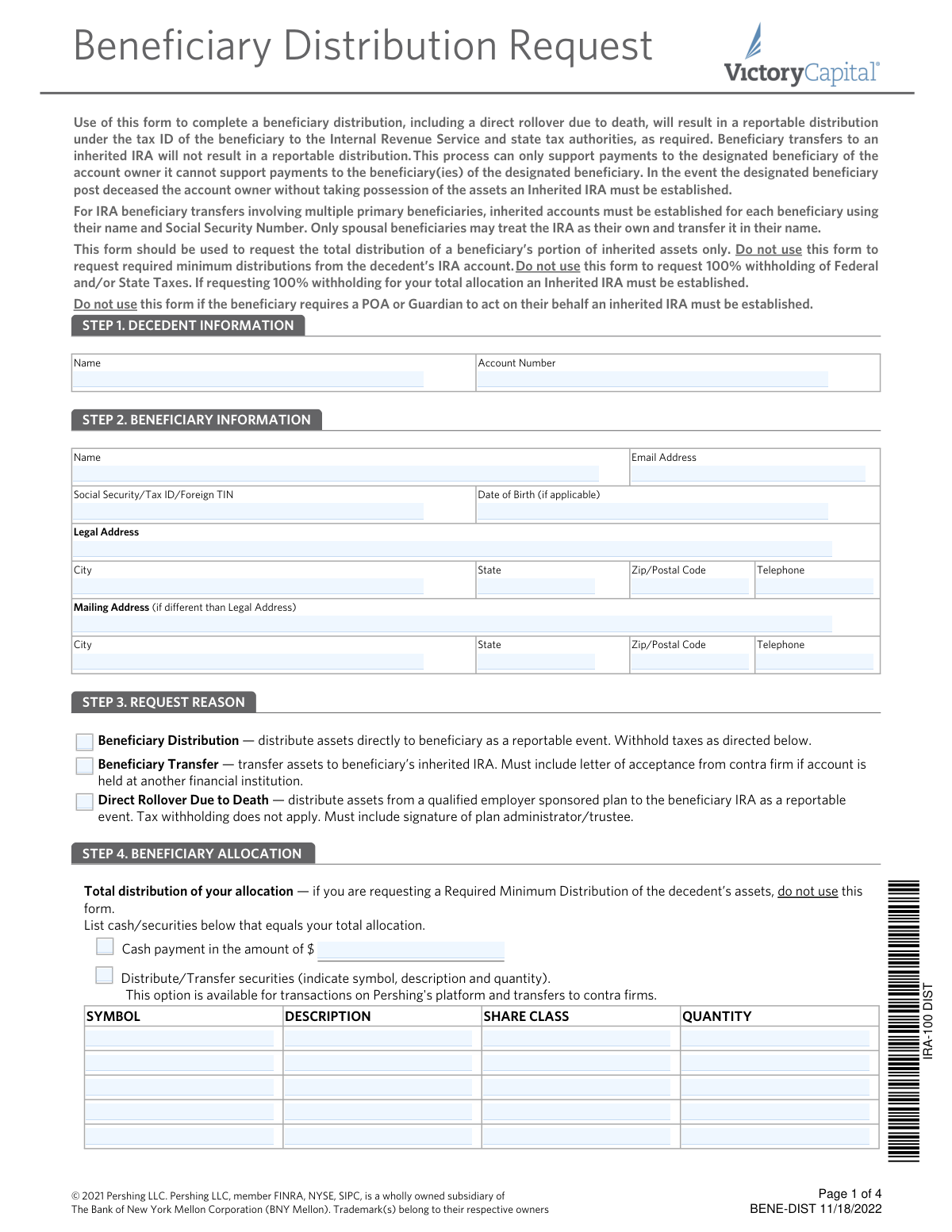
If you are initiating a total distribution of inherited assets and are looking for a standard framework to specify tax withholding and delivery methods (such as a direct rollover vs. cash payment), the Beneficiary Distribution Request serves as a comprehensive tool for starting the payout process.
Always ensure you have the decedent's account details and your tax identification information ready before you begin filling out these forms with Instafill.ai.
Form Comparison
| Form | Beneficiary Type | Account Type | Distribution Options |
|---|---|---|---|
| Beneficiary Distribution Request | Individual beneficiaries of inherited assets | General retirement or investment accounts | Direct cash, securities transfer, or transfer to inherited IRA |
| Distribution Due to Death for Spouse Beneficiary - Elevator Constructors Union Local No. 1 Annuity and 401(k) Fund | Surviving spouses of union members | Union Local No. 1 Annuity and 401(k) Fund | Lump-sum payment, direct rollover, or deferring the distribution |
| Fidelity Advisor 403(b) Beneficiary Distribution Request | Designated account beneficiaries | Fidelity Advisor 403(b) retirement plans | Direct rollover, lump-sum payment, or new beneficiary account |
| Fidelity Investments® Beneficiary Distribution Form | General retirement plan beneficiaries | Fidelity employer-sponsored retirement plans | Installment payments, direct rollover, or single lump-sum payment |
| Fidelity IRA Beneficiary Distribution — Charity, Foundation, or a University | Domestic charities, foundations, or university entities | Fidelity Individual Retirement Accounts (IRA) | Temporary inherited IRA establishment for liquidation and final transfer |
| IRA Distribution to Charitable Beneficiary | Designated charitable organizations | Vanguard Individual Retirement Accounts (IRA) | Direct transfer of assets from decedent to charitable entity |
| IRA Distribution to Charitable Beneficiary | Non-profit charitable organizations | Vanguard Brokerage IRA accounts | Asset liquidation with specific payment delivery and handling instructions |
| IRA/IRRA®/ROTH IRA/SEP/SRA Beneficiary Distribution Form | Merrill Lynch account beneficiaries | IRA, Roth IRA, SEP, and SRA accounts | Custom distribution amounts with specific federal and state tax withholding |
| IRA/IRRA®/Roth IRA/SEP/SRA Beneficiary Distribution Form | Merrill Lynch account beneficiaries | Inherited IRA, Roth IRA, SEP, or SRA | Specific distribution types and methods including crucial tax elections |
Tips for beneficiary distribution forms
Many beneficiary forms include default tax withholding rates that may not align with your specific financial situation. Always double-check the federal and state withholding sections to ensure you aren't overpaying or underpaying taxes on the distributed assets.
Financial institutions almost always require a certified copy of the death certificate or letters of testamentary to process these requests. Having high-quality digital scans of these documents ready will prevent your application from being rejected for missing information.
AI-powered tools like Instafill.ai can complete these complex forms in under 30 seconds with high accuracy, ensuring all data is mapped to the correct fields. Your sensitive data stays secure during the process, providing a massive time-saver for those managing multiple inherited accounts.
Selecting a lump-sum cash distribution can trigger immediate income tax, while a direct rollover to an inherited IRA usually maintains the tax-deferred status of the funds. Carefully mark the correct box to avoid unintended tax consequences and potential penalties.
A single transposed digit in an account or Social Security number is the leading cause of processing delays. Always cross-reference the account numbers on the form with the most recent statement from Fidelity, Vanguard, or Merrill Lynch to ensure a smooth transfer.
If the beneficiary is a charity, trust, or estate, you must provide the correct Employer Identification Number (EIN) rather than a personal SSN. Ensure the legal name of the entity matches the organization's official registration documents exactly to avoid legal hurdles.
Frequently Asked Questions
These forms are used by individuals or organizations designated as beneficiaries to claim assets from a deceased person's retirement or investment account. They provide the financial institution with instructions on how to handle the funds, such as transferring them to an inherited IRA or issuing a lump-sum payment.
The designated beneficiary, whether an individual, a spouse, or a representative of a charitable organization, must complete the form to initiate the transfer of assets. In some cases, a legal executor or administrator may assist, but the beneficiary's signature and specific tax elections are typically required.
Selection depends on the type of account, such as an IRA, 403(b), or 401(k), and your relationship to the deceased. For instance, spouses often have unique forms like the 'Distribution Due to Death for Spouse Beneficiary,' while charities must use specific forms designed for non-profit entities.
Yes, you can use AI tools like Instafill.ai to complete these documents efficiently. These tools can accurately extract data from source documents and place it into the correct fields, ensuring the form is ready for submission without manual typing errors.
Using AI-powered services, you can fill out complex beneficiary distribution forms in under 30 seconds. This process significantly reduces the time spent on paperwork and helps ensure that all required information is captured accurately from your supporting documentation.
Most forms allow you to choose between a total lump-sum distribution, a direct rollover to your own retirement account, or the creation of an inherited IRA. Each option has different tax implications, so it is important to review the specific choices provided by institutions like Fidelity, Vanguard, or Merrill Lynch.
Yes, charities, foundations, and universities often have dedicated forms, such as the 'IRA Distribution to Charitable Beneficiary.' These forms allow the organization to establish a temporary account to facilitate the liquidation and final transfer of the inherited funds to the non-profit entity.
Distributions from inherited retirement accounts are often subject to federal and state income taxes. The forms include a section for tax withholding elections where you can specify what percentage should be withheld from the payment to cover potential tax liabilities.
Most financial institutions require a certified copy of the death certificate to process the claim. Depending on the beneficiary type, you may also need to provide proof of identity, such as a government-issued ID, or organizational documents if the beneficiary is a trust or charity.
Completed forms are usually submitted directly to the plan administrator or the financial institution holding the assets. Submission instructions, including mailing addresses or secure digital upload portals, are typically found on the instruction page of the form or the provider's official website.
Some forms, particularly those for spouse beneficiaries, offer the option to defer the distribution or move the assets into a new beneficiary account. This allows the assets to remain in a tax-advantaged environment, though specific IRS rules regarding Required Minimum Distributions (RMDs) will eventually apply.
Generally, each beneficiary must submit their own separate distribution form to claim their specific percentage of the assets. The financial institution will divide the account according to the original owner's designations before processing each individual's chosen distribution method.
Glossary
- Form Complexity Index
- Instafill’s 0–100 measure of how much effort a form takes to complete, calculated deterministically from the form’s own structure rather than estimated. It combines the number of fillable fields (the largest factor), how difficult those fields are to complete based on their type, the number of pages that contain fields, the amount of conditional “fill-only-if” logic, and how many sections the form is divided into, then adds modifiers for tables and repeating lists, bundled instruction pages, and dense page layouts. A higher score means the form is harder to fill out by hand. The forms in this category have a median Form Complexity Index of 53/100 (Moderate). See exactly how it is calculated.
- Inherited IRA
- An account opened after an original owner's death to receive and hold the assets for a beneficiary while maintaining certain tax-deferred benefits.
- Direct Rollover
- The movement of retirement funds directly from the original account to another qualified retirement plan or IRA without the beneficiary taking possession of the money, usually to avoid immediate taxation.
- Lump-Sum Distribution
- A payout method where the beneficiary receives the entire balance of the inherited account in a single payment rather than in installments.
- Tax Withholding Election
- A section on the form where the beneficiary specifies whether they want federal or state income taxes deducted from the distribution before it is paid out.
- Decedent
- The deceased individual who originally owned the retirement or investment account from which the assets are being distributed.
- 403(b) Plan
- A retirement plan designed for employees of public schools and certain tax-exempt organizations, similar to a 401(k).
- SEP and SRA
- Simplified Employee Pension (SEP) and Savings Retirement Account (SRA) are specific types of IRAs often used by small business owners or self-employed individuals.
- Liquidation
- The process of selling securities, such as stocks or mutual funds, within the account to convert them into cash for distribution to the beneficiary.