Fill out practitioner application forms
with AI.
Practitioner application forms are essential documents used by healthcare and specialized service providers to obtain credentials, enroll in insurance networks, or register with local health departments. These forms serve as a gateway for professionals—ranging from medical doctors and nurse practitioners to body art specialists—to legally practice and receive reimbursement for their services. Accurate completion is vital, as these applications verify education, licensure, and professional history to ensure public safety and regulatory compliance.
By continuing, you acknowledge Instafill's Privacy Policy and agree to get occasional product update and promotional emails.
About practitioner application forms
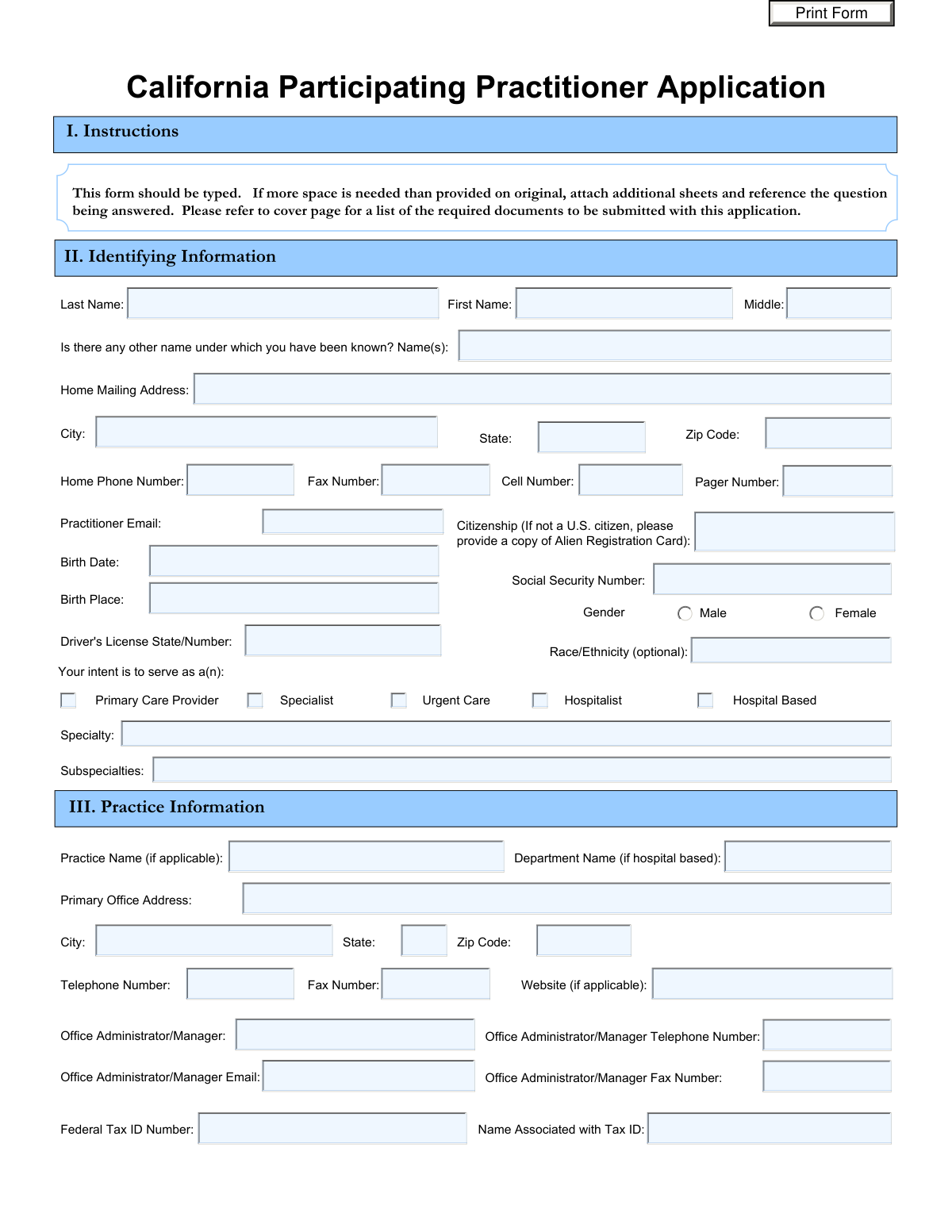
These applications are typically required when a provider is joining a new hospital system, enrolling in government programs like Medicare through the CMS-855I, or applying for state-specific insurance networks using the California Participating Practitioner Application (CPPA). Beyond clinical medicine, practitioners in fields like environmental health or substance use disorder treatment may need specific registration forms to operate legally within their jurisdictions. Whether you are a physician assistant, a clinical social worker, or a medical director, these documents are the foundation of your professional onboarding and credentialing process.
Filling out these lengthy, multi-page documents manually can be a significant administrative burden for busy professionals. Tools like Instafill.ai use AI to fill these forms in under 30 seconds, ensuring that data is handled accurately and securely so you can focus on your practice rather than paperwork.
Every form on this page can be completed without typing. Instafill is form filling software that reads a PDF and fills it for you — including flat and scanned documents that carry no fillable fields at all.
Forms in This Category
The forms in this category have a median Form Complexity Index of 93/100 (Very Complex), measured across 9 forms by field count, input difficulty, length, conditional logic and structure. See how it is calculated.
| Form Name | Pages | FCI | |
|---|---|---|---|
| 1. | California Participating Practitioner Application | 15 | Very Complex 85 |
| 2. | California Participating Practitioner Application (CPPA) | 17 | Very Complex 82 |
| 3. | CMS-855I, Medicare Enrollment Application for Physicians and Non-Physician Practitioners | 25 | Very Complex 89 |
| 4. | Contra Costa Environmental Health Division Body Arts Practitioner Application | 3 | Basic 45 |
| 5. | Oregon Practitioner Credentialing Application (2023) | 15 | Very Complex 100 |
| 6. | Oregon Practitioner Credentialing Application (including Attachment A: Professional Liability Action Detail) | 16 | Very Complex 100 |
| 7. | Oregon Practitioner Recredentialing Application | 13 | Very Complex 100 |
| 8. | SFHP Initial Application - California Participating Practitioner Application | 21 | Very Complex 94 |
| 9. | SFHP Initial Application, California Participating Practitioner Application | 22 | Very Complex 93 |
- Enterprise-grade security & data encryption
- 99%+ accuracy powered by AI
- 1,000+ forms from all industries
- Complete forms in under 60 seconds
How to Choose the Right Form
Medicare and Federal Enrollment
If you are a physician or non-physician practitioner (such as a nurse practitioner or physical therapist) looking to bill the federal government for services, you will likely need Form CMS-855I, Medicare Enrollment Application for Physicians and Non-Physician Practitioners. This multi-section document is used for initial enrollment, revalidation of your billing privileges, or reporting changes to your practice information. It is the essential form for obtaining a Medicare billing number (PTAN).
State-Specific Health Plan Credentialing
When joining a specific health plan’s network or seeking hospital privileges, the form you need depends heavily on your geographic location:
- California: Use the California Participating Practitioner Application (CPPA). This is the standardized form used by most California health plans and provider organizations. If you are specifically looking to join the San Francisco Health Plan, use the SFHP Initial Application - California Participating Practitioner Application.
- Oregon: Select the Oregon Practitioner Credentialing Application. This statewide form includes Attachment A: Professional Liability Action Detail and is required for credentialing with Oregon-based hospitals and health plans.
- Massachusetts: For enrollment in the MassHealth program, use the Commonwealth of Massachusetts Provider Application: Medical Practitioner (Form PE-MP) to provide your credentials and practice details.
Specialized Practice and Specialized Programs
If your practice falls outside of standard medical credentialing or involves specific state-funded programs, look for these specialized forms:
- Substance Use Disorder Treatment: If you are a medical director or treatment professional enrolling in the Drug Medi-Cal program in California, use Form DHCS 6010. This form links practitioners to specific clinic sites for program participation.
- Body Art Practitioners: For individuals in Contra Costa County performing tattooing, piercing, or permanent cosmetics, the Contra Costa Environmental Health Division Body Arts Practitioner Application is required to comply with the California Safe Body Art Act.
By selecting the form that matches both your state and your specific intent—whether it's federal billing, private insurance credentialing, or specialized registration—you can ensure your application is processed without delay.
Form Comparison
| Form | Purpose | Scope | Primary Focus |
|---|---|---|---|
| California Participating Practitioner Application | Credentialing for physicians joining health plan networks in California. | California health plans and provider organizations. | Practice details, education, licensure, and professional liability coverage. |
| California Participating Practitioner Application (CPPA) | Standardized application for initial credentialing and recredentialing across multiple plans. | California statewide health industry collaboration efforts. | Comprehensive demographics, hospital privileges, work history, and attestation statements. |
| CMS-855I, Medicare Enrollment Application for Physicians and Non-Physician Practitioners | Enrollment in Medicare to receive billing numbers or report changes. | Federal Medicare program across the United States. | Medical specialties, practice locations, and adverse legal history disclosure. |
| Commonwealth of Massachusetts Provider Application: Medical Practitioner | Enrolling individual practitioners into the state MassHealth program. | Commonwealth of Massachusetts healthcare system. | Professional credentials and disclosure of sanctions or criminal history. |
| Contra Costa Environmental Health Division Body Arts Practitioner Application | Registration for tattooing, piercing, permanent cosmetics, and branding services. | Contra Costa County, California local jurisdiction. | Proof of training, vaccination records, and Safe Body Art Act compliance. |
| Drug Medi-Cal Substance Use Disorder Medical Director/ Licensed Substance Use Disorder Treatment Professional/ Substance Use Disorder Non-Physician Medical Practitioner Application/Agreement/Disclosure Statement | Linking substance use disorder professionals to specific clinic sites. | California Department of Health Care Services (Drug Medi-Cal). | Provider agreements and disclosure statements for site-specific enrollment. |
| Oregon Practitioner Credentialing Application (including Attachment A: Professional Liability Action Detail) | Statewide credentialing for Oregon hospitals and health plans. | State of Oregon healthcare facilities and networks. | Professional liability history, facility affiliations, and peer references. |
| SFHP Initial Application - California Participating Practitioner Application | Application for joining the San Francisco Health Plan provider network. | San Francisco Health Plan (SFHP) localized network. | Credentialing details specific to San Francisco-based health services. |
Tips for practitioner application forms
Omissions or unexplained gaps in your employment history can trigger manual reviews and significantly delay your credentialing process. Always provide the month and year for every position and include brief explanations for any period of unemployment exceeding 30 days to ensure a smooth approval.
Most practitioner applications require specific details from your state license, DEA certificate, and board certifications. Having these documents scanned and ready in a single digital folder allows you to reference expiration dates and license numbers quickly without interrupting the data entry process.
AI-powered tools like Instafill.ai can complete these complex practitioner forms in under 30 seconds with high accuracy. This technology ensures your sensitive professional data stays secure during the process, making it an essential time-saver for providers managing multiple network applications.
Discrepancies between your self-disclosed legal history and official data bank reports can lead to immediate application denial. Be transparent about past professional liability actions or sanctions, ensuring your explanations match the official records provided in any required addendums.
For Medicare and state-specific forms, ensure the physical practice address is 100% accurate and matches your NPI registry data. Incorrect billing or 'remit-to' addresses are common reasons for reimbursement delays after your application is officially approved.
Standardized forms like the CPPA or Oregon Practitioner Application often require specific attachments such as professional liability action details. Missing these supplementary pages can result in your application being returned as incomplete, forcing you to restart the submission queue from the beginning.
Frequently Asked Questions
These forms are used by healthcare professionals and other specialized practitioners to enroll in insurance programs, join provider networks, or obtain legal registration to practice. They facilitate the credentialing process by verifying a practitioner's education, licensing, and professional history to ensure they meet the standards of a specific organization.
This category includes forms for a wide range of professionals, including physicians, nurse practitioners, physician assistants, and clinical social workers. In certain regions, specialized professionals like body art practitioners or substance use disorder medical directors also use these forms for local registration or state program enrollment.
The CMS-855I is specifically for individual physicians and non-physician practitioners who want to enroll in the Medicare program to bill for services. You should use this form if you are a new provider, need to revalidate your existing enrollment, or need to report changes to your practice information to the Centers for Medicare & Medicaid Services.
The CPPA is a standardized form used by many health plans and provider organizations across California to streamline the credentialing and recredentialing process. Instead of filling out different forms for every insurance network, practitioners can use this comprehensive document to provide their demographics, work history, and liability coverage details.
Yes, you can use AI tools like Instafill.ai to complete complex practitioner forms in under 30 seconds. The AI accurately extracts data from your existing CV or source documents and places it directly into the required fields, significantly reducing the manual effort involved.
Traditional manual entry for lengthy documents like the CMS-855I or the Oregon Credentialing Application can take several hours due to the amount of detail required. Using an AI-powered service like Instafill.ai, these forms can be completed in less than a minute by automating the data entry process.
Most applications require supporting documentation such as copies of your state professional license, DEA registration, and proof of professional liability insurance. You may also need to provide certificates of education, board certifications, and detailed explanations for any past legal or professional sanctions.
Submission locations vary depending on the specific form; for example, Medicare forms are sent to a Medicare Administrative Contractor (MAC), while the CPPA is usually submitted directly to the health plan or hospital. Always check the specific instructions provided by the organization requesting the form to ensure it reaches the correct department.
Yes, many of these forms are designed for both initial enrollment and periodic recredentialing. Standardized forms like the Oregon Practitioner Credentialing Application or the CMS-855I are also used to update information or revalidate your status every few years.
Errors or omissions on these applications can lead to significant delays in your ability to bill insurance or practice at a facility. In some cases, providing false information on federal forms like the CMS-855I can result in legal penalties or exclusion from government healthcare programs.
Glossary
- Form Complexity Index
- Instafill’s 0–100 measure of how much effort a form takes to complete, calculated deterministically from the form’s own structure rather than estimated. It combines the number of fillable fields (the largest factor), how difficult those fields are to complete based on their type, the number of pages that contain fields, the amount of conditional “fill-only-if” logic, and how many sections the form is divided into, then adds modifiers for tables and repeating lists, bundled instruction pages, and dense page layouts. A higher score means the form is harder to fill out by hand. The forms in this category have a median Form Complexity Index of 93/100 (Very Complex). See exactly how it is calculated.
- Credentialing
- The formal process of verifying a healthcare practitioner's education, training, experience, and licensure to ensure they meet the standards required by a health plan or medical facility.
- NPI (National Provider Identifier)
- A unique 10-digit identification number issued to healthcare providers in the United States by the Centers for Medicare & Medicaid Services (CMS) to improve the efficiency of electronic health transactions.
- CMS (Centers for Medicare & Medicaid Services)
- The federal agency that administers the Medicare program and works in partnership with state governments to administer Medicaid and the Children's Health Insurance Program (CHIP).
- PTAN (Provider Transaction Access Number)
- A Medicare-specific number assigned to a practitioner upon enrollment that is used to authenticate the provider's identity when calling the Medicare contractor or using automated systems.
- Reassignment of Benefits
- A legal arrangement where a practitioner authorizes Medicare to send payments for their services directly to an employer, such as a hospital or medical group, instead of receiving the payment personally.
- Attestation
- A formal declaration included in most application forms where the practitioner signs to certify that all information provided is true, accurate, and complete under penalty of law.
- Professional Liability Insurance
- Often called malpractice insurance, this is coverage that protects practitioners against claims of negligence or harm resulting from their professional services; proof of this is usually required for credentialing.
- Revalidation
- The periodic process where practitioners must resubmit or update their enrollment information to confirm they still meet all requirements to continue billing programs like Medicare or Medicaid.