Fill out verification forms
with AI.
Verification forms are essential instruments used to validate the accuracy of information provided by individuals or organizations. These documents serve as a formal record, ensuring that applicants meet specific legal, professional, or regulatory requirements. Whether it is confirming a person's identity, their legal authorization to work in a specific country, or their professional certifications, these forms provide the necessary proof to move forward with hiring, licensing, or financial applications.
By continuing, you acknowledge Instafill's Privacy Policy and agree to get occasional product update and promotional emails.
About verification forms
This category is frequently utilized by human resource professionals, government agencies, and medical administrators who must maintain strict compliance standards. For instance, the Form I-9 is a staple of the American onboarding process to verify employment eligibility, while specialized documents like the Medical Assistant Training Verification form ensure that healthcare providers are properly qualified. Beyond the workplace, legal authorization forms are also used in the insurance and financial sectors to verify property safety features or residential addresses for account security.
Filling out these detailed documents accurately is critical to avoid legal delays or rejected applications. Tools like Instafill.ai use AI to fill these verification forms in under 30 seconds, ensuring data is handled securely and precisely. This streamlined approach allows users to focus on their core responsibilities rather than manual data entry.
Every form on this page can be completed without typing. Instafill is form filling software that reads a PDF and fills it for you — including flat and scanned documents that carry no fillable fields at all.
Forms in This Category
The forms in this category have a median Form Complexity Index of 69/100 (Complex), measured across 13 forms by field count, input difficulty, length, conditional logic and structure. See how it is calculated.
| Form Name | Pages | FCI | |
|---|---|---|---|
| 1. | Address Verification Letter of Authorization | 1 | Basic 34 |
| 2. | AIA International Limited Medical Claim Form | 7 | Moderate 59 |
| 3. | Centrelink Form SY015 - Verification of 'Unreasonable to Live at Home' | 5 | Complex 70 |
| 4. | Centrelink Form SY041 - Verification of your family circumstances: Unreasonable to live at home | 2 | Complex 69 |
| 5. | Day Care Service Application Worker Verification Checklist | 5 | Basic 37 |
| 6. | Form I-9, Employment Eligibility Verification | 1 | – |
| 7. | Form I-9, Employment Eligibility Verification (08/01/23) | 4 | Complex 70 |
| 8. | Form I-9, Employment Eligibility Verification (08/01/23) - Duplicate | 4 | Complex 69 |
| 9. | Formulario I-9, Verificación de Elegibilidad de Empleo | 5 | Complex 70 |
| 10. | Form G-845, Verification Request | 3 | Moderate 46 |
| 11. | Independent Diagnostic Testing Facility (IDTF) Site Verification Report | 5 | Complex 71 |
| 12. | Medical Assistant Training Verification | 1 | Simple 28 |
| 13. | Uniform Mitigation Verification Inspection Form | 6 | Complex 73 |
- Enterprise-grade security & data encryption
- 99%+ accuracy powered by AI
- 1,000+ forms from all industries
- Complete forms in under 60 seconds
How to Choose the Right Form
Navigating verification and authorization forms can be complex, as they span across employment law, healthcare compliance, and financial security. To find the right document, identify the specific entity requesting the verification and the regulatory body involved.
Employment and Immigration Compliance
If you are an employer or a new hire, the most common document you will need is Form I-9, Employment Eligibility Verification. This is a mandatory USCIS form used to document that an employee is legally authorized to work in the United States.
For government agencies or registered organizations needing to confirm an individual's immigration status specifically to determine eligibility for public benefits, select Form G-845, Verification Request.
Healthcare and Facility Standards
Forms in this category often focus on professional qualifications or facility readiness:
- Medical Assistant Training Verification: Use this if you are a licensed physician needing to certify that a medical assistant has completed training for specific clinical tasks like injections or lab tests.
- Independent Diagnostic Testing Facility (IDTF) Site Verification Report: This is a specialized checklist for facilities seeking to meet CMS performance standards for Medicare enrollment. It is typically used during site visits to document equipment and personnel compliance.
Financial and Property Verification
These forms are used to validate residency or physical property safety for insurance and banking purposes:
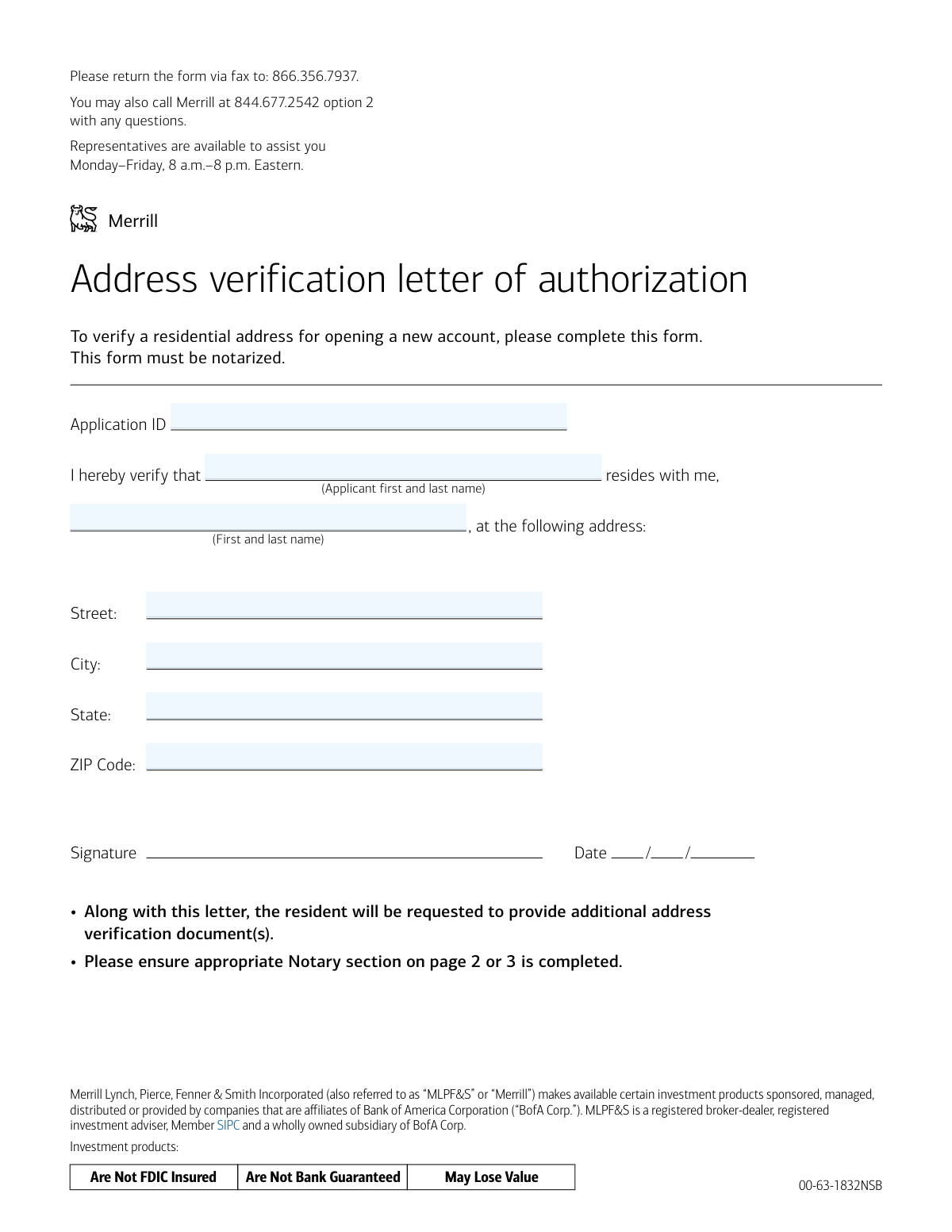
- Address Verification Letter of Authorization: Specifically provided by Merrill Lynch, this form is used when opening a new account. It allows a third party to attest to an applicant's residential address and requires notarization.
- Uniform Mitigation Verification Inspection Form: Also known as the OIR-B1-1802, this is the standard document for Florida homeowners to certify wind-resistant construction features. This form is essential for those looking to secure discounts on windstorm insurance premiums.
Using Instafill.ai, you can quickly complete these forms with AI assistance, ensuring that critical fields—such as notary sections or employer certifications—are handled accurately.
Form Comparison
| Form | Primary Purpose | Who is Verified | Required Verifier |
|---|---|---|---|
| Address Verification Letter of Authorization | Confirms residential address for opening a new financial account. | Applicant residing with a third-party host. | Third-party resident and a Notary Public. |
| Form I-9, Employment Eligibility Verification | Documents identity and legal authorization to work in U.S. | All newly hired employees regardless of citizenship status. | The employee and the employer. |
| Form G-845, Verification Request | Confirms immigration status for benefit or service eligibility. | Individuals applying for benefits through registered agencies. | Registered government agencies and USCIS. |
| Independent Diagnostic Testing Facility (IDTF) Site Verification Report | Ensures facility meets CMS standards for Medicare enrollment. | Independent Diagnostic Testing Facilities (IDTF). | Authorized site inspectors and CMS representatives. |
| Medical Assistant Training Verification | Attests to completion of specific clinical and laboratory training. | Medical assistants working under professional supervision. | A licensed physician or healthcare provider. |
| Uniform Mitigation Verification Inspection Form | Certifies wind mitigation features for insurance premium discounts. | Residential properties, specifically in Florida. | Qualified building inspectors or licensed engineers. |
Tips for verification forms
When filling out verification forms like the I-9 or G-845, double-check that the names, dates of birth, and identification numbers match your government-issued documents precisely. Even minor discrepancies between the form and your supporting ID can lead to processing delays or the rejection of your verification request.
Many forms in this category, such as the Medical Assistant Training Verification or Address Letter of Authorization, require signatures from supervisors or co-residents. Reach out to these individuals ahead of time to ensure they are available to sign and, if necessary, arrange for a notary to be present to witness the document.
Managing multiple verification forms is much easier when using automation. AI-powered tools like Instafill.ai can complete these forms in under 30 seconds with high accuracy, ensuring that your data stays secure and private while saving you significant manual effort.
Regulatory agencies frequently update forms like the I-9 or CMS site reports. Before you begin, check the expiration or edition date at the bottom of the document to ensure you are using the version currently accepted by the agency, as outdated forms are often returned as invalid.
Verification forms often contain sensitive personal information and serve as critical proof of compliance for employers and facilities. Store completed digital copies in an encrypted environment so you can quickly retrieve them during internal audits or when renewing insurance premiums and professional certifications.
For technical documents like the Uniform Mitigation Verification or IDTF reports, ensure every checkbox regarding equipment or construction features is clearly marked. Leaving technical sections blank can result in the denial of insurance discounts or the need for a costly follow-up site visit.
Frequently Asked Questions
Verification forms are official documents used to confirm the accuracy of specific information, such as an individual's identity, employment eligibility, residency, or professional qualifications. These forms provide a standardized way for third parties or government agencies to validate that the data provided by an applicant is truthful and meets specific regulatory requirements.
The responsibility for completion depends on the specific form; for example, the Form I-9 requires input from both the employee and the employer. Other forms, such as medical training or site inspections, must be completed and signed by a licensed professional or supervisor who can attest to the facts being verified.
The correct form is typically dictated by the organization requesting the verification, such as the USCIS for immigration matters, the CMS for healthcare facilities, or an insurance provider for property inspections. Always check the specific requirements of the requesting entity to ensure you are using the most current version of the document.
Yes, AI-powered tools like Instafill.ai can be used to fill out these forms in under 30 seconds. The AI accurately extracts data from your source documents and places it into the appropriate fields, ensuring that the final PDF is legible and correctly formatted.
Some verification forms, such as those used for residential address authorization, require a notary public to witness the signatures to be legally valid. You should review the signature section of your specific form to see if a notary seal or official stamp is required before submission.
While manual entry can take 15 to 20 minutes, using an AI service can complete the process in less than 30 seconds. These tools automate the data entry process by pulling information directly from your identification or records and mapping it to the form's specific fields.
Many organizations, including the USCIS for Form I-9, accept electronic signatures, provided they meet specific security and audit trail standards. However, some forms may still require a physical 'wet' signature, so it is important to confirm the submission guidelines with the receiving agency.
Submitting inaccurate information on verification forms can lead to significant delays, the denial of benefits, or even legal consequences for fraud. It is crucial to ensure all data, such as dates of birth and social security numbers, are double-checked for accuracy before the form is finalized.
Submission instructions vary by document; some are sent directly to government agencies, while others are kept on file by employers or submitted to insurance companies. Always refer to the filing instructions provided on the form or by the person who requested the documentation.
Different forms serve different regulatory needs; for instance, Form I-9 is for general employment eligibility, while Form G-845 is used by specific agencies to verify immigration status for benefit eligibility. Each form is tailored to meet the legal standards of the specific program or law it supports.
Glossary
- Form Complexity Index
- Instafill’s 0–100 measure of how much effort a form takes to complete, calculated deterministically from the form’s own structure rather than estimated. It combines the number of fillable fields (the largest factor), how difficult those fields are to complete based on their type, the number of pages that contain fields, the amount of conditional “fill-only-if” logic, and how many sections the form is divided into, then adds modifiers for tables and repeating lists, bundled instruction pages, and dense page layouts. A higher score means the form is harder to fill out by hand. The forms in this category have a median Form Complexity Index of 69/100 (Complex). See exactly how it is calculated.
- USCIS
- The U.S. Citizenship and Immigration Services, a federal agency within the Department of Homeland Security that oversees lawful immigration and processes employment verification forms.
- Employment Authorization
- The legal right for an individual to work in the United States, which must be verified by employers using specific identification and residency documents.
- List A, B, and C Documents
- Categories of identification used on the Form I-9; List A documents prove both identity and work eligibility, while List B proves identity and List C proves work authorization.
- Notarization
- The official act of a Notary Public witnessing the signing of a document to verify the identity of the signer and ensure the document is legally binding.
- Letter of Authorization (LOA)
- A formal document that grants a specific person or entity the legal permission to act on behalf of another or to verify sensitive information like a residential address.
- CMS
- The Centers for Medicare & Medicaid Services, the federal agency that sets performance standards and enrollment requirements for healthcare facilities and diagnostic centers.
- IDTF (Independent Diagnostic Testing Facility)
- A medical facility independent of a hospital or physician's office that performs diagnostic tests and must undergo site verification to participate in Medicare.
- Wind Mitigation
- The addition of specific construction features to a property, such as reinforced roof attachments, that reduce potential damage from high winds and can lower insurance premiums.