Fill out visa forms
with AI.
Visa forms represent the essential legal documentation required for international travel, residency, and professional migration. These documents are the primary method through which governments assess eligibility, security, and the specific purpose of a visit. Whether you are dealing with Australian immigration forms or European Schengen applications, providing accurate information is vital to avoid processing delays or entry rejections. These forms matter because they serve as the official record of an applicant's background, financial stability, and legal intent while in a foreign country.
By continuing, you acknowledge Instafill's Privacy Policy and agree to get occasional product update and promotional emails.
About visa forms
This category covers a wide range of scenarios, from business travelers needing a visitor stream visa for negotiations to individuals seeking safety through protection or offshore humanitarian programs. You will find various Australian government forms used by the Department of Home Affairs, alongside documents for long-stay visas in Europe or employment-related applications for domestic helpers in Hong Kong. Typically, these visa forms are required by anyone planning to stay in a foreign territory for work, family reunification, or study. Because many of these are complex home affairs forms, ensuring every detail matches your official identification is critical for a successful application.
Managing these administrative requirements can be time-consuming, but tools like Instafill.ai use AI to fill these forms in under 30 seconds, handling your data accurately and securely. This practical approach helps applicants move through the bureaucratic process more efficiently, ensuring that every field is addressed correctly before final submission.
Every form on this page can be completed without typing. Instafill is form filling software that reads a PDF and fills it for you — including flat and scanned documents that carry no fillable fields at all.
Forms in This Category
The forms in this category have a median Form Complexity Index of 72/100 (Complex), measured across 10 forms by field count, input difficulty, length, conditional logic and structure. See how it is calculated.
| Form Name | Pages | FCI | |
|---|---|---|---|
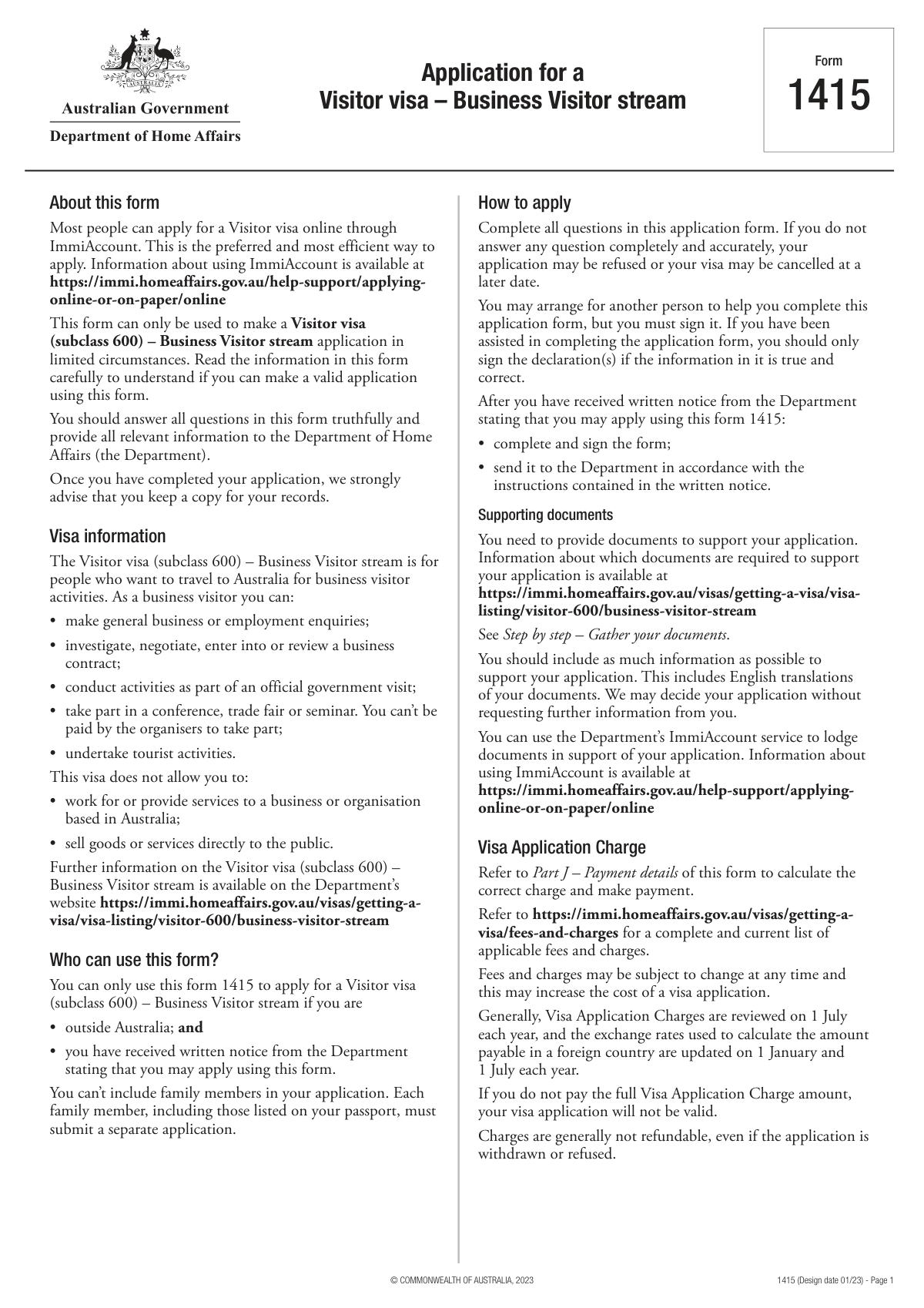
| 1. | Form 1415, Visitor Visa - Business Stream | 14 | Very Complex 89 |
| 2. | Application for Visit Visa (Sri Lanka) | 5 | Complex 67 |
| 3. | Australian Department of Home Affairs — Application for a Protection visa (subclass 866) (Form 866) | 34 | Complex 77 |
| 4. | Domanda di visto Nazionale (D), National Visa Application (D) | 4 | Complex 72 |
| 5. | Form 842, Application for an Offshore Humanitarian visa (Refugee and Humanitarian (Class XB) visa) | 34 | Complex 79 |
| 6. | Form DS-234, Special Immigrant Visa Biodata Form | 2 | Complex 79 |
| 7. | Form ID 988A, Visa/Extension of Stay Application Form for Domestic Helper from Abroad (to be completed by the helper) | 4 | Moderate 54 |
| 8. | Formular C1 – Antrag auf Erteilung eines Schengen-Visums (Application for Schengen Visa) | 4 | Moderate 58 |
| 9. | Solicitud de visado Schengen, Schengen Visa Application Form | 4 | Moderate 54 |
| 10. | Termo de Responsabilidade (Term of Responsability) – Alojamento e Encargos de Subsistência (Visa Code Article 14(4)) | 3 | Moderate 51 |
- Enterprise-grade security & data encryption
- 99%+ accuracy powered by AI
- 1,000+ forms from all industries
- Complete forms in under 60 seconds
How to Choose the Right Form
Navigating international travel and immigration requirements often starts with identifying the correct government paperwork. Whether you are searching for Australian Home Affairs forms or European entry documents, selecting the right form depends on your destination, the length of your stay, and your specific intent.
Australian Immigration and Protection
If you are dealing with Australian government forms, your choice depends on your current location and status:
- Business Travel: Use Form 1415, Visitor Visa - Business Stream if you are traveling to Australia for negotiations or conferences without seeking local employment.
- Humanitarian & Protection: If you are already in Australia and seeking asylum, use Form 866 (Protection visa). If you are currently outside Australia and applying for entry on humanitarian grounds, you must complete Form 842 (Offshore Humanitarian visa).
European and Schengen Visas
For travel within the EU, the forms are categorized by the duration of your stay and the country of entry:
- Short Stays: For visits up to 90 days in the Schengen Area, use Formular C1 – Antrag auf Erteilung eines Schengen-Visums.
- Long Stays (Italy): If you are planning to stay in Italy for more than 90 days for work, study, or family, the Domanda di visto Nazionale (D) is required.
- Sponsorship: If you are hosting a visitor and need to guarantee their accommodation and expenses, complete the Termo de Responsabilidade (Term of Responsibility).
Work and Tourism in Asia
- Hong Kong: Foreign domestic helpers applying for a visa or stay extension must use Form ID 988A to provide personal and employment details.
- Sri Lanka: For general tourism or short-term visits to Sri Lanka, the Application for Visit Visa (Sri Lanka) is the standard requirement for assessing entry eligibility.
Using Instafill.ai, you can quickly complete these complex visa forms by converting them into interactive, AI-assisted documents, ensuring all critical fields are filled accurately to avoid processing delays.
Tips for visa forms
Double-check that names, dates of birth, and passport numbers exactly match your official identification. Even a small typo or discrepancy between your visa form and your passport can lead to significant delays or immediate visa denials during the official review process.
Many immigration forms, especially for Australian and Italian visas, require a complete chronological history of your addresses and employment. If there are periods where you were unemployed or traveling, list them explicitly rather than leaving blank spaces in the timeline to avoid follow-up inquiries.
AI-powered tools like Instafill.ai can complete complex visa forms in under 30 seconds with high accuracy. This is a real time-saver for people dealing with multiple forms, and you can rest assured that your sensitive data stays secure during the entire process.
Gather your passport, travel itinerary, and host details, such as a Termo de Responsabilidade, before you begin filling out the application. Having these details ready prevents the need to search for information mid-form, which helps maintain focus and ensures no mandatory fields are missed.
Forms like the Australian 842 or the Hong Kong ID 988A often contain specific declarations or values statements that require separate signatures. Missing a single signature on these internal pages is a common mistake that can result in your entire application being returned as incomplete.
For international forms like the Schengen C1, ensure that names and places are transliterated correctly according to the standard used in your passport. If the form requires specific characters or a specific language, double-check that your inputs meet the consulate's technical requirements.
Frequently Asked Questions
If you are traveling to Australia for business purposes like negotiations or conferences without engaging in direct work, you should use Form 1415 (Visitor Visa - Business Stream). This form is specifically for individuals who do not intend to sell goods or services directly to the public during their stay.
A Schengen visa (Type C) allows for short stays of up to 90 days across the Schengen Area, while a National visa (Type D) is for long-term stays exceeding 90 days in a specific country, such as Italy. Each requires a different application form depending on your intended length of stay and purpose, such as study or work.
Yes, modern AI tools like Instafill.ai allow you to complete complex visa forms in under 30 seconds. The AI accurately extracts data from your source documents and places it directly into the required fields, reducing the risk of manual entry errors.
Form 842 is intended for individuals currently outside of Australia who are seeking entry on humanitarian grounds. This includes those applying for refugee, in-country special humanitarian, or woman at risk visa subclasses, and it often requires additional supporting documents from a proposer.
Submission locations vary by country and visa type, but most forms are submitted to the relevant embassy, consulate, or an authorized visa application center. Some forms, like Australian Home Affairs forms, may be submitted through official online portals or specific processing centers as indicated in the form instructions.
A Term of Responsibility is a formal declaration by a host or sponsor confirming they will provide accommodation and cover living expenses for the visitor. This document serves as proof of financial means and must typically be presented in its original form with a notarized signature to the consular authorities.
While manually completing these forms can take hours due to their complexity, using AI-powered services like Instafill.ai can reduce the time to less than 30 seconds. The system automatically populates the fields by pulling information from your identity and travel documents.
Yes, foreign domestic helpers applying for a visa or an extension of stay in Hong Kong must complete Form ID 988A. This form collects personal and employment details necessary for legal work authorization, whether for a new contract or a renewal.
Providing false or incomplete information can lead to the immediate rejection or later annulment of your visa. In some jurisdictions, it may also result in legal consequences or a ban from future visa applications, so ensuring data accuracy is critical for a successful outcome.
Most visa applications require supporting documentation such as passport copies, proof of funds, travel itineraries, and health or character declarations. You should always check the specific checklist for the visa subclass you are applying for to ensure all necessary attachments are included to avoid processing delays.
Glossary
- Form Complexity Index
- Instafill’s 0–100 measure of how much effort a form takes to complete, calculated deterministically from the form’s own structure rather than estimated. It combines the number of fillable fields (the largest factor), how difficult those fields are to complete based on their type, the number of pages that contain fields, the amount of conditional “fill-only-if” logic, and how many sections the form is divided into, then adds modifiers for tables and repeating lists, bundled instruction pages, and dense page layouts. A higher score means the form is harder to fill out by hand. The forms in this category have a median Form Complexity Index of 72/100 (Complex). See exactly how it is calculated.
- Subclass
- A specific category of Australian visa identified by a three-digit number that defines the rules, rights, and requirements of that particular visa type.
- Schengen Area
- A group of 29 European countries that have abolished internal border controls, allowing travelers to move between them using a single standardized visa.
- Department of Home Affairs (DHA)
- The Australian government agency responsible for managing immigration, border security, and the processing of all Australian visa applications.
- Biometrics
- Physical data, typically fingerprints and a digital photograph, that visa applicants must provide to verify their identity during the application process.
- Type D Visa
- Also known as a National Visa, this is a long-stay permit for European countries (like Italy) intended for stays longer than 90 days for work, study, or family reasons.
- Offshore Application
- A visa application submitted by an individual who is physically located outside of the country they are seeking to enter at the time of the application.
- Certified Document
- A photocopy of an original document that has been signed and stamped by an authorized professional to verify it is a true copy of the original.
- Protection Visa
- A specific visa class for individuals who are already within a country and are seeking asylum because they cannot return to their home country due to fear of persecution.