Yes! You can use AI to fill out Form 630, Individual Identification Information Record
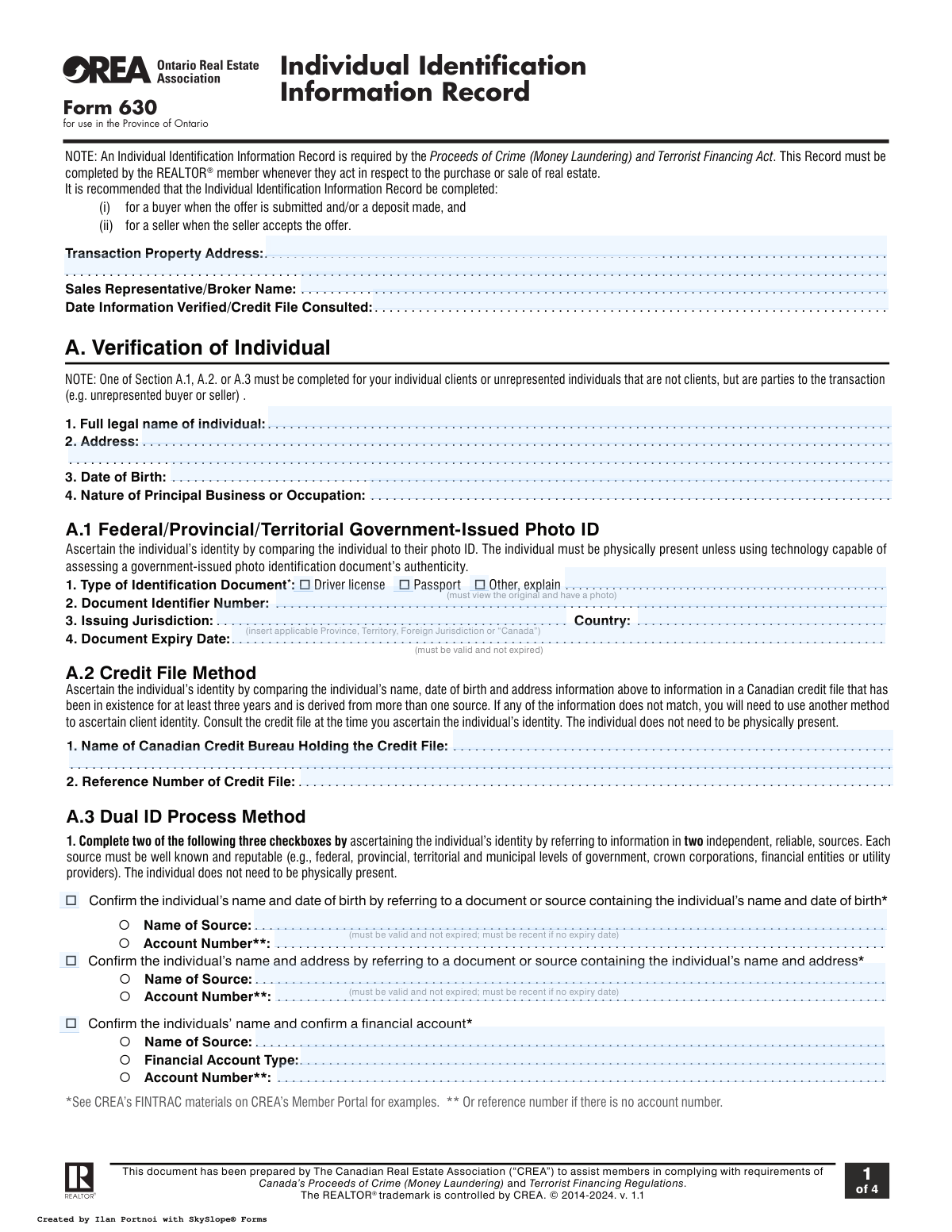
Form 630, the Individual Identification Information Record, is a mandatory document for REALTORSĀ® in Ontario, required by the Proceeds of Crime (Money Laundering) and Terrorist Financing Act. It is used to formally verify and record the identity of individuals involved in a real estate purchase or sale to prevent financial crimes. Today, this form can be filled out quickly and accurately using AI-powered services like Instafill.ai, which can also convert non-fillable PDF versions into interactive fillable forms.
Form 630 is part of the
identification forms category on Instafill.
Our AI automatically handles information lookup, data retrieval, formatting, and form filling.
It takes less than a minute to fill out Form 630 using our AI form filling.
Securely upload your data. Information is encrypted in transit and deleted immediately after the form is filled out.
Form specifications
| Form name: | Form 630, Individual Identification Information Record |
| Number of fields: | 159 |
| Number of pages: | 4 |
| Filled form examples: | Form Form 630 Examples |
| Language: | English |
More forms in Identification forms
Instafill Demo: How to fill out PDF forms in seconds with AI
How to Fill Out Form 630 Online for Free in 2026
Are you looking to fill out a FORM 630 form online quickly and accurately? Instafill.ai offers the #1 AI-powered PDF filling software of 2026, allowing you to complete your FORM 630 form in just 37 seconds or less.
Follow these steps to fill out your FORM 630 form online using Instafill.ai:
- 1 Navigate to Instafill.ai and upload or select the Individual Identification Information Record (Form 630).
- 2 Enter the transaction property address, your name as the Sales Representative/Broker, and the date of verification.
- 3 Provide the individual's full legal name, address, date of birth, and occupation.
- 4 Choose one of the three identity verification methods (Government-Issued Photo ID, Credit File, or Dual ID Process) and input the required document details.
- 5 Complete the sections for verifying third-party involvement and answer the client risk assessment questionnaire.
- 6 Specify the purpose of the business relationship, such as the type of property being transacted.
- 7 Review all the information pre-filled by the AI for accuracy, make any necessary corrections, and then securely download or share the completed Form 630.
Our AI-powered system ensures each field is filled out correctly, reducing errors and saving you time.
Why Choose Instafill.ai for Your Fillable Form 630 Form?
Speed
Complete your Form 630 in as little as 37 seconds.
Up-to-Date
Always use the latest 2026 Form 630 form version.
Cost-effective
No need to hire expensive lawyers.
Accuracy
Our AI performs 10 compliance checks to ensure your form is error-free.
Security
Your personal information is protected with bank-level encryption.
Frequently Asked Questions About Form Form 630
Form 630, the Individual Identification Information Record, is a mandatory document used by REALTORSĀ® in Ontario. It is required under Canada's Proceeds of Crime (Money Laundering) and Terrorist Financing Act to verify the identity of all individuals involved in a real estate transaction.
Your REALTORĀ® is responsible for completing this form for every individual they represent as a client, such as a buyer or seller. They must also complete it for unrepresented individuals who are a party to the transaction.
It is recommended that the form be completed for a buyer when an offer is submitted or a deposit is made. For a seller, it should be completed when they accept an offer.
You will need to provide your full legal name, address, date of birth, and your principal business or occupation. Your REALTORĀ® will then verify this information using one of the approved methods outlined in the form.
Your REALTORĀ® will use one of three methods: verifying a government-issued photo ID like a driver's license or passport, consulting your Canadian credit file, or using a dual-ID process with two independent sources (e.g., a utility bill and a bank statement).
This section is used to determine if you are conducting the real estate transaction on behalf of another person or entity. If so, your REALTORĀ® is required to collect information about that third party.
The Client Risk section (Section C) is an internal tool for the brokerage to comply with federal law. It helps assess the potential risk of money laundering or terrorist financing, and a high score simply triggers enhanced due diligence measures.
Not always. While the photo ID method requires you to be physically present (unless specific technology is used), the Credit File and Dual ID Process methods do not require you to be physically present for verification.
If the risk score is 10 or higher, the client is considered high risk, and the REALTORĀ® must apply enhanced measures. This may include asking for an additional piece of ID or conducting further searches in consultation with their Compliance Officer.
This section documents the purpose and intended nature of your professional relationship with the brokerage, such as buying a residential home or commercial land. It helps fulfill ongoing client monitoring requirements under FINTRAC regulations.
Yes, services like Instafill.ai use AI to accurately auto-fill form fields, which can save time and reduce errors for both clients and REALTORSĀ®. This helps streamline the entire documentation process.
Your REALTORĀ® can use a platform like Instafill.ai to send you a secure, interactive version of the form. You can then fill it out and sign it electronically from any device, making the process quick and convenient.
If you have a flat, non-fillable PDF, you can use a service like Instafill.ai to instantly convert it into a smart, fillable form. This allows you to easily type your information directly into the fields.
Compliance Form 630
Validation Checks by Instafill.ai
1
Ensures Identification Document is Not Expired
This check validates that the 'Document Expiry Date' provided in Section A.1 is a date in the future relative to the 'Date Information Verified'. This is critical for compliance as the form explicitly states the ID must be valid and not expired. If the ID is expired, the submission is invalid and cannot be used for identity verification, requiring the agent to request a current document from the individual.
2
Mandatory and Exclusive Verification Method Selection
This validation ensures that the user has completed the fields for exactly one of the three identity verification methods: A.1 (Photo ID), A.2 (Credit File), or A.3 (Dual ID). The form note specifies that one of these sections must be completed. A failure means either no method was chosen or multiple methods were, both of which make the form incomplete and non-compliant with FINTRAC regulations.
3
Conditional Requirement for 'Other' ID Type Explanation
If the 'Other' checkbox is selected under 'Type of Identification Document' in Section A.1, this check ensures the corresponding explanation field is not empty. This is important for clarity and record-keeping, as it specifies what type of non-standard ID was used. If the explanation is missing, the record is incomplete and lacks the necessary detail for an audit.
4
Dual ID Process Method Completeness
This check verifies that if Section A.3 (Dual ID Process Method) is used, exactly two of the three available checkboxes are selected and their associated data fields (e.g., 'Name of Source', 'Account Number') are filled. The form requires referring to two independent sources. Submitting with fewer or more than two sources selected, or with missing source details, invalidates this verification method.
5
Conditional Requirement for Third-Party Information
This validation enforces that if the user answers 'Yes' to the question 'Is the transaction being conducted on behalf of a third party?', then all fields in Section B.2 (Third Party Record) must be completed. This is a critical anti-money laundering check to identify all parties to a transaction. If Section B.2 is incomplete after a 'Yes' response, the submission fails as it does not meet the legal requirement to record third-party information.
6
Individual's Age Verification
This check validates that the 'Date of Birth' provided for the individual indicates they are of legal age to enter into a real estate contract (e.g., 18 years or older). This is essential to ensure the transaction is legally sound and the individual has the capacity to be a party to the agreement. A validation failure would flag the record for review as the transaction may not be legally enforceable.
7
Verification Date Logical Check
This validation ensures the 'Date Information Verified/Credit File Consulted' is a valid date and is not set in the future. The date must reflect when the verification activity actually occurred. A future date is logically impossible and indicates a data entry error, which compromises the integrity and accuracy of the compliance record.
8
Client Risk Questionnaire Completeness
This check ensures that every question in the Client Risk assessment (Part 1, questions 1-17) has been answered (e.g., 'Yes', 'No', 'Possibly'). An incomplete questionnaire prevents the calculation of an accurate risk score, which is a key component of the due diligence process. The form cannot be considered complete until all risk factors have been assessed.
9
Risk Score Calculation and High-Risk Flagging
This validation automatically calculates the total risk score based on the answers in Part 1 and the scoring table in Part 2. It then checks if the total is 10 or greater, as specified in Part 4. If the score is 10 or more, the system must flag the client as 'high risk' and prompt the user to consult a Compliance Officer, ensuring enhanced due diligence measures are applied as required by law.
10
Conditional Requirement for Risk Question Explanations
For risk questions that have a conditional explanation field (e.g., Q9, Q12, Q17), this check ensures the explanation is provided if the answer is 'Yes' or 'Possibly'. These explanations provide crucial context for the risk assessment and are necessary for a compliance officer's review. A missing explanation for a 'Yes' answer would result in an incomplete risk profile and a validation failure.
11
Transaction Property Address Completeness
This validation verifies that the 'Transaction Property Address' field is fully and properly completed, including street, city, province, and postal code. This information is fundamental to the record, linking the identity verification to a specific real estate transaction. An incomplete or malformed address makes the record ambiguous and difficult to audit, leading to a validation failure.
12
Third Party Telephone Number Format
When third-party information is provided in Section B.2, this check ensures the 'Telephone number' field contains a validly formatted phone number. Proper formatting is essential for data integrity and ensures that the third party can be contacted if necessary. An invalid format would be rejected to prevent the storage of useless or incorrect contact information.
13
Core Individual Information Mandatory Fields
This validation ensures that the individual's 'Full legal name', 'Address', 'Date of Birth', and 'Nature of Principal Business or Occupation' are all filled out. These four fields represent the core identity information required by FINTRAC regulations. If any of these fields are left blank, the form is fundamentally incomplete and cannot be accepted.
14
Business Relationship Purpose Selection
This check verifies that in Section D.1, at least one checkbox indicating the purpose of the business relationship is selected. It also ensures that if the 'Other, please specify' checkbox is selected, the corresponding text field is filled. This information is required to understand the context of the transaction and is necessary for a complete record; failure to specify the purpose results in an incomplete form.
Common Mistakes in Completing Form 630
The form explicitly requires a valid, unexpired government-issued photo ID. Individuals often forget to check the expiry date on their driver's license or passport, leading them to present an invalid document. This mistake invalidates the entire identity verification process, causing delays as the REALTORĀ® must re-engage the client to obtain a current ID. To avoid this, always check the expiry date before filling out the form; AI-powered tools like Instafill.ai can also flag expired dates during data entry.
Section A provides three distinct, mutually exclusive methods for identity verification (Photo ID, Credit File, or Dual ID). A common error is filling out more than one section or choosing an inappropriate method for the situation. This often happens due to confusion about the requirements for each method. This error can invalidate the compliance record, requiring the form to be redone and demonstrating a failure in the FINTRAC process. Carefully read the instructions and complete only one of sections A.1, A.2, or A.3.
When asked for 'Nature of Principal Business or Occupation', individuals often provide vague answers like 'Consultant,' 'Business Owner,' or 'Self-Employed.' FINTRAC regulations require a more specific description to properly assess risk and understand the client's source of funds. A vague entry can be a red flag for compliance officers, potentially triggering additional scrutiny and delays. Be specific, for example, 'IT Consultant specializing in network security' or 'Owner of a retail clothing store'.
Determining if a client is acting on behalf of a third party is a critical compliance step that is often misunderstood. People may not realize that acting on instructions from a family member, business partner, or hidden beneficial owner constitutes a third-party relationship. Ignoring this section or incorrectly checking 'No' is a serious compliance failure. This can lead to significant penalties for the brokerage for failing to identify potential money laundering risks. Always ask clients directly if they are acting on anyone else's instructions.
The risk assessment in Section C is complex, with a scoring system that can be counterintuitive. REALTORSĀ® may misinterpret questions, select the wrong response, or miscalculate the final score. An inaccurate risk score leads to applying the wrong level of due diligenceāeither creating unnecessary work or, more seriously, failing to identify a high-risk client as required by law. To prevent this, double-check each question and its corresponding score, and seek guidance from a compliance officer if the total is 10 or higher.
The form requires the individual's 'Full legal name' as it appears on their official identification. Many people habitually use a shortened name or nickname (e.g., 'Mike' instead of 'Michael') in daily life and enter it on the form. This creates a mismatch with the identification documents, rendering the verification invalid. This simple error can halt the transaction until the form is corrected and re-signed. Always use the exact full legal name as shown on your passport or driver's license.
This date field is crucial for creating a complete audit trail, as it documents the exact point in time when the client's identity was confirmed. It is frequently left blank or filled with an incorrect date, such as the date the transaction started rather than the date of verification. An omission or error here compromises the integrity of the compliance record. The REALTORĀ® must ensure this date is accurately recorded at the time of verification.
When using the Dual ID Process method, the form requires information from two separate, independent, and reliable sources. A frequent mistake is to only provide details for one source or to use two sources that are not considered independent (e.g., a bank statement and a credit card statement from the same bank). This renders the identification attempt incomplete and non-compliant. Ensure you provide complete details for two distinct sources as outlined in the form's instructions.
In Section A.1, when recording details from a photo ID, people often enter the country but forget to specify the 'Issuing Jurisdiction'. For a Canadian driver's license, for example, the jurisdiction is the province (e.g., 'Ontario'), not just 'Canada'. This omission makes the record incomplete, as the specific issuing authority is a required piece of data for proper identification. Always record both the country and the specific province, territory, or state that issued the document.
The very first field, 'Transaction Property Address', is sometimes filled out partially, perhaps missing a unit number or postal code. This happens when the person filling the form is in a hurry or assumes the information is known elsewhere. An incomplete address makes it difficult to definitively link the compliance record to the specific property, which can cause issues during an audit. To avoid this, always enter the full, complete, and accurate property address. AI form-fillers like Instafill.ai can help by autocompleting and validating addresses to ensure they are complete.
Saved over 80 hours a year
āI was never sure if my IRS forms like W-9 were filled correctly. Now, I can complete the forms accurately without any external help.ā
Kevin Martin Green
Your data stays secure with advanced protection from Instafill and our subprocessors

Robust compliance program
Transparent business model
Youāre not the product. You always know where your data is and what it is processed for.
ISO 27001, HIPAA, and GDPR
Our subprocesses adhere to multiple compliance standards, including but not limited to ISO 27001, HIPAA, and GDPR.
Security & privacy by design
We consider security and privacy from the initial design phase of any new service or functionality. Itās not an afterthought, itās built-in, including support for two-factor authentication (2FA) to further protect your account.
Fill out Form 630 with Instafill.ai
Worried about filling PDFs wrong? Instafill securely fills form-630-individual-identification-information-record forms, ensuring each field is accurate.



