Yes! You can use AI to fill out Form CH-100, Request for Civil Harassment Restraining Orders (Civil Harassment Prevention)
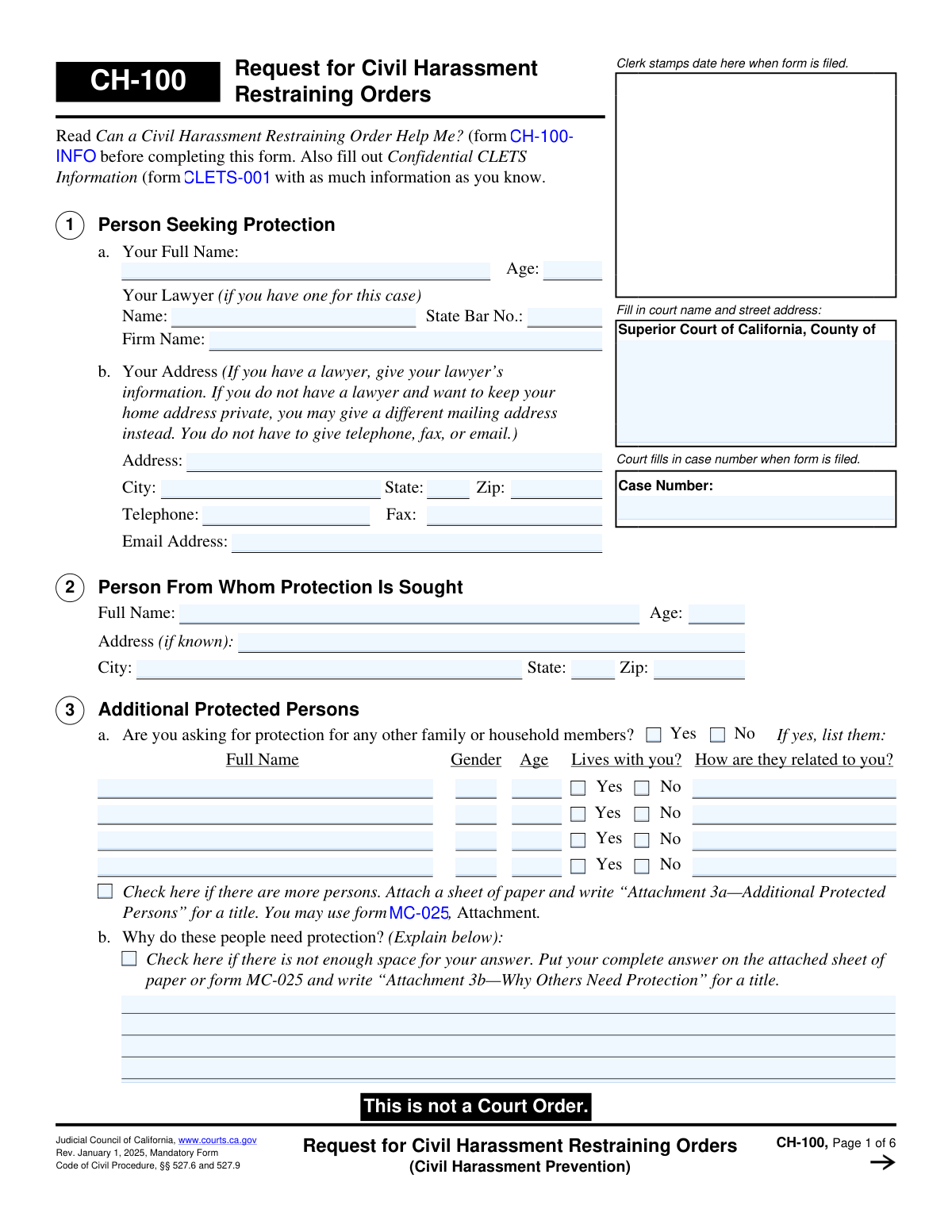
Form CH-100, Request for Civil Harassment Restraining Orders, is a legal document filed in a California Superior Court to seek protection from harassment, stalking, violence, or threats of violence by someone you are not closely related to. This form initiates the legal process for obtaining a court order that requires the harasser to stop their behavior and stay away from you. Today, this form can be filled out quickly and accurately using AI-powered services like Instafill.ai, which can also convert non-fillable PDF versions into interactive fillable forms.
CH-100 is part of the
restraining order forms category on Instafill.
Our AI automatically handles information lookup, data retrieval, formatting, and form filling.
It takes less than a minute to fill out CH-100 using our AI form filling.
Securely upload your data. Information is encrypted in transit and deleted immediately after the form is filled out.
Form specifications
| Form name: | Form CH-100, Request for Civil Harassment Restraining Orders (Civil Harassment Prevention) |
| Number of fields: | 208 |
| Number of pages: | 6 |
| Language: | English |
Instafill Demo: How to fill out PDF forms in seconds with AI
How to Fill Out CH-100 Online for Free in 2026
Are you looking to fill out a CH-100 form online quickly and accurately? Instafill.ai offers the #1 AI-powered PDF filling software of 2026, allowing you to complete your CH-100 form in just 37 seconds or less.
Follow these steps to fill out your CH-100 form online using Instafill.ai:
- 1 Navigate to Instafill.ai and upload the CH-100 form or select it from the template library.
- 2 Provide your personal information as the person seeking protection, including your name and contact details.
- 3 Enter the information for the person you need protection from, such as their name and last known address.
- 4 Describe the harassment in detail, including the date of the most recent incident, what happened, and any previous incidents.
- 5 Specify the protection orders you are requesting, such as no-contact orders, stay-away orders, and protection for animals.
- 6 Review all the information populated by the AI for accuracy, make any necessary edits, and then e-sign the declaration under penalty of perjury.
- 7 Download the completed CH-100 and any related forms (like CLETS-001) to file with the appropriate court.
Our AI-powered system ensures each field is filled out correctly, reducing errors and saving you time.
Why Choose Instafill.ai for Your Fillable CH-100 Form?
Speed
Complete your CH-100 in as little as 37 seconds.
Up-to-Date
Always use the latest 2026 CH-100 form version.
Cost-effective
No need to hire expensive lawyers.
Accuracy
Our AI performs 10 compliance checks to ensure your form is error-free.
Security
Your personal information is protected with bank-level encryption.
Frequently Asked Questions About Form CH-100
The CH-100 form is used to request a civil harassment restraining order from a California court. It is for protection against someone you are not closely related to, such as a neighbor, coworker, or acquaintance.
You should file this form if you are experiencing harassment, stalking, or threats from someone with whom you do not have a close family or dating relationship. For issues with family or a current/former partner, a Domestic Violence Restraining Order is typically the correct path.
You must also complete the Confidential CLETS Information (form CLETS-001). It is also strongly recommended that you read the information sheet (form CH-100-INFO) before starting.
Yes, in Section 1, you can provide an alternate mailing address, such as a P.O. Box or your lawyer's address, to keep your home address confidential. You are not required to list your phone number or email.
Yes, Section 3 allows you to list other family or household members who also need protection. You will need to explain why they are also being harassed or are at risk.
As defined in Section 7, harassment includes violence, threats of violence, or a repeated course of conduct that seriously alarms, annoys, or harasses you and causes you significant emotional distress.
A TRO is a short-term order a judge can issue immediately to protect you until the full court hearing. To request one, you must check the box in Section 11 and submit form CH-110 along with your CH-100 request.
Not necessarily. Section 13 explains that filing fees may be waived if your request involves violence, stalking, or credible threats. You can also apply for a general fee waiver by filing form FW-001.
If the judge grants the restraining order, the person will be prohibited from owning, possessing, or purchasing firearms, firearm parts, and ammunition. They will be ordered to turn in or sell any they currently have.
Yes, Section 15 allows you to ask the court for sole possession of your pets and order the other person to stay away from them. You must provide a reason why this is necessary for the animals' safety.
After you have filled out the form completely, you must file it with the clerk at the Superior Court in the appropriate county. The clerk will process it, assign a case number, and provide you with next steps.
Yes, services like Instafill.ai use AI to auto-fill form fields accurately and save time. This can be particularly useful for ensuring all sections of the multi-page CH-100 form are completed correctly.
You can use a service like Instafill.ai to upload the CH-100 PDF and complete it digitally. The platform allows you to type directly into the fields, check boxes, and prepare the document for printing and filing.
If you have a flat, non-fillable PDF, you can use a tool like Instafill.ai to convert it into an interactive, fillable form. This enables you to easily type your information instead of having to print the form and fill it out by hand.
Compliance CH-100
Validation Checks by Instafill.ai
1
Ensures Filer's Full Name is Provided
This check verifies that the 'Your Full Name' field in Section 1 is not empty. This is a fundamental requirement for legal identification of the person seeking protection. If this field is left blank, the form cannot be processed as the court would not know who is filing the request.
2
Validates Age Format
This check ensures that the 'Age' fields in Sections 1, 2, and 3 contain only positive integers. This is important for verifying the identity and legal status (minor or adult) of the individuals involved. A non-numeric or negative value would be rejected, and the user would be prompted to enter a valid age.
3
Conditional Requirement for Additional Protected Persons
This validation checks that if 'Yes' is selected in Section 3a ('Are you asking for protection for any other family or household members?'), then at least one person's details are entered in the subsequent table and the explanation in 3b is filled out. This ensures the request is complete and provides the necessary information for the court to evaluate the need for protecting others. If the condition is not met, the submission will be flagged as incomplete.
4
Venue Justification Completeness
This check verifies that at least one reason for filing in the specified county is selected in Section 5. This is a legal requirement to establish proper jurisdiction. If 'Other' is checked, the corresponding text field must be filled; otherwise, the form is considered incomplete and cannot be filed.
5
Logical Consistency for Other Court Cases
This validation ensures that if 'Yes' is checked in Section 6a ('Have you...been involved in another court case'), at least one case type checkbox is selected and its corresponding 'Year Filed' and 'Filed in (County/State)' fields are completed. This provides the court with crucial context about prior legal history between the parties. A 'Yes' response without any case details would trigger an error.
6
Validates Date of Last Harassment
This check confirms that the date provided in Section 7a(1) is a valid date and is not in the future. The recency of harassment is a critical factor in granting a restraining order. An invalid or future date would prevent the court from properly assessing the urgency and nature of the threat, leading to a validation failure.
7
Conditional Explanation for Weapon Use
This validation ensures that if 'Yes' is checked in Section 7a(4) regarding the use or threat of a weapon, the corresponding explanation text box is filled. The presence of a weapon significantly escalates the level of threat and is a key factor for the judge. Failure to provide an explanation would result in an incomplete and less compelling request.
8
Stay-Away Distance Format and Value
This check verifies that if any location is checked in Section 9a ('Stay-Away Orders'), the 'yards' field contains a positive numeric value. The distance is a core component of the order being requested. A blank, zero, or non-numeric value would make the order unenforceable and will cause the validation to fail.
9
Conditional Explanation for TRO Notification
This validation confirms that if 'No' is selected in Section 11 ('Has the person in 2 been told...'), the explanation field is mandatory. Courts require a valid reason for not notifying the other party before issuing a Temporary Restraining Order (TRO). Answering 'No' without an explanation fails to meet this legal standard and will block submission.
10
Harassment Description Completeness
This check ensures that the narrative field in Section 7a(3), 'How did the person in 2 harass you?', is not empty. This description is the primary evidence for the request and is essential for the judge to understand the events that occurred. A blank description would mean the core justification for the order is missing, making the form invalid.
11
Validates Lawyer's State Bar Number Format
This check verifies that if a lawyer's name is entered in Section 1, the 'State Bar No.' field contains a numeric value. The State Bar number is a unique identifier for a licensed attorney in California. This validation ensures the provided legal representation is legitimate and can be verified by the court.
12
Signature and Date Presence
This validation confirms that the signature and date fields at the end of the form (Section 17) are completed. The declaration under penalty of perjury is legally binding only with a signature and date. An unsigned or undated form is legally invalid and will be rejected by the court clerk.
13
Fee Waiver Form Cross-Reference
This check ensures that if checkbox 13c ('I am entitled to a fee waiver') is selected, the system flags that form FW-001 must also be submitted. This prevents the filing from being rejected due to an incomplete fee waiver application. The validation serves as a reminder and a process check rather than a hard block on the form itself.
14
Relationship of Parties Explanation Requirement
This check verifies that the text field in Section 4, 'How do you know the person in 2?', is filled out. This information is crucial for the court to determine if a Civil Harassment Restraining Order is the appropriate legal remedy, as opposed to other types like a Domestic Violence Restraining Order. An empty field would leave a critical legal question unanswered.
Common Mistakes in Completing CH-100
In Section 7, filers often use emotional or conclusory language instead of providing specific, factual details of harassing conduct. This happens due to the stress of the situation and not understanding that a judge needs concrete facts, dates, and actions to grant an order. A vague description can weaken the case and lead to the request being denied for failing to establish a 'course of conduct' or 'substantial emotional distress.' To avoid this, create a clear timeline of events with dates, locations, witnesses, and direct quotes before filling out the form.
People often list family or household members in Section 3a but then fail to explain in Section 3b why those specific individuals also need protection. The court cannot assume that harassment directed at the filer automatically extends to others without explicit evidence. This omission can result in the restraining order only protecting the primary filer, leaving children or other household members vulnerable. To prevent this, clearly describe specific incidents, actions, or threats made by the restrained person towards each additional person listed.
In Section 1b, a person seeking protection may list their actual home address out of habit, even when they want to keep it private for safety reasons. The form explicitly allows for an alternative mailing address, but this instruction is often missed in a stressful situation. Disclosing the home address makes it part of the public record and accessible to the person they are seeking protection from, defeating a key safety purpose of the order. Always use a secure alternative address, like a P.O. Box or a lawyer's address, if you have safety concerns.
Filers may leave fields in Section 2 blank, such as the address or age of the person from whom protection is sought, because they are unsure of the details. However, a full name and a known address are critical for law enforcement to properly serve the legal documents. Without successful service, the court cannot proceed with the hearing or make the restraining order enforceable. It is crucial to provide as much identifying information as possible, including a physical description and work address on the separate, confidential CLETS-001 form, to assist the process server.
In Section 6, individuals may forget or fail to disclose previous legal cases with the other party, such as divorce, custody, or other civil matters. This can happen due to poor record-keeping or a misunderstanding of what needs to be disclosed. Failing to list these cases can damage credibility with the judge and may result in conflicting court orders, which complicates legal matters significantly. Before filing, gather any documents from previous legal actions and list each case, including the case number and county, as accurately as possible.
The explanation in Section 4, 'How do you know the person in 2?', is often too brief (e.g., 'we know each other'). This field is crucial because the type of relationship determines if the case belongs in civil court or if it should be a Domestic Violence Restraining Order filed in family court. An incorrect or unclear description can lead to the case being filed in the wrong jurisdiction, causing significant delays or outright dismissal. Clearly state the nature and duration of the relationship, such as 'neighbor for 5 years,' 'former co-worker at XYZ Corp,' or 'landlord of my previous apartment.'
When requesting a Temporary Restraining Order (TRO) in Section 11, filers must explain why they need immediate protection and, if applicable, why they couldn't give notice to the other party. People often check the box but provide a weak or no explanation. This can result in the judge denying the immediate order, leaving the filer unprotected for weeks until the court hearing. To avoid this, clearly articulate the immediate danger or threat of harm that justifies issuing the order without the other party being present.
In Section 13, a filer might check box 13c to waive court fees but then forget to complete and attach the required FW-001 'Application for Waiver of Court Fees and Costs' form. This happens because they miss the instruction printed on the form itself. This omission will cause the court clerk to reject the filing until the fee is paid or the proper waiver application is submitted, delaying the legal process. If requesting a fee waiver based on financial hardship, ensure the FW-001 form is fully completed and filed along with the CH-100.
The signature and date on the final page are a declaration under penalty of perjury that the information provided is true and correct. In the rush to complete the lengthy form, filers sometimes forget this final, critical step. An unsigned form is invalid and will be immediately rejected by the court clerk, halting the entire process until it is properly signed. Always double-check the last page to ensure you have signed and dated the form before submitting it. AI-powered form filling tools like Instafill.ai can flag missing signature fields to prevent this error.
The form frequently prompts users to attach additional pages (using form MC-025) for long explanations, but filers often write in the margins or forget to include the attachments. They may also forget to check the box indicating that an attachment is being used. This results in an incomplete filing where the judge does not see the full story, weakening the case. To avoid this, use the MC-025 form for all overflow text, label each attachment exactly as instructed (e.g., 'Attachment 7b—Previous Harassment'), and count and enter the total number of attached pages in Section 17.
In Section 9, filers may check the boxes for places they want the person to stay away from but forget to specify the distance in yards. Leaving this blank forces the judge to guess at a reasonable distance, which may be less than what is needed for the filer's safety. This can lead to an order that is difficult to enforce or does not provide adequate protection. To avoid this, specify a clear and reasonable distance (e.g., 100 yards) and check all applicable locations, including home, work, school, and vehicle.
Saved over 80 hours a year
“I was never sure if my IRS forms like W-9 were filled correctly. Now, I can complete the forms accurately without any external help.”
Kevin Martin Green
Your data stays secure with advanced protection from Instafill and our subprocessors

Robust compliance program
Transparent business model
You’re not the product. You always know where your data is and what it is processed for.
ISO 27001, HIPAA, and GDPR
Our subprocesses adhere to multiple compliance standards, including but not limited to ISO 27001, HIPAA, and GDPR.
Security & privacy by design
We consider security and privacy from the initial design phase of any new service or functionality. It’s not an afterthought, it’s built-in, including support for two-factor authentication (2FA) to further protect your account.
Fill out CH-100 with Instafill.ai
Worried about filling PDFs wrong? Instafill securely fills form-ch-100-request-for-civil-harassment-restraining-orders-civil-harassment-prevention-1 forms, ensuring each field is accurate.