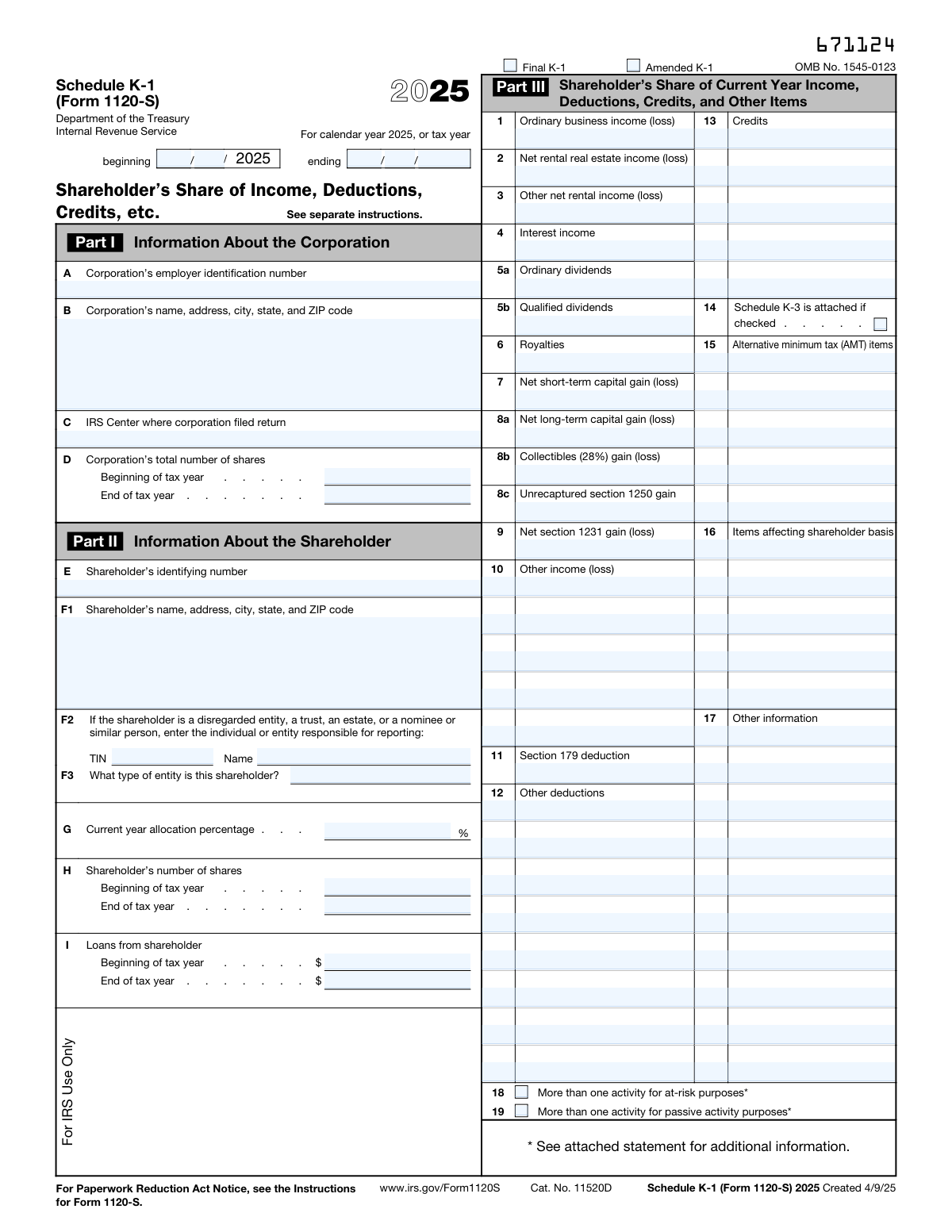
Yes! You can use AI to fill out Schedule K-1 (Form 1120-S), Shareholder’s Share of Income, Deductions, Credits, etc.
Schedule K-1 (Form 1120-S) is an Internal Revenue Service (IRS) tax document issued by S corporations to their shareholders. It reports each shareholder's pro-rata share of the corporation's income, losses, deductions, and credits, which the shareholder then uses to file their personal income tax return. Today, this form can be filled out quickly and accurately using AI-powered services like Instafill.ai, which can also convert non-fillable PDF versions into interactive fillable forms.
Our AI automatically handles information lookup, data retrieval, formatting, and form filling.
It takes less than a minute to fill out Schedule K-1 (Form 1120-S) using our AI form filling.
Securely upload your data. Information is encrypted in transit and deleted immediately after the form is filled out.
Form specifications
| Form name: | Schedule K-1 (Form 1120-S), Shareholder’s Share of Income, Deductions, Credits, etc. |
| Number of pages: | 1 |
| Language: | English |
| Categories: | income forms, credit forms |
Instafill Demo: How to fill out PDF forms in seconds with AI
How to Fill Out Schedule K-1 (Form 1120-S) Online for Free in 2026
Are you looking to fill out a SCHEDULE K-1 (FORM 1120-S) form online quickly and accurately? Instafill.ai offers the #1 AI-powered PDF filling software of 2026, allowing you to complete your SCHEDULE K-1 (FORM 1120-S) form in just 37 seconds or less.
Follow these steps to fill out your SCHEDULE K-1 (FORM 1120-S) form online using Instafill.ai:
- 1 Navigate to Instafill.ai and upload or select the Schedule K-1 (Form 1120-S).
- 2 Provide the S corporation's information in Part I, including its Employer Identification Number (EIN), name, and address.
- 3 Enter the specific shareholder's information in Part II, such as their identifying number, name, address, and share ownership details.
- 4 Fill in Part III with the shareholder's specific share of income, deductions, credits, and other financial items as allocated by the corporation.
- 5 Input any additional required information, such as items affecting shareholder basis or details for alternative minimum tax (AMT).
- 6 Review all the information entered by the AI for accuracy, making any necessary corrections before finalizing the document.
- 7 Securely download, print, or share the completed Schedule K-1 for tax filing purposes.
Our AI-powered system ensures each field is filled out correctly, reducing errors and saving you time.
Why Choose Instafill.ai for Your Fillable Schedule K-1 (Form 1120-S) Form?
Speed
Complete your Schedule K-1 (Form 1120-S) in as little as 37 seconds.
Up-to-Date
Always use the latest 2026 Schedule K-1 (Form 1120-S) form version.
Cost-effective
No need to hire expensive lawyers.
Accuracy
Our AI performs 10 compliance checks to ensure your form is error-free.
Security
Your personal information is protected with bank-level encryption.
Frequently Asked Questions About Form Schedule K-1 (Form 1120-S)
Schedule K-1 is an IRS form that an S corporation uses to report a shareholder's individual share of the corporation's income, deductions, credits, and other tax-related items. Shareholders use this information to complete their personal tax returns.
The S corporation is responsible for preparing and issuing a Schedule K-1 to each of its shareholders. The shareholder does not fill out this form but uses the information provided on it for their own tax filing.
Part II contains information about the shareholder, including your name, address, and taxpayer identifying number. It also details your ownership, showing your allocation percentage, number of shares, and any loans you've made to the corporation.
Part III details your specific share of the S corporation's financial results for the tax year. You must report these amounts, such as ordinary income, dividends, and capital gains, on your personal income tax return.
An 'Amended K-1' means the corporation has corrected information on a previously issued form. You should compare it to the original and, if you've already filed your taxes, you may need to file an amended personal return (Form 1040-X).
This percentage represents your ownership stake in the S corporation for the tax year. It is used to calculate your portion of the corporation's income, losses, and other items reported in Part III.
You use the information from your Schedule K-1 to complete your personal tax return (e.g., Form 1040). You do not need to attach the K-1 to your return, but you must keep it for your records.
This indicates the corporation has foreign transactions or assets, and your share of these international tax items is reported on the attached Schedule K-3. You will need this additional form to complete your tax return correctly.
These are items, like tax-exempt income or distributions you received, that adjust your investment cost (basis) in the corporation. Tracking your basis is crucial for determining the tax consequences of distributions and any future sale of your shares.
If you have a non-fillable or 'flat' PDF, you can use an online service to make it interactive. For example, Instafill.ai can convert non-fillable PDFs into fillable forms, making them easier to use and read.
Yes, services like Instafill.ai use AI to help preparers auto-fill form fields accurately and save significant time. This technology helps ensure the information provided to shareholders is correct and efficiently processed.
A preparer can upload the Schedule K-1 form to Instafill.ai, and its AI will intelligently identify and populate the required fields. This streamlines the process of creating K-1s for all shareholders.
Part I contains identifying information for the S corporation itself, such as its Employer Identification Number (EIN) and address. Part II contains your personal information as the shareholder, including your Social Security Number (SSN) or TIN and ownership details.
Compliance Schedule K-1 (Form 1120-S)
Validation Checks by Instafill.ai
1
Validates Corporation's EIN Format
This check ensures the Corporation's Employer Identification Number (EIN) in Part I, Box A, is a 9-digit number formatted as XX-XXXXXXX. This format is required by the IRS for unique identification of the business entity. An invalid format will cause the form to be rejected during electronic filing or delayed during manual processing, as the corporation cannot be matched in IRS systems.
2
Validates Shareholder's Identifying Number Format
Ensures the Shareholder’s identifying number in Part II, Box E, follows the standard format for a Social Security Number (SSN), Individual Taxpayer Identification Number (ITIN), or Employer Identification Number (EIN). This number is the primary key for the IRS to associate the K-1 income with the correct shareholder's tax return. An incorrect number will cause a data mismatch, likely triggering an IRS notice or audit for the shareholder.
3
Ensures Tax Year Period is Logical
Verifies that the 'Tax year ending' date occurs after the 'Tax year beginning' date, and that the period is reasonable (typically around 12 months). This check prevents illogical date entries that would make the tax period invalid. A failed validation indicates a data entry error that must be corrected, as an impossible tax period will cause the form to be rejected by the IRS.
4
Prevents Contradictory K-1 Type Selection
This validation confirms that the 'Final K-1' and 'Amended K-1' checkboxes are not selected simultaneously. A K-1 can be a final one for a shareholder or an amendment to a previous one, but not both for the same filing. Selecting both creates ambiguity and will lead to processing errors or rejection by the filing system.
5
Enforces Completion of Responsible Party Information
Checks that if the 'Shareholder entity type' in Box F3 is a pass-through entity like a trust, estate, or nominee, then the 'Responsible individual/entity TIN' and 'Name' fields in Box F2 must be completed. The IRS needs this information to track the income to the ultimate taxpayer. Failure to provide this information when required will result in an incomplete and non-compliant filing.
6
Validates Consistency Between Final K-1 Status and Share Count
This check cross-references the 'Final K-1' checkbox with the 'Shareholder’s number of shares' at the end of the tax year (Box H). If the 'Final K-1' box is checked because the shareholder disposed of all shares, the end-of-year share count should be zero. An inconsistency, such as a non-zero share count on a final K-1, suggests a data entry error and could lead to incorrect basis tracking for the shareholder.
7
Ensures Shareholder's Share Count Does Not Exceed Corporation's Total
Verifies that the number of shares held by the shareholder (Part II, Box H) is less than or equal to the corporation's total number of shares outstanding (Part I, Box D). This is a fundamental logical check to prevent data entry errors. A shareholder cannot own more shares than the corporation has issued, and a failure here indicates a significant error that must be corrected before filing.
8
Validates Current Year Allocation Percentage Range
This validation ensures that the 'Current year allocation percentage' in Part II, Box G, is a numeric value between 0 and 100, inclusive. The percentage is used to calculate the shareholder's portion of all financial items, making its accuracy paramount. An invalid percentage would lead to incorrect calculations for every item on the form, rendering the entire K-1 incorrect.
9
Validates Qualified Dividends Do Not Exceed Ordinary Dividends
This check confirms that the amount reported for 'Qualified dividends' (Line 5b) is less than or equal to the amount reported for 'Ordinary dividends' (Line 5a). By tax law, qualified dividends are a subset of total ordinary dividends. Reporting more qualified than ordinary dividends is a logical impossibility and will result in incorrect tax calculations and potential penalties for the shareholder.
10
Requires Description for 'Other Income' and 'Other Deductions'
This validation ensures that if a monetary value is entered for 'Other income (loss)' (Line 10) or 'Other deductions' (Line 12), the corresponding description field is also completed. The IRS requires an explanation for these catch-all categories to understand the nature of the item. Missing descriptions can lead to inquiries, processing delays, or disallowance of the reported item.
11
Ensures Completeness of Corporation and Shareholder Addresses
This check verifies that the corporation's address (Part I, Box B) and the shareholder's address (Part II, Box F1) are fully populated, including a name, street address, city, state, and ZIP code. Complete and accurate addresses are required for official correspondence and identity validation. An incomplete address can cause the form to be rejected or lead to missed communications from the IRS.
12
Prohibits Negative Values for Share and Loan Amounts
This validation ensures that all fields representing a quantity of shares (Boxes D and H) or a loan balance (Box I) are non-negative. It is physically and financially impossible to have a negative number of shares or a negative loan balance in this context. A negative value is a clear sign of a data entry error that would invalidate the financial data on the form.
Common Mistakes in Completing Schedule K-1 (Form 1120-S)
This error occurs when the corporation's Employer Identification Number (EIN) is entered in Part II, Box E instead of the shareholder's Social Security Number (SSN), ITIN, or EIN. This is a critical mistake as it prevents the IRS from matching the K-1 income to the correct shareholder's personal tax return, leading to automated notices, processing delays, and potential penalties. Always double-check that the number in Box E belongs to the shareholder listed in Box F1, not the corporation in Part I.
When the shareholder listed in Box F1 is a disregarded entity (like a single-member LLC), trust, or estate, filers often forget to complete Box F2. This box requires the name and Taxpayer Identification Number (TIN) of the ultimate individual or entity responsible for reporting the income. Failure to provide this information creates a mismatch in IRS records and can complicate the tax filing for the responsible party. Ensure that if the entity type in Box F3 is a pass-through or nominee, Box F2 is filled out completely.
A frequent error is a mismatch between the number of shares a shareholder owns at the beginning (Box H) and end of the year without a corresponding change in their ownership percentage or a corporate action. Furthermore, the sum of shares for all shareholders on their respective K-1s may not reconcile with the corporation's total shares reported in Part I, Box D. This indicates a record-keeping error and can trigger scrutiny. To avoid this, maintain a clear capitalization table and verify that individual K-1s align with the corporate-level data.
The loan balances from the shareholder at the beginning and end of the tax year (Part II, Box I) are often overlooked or carried over from the prior year without updates. This information is crucial for calculating the shareholder's debt basis, which determines their ability to deduct corporate losses. Inaccurate loan data can lead to an incorrect basis calculation and disallowed losses on the shareholder's personal return. Always verify and update these loan amounts to reflect any new loans, repayments, or adjustments during the year.
Filers often enter monetary values on lines for 'Other income (loss)' (Line 10) or 'Other deductions' (Line 12) but fail to provide the mandatory attached statement or description. The IRS requires a clear explanation of the source and nature of these amounts to verify their tax treatment. Without this detail, the K-1 is incomplete and may be rejected or trigger an IRS inquiry. Always attach a supporting schedule detailing each item included in these 'Other' categories.
Line 16, 'Items affecting shareholder basis,' is critical but frequently prepared incorrectly. Filers may omit key items like non-deductible expenses (e.g., 50% of meals), tax-exempt income, or certain credits, all of which are necessary for the shareholder to accurately track their stock basis. An incorrect basis can lead to miscalculating gain or loss on a future sale of stock or overstating deductible losses. Ensure all relevant items from the Form 1120-S are properly allocated and reported here with a detailed statement.
The checkboxes for 'Final K-1' and 'Amended K-1' at the top of the form are simple but important indicators that are often missed. Forgetting to check 'Final K-1' when a shareholder disposes of their entire interest can cause the IRS to expect a K-1 for them in subsequent years. Similarly, failing to mark an 'Amended K-1' can lead to confusion and incorrect processing of the corrected information. Always check the appropriate box to clearly communicate the status of the K-1.
Boxes 18 and 19, which indicate if there is more than one activity for at-risk or passive activity purposes, are frequently left unchecked when they should be. This information is vital for the shareholder, as it dictates that they must apply complex loss limitation rules on their personal return separately for each activity. Omitting this flag can lead the shareholder to incorrectly aggregate activities and claim losses they are not entitled to, resulting in future tax adjustments and penalties. If the corporation has multiple distinct business lines, these boxes must be checked and a supporting statement provided.
In Part II, Box G, filers sometimes enter a simple end-of-year ownership percentage even if the shareholder's stake changed during the year. Tax law requires income and loss items to be allocated on a per-share, per-day basis or through an interim closing of the books if ownership changes. Using an incorrect, simplified percentage results in an improper allocation of all Part III items, affecting the tax liability of all shareholders. To prevent this, carefully calculate the allocation based on the specific dates of any ownership changes during the tax year.
Simple typographical errors when transcribing financial data from the main Form 1120-S to the shareholder's Schedule K-1 are very common. A misplaced decimal or transposed numbers in fields like 'Ordinary business income (loss)' (Line 1) or 'Net long-term capital gain (loss)' (Line 8a) directly impacts the shareholder's reported income. These errors can lead to an incorrect tax assessment and require filing an amended return. Using an AI-powered tool like Instafill.ai can help prevent these mistakes by automating data entry and performing validation checks. If the form is a non-fillable PDF, Instafill.ai can also convert it into an interactive, fillable version to streamline the process.
Saved over 80 hours a year
“I was never sure if my IRS forms like W-9 were filled correctly. Now, I can complete the forms accurately without any external help.”
Kevin Martin Green
Your data stays secure with advanced protection from Instafill and our subprocessors

Robust compliance program
Transparent business model
You’re not the product. You always know where your data is and what it is processed for.
ISO 27001, HIPAA, and GDPR
Our subprocesses adhere to multiple compliance standards, including but not limited to ISO 27001, HIPAA, and GDPR.
Security & privacy by design
We consider security and privacy from the initial design phase of any new service or functionality. It’s not an afterthought, it’s built-in, including support for two-factor authentication (2FA) to further protect your account.
Fill out Schedule K-1 (Form 1120-S) with Instafill.ai
Worried about filling PDFs wrong? Instafill securely fills schedule-k-1-form-1120-s-shareholders-share-of-income-deductions-credits-etc forms, ensuring each field is accurate.