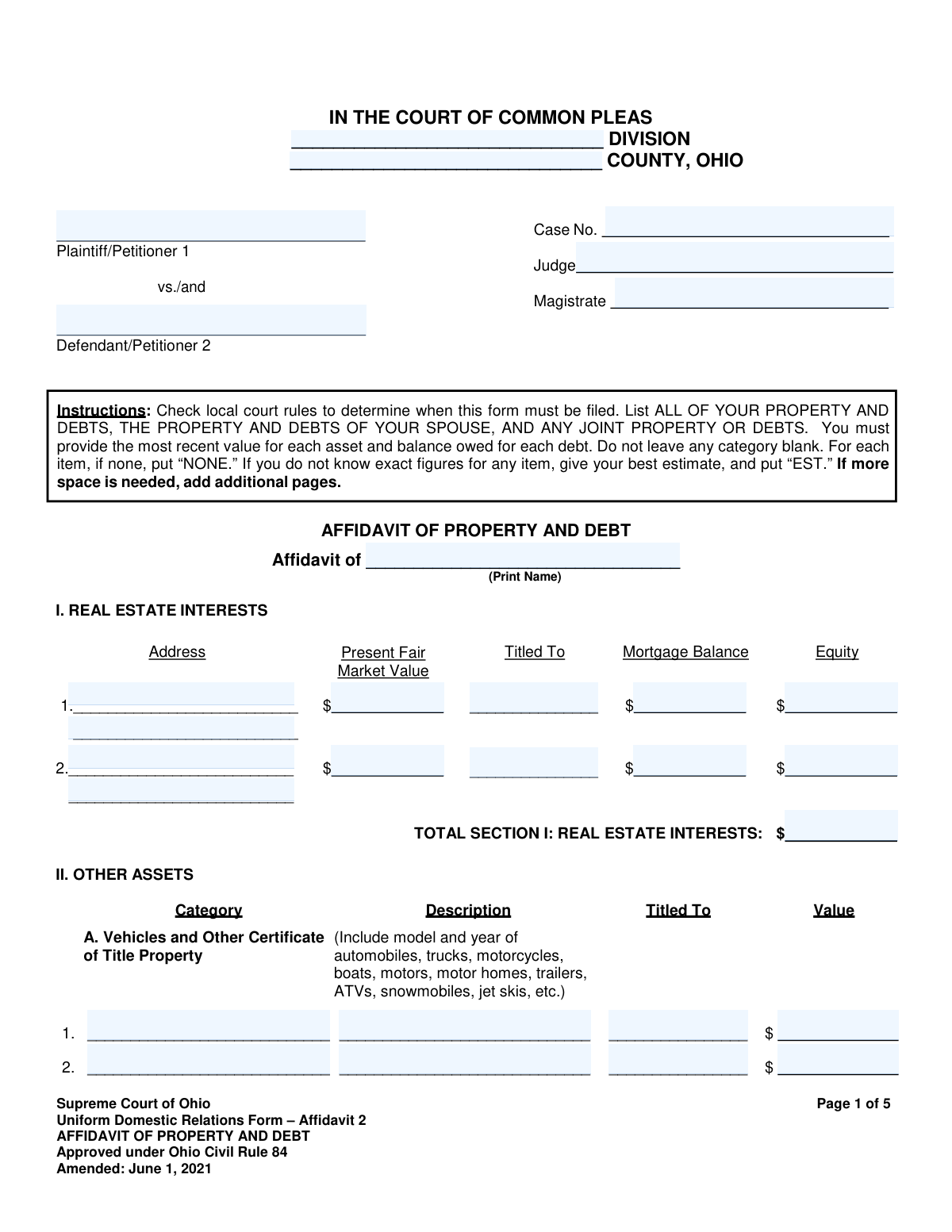
Yes! You can use AI to fill out Supreme Court of Ohio Uniform Domestic Relations Form – Affidavit 2, AFFIDAVIT OF PROPERTY AND DEBT

The Affidavit of Property and Debt is an official form from the Supreme Court of Ohio used in domestic relations cases, such as divorce or dissolution. It requires individuals to provide a sworn, detailed statement of all their real estate, assets, separate property claims, and debts to ensure full financial disclosure. This comprehensive listing is crucial for the court to make equitable decisions regarding the division of property and liabilities. Today, this form can be filled out quickly and accurately using AI-powered services like Instafill.ai, which can also convert non-fillable PDF versions into interactive fillable forms.
Uniform Domestic Relations Form – Affidavit 2 is part of the domestic relations forms category on Instafill.
Uniform Domestic Relations Form – Affidavit 2 has a very complex Form Complexity Index of 88/100 — 249 fillable fields across 5 pages. Instafill’s AI completes it accurately in under a minute.

Form specifications

Form name: Supreme Court of Ohio Uniform Domestic Relations Form – Affidavit 2, AFFIDAVIT OF PROPERTY AND DEBT
Number of fields: 249
Number of pages: 5
FCI: Very Complex (88/100)
Language: English
Our AI automatically handles information lookup, data retrieval, formatting, and form filling.
It takes less than a minute to fill out Uniform Domestic Relations Form – Affidavit 2 using our AI form filling.
Securely upload your data. Information is encrypted in transit and deleted immediately after the form is filled out.
Preview of Supreme Court of Ohio Uniform Domestic Relations Form – Affidavit 2, AFFIDAVIT OF PROPERTY AND DEBT

Instafill Demo: How to fill out PDF forms in seconds with AI

How to Fill Out Uniform Domestic Relations Form – Affidavit 2 Online for Free in 2026

Are you looking to fill out a UNIFORM DOMESTIC RELATIONS FORM – AFFIDAVIT 2 form online quickly and accurately? Instafill.ai offers the #1 AI-powered PDF filling software of 2026, allowing you to complete your UNIFORM DOMESTIC RELATIONS FORM – AFFIDAVIT 2 form in just 37 seconds or less.
Follow these steps to fill out your UNIFORM DOMESTIC RELATIONS FORM – AFFIDAVIT 2 form online using Instafill.ai:
  1. 1 Navigate to Instafill.ai and upload or select the Ohio Affidavit of Property and Debt form.
  2. 2 Use the AI assistant to automatically populate the case information, including court, county, party names, and case number.
  3. 3 Complete Section I by detailing all real estate interests, including their market value, mortgage balance, and equity.
  4. 4 Fill out Section II by listing all other assets, such as vehicles, financial accounts, retirement plans, stocks, and personal property.
  5. 5 Declare any separate property claims with justifications and values in Section III.
  6. 6 Itemize all secured and unsecured debts in Section IV, providing creditor names, account details, and balances.
  7. 7 Carefully review the entire affidavit for accuracy and completeness, then print the form and sign it in the presence of a Notary Public.

Our AI-powered system ensures each field is filled out correctly, reducing errors and saving you time.

Why Choose Instafill.ai for Your Fillable Uniform Domestic Relations Form – Affidavit 2 Form?

Speed

Complete your Uniform Domestic Relations Form – Affidavit 2 in as little as 37 seconds.

Up-to-Date

Always use the latest 2026 Uniform Domestic Relations Form – Affidavit 2 form version.

Cost-effective

No need to hire expensive lawyers.

Accuracy

Our AI performs 10 compliance checks to ensure your form is error-free.

Security

Your personal information is protected with bank-level encryption.

Frequently Asked Questions About Uniform Domestic Relations Form – Affidavit 2

Uniform Domestic Relations Form – Affidavit 2 has a Form Complexity Index of 88 out of 100, placing it in the very complex complexity tier. This score is calculated deterministically from the form’s own structure using Instafill’s published Form Complexity Index methodology, so it can be reproduced and independently verified — it is not a subjective estimate.

For Uniform Domestic Relations Form – Affidavit 2 specifically, the score reflects 249 fillable fields across 5 pages, grouped into 65 sections, and 36 conditional fields that only apply depending on earlier answers, 13 tables or repeating lists. The number of fields is the largest factor in the base score (weighted 36%), followed by how difficult those fields are to complete based on their type, where free-text and signature fields count for more than simple checkboxes (26%). The number of pages that actually contain fields (15%), the amount of conditional “fill-only-if” logic (16%), and how many sections the form is divided into (7%) account for the rest of the base. On top of that base, the index adds points for tables and repeating lists, bundled instruction pages, and dense page layouts — capturing difficulty the base alone can miss.

In practical terms, a very complex score means the form is exceptionally demanding — a very large number of fields, often combined with tables, dense pages or extensive conditional logic. Instafill removes that effort entirely: our AI reads your information, maps each value to the correct field — including the conditional ones — and completes Uniform Domestic Relations Form – Affidavit 2 accurately in under a minute, with every field available for you to review before you download. See exactly how the Form Complexity Index is calculated.

This form is used in Ohio domestic relations cases, like divorce, to provide the court with a complete, sworn list of all assets and debts for both you and your spouse, whether held jointly or separately.

Both parties in a domestic relations case filed in an Ohio Court of Common Pleas are typically required to complete and file this affidavit to fully disclose their financial situation.

The instructions specify that you should not leave any category blank. If you do not have an item for a specific category, you must write "NONE" in that section.

If you cannot determine the exact figure, you should provide your best estimate. The form requires you to write "EST." next to any amount that is an estimate.

Yes, the form explicitly requires you to list all of your property and debts, your spouse's property and debts, and any joint items. The goal is to present a complete financial picture to the court.

Separate property generally includes assets owned by one spouse before the marriage, or gifts and inheritances received by only one spouse during the marriage. You must briefly explain why you are claiming the asset as separate property.

To calculate the equity for a property listed in Section I, subtract the current 'Mortgage Balance' from the 'Present Fair Market Value'. The result is the equity amount.

Yes, the affidavit includes an 'Oath or Affirmation' section that must be signed in the presence of a Notary Public. Do not sign the form beforehand.

You are signing this form under oath, and the document warns that if you do not tell the truth, you may be subject to penalties for perjury.

Yes, services like Instafill.ai use AI to auto-fill form fields accurately and save time. This can help ensure consistency and reduce the time spent entering repetitive information.

You can use a service like Instafill.ai to easily fill out this form on your computer. Simply upload the document to their platform, and you can type your information directly into the fields before printing.

If you have a non-fillable PDF, you can use a tool like Instafill.ai. It can convert flat PDFs into interactive, fillable forms that you can complete online.

In this section, you should list major items like furniture sets, appliances, and electronics. You can group items together (e.g., 'Living room furniture') and provide an estimated value for the group.

The form's instructions state that you must check your local court rules to determine the specific deadline for filing. These deadlines can vary between different counties in Ohio.

Compliance Uniform Domestic Relations Form – Affidavit 2
Validation Checks by Instafill.ai

1
Affiant Name Consistency
This check ensures the printed name of the affiant at the top of page 1 matches the printed name within the 'Oath or Affirmation' section on page 5. This is critical to confirm that the person swearing to the affidavit's contents is the same person identified at the beginning of the document. A mismatch could invalidate the affidavit or lead to its rejection by the court.
2
Case Number Format Validation
This validation verifies that the 'Case No.' field is not empty and conforms to the expected format for the specific county court (e.g., containing specific prefixes, year indicators, and sequential numbers). An incorrect or missing case number will prevent the document from being correctly filed and associated with the proper legal proceeding. The system should flag the entry for manual review and correction.
3
Real Estate Equity Calculation
This check performs a mathematical validation on each real estate entry in Section I, ensuring that the 'Equity' amount equals the 'Present Fair Market Value' minus the 'Mortgage Balance'. This is important for maintaining the financial accuracy and integrity of the asset declaration. If the calculation is incorrect, it suggests a data entry error that could misrepresent the party's net worth and must be corrected.
4
Section I Total Calculation
This validation verifies that the 'TOTAL SECTION I: REAL ESTATE INTERESTS' field is the correct sum of all 'Equity' values listed for each property in that section. An incorrect total misrepresents the total equity in real estate, a key component of the marital estate. Failure would require the user to recalculate and correct the total before submission.
5
Section II Total Calculation
This check ensures the 'TOTAL SECTION II: OTHER ASSETS' field accurately reflects the sum of all 'Value' fields from subsections A through I. This total is a critical summary figure for all non-real estate assets being declared. An error in this total would provide a misleading financial picture to the court and opposing party, requiring correction.
6
Section IV Total Debt Calculation
This validation confirms that the 'TOTAL SECTION IV: DEBT' amount is the correct sum of all 'Total Debt Due' values listed in subsections A (Secured Debt) and B (Unsecured Debt). Accurately totaling all liabilities is essential for determining the net value of the estate. If the total is incorrect, the form will be considered inaccurate and will need to be amended.
7
Mandatory Field Entry Enforcement
Based on the form's instructions ('Do not leave any category blank. For each item, if none, put “NONE.”'), this check ensures that for any listed asset or debt, all associated fields (e.g., Description, Titled To, Value) are filled. It also flags any major category that is left completely empty without a 'NONE' entry. This prevents incomplete submissions and ensures all required information is explicitly provided, avoiding ambiguity.
8
Separate Property Claim Justification
This validation ensures that if an asset is listed in 'Section III: Separate Property Claims' with a market value, the corresponding 'Why do you claim this as separate property?' field is not empty. The justification is a legal requirement for making a separate property claim. An omission would render the claim unsubstantiated and would likely be rejected by the court, so the form should not be accepted without this information.
9
Bankruptcy Date Logic
This check verifies that for any bankruptcy entry in Section V, the 'Date of Discharge or Relief from Stay' is on or after the 'Date of Filing'. A discharge date cannot precede the filing date. This logical check prevents nonsensical data entry errors that would call the accuracy of the entire section into question and require correction.
10
Bankruptcy Case Type Validation
This validation ensures the 'Type of Case' field in Section V contains one of the expected values, such as 'Ch. 7', '11', '12', or '13'. Using a predefined list prevents invalid or ambiguous entries. An incorrect entry would cause confusion and require clarification, so the system should reject entries that do not match the expected format.
11
Notary Commission Expiration Date Validity
This check validates that the 'Commission Expiration Date' in the notary block is a valid date and occurs after the date the document was sworn to. A notarization with an expired commission is legally invalid. If the date is in the past, the affidavit is not properly executed and cannot be filed with the court.
12
Monetary Field Format
This validation ensures that all fields intended for dollar amounts (e.g., 'Value', 'Mortgage Balance', 'Total Debt Due') contain only valid numeric characters, a decimal point, or the specific abbreviation 'EST.' as allowed by the instructions. This maintains data consistency and prevents calculation errors from non-numeric text. An invalid format would trigger an error message requiring the user to correct the entry.
13
Mortgage Debt Consistency Check
This is a cross-referencing check that verifies if a 'Mortgage Balance' greater than zero is listed in Section I, a corresponding entry for that mortgage exists in Section IV-A (Secured Debt). This ensures consistency between declared assets and their associated liabilities. A mismatch could indicate an omission or error in either the asset or debt section, requiring the user to review and reconcile both sections.
14
Case Caption Completeness
This check verifies that essential case-identifying information at the top of the form, including 'County', 'Case No.', 'Plaintiff/Petitioner 1', and 'Defendant/Petitioner 2', is not left blank. This information is fundamental for the court clerk to file the document correctly. An incomplete caption would lead to the document's rejection at intake.

Common Mistakes in Completing Uniform Domestic Relations Form – Affidavit 2

Leaving Fields Blank Instead of Writing 'NONE'

The form instructions explicitly state, 'Do not leave any category blank. For each item, if none, put “NONE.”' People often skip sections that don't apply to them, leaving them empty. This creates ambiguity for the court, which may question whether the information was forgotten or is truly non-existent, potentially causing filing delays. To avoid this, carefully review every line item and write 'NONE' in the first field of any row or category where you have no assets or debts to declare.

Incorrectly Valuing Real Estate

In Section I, filers are asked for the 'Present Fair Market Value,' not the original purchase price or tax-assessed value. People often use outdated figures, leading to an inaccurate calculation of equity and misrepresentation of the marital estate. An incorrect valuation can be challenged by the other party, requiring costly appraisals and delaying the case. To avoid this, obtain a recent estimate from a real estate professional or use reliable online valuation tools, and be sure to mark any estimated value with 'EST.'

Misstating Life Insurance Value

When listing life insurance in Section II-F, people frequently list the policy's death benefit instead of its 'Cash Value.' Term life insurance policies typically have no cash value, while whole life policies accumulate value over time. Listing the death benefit incorrectly inflates the asset total and misrepresents the marital estate. Always check the policy statement for the current 'cash surrender value' and list that amount; if it's a term policy with no cash value, enter '$0' or 'NONE'.

Failing to Disclose All Spousal and Joint Assets/Debts

The instructions require listing ALL property and debts, including those held individually by your spouse and those held jointly. Filers sometimes mistakenly only list assets and debts in their own name. This omission is a serious error that can lead to legal penalties for perjury and may require the case to be reopened later if hidden assets are discovered. To prevent this, gather all financial documents for both parties to ensure a complete and transparent accounting of the entire marital estate.

Signing the Affidavit Prematurely

The Oath section on the final page includes the explicit warning, '(Do not sign until Notary Public is present).' Many people sign the form as soon as they finish filling it out at home, which invalidates the notarization. A document signed without the notary present cannot be legally affirmed and will be rejected by the court, forcing you to redo the signature and notarization process. Always wait to sign the document physically in the presence of a licensed Notary Public after they have verified your identity.

Incorrectly Calculating Equity and Section Totals

The form requires several calculations, such as the equity for real estate (Market Value - Mortgage Balance) and the totals for each major section. Simple arithmetic errors are common and can skew the entire financial picture presented to the court. These mistakes can undermine your credibility and lead to disputes over the final division of property. To avoid this, double-check all calculations. AI-powered form filling tools like Instafill.ai can prevent these errors by performing calculations automatically as you enter the data.

Vague or Incomplete Asset Descriptions

In sections for vehicles, financial accounts, and retirement plans, people often provide generic descriptions like 'car,' 'bank account,' or '401k.' This lack of detail (e.g., '2020 Honda CR-V,' 'Chase Checking Acct ending in 1234') makes it impossible for the court to identify the specific asset. This ambiguity causes confusion and disputes, requiring further clarification and delaying proceedings. Be as specific as possible, including year/model, financial institution names, and account numbers where appropriate.

Misunderstanding 'Separate Property' Claims

In Section III, filers often misunderstand the legal standard for 'separate property,' such as gifts to one spouse, inheritances, or property owned before marriage. They might incorrectly claim an asset that has been commingled with marital funds, like an inheritance deposited into a joint savings account. Making an improper claim can be contested and denied by the court, weakening the filer's overall position. If you are unsure, consult with an attorney and provide a clear, factual reason for the claim, such as 'Inheritance from grandmother's estate received on [Date].'

Using Estimates Without Proper Notation

The form allows for estimates when exact figures are unknown but requires the notation 'EST.' Filers often provide a best guess for a value without this notation, presenting it as a firm number. This can be misleading and open to challenge if the actual value is later found to be significantly different. To maintain transparency and credibility, always add 'EST.' next to any value that is an approximation rather than a figure from a recent statement or appraisal.

Omitting Case and Court Header Information

The header on the first page requires crucial identifying information like the County, Case Number, Judge, and Magistrate. People sometimes overlook these fields while focusing on the complex financial data. An affidavit without a proper case number or court information cannot be correctly filed by the clerk's office, causing rejection and unnecessary delays. Ensure all header information is filled out completely and accurately by referencing your other court documents.

Forgetting to Attach Additional Pages When Necessary

The form provides limited space for listing numerous assets or debts, and the instructions state to 'add additional pages' if more space is needed. People may try to cram information into the small spaces or simply omit assets that don't fit, resulting in an incomplete affidavit. If you run out of space, create a clearly labeled addendum that references the specific section. If the form is a non-fillable PDF, a tool like Instafill.ai can convert it to a fillable version where fields can be expanded or organized attachments can be generated.
Saved over 80 hours a year

“I was never sure if my IRS forms like W-9 were filled correctly. Now, I can complete the forms accurately without any external help.”

Kevin Martin Green

Your data stays secure with advanced protection from Instafill and our subprocessors

Robust compliance program

Transparent business model

You’re not the product. You always know where your data is and what it is processed for.

ISO 27001, HIPAA, and GDPR

Our subprocesses adhere to multiple compliance standards, including but not limited to ISO 27001, HIPAA, and GDPR.

Security & privacy by design

We consider security and privacy from the initial design phase of any new service or functionality. It’s not an afterthought, it’s built-in, including support for two-factor authentication (2FA) to further protect your account.

Fill out Uniform Domestic Relations Form – Affidavit 2 with Instafill.ai

Worried about filling PDFs wrong? Instafill securely fills supreme-court-of-ohio-uniform-domestic-relations-form-affidavit-2-affidavit-of-property-and-debt forms, ensuring each field is accurate.