Fill out workers compensation forms
with AI.
Workers' compensation forms are critical documents used to manage the complex process of reporting workplace injuries and securing necessary benefits. These forms serve as the legal and administrative bridge between employees, employers, insurance carriers, and government agencies, ensuring that medical treatments are documented and financial support is provided to those injured on the job. Whether it is a federal Duty Status Report (Form CA-17) used for federal employees or a state-specific dispute filing like a Workers' Compensation Complaint, these documents establish the official record of an incident and the subsequent medical findings.
By continuing, you acknowledge Instafill's Privacy Policy and agree to get occasional product update and promotional emails.
About workers compensation forms
Typically, these forms are required by injured workers, supervisors, and healthcare providers during the aftermath of a workplace accident or the onset of an occupational disease. Employers use them to describe job requirements and injury details, while physicians use them to outline specific work restrictions and recovery progress. Accurate documentation is essential for determining benefit eligibility and facilitating a safe return to work without administrative delays. Because these forms often require precise medical and administrative data, tools like Instafill.ai use AI to fill these forms in under 30 seconds, ensuring data is handled accurately and securely while saving significant time for all parties involved.
Every form on this page can be completed without typing. Instafill is form filling software that reads a PDF and fills it for you — including flat and scanned documents that carry no fillable fields at all.
Forms in This Category
The forms in this category have a median Form Complexity Index of 59/100 (Moderate), measured across 7 forms by field count, input difficulty, length, conditional logic and structure. See how it is calculated.
| Form Name | Pages | FCI | |
|---|---|---|---|
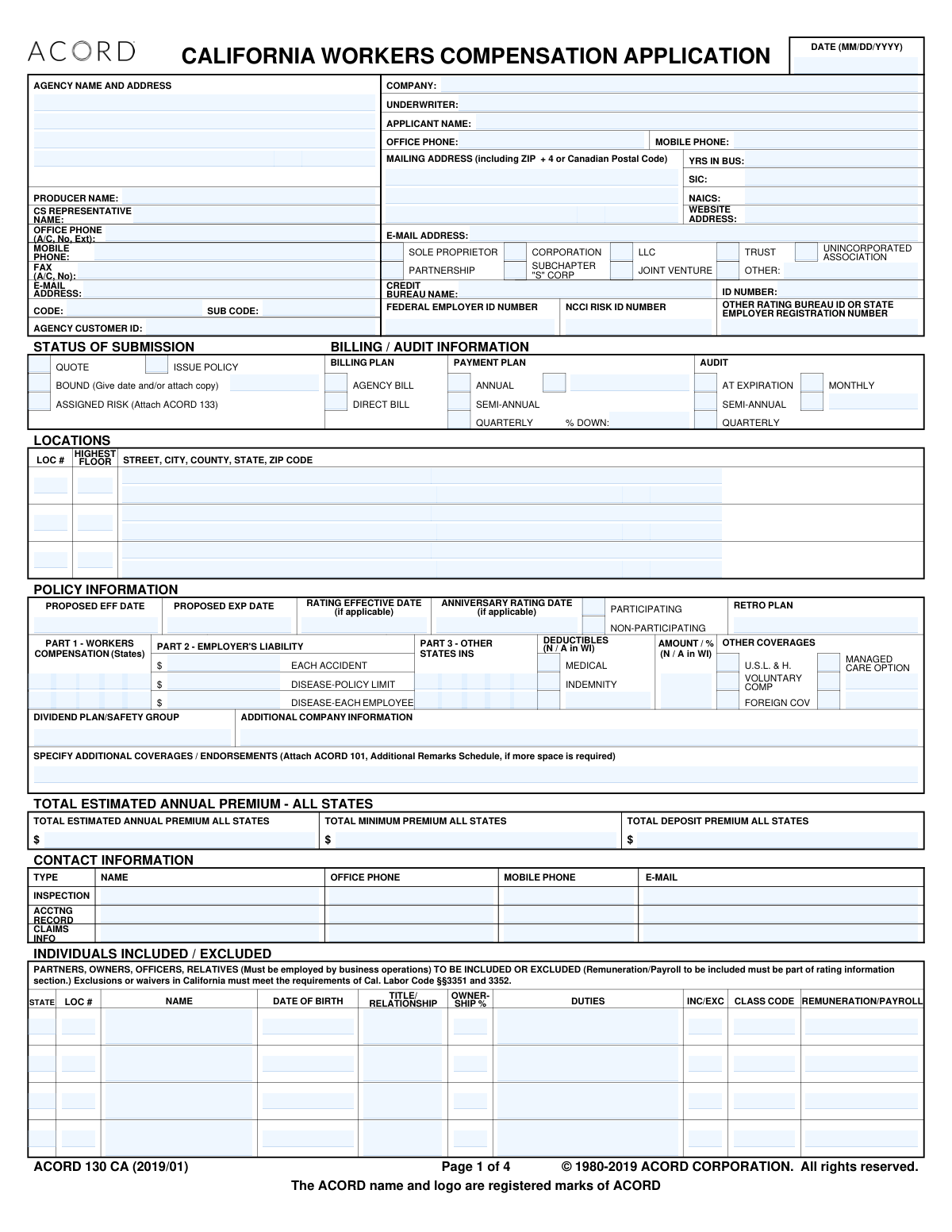
| 1. | ACORD 130 CA, California Workers Compensation Application | 4 | Complex 67 |
| 2. | Form CA-17, Duty Status Report | 3 | Complex 65 |
| 3. | DWC Form-001, Employer’s first report of injury or illness | 2 | Moderate 59 |
| 4. | DWC001S, Employer’s first report of injury or illness | 2 | Moderate 58 |
| 5. | DWC002, Employer’s report for reimbursement of voluntary payment | 2 | Basic 39 |
| 6. | Form BWC-1141, Request for Medical Information | 1 | Moderate 48 |
| 7. | State of New Mexico Workers’ Compensation Administration — Workers' Compensation Complaint (Rev. 8/22) (11.4.4.9 NMAC) | 4 | Moderate 59 |
- Enterprise-grade security & data encryption
- 99%+ accuracy powered by AI
- 1,000+ forms from all industries
- Complete forms in under 60 seconds
How to Choose the Right Form
Navigating workers' compensation can be complex, especially when dealing with different jurisdictions and specific reporting requirements. To find the right document, you first need to identify whether your claim is at the federal or state level.
Federal Employee Claims (FECA)
If you are a federal employee filing a claim through the U.S. Department of Labor’s Office of Workers' Compensation Programs (OWCP), you will primarily deal with forms designed for the Federal Employees' Compensation Act (FECA).
- Form CA-17, Duty Status Report: This is the most common form for managing return-to-work transitions. It is a dual-purpose document: the supervisor completes one side to outline job demands, while the treating physician completes the other to detail medical restrictions and work capacity. Use this to determine if you can return to regular or modified duty.
State-Specific Disputes and Filings
Workers' compensation laws vary significantly by state. If your claim is handled by a state agency rather than the federal government, you must use forms specific to that state’s administration.
- State of New Mexico Workers’ Compensation Administration — Workers' Compensation Complaint: If you are working in New Mexico and have reached a point of disagreement regarding your benefits or medical treatment, this is the form used to initiate a formal dispute. It frames the issues for mediation and creates the official record for the WCA.
How to Identify the Correct Form
To ensure you are using the right document from this category, ask the following questions:
- Who is the employer? Federal agencies always require OWCP forms like the Form CA-17. Private employers or state agencies will require state-specific forms (e.g., New Mexico WCA forms).
- What is the goal? If you are simply updating your work status to get back to your job, look for a "Duty Status" or "Work Capacity" report. If you are filing a legal challenge because benefits were denied, look for a "Complaint" or "Petition" form.
- Is the jurisdiction correct? While many forms look similar, using a New Mexico form for a claim in Alberta or a federal case will result in an immediate rejection. Always match the form to the governing body overseeing your claim.
Form Comparison
| Form | Main Purpose | Who Completes It | Jurisdiction | Usage Scenario |
|---|---|---|---|---|
| Form CA-17, Duty Status Report (U.S. Department of Labor, Office of Workers' Compensation Programs) | Communicates an employee's work capacity and medical restrictions for FECA claims. | Completed jointly by the employee's supervisor and the treating physician. | Federal (U.S. Department of Labor OWCP) | Used to determine return-to-work eligibility and appropriate modified duty assignments. |
| State of New Mexico Workers’ Compensation Administration — Workers' Compensation Complaint (Rev. 8/22) (11.4.4.9 NMAC) | Initiates or responds to a formal legal dispute regarding workers' compensation. | The injured worker, the employer, or the insurance carrier. | State of New Mexico | Required when mediation or a judicial hearing is needed to resolve benefits. |
Tips for workers compensation forms
For forms like the CA-17, ensure the supervisor completes the job demand section before giving the form to the physician. This allows the medical provider to make an informed decision regarding work capacity based on actual duties. Clear communication between both parties prevents administrative delays in return-to-work planning.
Avoid using vague terms like 'light duty' when describing medical limitations. Ensure the physician provides detailed metrics, such as specific weight limits for lifting or hourly caps on standing and sitting. Precise data helps the employer identify appropriate modified assignments and ensures the claim is processed correctly.
Always double-check identifiers like the OWCP file number or state-specific WCA case numbers on every page. Missing or incorrect identification numbers are a leading cause of paperwork being lost or ignored by administrative agencies. Keeping a list of these numbers nearby will save time when filling out multiple related forms.
Managing high volumes of workers' compensation paperwork is much easier with modern technology. AI-powered tools like Instafill.ai can complete these forms in under 30 seconds with high accuracy, ensuring your data stays secure throughout the process. It is a practical time-saver for anyone dealing with recurring status reports or complex complaints.
Workers' compensation claims often involve long-term oversight and multiple updates over several months or years. Always save a digital or physical copy of every submitted form for your own records. This documentation is vital if you need to reference past medical findings during a mediation or hearing.
When filing a formal dispute or complaint, be as explicit as possible about the specific relief or medical treatment you are seeking. Ambiguity regarding the benefits requested can lead to unnecessary delays in the mediation process. Framing the issues clearly from the start helps the agency and opposing parties address the claim more efficiently.
Frequently Asked Questions
Workers' compensation forms typically require input from multiple parties, including the injured employee, their supervisor or employer, and the treating medical professional. For example, in duty status reports, the supervisor outlines job requirements while the physician provides medical findings and work restrictions.
Federal employees covered under the Federal Employees' Compensation Act (FECA) usually require Department of Labor forms, such as the CA-17 Duty Status Report. This specific form is used to coordinate return-to-work efforts by documenting an employee's physical limitations and work capacity.
If a claim is denied or benefits are contested, you may need to file a formal complaint with your state's workers' compensation board. In New Mexico, for instance, the Workers' Compensation Complaint form is the official document used to initiate a dispute resolution process or request a hearing.
Yes, workers' compensation regulations are generally managed at the state or provincial level, meaning forms for New Mexico will differ from those for Alberta (WCB) or other jurisdictions. It is important to select the forms specific to the location where the injury occurred or where the employer is registered.
A Duty Status Report, such as Form CA-17, serves as a communication tool between an employer and a healthcare provider. It helps determine if an injured worker can return to their regular job, requires modified duties, or has specific physical restrictions that must be accommodated.
Yes, you can use AI-powered tools to complete these documents more efficiently. Platforms like Instafill.ai can accurately extract data from your source documents and populate the necessary fields in under 30 seconds, reducing the risk of manual entry errors.
Filling out complex workers' compensation forms manually can take significant time, but using AI automation streamlines the process. By utilizing AI to identify and place data into the correct fields, these forms can often be completed in less than a minute.
Submission locations depend on the form type; federal forms are usually sent to the Office of Workers' Compensation Programs (OWCP), while state-specific forms are submitted to the local Workers' Compensation Administration or board. Always check the instructions on the form to ensure it is sent to the correct government agency or insurance carrier.
Accurate medical data is crucial because it directly impacts benefit eligibility and the safety of the employee's return to the workplace. Incomplete or incorrect information regarding a diagnosis or physical limitation can lead to claim delays or inappropriate work assignments.
The correct form depends on whether you are reporting an initial injury, providing a medical update, or filing a legal dispute. Employees should consult with their HR department or workers' compensation board to ensure they are using the current version of the required form for their specific claim stage.
Glossary
- Form Complexity Index
- Instafill’s 0–100 measure of how much effort a form takes to complete, calculated deterministically from the form’s own structure rather than estimated. It combines the number of fillable fields (the largest factor), how difficult those fields are to complete based on their type, the number of pages that contain fields, the amount of conditional “fill-only-if” logic, and how many sections the form is divided into, then adds modifiers for tables and repeating lists, bundled instruction pages, and dense page layouts. A higher score means the form is harder to fill out by hand. The forms in this category have a median Form Complexity Index of 59/100 (Moderate). See exactly how it is calculated.
- OWCP
- The Office of Workers' Compensation Programs is a division of the U.S. Department of Labor that manages disability benefit programs for federal employees and other specific worker groups.
- Duty Status
- A medical classification that describes whether an employee is cleared for regular work, requires modified tasks, or is currently unable to work due to their injury.
- Modified Duty
- Temporary job assignments or tasks provided to an injured worker that accommodate their specific medical restrictions while they recover.
- FECA
- The Federal Employees' Compensation Act is the law that provides workers' compensation benefits, including medical expenses and wage loss compensation, to federal civil service employees.
- WCB / WCA
- These abbreviations refer to the Workers' Compensation Board or Administration, the state or provincial agencies responsible for overseeing workplace safety and insurance claims.
- Occupational Disease
- A health condition or illness caused by long-term exposure to hazardous substances or repetitive physical stress encountered in the work environment.
- Mediation
- An informal legal proceeding where a neutral third party helps the employee and the insurance carrier resolve disputes regarding benefits or claim denials.
- Work Capacity
- A physician's formal assessment of an employee's physical or mental ability to perform specific work-related activities, such as lifting, sitting, or reaching.