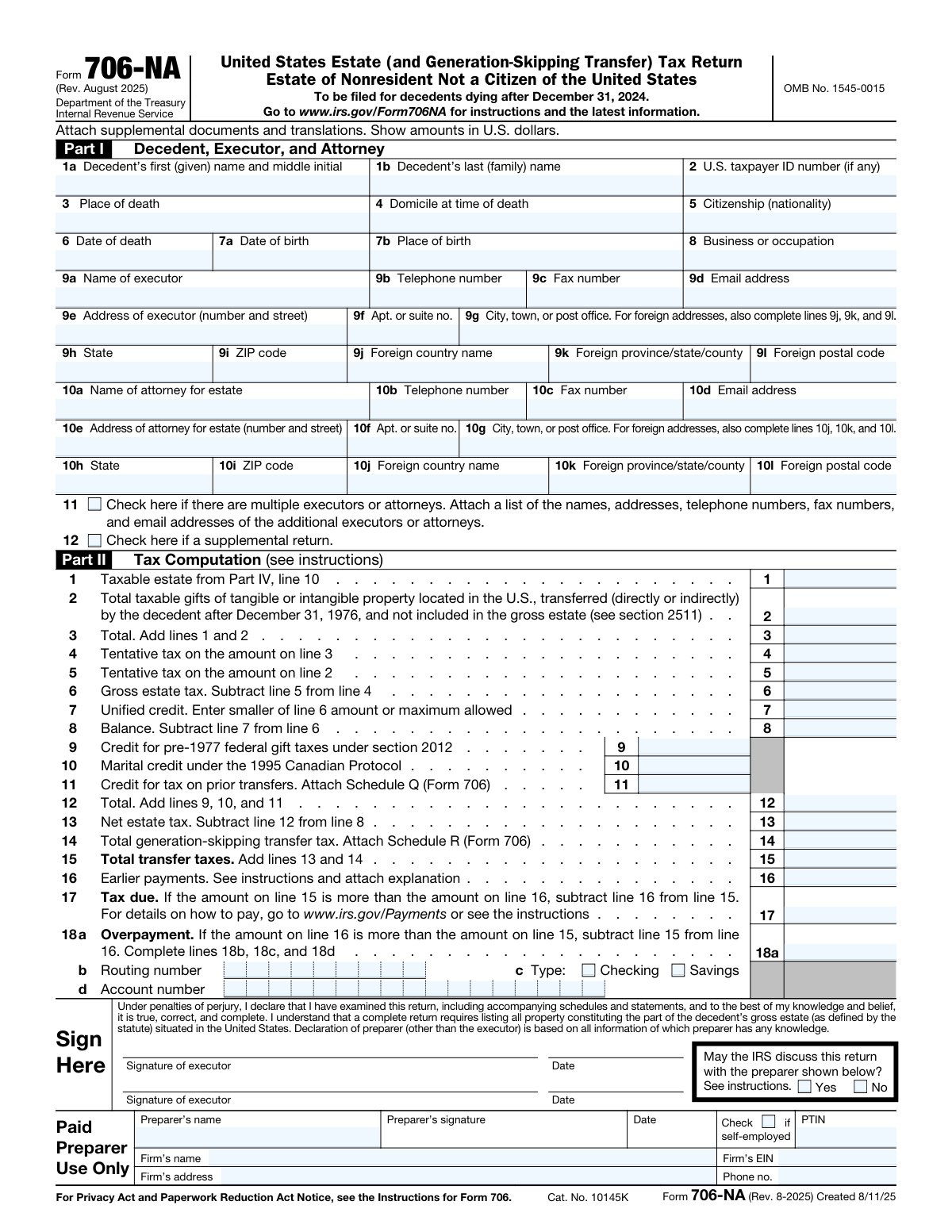
Yes! You can use AI to fill out Form 706-NA, United States Estate (and Generation-Skipping Transfer) Tax Return Estate of Nonresident Not a Citizen of the United States
Form 706-NA is an Internal Revenue Service (IRS) tax return filed by the executor of an estate for a deceased individual who was neither a citizen nor a resident of the United States at the time of death but owned property situated in the U.S. The form is used to compute the estate tax and any generation-skipping transfer (GST) tax liability on the decedent's U.S.-based assets. Today, this form can be filled out quickly and accurately using AI-powered services like Instafill.ai, which can also convert non-fillable PDF versions into interactive fillable forms.
Form 706-NA is part of the
estate forms, estate tax forms, NJ state forms, PA state forms, state ID forms, state tax forms, tax forms, transfer forms and transfer tax forms categories on Instafill.
Our AI automatically handles information lookup, data retrieval, formatting, and form filling.
It takes less than a minute to fill out Form 706-NA using our AI form filling.
Securely upload your data. Information is encrypted in transit and deleted immediately after the form is filled out.
Form specifications
| Form name: | Form 706-NA, United States Estate (and Generation-Skipping Transfer) Tax Return Estate of Nonresident Not a Citizen of the United States |
| Number of fields: | 259 |
| Number of pages: | 3 |
| Language: | English |
More forms in Estate forms
Instafill Demo: How to fill out PDF forms in seconds with AI
How to Fill Out Form 706-NA Online for Free in 2026
Are you looking to fill out a FORM 706-NA form online quickly and accurately? Instafill.ai offers the #1 AI-powered PDF filling software of 2026, allowing you to complete your FORM 706-NA form in just 37 seconds or less.
Follow these steps to fill out your FORM 706-NA form online using Instafill.ai:
- 1 Navigate to Instafill.ai and upload your PDF of Form 706-NA or select it from the template library.
- 2 Provide the decedent's personal details in Part I, including their name, taxpayer ID, date and place of death, domicile, and citizenship.
- 3 Enter the complete contact information for the estate's executor and attorney, including names, addresses, and phone numbers.
- 4 Complete Part V by listing all property and securities comprising the decedent's gross estate in the United States, and then use this information to calculate the taxable estate in Part IV.
- 5 Fill out Part II to compute the estate tax, applying any relevant credits such as the unified credit or credits for prior transfers.
- 6 Answer all general information questions in Part III regarding the decedent's property, business activities, and prior tax filings.
- 7 Review all entered information for accuracy, then have the executor sign and date the return before filing with the IRS, attaching any required supplemental documents.
Our AI-powered system ensures each field is filled out correctly, reducing errors and saving you time.
Why Choose Instafill.ai for Your Fillable Form 706-NA Form?
Speed
Complete your Form 706-NA in as little as 37 seconds.
Up-to-Date
Always use the latest 2026 Form 706-NA form version.
Cost-effective
No need to hire expensive lawyers.
Accuracy
Our AI performs 10 compliance checks to ensure your form is error-free.
Security
Your personal information is protected with bank-level encryption.
Frequently Asked Questions About Form Form 706-NA
Form 706-NA is the U.S. Estate Tax Return for the estate of a deceased person who was not a U.S. citizen and was not domiciled in the U.S. at the time of death. It must be filed if the value of the decedent's assets located in the U.S. exceeds the $60,000 filing threshold.
Citizenship refers to the country of the decedent's nationality. Domicile refers to the place the decedent considered their permanent home; it is a key factor in determining U.S. residency status for estate tax purposes.
U.S.-sited assets typically include real estate located in the U.S., stock in U.S. corporations, and certain debt obligations from U.S. persons or government entities. Part III of the form helps identify these assets.
You may need to attach several documents, including a certified copy of the will, documentation for the value of assets inside and outside the U.S., and any required schedules (e.g., for marital or charitable deductions).
The deduction is prorated; you must report the decedent's entire gross estate worldwide to calculate the ratio of U.S. assets to the total estate. This ratio is then applied to the total amount of expenses to determine the deductible portion.
This allows the executor to value the estate's assets six months after the date of death, rather than on the date of death. This can be beneficial if asset values have decreased, potentially lowering the estate tax owed.
Check the box on line 11 in Part I and attach a list with the names, addresses, and contact information for all additional executors.
Yes, it is very important. Part III, line 6, asks about former U.S. citizenship or residency, as special tax rules may apply to 'covered expatriates' who renounced their status within 10 years of death.
The form is due within 9 months after the decedent's date of death. An extension may be requested, but it is crucial to file and pay on time to avoid penalties.
All financial figures reported on Form 706-NA must be stated in U.S. dollars, regardless of the original currency of the asset or transaction.
Yes, services like Instafill.ai use AI to help you accurately auto-fill form fields from your data. This can save time and reduce errors on complex forms like this one.
Simply upload the Form 706-NA PDF to the Instafill.ai platform. The AI will identify the fields, allowing you to answer simple questions to populate the form, which you can then download and print for submission.
You can use a service like Instafill.ai, which can convert flat, non-fillable PDFs into interactive forms. Just upload your file, and the platform will make it possible to fill out digitally.
Compliance Form 706-NA
Validation Checks by Instafill.ai
1
Ensures Date of Death is After Date of Birth
This validation checks that the 'Date of death' entered in line 6 is chronologically after the 'Date of birth' entered in line 7a. This is a fundamental logical check to ensure the decedent's basic timeline is accurate. If the date of death is before the date of birth, the return is invalid and will be rejected, as it represents a logical impossibility.
2
Validates Executor Address for U.S. or Foreign Exclusivity
This check ensures that for the executor's address (lines 9e-9l), either U.S.-specific fields (State, ZIP code) are filled or foreign-specific fields (Foreign country, province, postal code) are filled, but not both. This prevents contradictory or ambiguous address information, which is critical for legal notices and correspondence. An invalid address structure could result in misdirected mail and significant processing delays.
3
Verifies Part II, Line 3 Calculation (Total Taxable Estate and Gifts)
This validation confirms that the value on Line 3 of Part II is the precise sum of the 'Taxable estate' (Line 1) and 'Total taxable gifts' (Line 2). This is a core calculation for determining the tentative tax base. An incorrect sum will cause errors in all subsequent tax calculations, making the return inaccurate and requiring an amendment.
4
Ensures Consistency Between Part IV, Line 10 and Part II, Line 1
This validation confirms that the 'Taxable estate' value calculated on Part IV, Line 10 is identical to the value entered on Part II, Line 1. This is a critical data transfer step that links the taxable estate calculation to the tax computation section. A mismatch indicates a data entry or calculation error and will invalidate the entire tax computation.
5
Ensures Gift Tax Return Details are Provided When Applicable
This check validates that if question 10a in Part III ('Have federal gift tax returns ever been filed?') is answered 'Yes,' then the 'Period(s) covered' (10b) and 'IRS office(s) where filed' (10c) are completed. This information is required for the IRS to cross-reference previous filings and verify the decedent's tax history. Missing these details when required will result in an incomplete return and follow-up inquiries from the IRS.
6
Verifies Part IV, Line 5 Calculation (Proration Ratio)
This validation checks that the value on Line 5 of Part IV is the result of dividing the 'Gross estate in the United States' (Line 1) by the 'Entire gross estate wherever located' (Line 3). This ratio is essential for correctly prorating deductions for a nonresident's estate. An incorrect ratio will lead to an improper deduction amount on Line 6 and an inaccurate taxable estate.
7
Validates Part V Asset Valuation Columns Based on Election
This check ensures that if the alternate valuation election on Part V, line 1 is 'No,' then the 'Alternate valuation date' (column d) and 'Alternate value' (column e) are blank for all listed assets. Conversely, if the election is 'Yes,' these columns must be completed. This enforces the rules of the election and prevents the use of incorrect valuation figures, which is fundamental to determining the gross estate value.
8
Ensures Mutual Exclusivity of Tax Due and Overpayment
This validation confirms that either 'Tax due' (Line 17) or 'Overpayment' (Line 18a) has a value, but not both. Tax due is calculated only if Line 15 is greater than Line 16, while overpayment is calculated if Line 16 is greater than Line 15. Having values in both fields is a logical impossibility and indicates a severe calculation error in the final tax determination.
9
Requires Direct Deposit Details Only When Overpayment Exists
This validation ensures that the bank routing number (18b), account type (18c), and account number (18d) are filled out only if an 'Overpayment' amount greater than zero is present on line 18a. Providing bank details without an overpayment is unnecessary and could be a data entry error. Failure to provide these details when an overpayment exists will result in a paper check being mailed, delaying the refund.
10
Validates Format of Decedent's U.S. Taxpayer ID Number
This check verifies that the 'U.S. taxpayer ID number' in field 2, if provided, is a valid 9-digit number consistent with an SSN or ITIN format. This ID is the primary key for the IRS to identify the decedent's tax records. An incorrectly formatted or invalid number will prevent the IRS from processing the return correctly and may require manual intervention.
11
Enforces Conditional Logic for Expatriation Questions
This validation ensures that questions 6b and 6c in Part III are answered only if question 6a ('Was the decedent ever a citizen or resident of the United States?') is answered 'Yes.' These follow-up questions regarding loss of citizenship and expatriate status are irrelevant if the decedent was never a U.S. person. This check prevents extraneous information from being submitted and ensures the form's logic is followed.
12
Ensures Consistency Between Part V, Line 3 and Part IV, Line 1
This validation confirms that the total value from Part V, Line 3 ('Total' gross estate in the U.S.) is correctly transferred to Part IV, Line 1 ('Gross estate in the United States'). This is a foundational step linking the detailed asset list to the taxable estate calculation. Any discrepancy between these two fields will cause all subsequent calculations in Part IV to be incorrect.
13
Validates Unified Credit Does Not Exceed Gross Estate Tax
This check ensures the 'Unified credit' amount on Part II, Line 7 is less than or equal to the 'Gross estate tax' on Part II, Line 6, as the instructions specify entering the smaller of the two. This prevents the balance on line 8 from becoming negative due to an excessive credit, which is not allowed. An error here would disrupt the tax calculation flow and lead to an incorrect net tax.
14
Verifies Part IV, Line 9 Calculation (Total Deductions)
This check validates that the 'Total deductions' on Part IV, Line 9 is the correct sum of lines 6, 7, and 8. This total is subtracted from the gross estate to determine the taxable estate. A mathematical error here will directly result in an incorrect taxable estate amount on Line 10, invalidating the entire return.
Common Mistakes in Completing Form 706-NA
Filers often incorrectly enter the decedent's place of death (Part I, line 3) in the field for their domicile (Part I, line 4). Domicile is a legal concept referring to one's permanent home, which determines which country's laws and tax treaties apply, whereas place of death is merely a geographical location. This error can lead to incorrect application of tax treaty benefits and significant delays in processing the return.
A frequent and critical error is failing to correctly identify which assets are 'situated in the United States' for estate tax purposes (Part V). For example, stock in U.S. corporations is a U.S. situs asset regardless of where the stock certificate is held, while stock in a foreign corporation is not, even if held in a U.S. brokerage account. Misclassification leads to an incorrect gross estate value (Part IV, line 1), resulting in an improper tax calculation and potential audits.
Many filers mistakenly claim the full amount of funeral expenses, debts, and administration costs, rather than the prorated amount required by the form. On Form 706-NA, these deductions (Part IV, line 4) must be prorated based on the ratio of the U.S. gross estate to the entire gross estate worldwide (Part IV, line 5). This calculation is often overlooked or performed incorrectly, leading to an improper deduction and an incorrect taxable estate.
This form frequently requires attaching other schedules (like Schedules E, G, H, O, M, Q, or R from Form 706) or supplemental documentation. A common mistake is answering 'Yes' to a question in Part III but forgetting to attach the corresponding schedule, or failing to provide itemized lists for deductions. This omission results in an incomplete filing, which will be rejected or delayed by the IRS until the missing information is provided.
Filers sometimes mistakenly apply the large unified credit available to U.S. citizens, rather than the much smaller credit allowed for non-resident aliens. The unified credit on this form (Part II, line 7) is generally limited to $13,000, unless a specific tax treaty allows for a larger, prorated amount. Using the wrong credit amount will cause a major error in the net tax due, potentially leading to significant underpayment, penalties, and interest.
In Part V, filers often provide vague descriptions for assets, such as 'stocks' or 'real estate,' without the necessary details. The IRS requires specific information, including the full name of the company for stocks, the physical address for real property, and CUSIP numbers for securities (Column c). Incomplete descriptions force the IRS to issue notices requesting clarification, significantly delaying the estate's closure. To avoid this, provide complete, unambiguous descriptions for every asset listed.
When entering a foreign address for an executor or attorney (Part I, lines 9 and 10), people often mistakenly fill in the 'State' and 'ZIP code' fields, which are intended only for U.S. addresses. This causes data entry confusion and can lead to correspondence being misdirected. For any non-U.S. address, you must leave lines 9h/9i (or 10h/10i) blank and use the specific foreign address fields. AI-powered form-filling tools like Instafill.ai can help prevent this by intelligently handling and formatting both U.S. and foreign addresses.
Some filers incorrectly believe they only need to report U.S. assets and leave the 'Gross estate outside the United States' (Part IV, line 2) blank or understated. This figure is essential for the correct proration of deductions, as calculated on lines 5 and 6. Omitting or undervaluing the worldwide estate leads to an inflated deduction amount and an incorrect tax liability, which can be considered a material misrepresentation.
Electing the alternate valuation date (Part V, line 1) is complex and often misunderstood. Filers may try to pick and choose which assets to value on the alternate date, which is not permitted; if the election is made, all assets must be valued on that basis. Furthermore, the election is only valid if it decreases both the value of the gross estate and the net estate tax due. Making an invalid election can result in it being disallowed, forcing a recalculation and potential penalties.
The form instructions state that if any supplemental document (like a will or death certificate) is in a foreign language, a certified English translation must be attached. Executors often submit foreign-language documents without the required translation, rendering the submission incomplete. This will halt the processing of the return until the proper translations are provided. To ensure a smooth process, have all non-English documents translated and certified before filing.
Saved over 80 hours a year
“I was never sure if my IRS forms like W-9 were filled correctly. Now, I can complete the forms accurately without any external help.”
Kevin Martin Green
Your data stays secure with advanced protection from Instafill and our subprocessors

Robust compliance program
Transparent business model
You’re not the product. You always know where your data is and what it is processed for.
ISO 27001, HIPAA, and GDPR
Our subprocesses adhere to multiple compliance standards, including but not limited to ISO 27001, HIPAA, and GDPR.
Security & privacy by design
We consider security and privacy from the initial design phase of any new service or functionality. It’s not an afterthought, it’s built-in, including support for two-factor authentication (2FA) to further protect your account.
Fill out Form 706-NA with Instafill.ai
Worried about filling PDFs wrong? Instafill securely fills form-706-na-united-states-estate-and-generation-skipping-transfer-tax-return-estate-of-nonresident-not-a-citizen-of-the forms, ensuring each field is accurate.