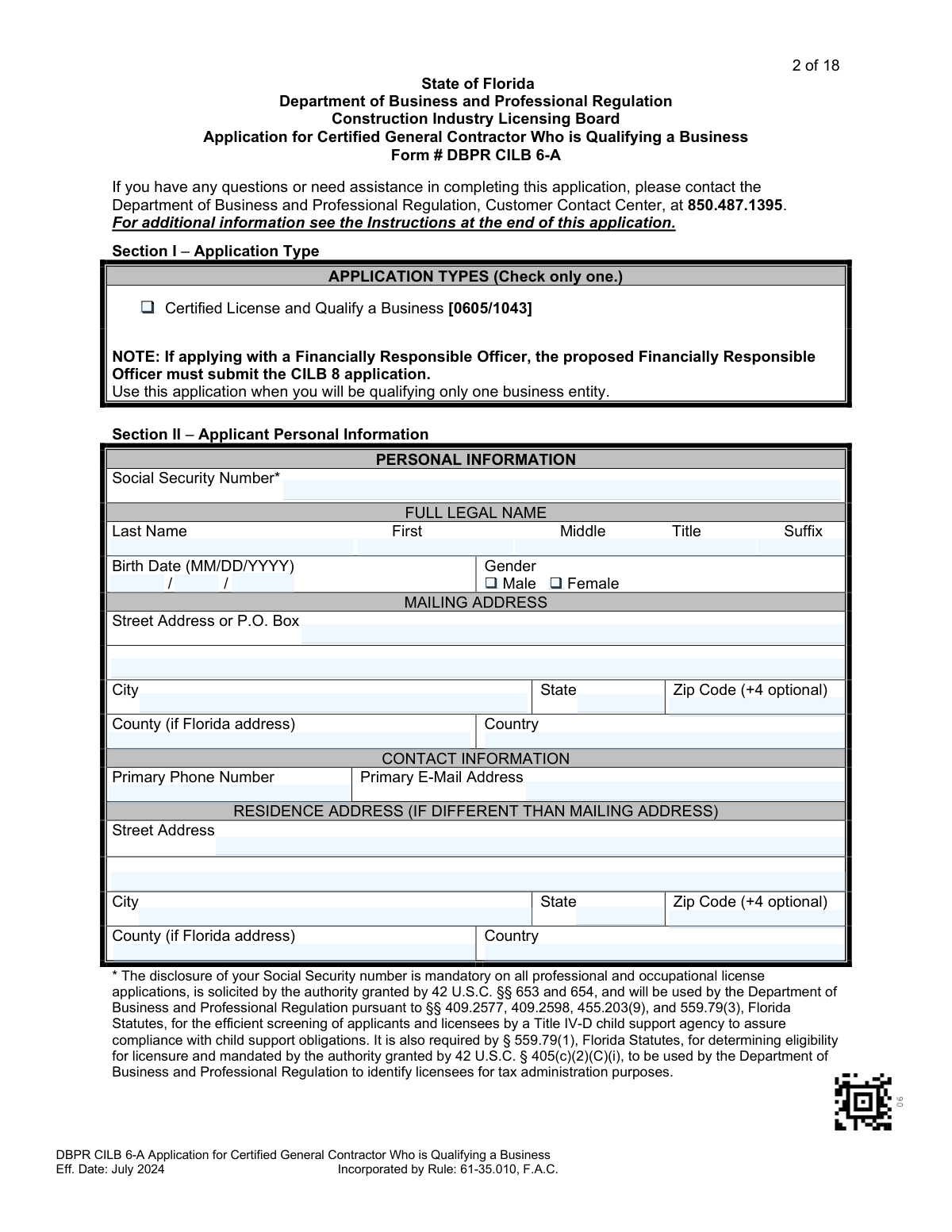
Yes! You can use AI to fill out Form DBPR CILB 6-A, Application for Certified General Contractor Who is Qualifying a Business

Form DBPR CILB 6-A is a mandatory application submitted to the Florida Department of Business and Professional Regulation's Construction Industry Licensing Board. It is used by general contractors to apply for certification and to legally qualify a business entity to perform construction work in the state, detailing experience, financial stability, and background information. Today, this form can be filled out quickly and accurately using AI-powered services like Instafill.ai, which can also convert non-fillable PDF versions into interactive fillable forms.
Our AI automatically handles information lookup, data retrieval, formatting, and form filling.
It takes less than a minute to fill out DBPR CILB 6-A using our AI form filling.
Securely upload your data. Information is encrypted in transit and deleted immediately after the form is filled out.

Form specifications

Form name: Form DBPR CILB 6-A, Application for Certified General Contractor Who is Qualifying a Business
Number of fields: 477
Number of pages: 14
Language: English
Categories: business forms, contractor forms, DBPR forms, CILB forms
main-image

Instafill Demo: How to fill out PDF forms in seconds with AI

How to Fill Out DBPR CILB 6-A Online for Free in 2026

Are you looking to fill out a DBPR CILB 6-A form online quickly and accurately? Instafill.ai offers the #1 AI-powered PDF filling software of 2026, allowing you to complete your DBPR CILB 6-A form in just 37 seconds or less.
Follow these steps to fill out your DBPR CILB 6-A form online using Instafill.ai:
  1. 1 Navigate to Instafill.ai and upload or select the DBPR CILB 6-A form to begin the AI-guided filling process.
  2. 2 Provide your personal information in Section II, including your full legal name, contact details, Social Security Number, and any prior license history.
  3. 3 In Section III, select your method of qualification and provide a detailed employment history, including specific project experience, to demonstrate you meet the state's requirements.
  4. 4 Enter the complete information for the business you intend to qualify in Section IV, including its legal name, FEID, address, and ownership structure.
  5. 5 Complete the financial and insurance sections (VIII & IX), providing details on your credit report, financial responsibility course completion if required, and insurance coverage.
  6. 6 Carefully answer all background questions in Section X for yourself and all authorized business representatives, providing detailed explanations and supporting documents for any 'Yes' answers.
  7. 7 Review all entered information for accuracy, then electronically sign and date the affirmation in Section XIII to certify the application before submission.

Our AI-powered system ensures each field is filled out correctly, reducing errors and saving you time.

Why Choose Instafill.ai for Your Fillable DBPR CILB 6-A Form?

Speed

Complete your DBPR CILB 6-A in as little as 37 seconds.

Up-to-Date

Always use the latest 2026 DBPR CILB 6-A form version.

Cost-effective

No need to hire expensive lawyers.

Accuracy

Our AI performs 10 compliance checks to ensure your form is error-free.

Security

Your personal information is protected with bank-level encryption.

Frequently Asked Questions About Form DBPR CILB 6-A

This form is for individuals applying to become a Certified General Contractor in Florida who will also be qualifying a business entity to perform construction work.

The fee is $245 if applying between May 1st of an even year and August 31st of an odd year, or $145 if applying between September 1st of an odd year and April 30th of an even year.

You must submit the application with the correct fee, electronic fingerprints, and credit reports for both yourself and the business you are qualifying. Additional documents may be required based on your answers and qualifications.

If your FICO-derived credit score is below 660, you are required to complete a 14-hour financial responsibility course approved by the Board. You must provide proof of completion with your application.

You must detail your employment history, including specific projects, your role (worker or foreman), and the types of work performed. To qualify as a General Contractor, you must show experience in at least four specified areas and have at least one year of experience on structures four stories or higher.

A Financially Responsible Officer (FRO) is an individual who assumes financial responsibility for the business, which can relieve the primary qualifier of that specific duty. Appointing an FRO is optional but may be in your best interest if you do not have final approval authority on all business matters.

The applicant and all authorized representatives of the business must answer the background questions. This includes all officers, directors, members, managers, or partners associated with the business entity.

You must answer "Yes" to the relevant question and provide a complete, detailed explanation in Section XI for each offense, regardless of adjudication. Be prepared to submit supporting legal documents as instructed.

You must obtain general liability insurance with minimums of $300,000 for public liability and $50,000 for property damage. You must also attest that you have or will obtain workers’ compensation insurance or an exemption within 30 days after your license is issued.

Mail your completed application, all required documentation, and the fee to the Department of Business and Professional Regulation, 2601 Blair Stone Road, Tallahassee, FL 32399-0783.

The 'Upgrade Method' allows a currently licensed and active certified residential or building contractor with at least 4 years of experience to take the general contractor's examination. If you qualify this way, you are exempt from filling out the Employment History section.

Yes, services like Instafill.ai use AI to accurately auto-fill form fields with your information, which can save you significant time and help prevent errors on this detailed application.

You can use a service like Instafill.ai to easily complete this form online. Simply upload the PDF, and the platform will make it interactive, allowing you to type your answers directly into the fields.

If you have a non-fillable or 'flat' PDF, you can use Instafill.ai to instantly convert it into an interactive, fillable form. This allows you to complete the application on your computer rather than printing it and filling it out by hand.

Compliance DBPR CILB 6-A
Validation Checks by Instafill.ai

1
Validates Social Security Number Format
This check ensures that the Social Security Number entered in Section II is in a valid format, such as XXX-XX-XXXX or XXXXXXXXX. It is a mandatory field for identity verification and tax administration purposes as stated in the form's disclosure. If the format is incorrect, the system should prompt the user to correct the entry before submission, preventing data entry errors and processing delays.
2
Ensures Birth Date is Plausible and Applicant is of Legal Age
This validation confirms that the Birth Date in Section II is a valid calendar date and that the calculated age is reasonable for a professional license applicant (e.g., over 18 years old). This is important for verifying the applicant's identity and eligibility. An invalid or future date, or an age that is too young, would result in an error message requiring the applicant to enter a correct date of birth.
3
Conditional Requirement for Florida County
This check validates that the 'County (if Florida address)' field in Section II is filled out if and only if the 'State' field is entered as 'Florida' or 'FL'. This rule applies to both the Mailing Address and Residence Address sections. It ensures data accuracy and completeness for state-specific reporting and jurisdiction. If the state is Florida and the county is blank, or if the state is not Florida and the county is filled, the form should flag an error.
4
Verifies Consistency Between Qualification Method and Experience
This is a critical logical check that cross-references Section III Part A (Method of Qualification) with the 'Total Time of Experience' totals from Part B. For example, if the applicant selects Method 5 ('Four years experience...'), the system must verify that the sum of 'Worker' and 'Foreman' years in Part B is at least four, with at least one year as a 'Foreman'. This ensures the applicant meets the minimum legal requirements for the license, and failure would result in a validation error explaining the discrepancy.
5
Validates 'Upgrade Method' Requirements
This check enforces the specific rules for Qualification Method #6, the 'Upgrade Method'. If this option is selected in Section III Part A, the 'License #' field must be populated, and one of the 'Building' or 'Residential' checkboxes must be selected. Furthermore, the system should recognize that the Employment History in Part B is not required for these applicants. This prevents unnecessary data entry and ensures the specific path to qualification is correctly documented.
6
Confirms General Contractor Specific Experience Requirements
Based on the note in Section III, this validation ensures that applicants for a General Contractor license have documented the required specialized experience. The system must check all Employment History entries in Part B to confirm that at least four different 'Experience area(s)' are checked and that at least one project entry indicates 'Yes' for 'construction of structures 4 stories or higher' with a project duration of at least one year. Failure to meet these criteria would block submission, as the applicant does not meet the specific scope of practice requirements.
7
Validates Logical Employment and Project Date Ranges
This check ensures the dates provided in the Employment History (Section III, Part B) are logical. It verifies that the 'Dates of Project' fall within the 'Dates Employed' for a given employer. This prevents logical impossibilities, such as working on a project for an employer before being hired. An error would be triggered if the project start date is before the employment start date or the project end date is after the employment end date.
8
Ensures Business Ownership Percentages Total 100%
This validation check sums the values entered in the '% of ownership' column in Section VII (Business Ownership). The total must equal exactly 100%. This is crucial for establishing the legal ownership structure of the business being qualified. If the total is not 100%, the application is incomplete and legally ambiguous, so the system must display an error and prevent submission until the percentages are corrected.
9
Conditional Requirement for Financial Responsibility Course
This check enforces the rule in Section IX based on the applicant's credit score. If the applicant checks 'No' for 'Does the submitted credit report show a credit score of 660 or higher?', then the 'Have you completed a financial responsibility course?' question must be answered 'Yes'. Consequently, the fields for 'School Name', 'School Provider #', 'Name of Course', and 'Date(s) Attended' become mandatory. This ensures applicants who don't meet the stability threshold provide proof of required remedial education.
10
Mandatory Explanation for 'Yes' Answers to Background Questions
This validation links the 'Yes'/'No' questions in Section X to the explanation sections XI and XII. If any applicant or authorized representative answers 'Yes' to questions 1 or 2, the system must require at least one corresponding explanation entry in Section XI. Similarly, a 'Yes' to questions 3 or 4 must require an entry in Section XII. This ensures that all potential disqualifying information is fully disclosed and explained as required by law, preventing incomplete applications.
11
Requires at Least One Physical Address
This check enforces the requirement from the instructions (Section 2.b.v) that a physical address must be provided. The system will check if the 'Mailing Address' in Section II is a P.O. Box. If it is, the 'Residence Address' fields become mandatory and must not contain a P.O. Box. This ensures the department has a physical location for the licensee on record, which is a standard regulatory requirement.
12
Validates Selection of Financial Responsibility Status
In Section V, this check ensures that exactly one of the three checkboxes regarding financial responsibility is selected. It also enforces that if the first or second option is chosen, the corresponding name/license number field is not left blank. This prevents ambiguity about who holds financial responsibility for the business, which is a critical legal aspect of the qualification. An error would occur if zero or more than one option is selected.
13
Validates Federal Employer ID Number (FEID) Format
This check ensures the Federal Employer ID Number (FEID) in Section IV is entered in the correct 9-digit format, typically XX-XXXXXXX. This is essential for correctly identifying the business entity for tax and regulatory purposes. An invalid format could lead to processing failure or incorrect record matching. The system should reject any entry that does not conform to the standard FEID structure.
14
Enforces Mandatory Insurance Affirmation
This validation checks the two questions in Section VIII regarding insurance coverage. The system must ensure that the applicant has answered 'Yes' to both question 1 (Liability Insurance) and question 2 (Workers' Compensation). A 'No' answer to either question indicates the applicant does not meet the minimum statutory requirements for licensure. Therefore, a 'No' response should trigger a hard stop, informing the applicant they are ineligible until they can affirm they have the required coverage.

Common Mistakes in Completing DBPR CILB 6-A

Submitting Incomplete or Vague Employment History

Section III-B requires extremely detailed project and employment history to prove qualification. Applicants often provide vague descriptions of their duties, omit the qualifying contractor's name and license number, or fail to provide specific project details like square footage and number of stories. These omissions make it impossible for the board to verify experience, leading to deficiency notices and significant processing delays. To avoid this, meticulously document each project, ensuring every field is completed with verifiable information.

Failing to Document 4-Story Building Experience

A critical and often-missed requirement for the Certified General Contractor license is providing proof of at least one year of experience in constructing structures that are four stories or higher (Rule 61G4-15.001). Applicants may have extensive experience but overlook this specific mandate buried in the notes of Section III, Part B. Failure to clearly identify and describe a project that meets this height requirement will result in an automatic application deficiency. Always ensure your employment history explicitly includes and details this specific type of experience.

Under-disclosing on Background Questions

The background questions in Section X are intentionally broad, covering everything from minor traffic offenses to felonies. Applicants frequently misinterpret the scope, believing that old, dismissed, or sealed records do not need to be disclosed, which is incorrect. Failing to disclose an offense, regardless of its nature or outcome, can be considered falsification and may lead to immediate denial of the application or future license revocation. When in doubt, it is always better to disclose and provide a full explanation in Section XI.

Submitting Incorrect or Incomplete Credit Reports

The application requires two separate credit reports: one for the individual applicant and one for the business being qualified. A common error is submitting only one report or providing reports that lack the mandatory FICO score and the required public records statement. This instantly makes the application incomplete. Ensure both reports are from a nationally recognized agency and explicitly state that public records have been checked at local, state, and federal levels.

Ignoring Low Credit Score Protocol

If an applicant's personal FICO score is below 660, the application is not automatically denied, but it triggers an additional requirement: completion of a 14-hour financial responsibility course. Many applicants with scores below 660 submit their application without proof of course completion, assuming they can do it later. This results in a deficiency notice and halts the review process until the course certificate is provided. It is crucial to complete the course *before* submitting the application if your score is below the threshold.

Incomplete Disclosures for Business Representatives

Section X requires background questions to be answered not just by the applicant, but by *all* authorized representatives of the business, including officers, directors, members, and partners. A frequent mistake is for only the applicant to fill out this section, leaving the other required parties' information blank. The board verifies this information against public records from Sunbiz.org, and an incomplete section will cause the application to be rejected until all required individuals have provided their information and answered the questions.

Mismatching Business Name with State Records

The business name and any 'Doing Business As' (D/B/A) name listed in Section IV must exactly match the information registered with the Florida Division of Corporations (Sunbiz). Applicants often use abbreviations, slight variations, or forget to include suffixes like 'LLC' or 'Inc.', causing a mismatch. Any discrepancy between the application and official state records will lead to a deficiency and require correction, delaying the licensing process. AI-powered form fillers like Instafill.ai can help prevent this by cross-referencing public databases to ensure accuracy.

Miscalculating or Mismatching Experience Requirements

In Section III-A, the applicant selects a method of qualification, each with a specific combination of education, worker, and foreman experience. A common error is selecting a method and then failing to provide corresponding proof in the Employment History (Part B) that meets or exceeds the required timeframes. For example, an applicant might claim four years of experience but only document three and a half, or confuse the definitions of 'worker' and 'foreman'. This mismatch between the claimed qualification method and the documented proof is a primary reason for application rejection.

Incorrectly Calculating Application Fees

The application fee changes based on the time of year, with one fee for applications submitted between May 1st of an even year and August 31st of an odd year, and a different fee for all other times. Applicants often overlook this detail and send the wrong amount, which can cause the entire application package to be returned. Always double-check the current date against the fee schedule on the first page before writing the check. Since this form is a non-fillable PDF, tools like Instafill.ai can convert it into a fillable version and include logic to help calculate the correct fee based on the submission date.

Failing to List All Prior Names and Aliases

Section II requires applicants to list any name they have ever used, including maiden names, nicknames, or aliases. People often forget to include names that appear on older supporting documents like diplomas or past licenses. When the name on a supporting document does not match the legal name on the application and is not listed as a prior name, it creates a discrepancy that flags the application as deficient. This simple oversight can cause significant delays while the applicant provides clarifying documentation.
Saved over 80 hours a year

“I was never sure if my IRS forms like W-9 were filled correctly. Now, I can complete the forms accurately without any external help.”

Kevin Martin Green

Your data stays secure with advanced protection from Instafill and our subprocessors

Robust compliance program

Transparent business model

You’re not the product. You always know where your data is and what it is processed for.

ISO 27001, HIPAA, and GDPR

Our subprocesses adhere to multiple compliance standards, including but not limited to ISO 27001, HIPAA, and GDPR.

Security & privacy by design

We consider security and privacy from the initial design phase of any new service or functionality. It’s not an afterthought, it’s built-in, including support for two-factor authentication (2FA) to further protect your account.

Fill out DBPR CILB 6-A with Instafill.ai

Worried about filling PDFs wrong? Instafill securely fills form-dbpr-cilb-6-a-application-for-certified-general-contractor-who-is-qualifying-a-business forms, ensuring each field is accurate.