Fill out investment application forms
with AI.
Investment application forms are the foundational documents required to open accounts and commit capital to various financial vehicles. These forms cover a broad spectrum of financial activities, from establishing individual retirement accounts (IRAs) and 403(b) custodial plans to setting up complex institutional investment structures. They serve a dual purpose: they gather the necessary personal and financial data to comply with anti-money laundering (AML) and "know your customer" (KYC) regulations, while also formalizing the legal agreement between the investor and the fund manager or financial institution.
By continuing, you acknowledge Instafill's Privacy Policy and agree to get occasional product update and promotional emails.
About investment application forms
Typically, these forms are needed by individuals planning for retirement, corporate entities looking to manage surplus cash, or trustees overseeing asset distributions. Whether you are applying for a specific retail hedge fund or submitting a subscription agreement for a private investment fund, accuracy is paramount. Errors in tax residency, source of wealth, or beneficiary designations can lead to significant processing delays or legal complications. Tools like Instafill.ai use AI to fill these forms in under 30 seconds, ensuring that data is handled accurately and securely while saving you the frustration of manual entry.
These documents are essential for anyone navigating the transition from financial planning to active investing. By centralizing information on investment choices, risk tolerance, and account features, they provide the framework for long-term wealth management. From individual investor profiles to master applications for employer-sponsored retirement plans, these forms are the gateways to the global financial markets.
Every form on this page can be completed without typing. Instafill is form filling software that reads a PDF and fills it for you — including flat and scanned documents that carry no fillable fields at all.
Forms in This Category
The forms in this category have a median Form Complexity Index of 63/100 (Complex), measured across 20 forms by field count, input difficulty, length, conditional logic and structure. See how it is calculated.
- Enterprise-grade security & data encryption
- 99%+ accuracy powered by AI
- 1,000+ forms from all industries
- Complete forms in under 60 seconds
How to Choose the Right Form
Selecting the correct investment application depends primarily on two factors: the type of legal entity making the investment (individual, trust, or corporation) and the specific financial institution or fund you are joining.
Retirement and Workplace Savings
If you are setting up a personal or employer-sponsored retirement account, look for forms tailored to tax-advantaged structures:
- Individual IRAs: Use the Voya Investment Management Traditional, Roth, Rollover, and SEP IRA Application or the New York Life Investments Funds Individual Retirement Account Application to establish new retirement savings accounts.
- Workplace Plans: The Fidelity Investments 403(b) Custodial Account Application is designed for employees of eligible non-profits, while the Fidelity Advisor Investment-Only Retirement Plan Master Application helps employers set up broader investment platforms.
- Trustee-Directed Accounts: For plan trustees managing qualified retirement plans, the Fidelity Investment-Only (Non-Prototype) Retirement Account Application allows for the creation of pooled or participant-level accounts.
Institutional and Corporate Investing
Organizations and high-net-worth entities require forms that capture complex ownership and tax residency data:
- Corporations and Institutions: The SEI Corporate Investor Application and Agreement and the Northern Trust Institutional Investor Application are standard for business entities.
- Regional Specifics: If you are an Australian or New Zealand entity, choose the Vanguard Wholesale Funds - Application Form – Companies or the Vanguard Wholesale Funds - Application Form – Associations.
Private Funds and Specialized Trading
For alternative investments or specific trading permissions, use these targeted documents:
- Private Equity and Hedge Funds: New investors in specialized funds should use the BlackRock Private Investments Fund Subscription Agreement and Application or the Pomona Investment Fund Investor Initial Application.
- Hedge Funds for Individuals: The Application Form: Individual Investor | Monthly Liquidity – Retail Hedge Fund is specifically for individuals entering Fundrock’s retail hedge structures.
- Options Trading: If you already have a Fidelity account but want to trade derivatives, you must complete the Options Application - Fidelity Investments.
Trust-Specific Investments
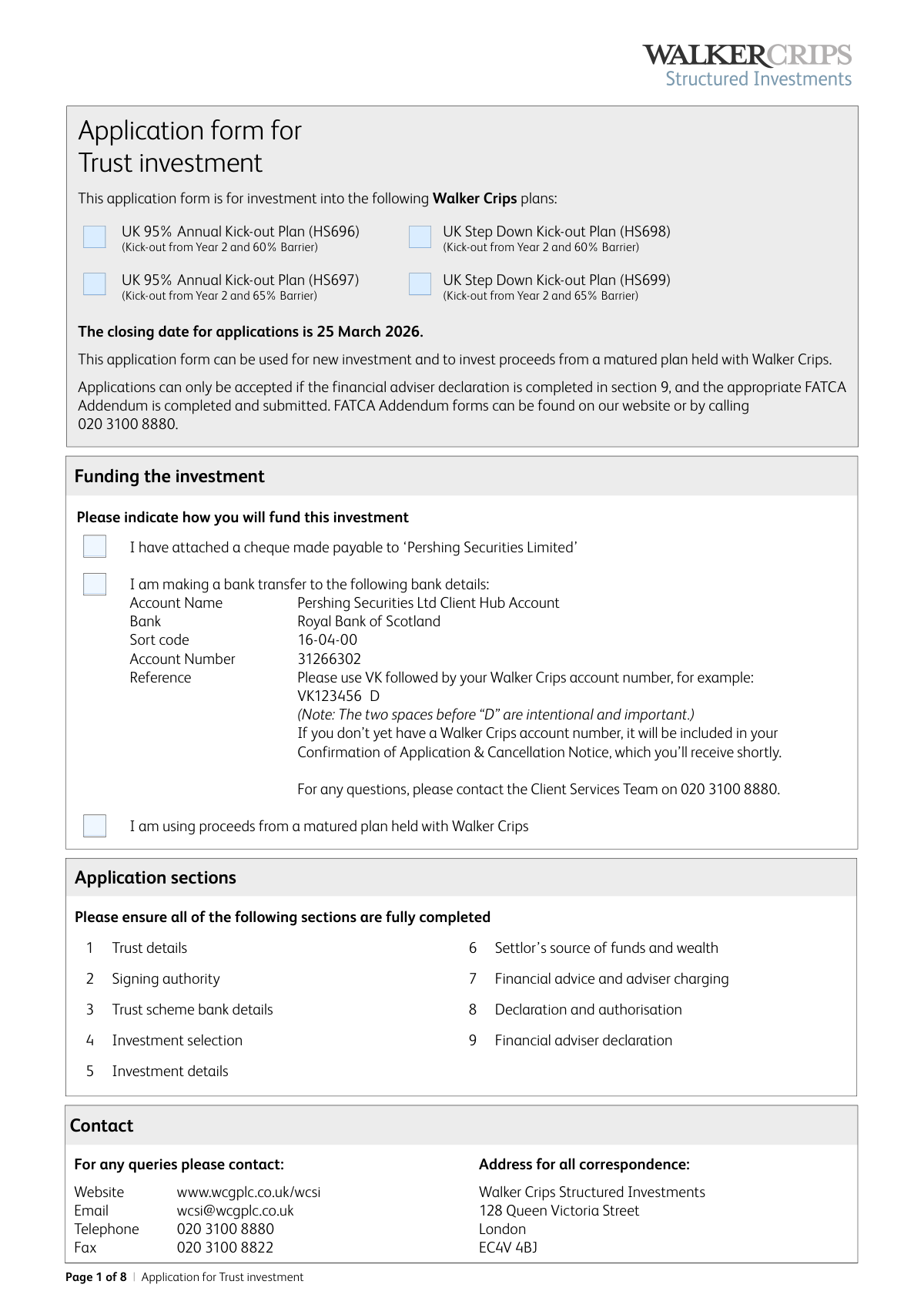
For trustees managing assets on behalf of a trust, the Application form for Trust investment (Walker Crips) or the Application Form Franklin Templeton Investment Funds provides the necessary fields to document trust details and funding sources accurately.
Form Comparison
| Form | Target Investor | Investment Category | Primary Requirement |
|---|---|---|---|
| Application form for Trust investment | Trustees and legal trust entities | Structured investment plans | Trust details, funding source, and financial advisor information |
| Application Form Franklin Templeton Investment Funds | Individuals, companies, and trusts | Mutual funds and investment funds | Tax residency, source of wealth, and specific fund choices |
| Application Form: Individual Investor | Monthly Liquidity – Retail Hedge Fund | Individual retail investors | Retail hedge funds | Banking details and FICA/FATCA regulatory compliance information |
| BlackRock Private Investments Fund Subscription Agreement and Application | New private fund subscribers | Private investment funds | Investor suitability certifications and legal risk acknowledgments |
| Corporate Investor Application and Agreement - SEI | Corporate entities and organizations | SEI sub-funds | Binding agreement terms and detailed corporate regulatory disclosures |
| Fidelity Advisor Investment-Only Retirement Plan Master Application | Employers and plan trustees | Employer-sponsored retirement plans | Trustee details, investment allocations, and plan-level account setup |
| Fidelity Charitable Investment Advisor Program Application | Donors with Giving Accounts | Charitable asset management | Nominated investment advisor details and account holder information |
| Fidelity Investments 403(b) Custodial Account Application | Employees of eligible organizations | Tax-advantaged 403(b) retirement plans | Employment details, investment selections, and beneficiary designations |
| New York Life Investments Funds Individual Retirement Account Application and NYLIFE Securities LLC Investor Profile | Individual retirement savers | Traditional, Roth, or SEP IRAs | Investor financial profile, objectives, and fund selection |
| Northern Trust Institutional Investor Application | Corporations, partnerships, and foundations | Institutional investment funds | Beneficial ownership data and federal tax status documentation |
| Options Application - Fidelity Investments | Existing Fidelity account holders | Options trading privileges | Financial situation, trading experience, and risk tolerance assessment |
| Vanguard Wholesale Funds - Application Form – Companies | Australian and New Zealand companies | Wholesale investment funds | Corporate information and AML/CTF beneficial ownership compliance |
Tips for investment application forms
Ensure that the Social Security Number or Employer Identification Number matches the legal name of the individual or entity exactly. Discrepancies in these fundamental fields are the leading cause of application rejection or delayed account activation.
To comply with Anti-Money Laundering regulations, the bank account used for funding must usually be in the same name as the investment applicant. Using a third-party account often triggers manual compliance reviews and can significantly delay your investment timeline.
AI-powered tools like Instafill.ai can complete these complex investment forms in under 30 seconds with high accuracy. This technology ensures your data stays secure during the process while saving you from the tedious task of repetitive manual entry across multiple documents.
Most applications for trusts, associations, or corporations require additional paperwork like trust deeds, articles of incorporation, or lists of beneficial owners. Gathering digital copies of these documents before you start the form will streamline your submission and prevent mid-process interruptions.
For retirement and trust-based accounts, clearly defining beneficiaries is essential for effective estate planning. Leaving these sections blank or providing vague information can lead to complicated legal hurdles for your heirs and executors in the future.
Investment providers often offer multiple share classes with different fee structures and minimums. Carefully cross-reference the specific fund codes or ticker symbols to ensure you are applying for the exact investment vehicle recommended for your financial profile.
Frequently Asked Questions
These forms are used to formally establish a relationship between an investor and a financial institution or fund manager. They document essential details such as the investor's identity, tax residency, and the specific investment products being selected, ensuring the account is opened in compliance with financial regulations.
The correct form usually depends on your legal entity type and the specific fund you are targeting. For example, there are distinct forms for individual investors, corporate entities, trusts, and institutional associations, as well as specific applications for retirement accounts like IRAs or 403(b) plans.
Yes, you can use AI-powered tools like Instafill.ai to complete these forms in under 30 seconds. The AI accurately extracts relevant data from your source documents and places it directly into the required fields, significantly reducing manual data entry.
In addition to the application, you may need to provide proof of identity, such as a passport or driver's license, and proof of address. For corporate or trust investments, you might also be required to submit governing documents like a trust deed or articles of incorporation.
Financial institutions are legally mandated to identify where their investors are tax residents to comply with international reporting standards. This information helps prevent tax evasion and ensures that the institution reports the necessary data to the appropriate national tax authorities.
When using traditional manual methods, complex investment forms can take 30 minutes or more to complete. However, with AI tools like Instafill.ai, the process is streamlined to under 30 seconds by automatically populating the form with your existing information.
An initial application is used to open a brand-new account and establish your identity with the fund manager. A subsequent application is used by existing investors who wish to increase their holdings or buy into a different class of shares within the same fund structure.
Generally, the investor or their authorized financial advisor is responsible for submitting the completed form to the fund's transfer agent, custodian, or investment manager. Submission instructions, such as mailing addresses or secure email portals, are typically found at the end of the application document.
Yes, retirement investments often require specialized applications such as IRA Adoption Agreements or 403(b) Custodial Account Applications. These forms include additional sections for beneficiary designations and specify the tax-advantaged status of the account under the Internal Revenue Code.
You can use AI services like Instafill.ai to convert non-fillable or scanned PDF versions into interactive forms. This allows you to type directly into the document and use AI to map your data to the correct fields without needing to print and scan the paperwork.
Glossary
- Form Complexity Index
- Instafill’s 0–100 measure of how much effort a form takes to complete, calculated deterministically from the form’s own structure rather than estimated. It combines the number of fillable fields (the largest factor), how difficult those fields are to complete based on their type, the number of pages that contain fields, the amount of conditional “fill-only-if” logic, and how many sections the form is divided into, then adds modifiers for tables and repeating lists, bundled instruction pages, and dense page layouts. A higher score means the form is harder to fill out by hand. The forms in this category have a median Form Complexity Index of 63/100 (Complex). See exactly how it is calculated.
- AML/CTF
- Anti-Money Laundering and Counter-Terrorism Financing regulations that require financial institutions to verify the identity of investors to prevent illegal financial activities.
- FATCA/CRS
- The Foreign Account Tax Compliance Act and Common Reporting Standard are international tax regulations used to identify and report the tax residency of account holders.
- Beneficial Owner
- An individual who ultimately owns or controls a legal entity, such as a corporation or trust, or who exercises significant influence over its financial decisions.
- FBO (For the Benefit Of)
- A designation used when an account is held by one party, such as a trustee or employer, but the assets are legally owned by another specific individual.
- Subscription Agreement
- A formal legal contract between an investor and a fund that outlines the terms of the investment and confirms the investor's commitment to purchase shares.
- Non-Prototype Account
- A retirement account structure where the financial provider offers the investment platform but does not provide the standardized plan documents, tax reporting, or recordkeeping.
- Custodial Account
- An account where a financial institution (the custodian) holds and manages assets on behalf of a beneficiary, such as a minor or a retirement plan participant.
- Omnibus Account
- A single master account that pools together the assets of multiple individual participants rather than maintaining separate individual accounts at the fund level.
- Source of Wealth
- A section in application forms where investors must explain the origin of the funds they are investing, such as inheritance, business profits, or salary.