Fill out IRA application forms
with AI.
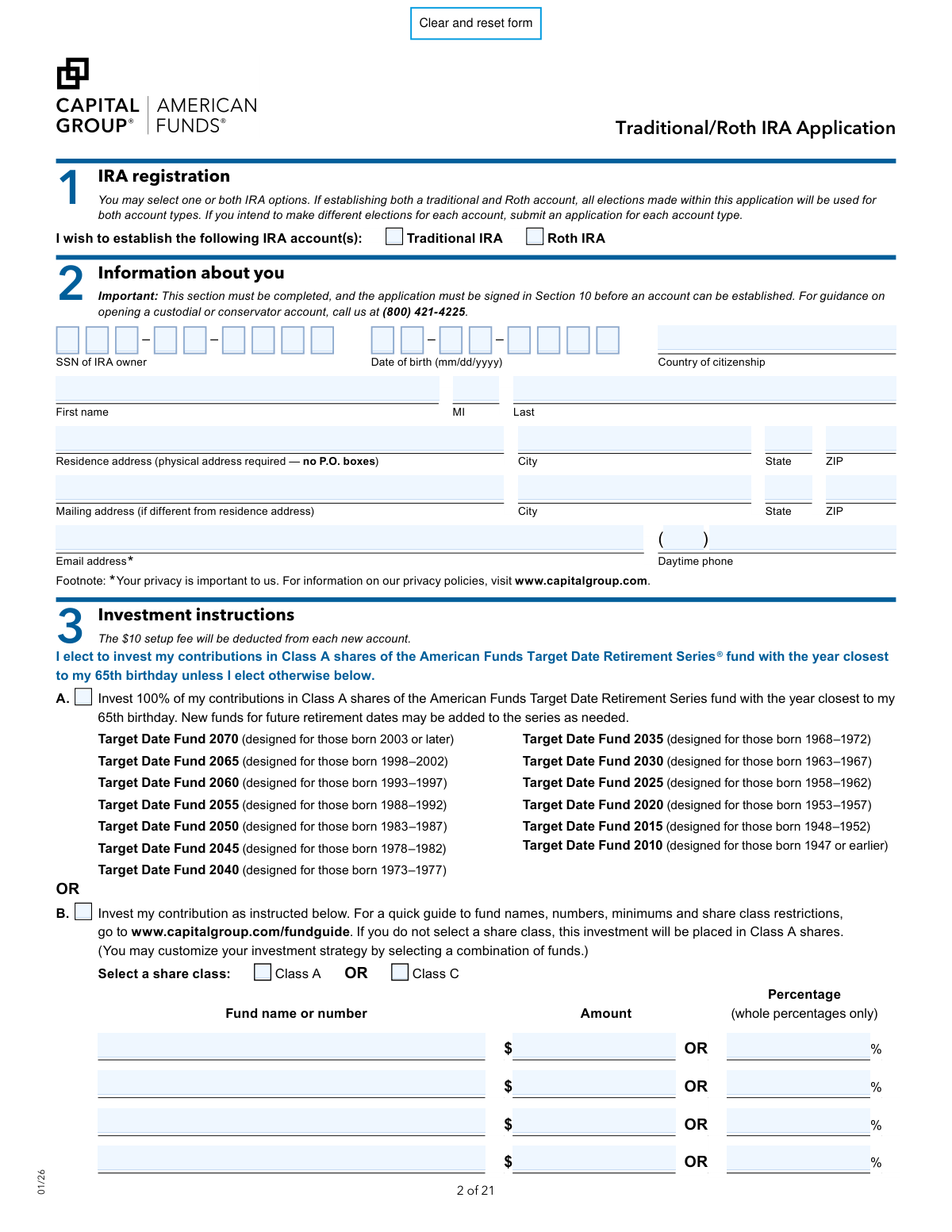
Individual Retirement Accounts (IRAs) are essential vehicles for building long-term wealth and securing financial stability during retirement. This category of forms covers the critical documentation required to establish various types of IRAs, including Traditional, Roth, and Rollover accounts, as well as specialized options like SIMPLE IRAs for small business employees. Whether you are initiating a new investment strategy or transferring existing assets, these forms serve as the legal foundation for your account. They capture vital data such as beneficiary designations, employment history, and investment preferences to ensure your assets are managed according to federal regulations and your personal financial goals.
By continuing, you acknowledge Instafill's Privacy Policy and agree to get occasional product update and promotional emails.
About IRA application forms
Typically, these forms are needed by individuals entering a new phase of their financial life. This includes employees moving funds from a former employer’s 401(k) into a Rollover IRA, small business owners setting up retirement benefits, or beneficiaries managing an Inherited IRA. Major financial institutions like Charles Schwab, Fidelity, and Merrill Edge require these specific applications to verify identity and set up custodial agreements. Navigating these multi-page documents can be time-consuming and requires high precision to avoid processing delays. Tools like Instafill.ai use AI to fill these forms in under 30 seconds, ensuring data is handled accurately and securely.
Every form on this page can be completed without typing. Instafill is form filling software that reads a PDF and fills it for you — including flat and scanned documents that carry no fillable fields at all.
Forms in This Category
The forms in this category have a median Form Complexity Index of 68/100 (Complex), measured across 15 forms by field count, input difficulty, length, conditional logic and structure. See how it is calculated.
- Enterprise-grade security & data encryption
- 99%+ accuracy powered by AI
- 1,000+ forms from all industries
- Complete forms in under 60 seconds
How to Choose the Right Form
Selecting the correct IRA application depends on two main factors: the financial institution you have chosen and the specific tax structure of the account you need.
Standard Personal IRAs
If you are opening a new personal retirement account (Traditional, Roth, or a standard Rollover), look for the primary application from your chosen brokerage:
- Charles Schwab: Use the Charles Schwab IRA Account Application or the Schwab IRA Account Application. These are comprehensive forms for setting up most personal IRA types and designating beneficiaries.
- Voya: The Voya Investment Management Traditional, Roth, Rollover, and SEP Individual Retirement Account (IRA) Application is a multi-purpose document that includes the adoption agreement and custodial details.
- Merrill Edge: For those managing their own investments, the Merrill Edge® Self-Directed BASIC™ Retirement Account Application is the standard choice for U.S. residents.
Small Business and Employer-Sponsored IRAs
If you are a small business owner or an employee enrolling in a company-sponsored plan, you will need a SIMPLE IRA form:
- Merrill Edge: Use the Merrill Edge® Self-Directed SIMPLE IRA Retirement Account Application to enroll in a tax-deferred plan with employer matching.
- Fidelity: The New Fidelity Account Application — SIMPLE IRA is designed specifically for self-employed individuals or employees of businesses with 100 or fewer staff members.
Inherited and Automatic Rollover Accounts
Specialized forms are required if you are receiving funds from a deceased person's estate or an old employer plan:
- Inherited Assets: Use the Inherited IRA Application (Pershing) or the Inherited IRA Application for Individual Beneficiaries (Charles Schwab) to transfer assets into your name after the original owner's death.
- Automatic Rollovers: If a former employer automatically moved your 401(k) funds, use the Fidelity Advisor IRA Application for Automatic Rollover Accounts to claim and manage those assets.
- Direct Rollovers: For moving funds from a current employer plan to Transamerica, select the Transamerica Premier Funds Direct Rollover IRA Application.
Form Comparison
| Form | Primary Purpose | Financial Institution | IRA Types Supported |
|---|---|---|---|
| Charles Schwab IRA Account Application | Establish a new personal retirement account with full authorizations. | Charles Schwab | Traditional, Roth, and Rollover |
| Fidelity Advisor IRA Application for Automatic Rollover Accounts | Manage assets automatically transferred from a former employer's plan. | Fidelity Investments | Rollover and Roth IRAs |
| Inherited IRA Application | Transfer assets to a beneficiary after the account owner's death. | Pershing LLC | Inherited (Beneficiary) IRA |
| Inherited IRA Application for Individual Beneficiaries | Legally transfer Schwab assets to a designated individual heir. | Charles Schwab | Inherited (Beneficiary) IRA |
| Merrill Edge® Self-Directed BASIC™ Retirement Account Application | Open a self-managed retirement account for U.S. residents. | Merrill Edge | Traditional and Roth |
| Merrill Edge® Self-Directed SIMPLE IRA Retirement Account Application | Establish a tax-deferred plan for small business employees. | Merrill Edge | SIMPLE IRA |
| New Fidelity Account Application — SIMPLE IRA | Open a retirement plan for self-employed or small businesses. | Fidelity Investments | SIMPLE IRA |
| Transamerica Premier Funds Direct Rollover IRA Application | Consolidate employer-sponsored retirement funds into a single account. | Transamerica | Rollover IRA |
| Voya Investment Management Traditional, Roth, Rollover, and SEP IRA Application | Comprehensive application and custodial agreement for new investors. | Voya / BNY Mellon | Traditional, Roth, Rollover, and SEP |
| IRA Account Application | Standard onboarding form for new tax-advantaged retirement accounts. | Charles Schwab | Traditional, Roth, and Rollover |
Tips for IRA application forms
IRA applications often cover multiple account types like Traditional, Roth, and Rollover on the same document. Selecting the wrong box can lead to significant tax reporting errors, so verify your eligibility for the specific account type before checking the box.
One of the most common mistakes is leaving the beneficiary section blank or incomplete. Clearly designating both primary and contingent beneficiaries ensures your retirement assets are distributed according to your wishes without the delays of probate.
When filling out an Inherited IRA application, you will need the original account owner's legal name, date of birth, and date of death. Having these details ready prevents the form from being rejected by custodians like Charles Schwab or Pershing during the transfer process.
For Merrill Edge or Fidelity SIMPLE IRA applications, you must provide accurate employer plan information and contribution allocations. Discrepancies between your application and the employer's plan document can stall the account setup and delay your tax-deferred contributions.
Filling out lengthy retirement documents can be tedious and prone to manual error. AI-powered tools like Instafill.ai can complete these forms in under 30 seconds with high accuracy, ensuring your data stays secure while saving you significant time on paperwork.
Financial institutions use your Social Security number for identity verification and routing numbers for initial funding. A single transposed digit can cause a security flag or a failed transfer, so perform a final review of all numerical identifiers before submitting.
If you are moving funds from a 401(k) to a Rollover IRA, keep your most recent statement from the previous provider handy. You will likely need to reference the exact account number and the current market value to ensure a smooth direct rollover without tax withholding.
Frequently Asked Questions
An IRA application form is a legal document used to establish a new Individual Retirement Account with a financial custodian such as Charles Schwab, Fidelity, or Merrill Edge. These forms collect essential information including your identity, employment status, and investment objectives to ensure the account is set up according to federal regulations.
The form you need depends on the type of account you intend to open and the financial institution you have chosen. For example, if you are moving funds from a former employer's 401(k), you likely need a Rollover IRA application, whereas small business owners or employees of small firms might use a SIMPLE IRA application.
Most IRA applications require your Social Security number, legal address, date of birth, and employment details. You will also need to provide information for your designated beneficiaries, including their names and dates of birth, to ensure your assets are distributed according to your wishes.
Yes, you can use AI tools like Instafill.ai to fill out IRA application forms efficiently. These tools can accurately extract data from your source documents and place it into the correct fields of the PDF in under 30 seconds, reducing the risk of manual entry errors.
While manually filling out these multi-page documents can take 20 minutes or more, using an AI-powered service can complete the process in seconds. Instafill.ai specifically allows you to convert non-fillable PDFs into interactive forms and populate them almost instantly with extracted data.
An Inherited IRA application is specifically for individuals who have been named as beneficiaries of a deceased person's retirement account. This form is required to legally transfer the assets into a new account held in the beneficiary's name while maintaining the tax-advantaged status of the funds.
Once the form is completed and signed, it is typically submitted directly to the financial institution managing the account. Most major custodians like Merrill Edge or Schwab allow for digital uploads through their secure portals, though some may still require physical mail for specific account types.
A self-directed IRA form, such as those offered by Merrill Edge, is used when the account holder wants full control over specific investment choices rather than using a managed portfolio. These applications often require additional acknowledgments regarding the risks associated with managing your own retirement trades.
Yes, because a SIMPLE IRA is an employer-sponsored plan, the application usually requires information about the participating business. While you fill out your individual enrollment and investment selections, the plan must be established by the employer before you can open your specific account.
Many financial institutions use a single, comprehensive application form that allows you to check a box indicating whether you are opening a Traditional or a Roth IRA. However, you must ensure you meet the specific eligibility and income requirements for the account type you select on the form.
Glossary
- Form Complexity Index
- Instafill’s 0–100 measure of how much effort a form takes to complete, calculated deterministically from the form’s own structure rather than estimated. It combines the number of fillable fields (the largest factor), how difficult those fields are to complete based on their type, the number of pages that contain fields, the amount of conditional “fill-only-if” logic, and how many sections the form is divided into, then adds modifiers for tables and repeating lists, bundled instruction pages, and dense page layouts. A higher score means the form is harder to fill out by hand. The forms in this category have a median Form Complexity Index of 68/100 (Complex). See exactly how it is calculated.
- Beneficiary
- A person or entity designated to receive the assets in the IRA account upon the death of the account holder, often categorized as primary or contingent.
- Rollover
- The process of moving retirement funds from one tax-advantaged account, such as a former employer's 401(k), into an IRA to maintain tax-deferred status.
- Custodian
- A financial institution, such as Charles Schwab or Merrill Edge, that is responsible for holding the account's assets and ensuring compliance with IRS regulations.
- Inherited IRA
- An account opened by a beneficiary after the original IRA owner passes away, used to transfer and manage assets while following specific IRS distribution rules.
- SIMPLE IRA
- Standing for Savings Incentive Match Plan for Employees, this is a retirement plan for small businesses with 100 or fewer employees that allows both employer and employee contributions.
- Roth IRA
- An individual retirement account where contributions are made with after-tax dollars, allowing for tax-free growth and tax-free withdrawals in retirement.
- Traditional IRA
- A retirement account where contributions may be tax-deductible and taxes on investment earnings are deferred until the funds are withdrawn.
- SEP IRA
- A Simplified Employee Pension plan that allows self-employed individuals or small business owners to make retirement contributions for themselves and their employees.