Fill out lease agreement forms
with AI.
Lease agreement forms serve as the essential legal foundation for any rental arrangement, providing a clear framework for the rights and responsibilities of both landlords and tenants. These real estate forms are vital for establishing terms related to property use, financial obligations, and maintenance standards, ensuring that all parties are protected under a binding contract. By clearly documenting expectations from the start, these agreements help prevent future disputes and provide a roadmap for the duration of the tenancy.
By continuing, you acknowledge Instafill's Privacy Policy and agree to get occasional product update and promotional emails.
About lease agreement forms
Property managers, real estate investors, and individual homeowners frequently rely on these documents when leasing out residential or commercial spaces. Whether you are finalizing a Commercial Lease Agreement for a new business location or setting up a Residential Lease or Month-to-Month Rental Agreement for a new tenant, these forms ensure that critical details—such as security deposits, pet policies, and utility responsibilities—are handled correctly. They are particularly important during the onboarding process or when transitioning a property between occupants.
Manually completing these comprehensive documents can be a tedious process, often requiring repetitive data entry that increases the risk of errors. Tools like Instafill.ai use AI to fill these lease agreement forms in under 30 seconds, handling your data accurately and securely to streamline your administrative workflow. This modern approach allows you to move from application to signed agreement faster, reducing the time spent on manual paperwork.
Every form on this page can be completed without typing. Instafill is form filling software that reads a PDF and fills it for you — including flat and scanned documents that carry no fillable fields at all.
Forms in This Category
The forms in this category have a median Form Complexity Index of 59/100 (Moderate), measured across 8 forms by field count, input difficulty, length, conditional logic and structure. See how it is calculated.
| Form Name | Pages | FCI | |
|---|---|---|---|
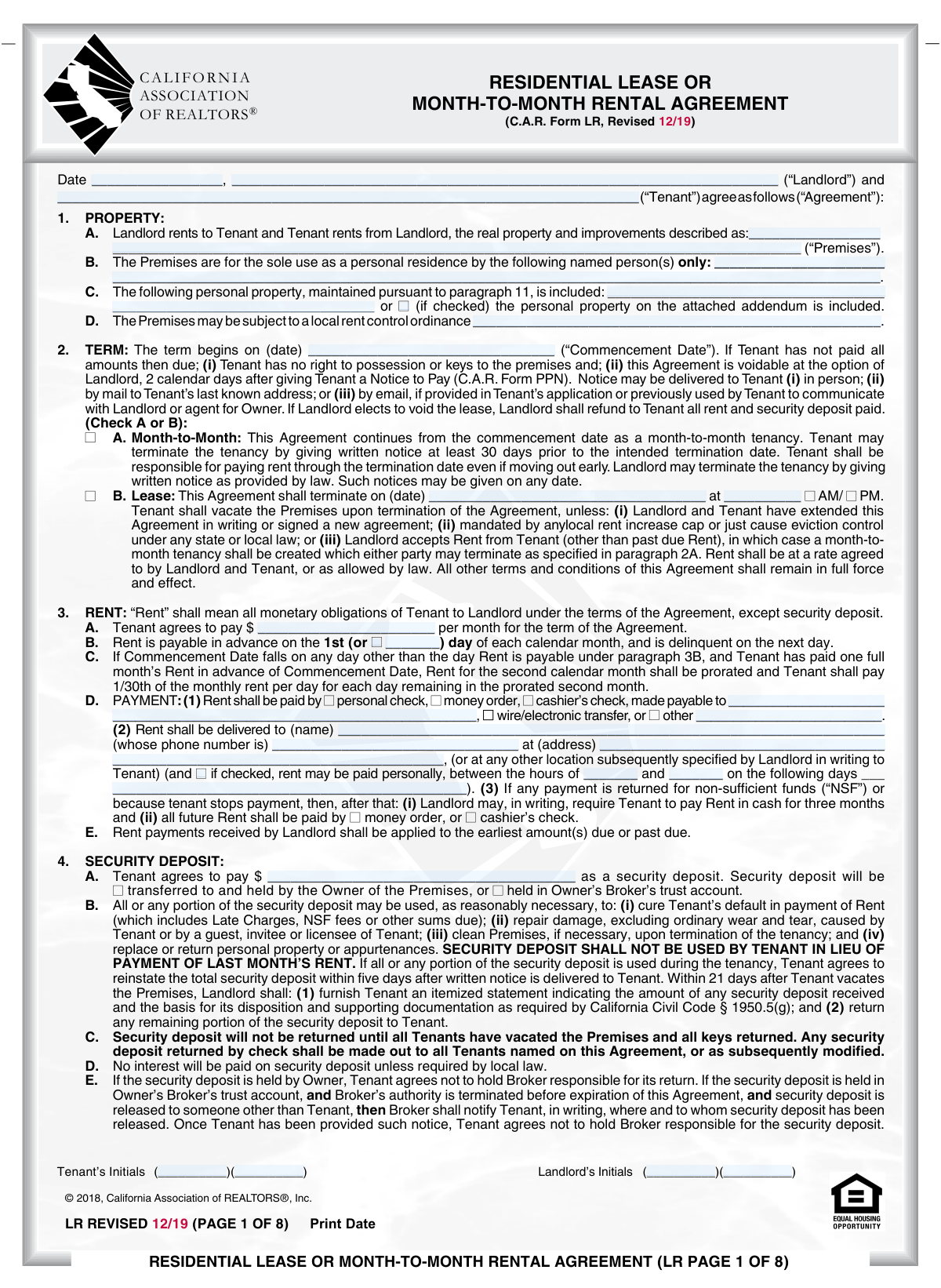
| 1. | California Association of REALTORS® (C.A.R.) Form LR, Residential Lease or Month-to-Month Rental Agreement (Revised 12/19) | 8 | Complex 72 |
| 2. | Commercial Lease Agreement (C.A.R. Form CL, Revised 10/01) | 6 | Complex 79 |
| 3. | Form 211, Listing Agreement Authority to Offer for Lease | 1 | Simple 28 |
| 4. | Form 300, Buyer Representation Agreement, Authority for Purchase or Lease | 4 | Moderate 59 |
| 5. | Form 420, Amendment to Agreement to Lease - Residential | 2 | Moderate 48 |
| 6. | New Jersey Judiciary Photo Release Agreement for Adults | 1 | Simple 24 |
| 7. | New Jersey Judiciary Photo Release Agreement for Minors | 1 | Simple 25 |
| 8. | OREA Form 210, Listing Agreement Landlord Representation Agreement, Authority to Offer for Lease | 4 | Moderate 61 |
- Enterprise-grade security & data encryption
- 99%+ accuracy powered by AI
- 1,000+ forms from all industries
- Complete forms in under 60 seconds
How to Choose the Right Form
Choosing Between Residential and Commercial Leases
Selecting the correct lease agreement depends primarily on the type of property you are renting and the nature of the tenant's activities. Using the wrong form can lead to legal complications, as residential and commercial tenancies are governed by different sets of laws and disclosure requirements.
Residential Rentals
If you are leasing a house, apartment, condo, or any space intended for living, you should use the California Association of REALTORS® (C.A.R.) Form LR, Residential Lease or Month-to-Month Rental Agreement.
- Best for: Landlords and property managers renting to individuals or families.
- Key Features: This form includes specific protections for tenants, such as security deposit limits, HOA rule compliance, and statutory disclosures (like lead-based paint or bedbug notices).
- Flexibility: It allows you to specify whether the arrangement is a fixed-term lease or a flexible month-to-month agreement.
Commercial Properties
For business-related rentals—such as office spaces, retail storefronts, or industrial warehouses—the Commercial Lease Agreement (C.A.R. Form CL) is the standard choice.
- Best for: Property owners leasing to business entities or sole proprietors for commercial use.
- Key Features: Unlike residential forms, this agreement focuses on business-specific terms like CPI-adjusted rent, maintenance of commercial systems, parking/storage allocations for employees or customers, and detailed insurance requirements.
- Complexities: It handles tiered rent structures and various expense distributions that are not found in residential contracts.
Quick Decision Check
To find the right form quickly, ask these two questions:
1. Is the tenant living there? If yes, select the C.A.R. Form LR.
2. Is the tenant running a business there? If yes, select the C.A.R. Form CL.
Regardless of which form you choose, ensure all fields regarding rent, security deposits, and maintenance responsibilities are filled out completely. Both of these standardized forms can be processed through Instafill.ai to ensure accuracy and to convert static PDF versions into interactive, fillable documents.
Form Comparison
| Form | Property Type | Primary Use | Key Provisions |
|---|---|---|---|
| Commercial Lease Agreement (C.A.R. Form CL, Revised 10/01) | Commercial real property such as retail, office, or industrial spaces. | Defining legal and financial terms for business-to-business property rentals. | Includes base rent structures, CPI adjustments, and commercial maintenance responsibilities. |
| California Association of REALTORS® (C.A.R.) Form LR, Residential Lease or Month-to-Month Rental Agreement (Revised 12/19) | Residential properties including houses, apartments, and condominiums. | Setting terms for fixed-term or month-to-month residential living arrangements. | Covers security deposits, HOA rules, pet/smoking policies, and statutory disclosures. |
Tips for lease agreement forms
For both residential and commercial leases, explicitly state which party is responsible for specific repairs, such as HVAC systems, plumbing, or landscaping. Clearly delineating these duties in the agreement prevents confusion and disputes when urgent maintenance issues arise during the tenancy.
AI-powered tools like Instafill.ai can complete complex lease agreements in under 30 seconds with high accuracy. Your data stays secure during the process, making it a reliable and efficient way to handle multiple rental documents without manual data entry errors.
Avoid ambiguity by listing the exact deposit amount and the specific conditions under which funds may be withheld for repairs or cleaning. Stating the expected timeline for returning the deposit after the lease ends helps set clear expectations for the tenant from day one.
Ensure that all mandatory state disclosures, such as lead-based paint notifications or mold disclosures, are physically attached to the signed lease. Missing these vital documents can sometimes invalidate specific clauses or lead to compliance issues for landlords.
When filling out commercial lease forms, be highly specific about the 'permitted use' of the space to avoid zoning conflicts or competition issues with other tenants in the same building. This protects the landlord's property value and ensures the tenant's business can operate without legal interference.
Clearly define the exact date rent is due, the duration of any grace period, and the specific cost of late fees. Establishing these financial boundaries upfront reduces payment delays and ensures consistent cash flow throughout the duration of the lease.
Ensure every adult occupant is listed on a residential lease and that the correct legal business entity is named on a commercial lease. Verifying that all parties are correctly identified ensures that the agreement is legally enforceable against the right individuals or companies.
Frequently Asked Questions
A residential lease is designed for living spaces like apartments or houses, focusing on tenant rights and habitability. In contrast, a commercial lease is used for business properties such as offices or retail spaces and often includes more complex terms regarding property modifications, insurance, and maintenance responsibilities.
These forms are primarily used by property owners, landlords, and real estate agents to establish a formal legal contract with a tenant. They ensure that both parties are protected and understand their financial obligations, maintenance duties, and the specific terms of the occupancy.
A fixed-term lease provides stability for a set duration, usually one year, which is ideal if you want guaranteed occupancy and rent. A month-to-month agreement offers more flexibility for both the landlord and tenant, allowing the arrangement to be terminated or modified with a shorter notice period.
Yes, AI tools like Instafill.ai can fill out these lease forms in under 30 seconds by accurately extracting data from your source documents. This technology automatically places information into the correct fields, significantly reducing the risk of manual entry errors in complex real estate contracts.
Filling out comprehensive real estate forms manually can be time-consuming, but using AI-powered platforms can complete the process in less than a minute. These tools automate the data entry process, allowing you to generate a finalized, ready-to-sign document almost instantly.
Standardized forms are drafted by legal experts to comply with specific state laws and include essential disclosures and protections. Using recognized templates helps prevent future legal disputes and ensures that mandatory provisions, such as security deposit limits and dispute resolution, are properly documented.
You will need the legal names of all parties involved, the full address of the property, the monthly rent amount, and the security deposit total. It is also helpful to have details regarding parking, utility responsibilities, and any specific house rules or pet policies you wish to incorporate into the agreement.
While the C.A.R. forms provided are specific to California, landlords in Washington or other regions should ensure they use forms that comply with their specific local landlord-tenant laws. Most lease agreements follow a similar structure, but statutory disclosures and notice periods can vary significantly from one state to another.
Most standard lease forms include sections or checkboxes for required disclosures, such as lead-based paint warnings or mold notifications. It is important to review the specific form to ensure all state-mandated addendums are attached and signed by both the landlord and the tenant.
Many modern lease forms include clauses for mediation or arbitration to resolve conflicts without going to court. These provisions help both parties save time and legal fees by requiring a structured meeting to settle issues regarding repairs, rent payments, or security deposit returns.
While not strictly required by law, a security deposit is standard practice to protect the landlord against property damage or unpaid rent. The lease agreement form will specify the exact amount of the deposit and the conditions under which it must be returned to the tenant after the lease ends.
Yes, landlords often add custom terms or house rules as addendums to a standard lease form. However, any custom terms must still comply with state and local laws to be enforceable, so it is important to ensure they do not conflict with the primary lease document.
Glossary
- Form Complexity Index
- Instafill’s 0–100 measure of how much effort a form takes to complete, calculated deterministically from the form’s own structure rather than estimated. It combines the number of fillable fields (the largest factor), how difficult those fields are to complete based on their type, the number of pages that contain fields, the amount of conditional “fill-only-if” logic, and how many sections the form is divided into, then adds modifiers for tables and repeating lists, bundled instruction pages, and dense page layouts. A higher score means the form is harder to fill out by hand. The forms in this category have a median Form Complexity Index of 59/100 (Moderate). See exactly how it is calculated.
- C.A.R.
- An abbreviation for the California Association of REALTORS®, the professional organization that develops the standardized real estate forms commonly used in California.
- Month-to-Month Tenancy
- A rental agreement with no fixed end date that automatically renews every month until either the landlord or tenant provides written notice to terminate.
- Security Deposit
- A refundable sum of money paid by the tenant at the start of the lease to protect the landlord against property damage or unpaid rent.
- Disclosures
- Legally required statements where the landlord informs the tenant about specific property conditions, such as the presence of lead-based paint, mold, or death on the premises.
- Base Rent
- The fixed monthly amount a tenant pays for the use of the property, excluding additional expenses like utilities, insurance, or common area maintenance.
- CPI-Adjusted Rent
- A rent structure common in commercial leases where the payment amount increases periodically based on changes in the Consumer Price Index to account for inflation.
- Default
- A situation where a party fails to fulfill their legal obligations under the lease agreement, such as non-payment of rent or violating property rules.
- Mediation
- A dispute resolution process where a neutral third party helps the landlord and tenant reach a voluntary agreement to avoid going to court.