Fill out provider enrollment forms
with AI.
Provider enrollment forms serve as the essential gateway for healthcare professionals and facilities to participate in federal and state health programs. These documents are critical for establishing billing privileges, ensuring compliance with regulatory standards, and securing reimbursement for medical services. Whether you are an individual practitioner or a large institutional facility, completing these forms accurately is the first step toward providing care under programs like Medicare and Medicaid and ensuring your practice remains in good standing with regulatory bodies.
By continuing, you acknowledge Instafill's Privacy Policy and agree to get occasional product update and promotional emails.
About provider enrollment forms
This category covers a broad spectrum of requirements, from the comprehensive CMS-855A for institutional providers to the CMS-588 for authorizing electronic funds transfers. You will also find state-specific Medicaid enrollment packets and reassignment of benefit forms, such as the CMS-855R, which are necessary when practitioners join medical groups or change their billing arrangements. These forms are typically required during initial enrollment, periodic revalidation, or when reporting significant changes in practice ownership and financial structures.
Because these applications are often lengthy and require precise data, administrative errors can lead to frustrating delays in reimbursement or even the denial of billing privileges. Tools like Instafill.ai use AI to fill these forms in under 30 seconds, handling complex data accurately and securely to streamline the credentialing process. By automating the repetitive aspects of provider enrollment, healthcare organizations can reduce their administrative burden and focus more resources on patient care.
Every form on this page can be completed without typing. Instafill is form filling software that reads a PDF and fills it for you — including flat and scanned documents that carry no fillable fields at all.
Forms in This Category
The forms in this category have a median Form Complexity Index of 59/100 (Moderate), measured across 11 forms by field count, input difficulty, length, conditional logic and structure. See how it is calculated.
- Enterprise-grade security & data encryption
- 99%+ accuracy powered by AI
- 1,000+ forms from all industries
- Complete forms in under 60 seconds
How to Choose the Right Form
Medicare Enrollment and Financial Setup
If you are looking to bill the federal government for healthcare services, you must select the correct CMS form based on your practice type and financial needs:
- Institutional Providers: Use CMS-855A if you represent a hospital, home health agency, hospice, or skilled nursing facility. This form is used for initial enrollment, revalidation, or reporting ownership changes.
- Individual Practitioners: If you are joining a medical group, use Form CMS-855R to reassign your Medicare benefits so the organization can bill on your behalf.
- Payment Setup: Regardless of your provider type, use the CMS-588 Electronic Funds Transfer (EFT) Authorization to ensure Medicare reimbursements are deposited directly into your bank account.
State Medicaid Programs
Medicaid enrollment is handled at the state level. Choose the form that corresponds to the state where you provide services:
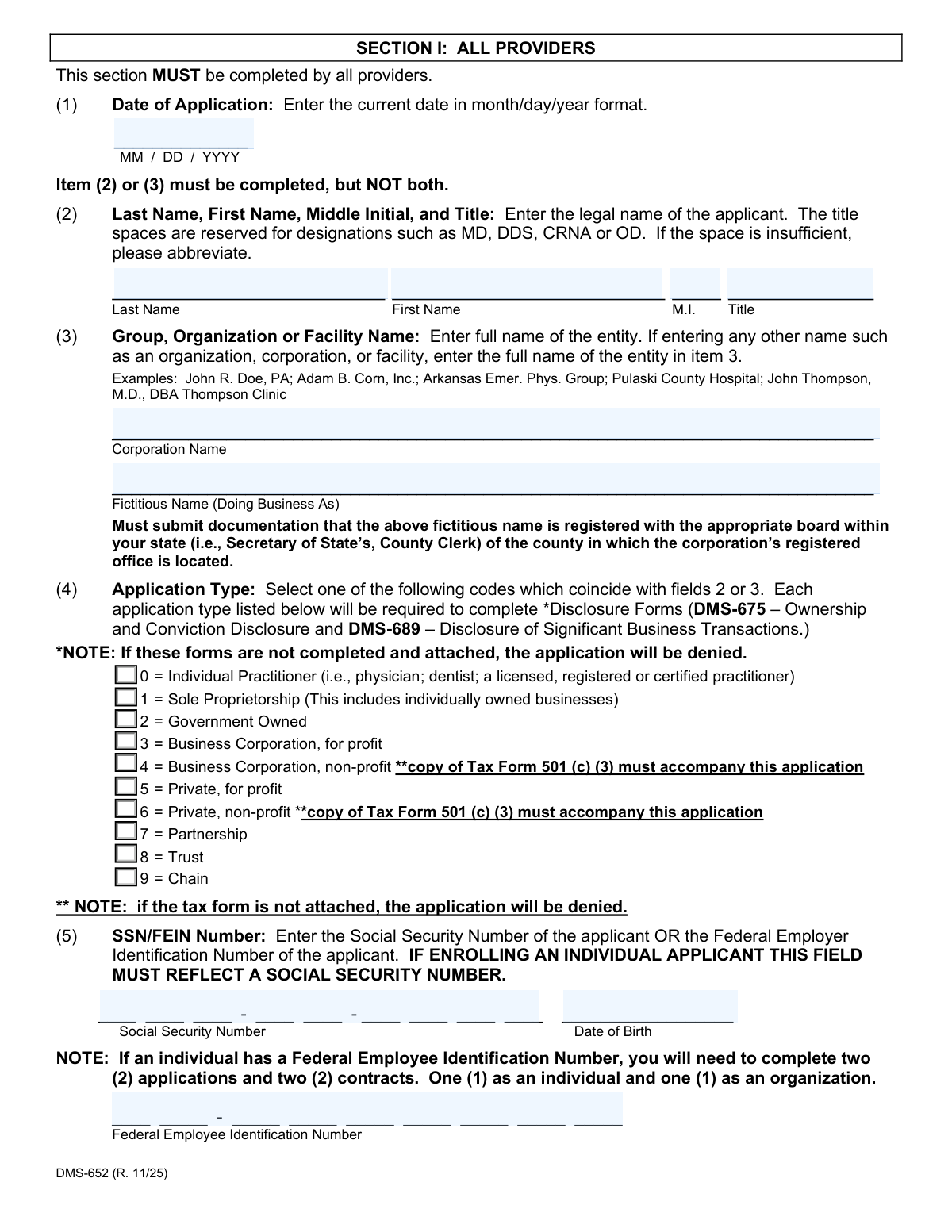
- Arkansas: Use the Arkansas Medicaid Provider Application Packet (DMS-652) for a comprehensive enrollment that includes tax and disclosure forms.
- Illinois: Select Form HFS 2243 for the Medical Assistance Program.
- Indiana: Use the IHCP Managed Care Entity (MCE) Provider Enrollment Form if you are joining networks like Healthy Indiana Plan or Hoosier Healthwise.
- Montana & Nevada: Look for the Montana Healthcare Programs Provider Enrollment Application or Form FA-31 for Nevada Medicaid and Check Up programs.
- Oregon: Use the Provider Enrollment Agreement (OHA 3975) to participate in the Oregon Health Plan.
- Nebraska: If you are participating in specific screening programs like Every Woman Matters, use the Provider Participation Enrollment Form - DHHS.
Electronic Billing and Private Networks
- Alaska Providers: To move from paper to electronic billing, complete the Medicaid Alaska EDI Enrollment or the 835 Authorization and Claims Enrollment Form.
- Private Insurance: If you are applying to join the Blue Shield of California network as a group, use the Provider Group/Facility Application (RA-02).
Form Comparison
| Form | Program or Agency | Provider Type | Primary Purpose |
|---|---|---|---|
| CMS-855A, Medicare Enrollment Application for Institutional Providers | Medicare | Institutional (Hospitals, SNFs, Home Health) | Enroll facility or report changes in ownership |
| Form CMS-855R, Medicare Enrollment Application - Reassignment of Medicare Benefits | Medicare | Individual Practitioners | Reassign billing rights to an group or organization |
| CMS-588 Electronic Funds Transfer (EFT) Authorization Agreement Checklist | Medicare | All Medicare Providers | Setup or change direct deposit for reimbursement |
| Arkansas Medicaid Provider Application Packet (DMS-652) | Arkansas Medicaid | All state healthcare providers | Comprehensive enrollment or update of state participation |
| FA-31: Provider Enrollment Application | Nevada Medicaid | Individual, Group, or Facility | Establish eligibility for Nevada state program reimbursement |
| Form HFS 2243, Provider Enrollment Application Illinois Medical Assistance Program | Illinois Medicaid | State-based healthcare providers | Initial enrollment or status changes in Illinois |
| Indiana Health Coverage Programs (IHCP) Managed Care Entity (MCE) Provider Enrollment Form | Indiana Managed Care | Individual practitioners | Join or update status within MCE networks |
| Provider Enrollment Agreement (OHA 3975), Oregon Medicaid ID Application Form | Oregon Health Plan | Oregon healthcare professionals | Legal agreement for participation in Oregon Medicaid |
| Montana Healthcare Programs Provider Enrollment Application | Montana Medicaid/CHIP | Individuals and organizations | Enrollment for treating eligible members in Montana |
| Provider Group/Facility Application (RA-02) | Blue Shield of California | Medical groups and facilities | Join Blue Shield's private provider network |
| Medicaid Alaska EDI Enrollment - Provider Information Submission Agreement | Alaska Medicaid | Enrolled Medicaid providers | Authorize electronic clinical and financial data submission |
| Provider Participation Enrollment Form - DHHS | Nebraska DHHS | Screening program providers | Register for state-specific cancer screening programs |
Tips for provider enrollment forms
Ensure the National Provider Identifier (NPI) and Tax Identification Number (TIN) match exactly across all documents, including the primary application, W-9, and bank verification letters. Discrepancies between these identifiers are the leading cause of enrollment delays and application rejections.
Many enrollment forms, such as the CMS-588 for Electronic Funds Transfer, require an original voided check or a formal bank letter on official letterhead. Having these digital files ready before you start will prevent you from having to stop mid-application to hunt for financial records.
AI-powered tools like Instafill.ai can complete these complex provider enrollment forms in under 30 seconds with high accuracy. The data stays secure during the process, providing a practical way to manage multiple state or federal applications without manual data entry.
When filing reassignment forms like the CMS-855R, verify that both the individual practitioner and the receiving group are already fully enrolled in the program. If the group's enrollment is inactive or pending, the reassignment of benefits cannot be processed, and the form will be denied.
Ensure that the person signing the enrollment forms is already listed as an Authorized Official or Delegated Official in the system. Forms signed by unauthorized staff members, even if they are high-level administrators, will be returned and require a complete resubmission.
Medicare and Medicaid forms often require detailed disclosures regarding any person or entity with 5% or more ownership. Collect the legal names, Social Security numbers, and dates of birth for all owners and managing employees beforehand to navigate these multi-section disclosure pages efficiently.
List every physical location where services are rendered, ensuring the 'doing business as' (DBA) name matches local records exactly. For institutional providers, providing an incorrect suite number or zip code can trigger a site visit failure or a formal request for additional clarification.
Frequently Asked Questions
These forms are the official gateway for healthcare practitioners and facilities to join insurance networks like Medicare, Medicaid, or private payers. They establish your eligibility to bill for services and ensure you meet federal and state regulatory standards for patient care and financial integrity.
Generally, federal CMS forms like the 855 series are required for Medicare enrollment, while state-specific forms are used for Medicaid programs. If your practice treats patients under both programs, you will typically need to complete both sets of applications to receive reimbursements from each.
Yes, you can fill out provider enrollment forms using AI tools like Instafill.ai to ensure precision and speed. These tools can accurately extract data from your professional credentials and automatically populate complex multi-page documents in under 30 seconds.
The CMS-855A is designed for institutional providers, such as hospitals, skilled nursing facilities, and home health agencies, to enroll in Medicare. In contrast, the CMS-855R is a shorter form used specifically by individual practitioners to reassign their billing rights to an employer or group practice.
Forms like the CMS-588 are necessary to authorize the payer to deposit reimbursements directly into your financial institution's account. Most modern healthcare programs require electronic payments and will not issue paper checks for services rendered.
While manual entry for these detailed applications can take hours, using AI-powered services like Instafill.ai allows you to complete these forms in under 30 seconds. The AI identifies where to place NPI numbers, tax IDs, and practice addresses by pulling data directly from your source documents.
You should have your National Provider Identifier (NPI), Tax Identification Number (TIN/EIN), and state professional licenses ready. Many forms also require detailed information regarding practice locations, ownership structure, and banking details for electronic payments.
Errors or omissions on enrollment forms often lead to significant delays in processing or the denial of billing privileges. Using automated tools can help minimize manual entry errors, ensuring that critical data matches your official records and reducing the risk of application rejection.
Providers must update their enrollment whenever there is a change in ownership, practice location, contact information, or managing control. Additionally, most programs require periodic revalidation to ensure that all information on file remains current and compliant with regulations.
No, these forms are used throughout the lifecycle of a provider's career, including for revalidating current enrollment, reporting changes in practice structure, or voluntarily terminating a provider agreement. They are also used to add new specialties or practice locations to an existing profile.
Yes, a National Provider Identifier (NPI) is a standard requirement for virtually all provider enrollment applications in the United States. It serves as your unique, permanent identification number for all HIPAA-standard electronic healthcare transactions.
Submission methods vary; many federal forms are submitted through the PECOS online portal, while state Medicaid forms often have their own specific submission systems. Always verify if the form requires an original 'wet' signature or if a digital signature is accepted before submitting.
Glossary
- Form Complexity Index
- Instafill’s 0–100 measure of how much effort a form takes to complete, calculated deterministically from the form’s own structure rather than estimated. It combines the number of fillable fields (the largest factor), how difficult those fields are to complete based on their type, the number of pages that contain fields, the amount of conditional “fill-only-if” logic, and how many sections the form is divided into, then adds modifiers for tables and repeating lists, bundled instruction pages, and dense page layouts. A higher score means the form is harder to fill out by hand. The forms in this category have a median Form Complexity Index of 59/100 (Moderate). See exactly how it is calculated.
- NPI (National Provider Identifier)
- A unique 10-digit identification number issued to healthcare providers in the United States by CMS to ensure standard identification across all administrative and financial transactions.
- CMS (Centers for Medicare & Medicaid Services)
- The federal agency within the U.S. Department of Health and Human Services that administers Medicare and works with state governments to manage Medicaid programs.
- PECOS (Provider Enrollment, Chain, and Ownership System)
- The official online system used by healthcare providers to submit, track, and manage their Medicare enrollment information electronically.
- Reassignment of Benefits
- A legal arrangement, typically filed via form CMS-855R, where an individual healthcare professional allows a group practice or employer to bill and receive payments for their services.
- EFT (Electronic Funds Transfer)
- A mandatory payment method where Medicare or Medicaid reimbursements are deposited directly into a provider's bank account instead of being sent as a paper check.
- CHOW (Change of Ownership)
- A regulatory event that occurs when a healthcare facility is sold or changes its legal structure, requiring the submission of updated enrollment forms to maintain billing privileges.
- EDI (Electronic Data Interchange)
- The automated exchange of standardized clinical and financial information between a provider and a payer, essential for electronic claims submission.
- ABN (Advance Beneficiary Notice)
- A notice given to Medicare beneficiaries before they receive services that Medicare is not expected to pay for, allowing the provider to bill the patient directly.
- Institutional Provider
- A healthcare facility, such as a hospital, hospice, or skilled nursing facility, that uses specialized enrollment forms like the CMS-855A rather than individual practitioner forms.