Yes! You can use AI to fill out ACORD 36, Agent / Broker of Record Change
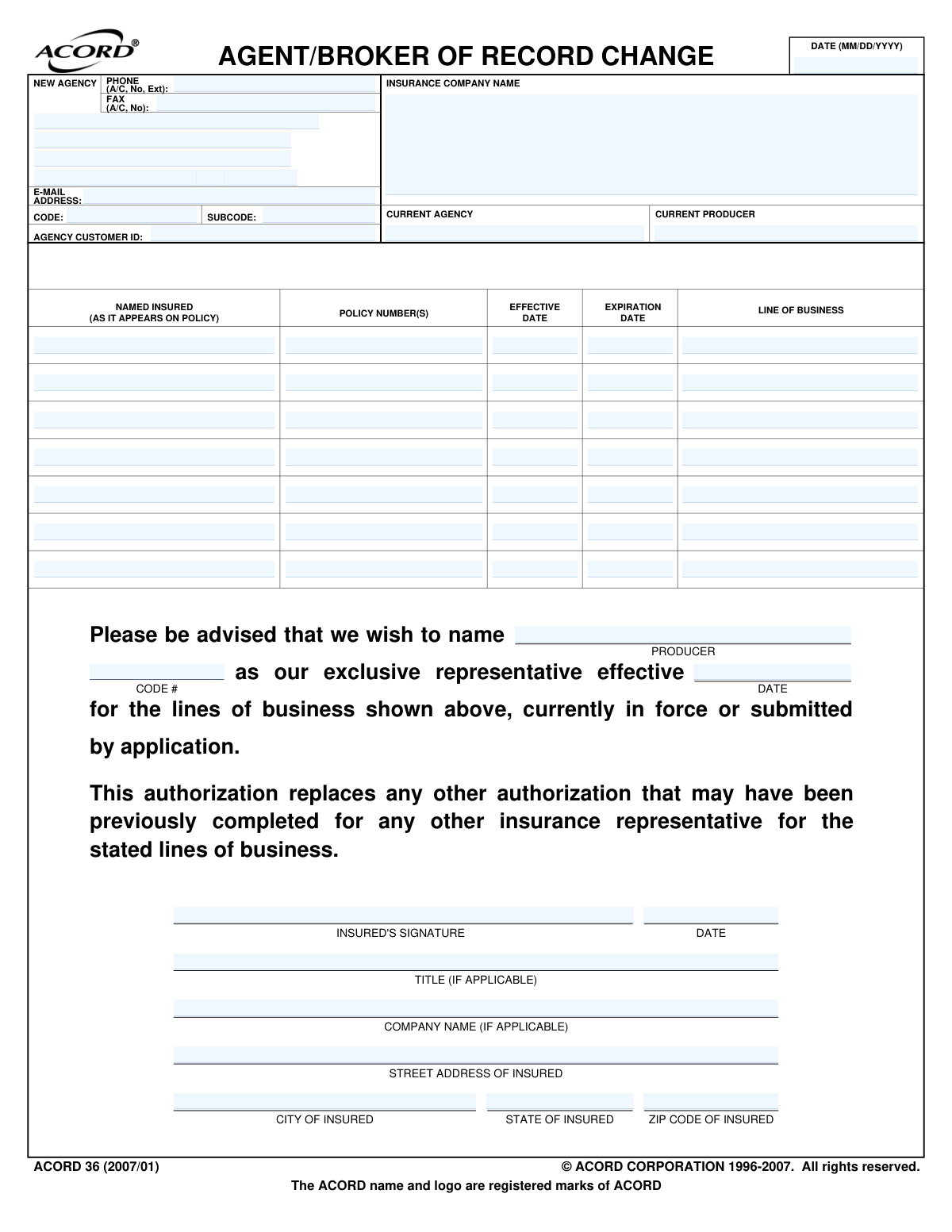
ACORD 36, the Agent/Broker of Record Change form, is a legal document used by an insured party to formally notify an insurance company of a change in their representing agent or broker. This ensures that the new agent has the authority to manage the specified policies, receive commissions, and handle communications on the insured's behalf. Today, this form can be filled out quickly and accurately using AI-powered services like Instafill.ai, which can also convert non-fillable PDF versions into interactive fillable forms.
ACORD 36 is part of the
broker of record forms, policy change forms and policy service forms categories on Instafill.
Our AI automatically handles information lookup, data retrieval, formatting, and form filling.
It takes less than a minute to fill out ACORD 36 using our AI form filling.
Securely upload your data. Information is encrypted in transit and deleted immediately after the form is filled out.
Form specifications
| Form name: | ACORD 36, Agent / Broker of Record Change |
| Number of fields: | 62 |
| Number of pages: | 1 |
| Language: | English |
Instafill Demo: How to fill out PDF forms in seconds with AI
How to Fill Out ACORD 36 Online for Free in 2026
Are you looking to fill out a ACORD 36 form online quickly and accurately? Instafill.ai offers the #1 AI-powered PDF filling software of 2026, allowing you to complete your ACORD 36 form in just 37 seconds or less.
Follow these steps to fill out your ACORD 36 form online using Instafill.ai:
- 1 Navigate to Instafill.ai and upload your ACORD 36 form, or select it from the template library.
- 2 Enter the date and the full name of the insured individual or company exactly as it appears on the policy.
- 3 List the specific policy numbers, lines of business, and their effective and expiration dates that are being transferred.
- 4 Provide the name of the new producer (agent/broker) you are appointing and the effective date of the change.
- 5 Fill in the contact details for the new agency, including name, address, phone number, and email.
- 6 Use the AI assistant to review all entered information for accuracy, then have the insured party electronically sign and date the form.
- 7 Download, print, or securely share the completed ACORD 36 form with your insurance company, the new agent, and the former agent.
Our AI-powered system ensures each field is filled out correctly, reducing errors and saving you time.
Why Choose Instafill.ai for Your Fillable ACORD 36 Form?
Speed
Complete your ACORD 36 in as little as 37 seconds.
Up-to-Date
Always use the latest 2026 ACORD 36 form version.
Cost-effective
No need to hire expensive lawyers.
Accuracy
Our AI performs 10 compliance checks to ensure your form is error-free.
Security
Your personal information is protected with bank-level encryption.
Frequently Asked Questions About Form ACORD 36
This form is used to officially notify your insurance company that you are appointing a new agent or broker to represent you and service your insurance policies.
The policyholder, referred to as the 'Named Insured' on the form, must complete and sign it. For a business, this should be an authorized officer or owner of the company.
No, submitting this form does not cancel your policy. It only transfers the servicing and representation rights for your existing policies to a new agent or broker.
Typically, you send the signed form to your new agent or broker. They will then forward it to the insurance company to process the change.
You will need your policy number(s), the name of the insurance company, and the full name and contact details of the new agency you are appointing.
The effective date is the date you want your new agent to officially take over your policies. You can make it effective immediately or set it for a future date; it's best to discuss this with your new agent.
Yes, you should list all policy numbers and the corresponding lines of business (e.g., General Liability, Auto) that you want the new agent to manage. Any policies not listed may remain with your current agent.
Yes, you have the right to change your agent of record at any time during your policy term by completing and submitting this form.
Once the insurance company processes the form, your new agent will gain access to your policy information and will handle service requests, renewals, and communication going forward. Your old agent will no longer represent you for the listed policies.
Yes, services like Instafill.ai use AI to auto-fill form fields accurately and save time. This can help you complete the form quickly and reduce the chance of errors.
You can use a platform like Instafill.ai to upload the form, fill it out on your computer, and add your digital signature. This is often more convenient than printing and scanning a physical copy.
If you have a non-fillable or 'flat' PDF, you can upload it to a service like Instafill.ai. The platform can automatically convert it into an interactive, fillable form for you to complete online.
Compliance ACORD 36
Validation Checks by Instafill.ai
1
Ensures Named Insured is Provided
Checks that the 'NAMED INSURED' field is not empty. This field is critical as it identifies the policyholder requesting the change, and without it, the form cannot be processed. A failure means the form is rejected until the insured's name is correctly entered as it appears on the policy.
2
Validates At Least One Policy Number is Listed
Verifies that at least one policy number is entered in the policy details section. The purpose of the form is to change the agent for specific policies, so this information is mandatory. If no policy numbers are provided, the request is ambiguous and cannot be fulfilled.
3
Change Effective Date Logical Check
Ensures the 'EFFECTIVE DATE' of the agent change is on or after the date the insured signs the form. An effective date in the past is not legally permissible and would create a gap in representation. This validation prevents backdating and ensures a clear transition of service responsibility.
4
Verifies Insured's Signature Presence
Confirms that the 'INSURED'S SIGNATURE' field is signed or has a valid digital equivalent. The signature is the legal authorization for the agent of record change and is non-negotiable for compliance. An unsigned form is invalid and must be returned to the insured for completion.
5
Requires New Producer and Agency Information
Validates that the name of the new 'PRODUCER' and/or 'NEW AGENCY' is provided. This information is the primary objective of the form, specifying who will take over as the representative. Missing this information makes the form's purpose unachievable, and the submission will be rejected.
6
Checks for Complete Insured Address
Verifies that the insured's full address, including street, city, state, and ZIP code, is complete. This information is used to verify the identity of the insured and match them to the correct policy records. Incomplete addresses can lead to processing delays or incorrect record matching.
7
Validates US ZIP Code Format
Checks that the 'ZIP CODE OF INSURED' field contains a valid 5-digit or 9-digit (ZIP+4) numeric format. This ensures data quality and is essential for mail correspondence and location-based services or ratings. An invalid format will cause the form to be flagged for correction.
8
Validates State Field is a Standard Abbreviation
Ensures the 'STATE OF INSURED' field contains a valid two-letter US state or territory abbreviation. Using a standardized format prevents ambiguity and ensures the data can be correctly processed by automated systems. Mismatched or misspelled states will result in a validation error.
9
New Agency Phone Number Format
Validates that the 'PHONE' number for the new agency follows a standard North American format (e.g., 10 digits, optional country code, parentheses, and hyphens). This ensures the insurance company can contact the new agent if needed. An incorrectly formatted number would be rejected.
10
New Agency Email Address Format
Checks that the 'E-MAIL ADDRESS' provided for the new agency is in a valid format, such as '[email protected]'. This is crucial for electronic communication, sending policy documents, and other correspondence. An invalid email format will prevent successful communication and cause the submission to fail validation.
11
Policy Expiration Date vs. Effective Date
Verifies that the policy's 'EXPIRATION DATE' is after the change 'EFFECTIVE DATE'. It is illogical to change the agent of record on a policy that will have already expired by the time the change takes effect. This check prevents processing of pointless or erroneous requests.
12
Ensures Line of Business is Specified
Confirms that for each 'POLICY NUMBER' listed, a corresponding 'LINE OF BUSINESS' is also provided. This detail is necessary for the insurance company to correctly identify the policy type (e.g., Auto, Home, Liability) and apply the change accurately. A missing Line of Business will result in an incomplete request.
13
Verifies Insurance Company Name is Present
Checks that the 'INSURANCE COMPANY NAME' field is filled out. This form is sent to the insurance carrier, so specifying which carrier is being addressed is a fundamental requirement. Without this information, the form cannot be routed or processed by the correct entity.
14
Distinguishes Between Current and New Producer
Validates that the information in the 'CURRENT PRODUCER' field is different from the 'NEW PRODUCER' field. The purpose of the form is to facilitate a change, so the current and new representatives cannot be the same. If the values are identical, it indicates a user error and the form should be rejected.
15
Validates All Date Formats
Ensures all date fields on the form, including the main date, effective date, expiration date, and signature date, adhere to the specified MM/DD/YYYY format. Consistent and valid date formatting is essential for accurate record-keeping and preventing system errors during data entry. Any date not matching this format will trigger an error.
Common Mistakes in Completing ACORD 36
This occurs when the name entered in the 'Named Insured' field does not exactly match the legal name on the insurance policy. People often use a DBA or a shortened company name out of habit. This mismatch will cause the insurance carrier to reject the form, as they cannot verify the request against their records, delaying the agent change process.
Insureds frequently forget to list all active policies they wish to move to the new agent, such as separate umbrella or auto policies. This results in the old agent remaining the agent of record for the omitted policies, leading to split service, confusion, and potential coverage gaps. To avoid this, gather all policy declaration pages before filling out the form to ensure a complete and accurate list.
Typographical errors, transposing digits, or using an old quote number instead of the active policy number are common mistakes. An incorrect policy number makes it impossible for the carrier to identify and reassign the policy. This leads to the rejection of the change for that specific policy, requiring a corrected form to be resubmitted.
Writing 'ASAP' or a date that has already passed in the 'Effective Date' field creates ambiguity for the carrier. This can lead to rejection or the carrier processing the change on a date not intended by the insured, potentially causing billing or service issues. Always enter a specific, future date (MM/DD/YYYY) to allow for processing time and ensure a clear transition.
Forgetting to sign and date the form is a simple but critical error, often happening when rushing to complete the paperwork. An unsigned form is legally invalid and will be rejected immediately by the insurance company. This halts the entire process until a properly signed and dated form is provided.
This form must be signed by a person with the legal authority to act on behalf of the 'Named Insured,' such as a company officer or owner. If a manager or employee without this authority signs, the request is invalid and will be rejected for compliance reasons. Always ensure the signer is a legal representative and that their title is accurately listed on the form.
The insured may not know the new agency's exact legal name, producer code, or other identifiers required by the insurance company. Providing incomplete or incorrect information can cause the carrier to delay the change or, in a worst-case scenario, assign the policies to the wrong agency. To prevent this, ask the new agent to provide all their required information in writing before you fill out the form.
When a form is filled out by hand, poor handwriting can lead to data entry errors by the insurance company staff, causing policy numbers or names to be misinterpreted. This can result in rejection and significant delays. Since this form is often a non-fillable PDF, using a tool like Instafill.ai can convert it into a fillable version, allowing you to type your information for maximum clarity and avoid manual errors.
Users often write generic terms like 'Business Insurance' or 'Liability' in the 'Line of Business' column. Carriers require the specific policy type, such as 'Commercial General Liability' or 'Workers' Compensation,' to correctly identify the policy. Vague descriptions create confusion and force the carrier to seek clarification, delaying the agent transfer.
While the form's primary purpose is to name the new agent, the field for the 'Current Producer/Agency' is sometimes left blank. This information helps the insurance company internally to ensure a smooth transition and proper notification. Leaving it blank can slow down processing as the carrier may need to look up the information themselves.
Saved over 80 hours a year
“I was never sure if my IRS forms like W-9 were filled correctly. Now, I can complete the forms accurately without any external help.”
Kevin Martin Green
Your data stays secure with advanced protection from Instafill and our subprocessors

Robust compliance program
Transparent business model
You’re not the product. You always know where your data is and what it is processed for.
ISO 27001, HIPAA, and GDPR
Our subprocesses adhere to multiple compliance standards, including but not limited to ISO 27001, HIPAA, and GDPR.
Security & privacy by design
We consider security and privacy from the initial design phase of any new service or functionality. It’s not an afterthought, it’s built-in, including support for two-factor authentication (2FA) to further protect your account.
Fill out ACORD 36 with Instafill.ai
Worried about filling PDFs wrong? Instafill securely fills acord-36-agent-broker-of-record-change forms, ensuring each field is accurate.