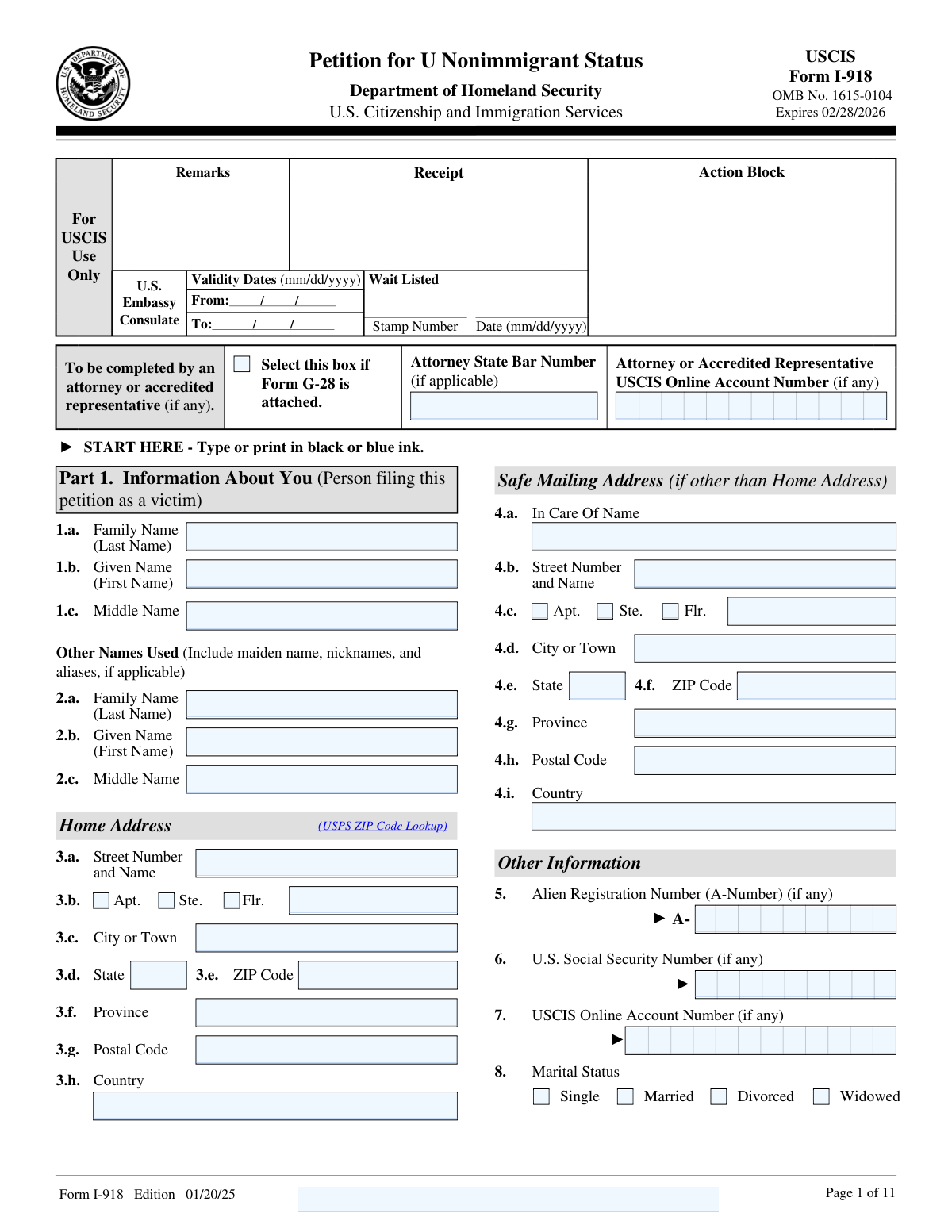
Yes! You can use AI to fill out Form I-918, Petition for U Nonimmigrant Status
Form I-918, Petition for U Nonimmigrant Status, is a U.S. Citizenship and Immigration Services (USCIS) form used by victims of certain qualifying criminal activities to apply for a U visa. This nonimmigrant status provides temporary legal status and work authorization to victims who have suffered substantial physical or mental abuse and are helpful to law enforcement or government officials in the investigation or prosecution of the criminal activity. Today, this form can be filled out quickly and accurately using AI-powered services like Instafill.ai, which can also convert non-fillable PDF versions into interactive fillable forms.
I-918 is part of the
immigrant petition forms category on Instafill.
Our AI automatically handles information lookup, data retrieval, formatting, and form filling.
It takes less than a minute to fill out I-918 using our AI form filling.
Securely upload your data. Information is encrypted in transit and deleted immediately after the form is filled out.
Form specifications
| Form name: | Form I-918, Petition for U Nonimmigrant Status |
| Number of fields: | 373 |
| Number of pages: | 11 |
| Language: | English |
Instafill Demo: How to fill out PDF forms in seconds with AI
How to Fill Out I-918 Online for Free in 2026
Are you looking to fill out a I-918 form online quickly and accurately? Instafill.ai offers the #1 AI-powered PDF filling software of 2026, allowing you to complete your I-918 form in just 37 seconds or less.
Follow these steps to fill out your I-918 form online using Instafill.ai:
- 1 Navigate to Instafill.ai and upload your Form I-918 or select it from their template library.
- 2 Use the AI assistant to accurately fill in your personal information in Part 1, including your name, addresses, and other identifying details.
- 3 Provide additional information about yourself in Part 2, including details about your entry into the U.S. and the criminal activity you experienced.
- 4 Carefully answer the detailed background and admissibility questions in Part 3. The AI can help clarify complex questions.
- 5 If you are petitioning for qualifying family members, enter their information in Part 4 and prepare the required Supplement A.
- 6 Review all the information you've entered for completeness and accuracy, then electronically sign and date your petition in Part 5.
- 7 Download the completed, signed form and gather all necessary supporting documents, such as your personal narrative and Form I-918, Supplement B, for submission to USCIS.
Our AI-powered system ensures each field is filled out correctly, reducing errors and saving you time.
Why Choose Instafill.ai for Your Fillable I-918 Form?
Speed
Complete your I-918 in as little as 37 seconds.
Up-to-Date
Always use the latest 2026 I-918 form version.
Cost-effective
No need to hire expensive lawyers.
Accuracy
Our AI performs 10 compliance checks to ensure your form is error-free.
Security
Your personal information is protected with bank-level encryption.
Frequently Asked Questions About Form I-918
Form I-918, Petition for U Nonimmigrant Status, is used by victims of certain qualifying criminal activities to request temporary immigration benefits. This status is for individuals who have suffered substantial mental or physical abuse from the crime and are helpful to law enforcement or government officials.
You may be eligible if you are a victim of a qualifying crime, have suffered substantial abuse, possess information about the crime, and have a certification (Form I-918, Supplement B) from law enforcement stating your helpfulness.
A safe mailing address is an alternative address where you can securely receive mail from USCIS. This is particularly important for petitioners who may not want official documents sent to their home address for safety or privacy reasons.
Yes, you must submit Form I-918, Supplement B, which is a certification from a law enforcement agency. You must also include a personal narrative statement describing the crime, and if you are petitioning for family members, you'll need Form I-918, Supplement A for each.
Yes, you can still file, but you must honestly answer all questions about your criminal history in Part 3. Answering 'Yes' to these questions may make you inadmissible, but you may be able to apply for a waiver of inadmissibility along with your petition.
You must disclose if you are or have ever been in immigration proceedings in Part 1 of the form. Filing for a U visa can sometimes help in these situations, but it is a complex matter and you should consider seeking legal advice.
Yes, you can petition for certain qualifying family members, such as your spouse and unmarried children under 21. You must provide their information in Part 4 and file a separate Form I-918, Supplement A for each family member.
You should use Part 8, 'Additional Information,' at the end of the form. If you need even more space, you can attach separate sheets of paper, making sure to write your name, A-Number (if any), and the specific Page, Part, and Item Number you are referencing.
After submission, USCIS will review your petition for completeness and eligibility. You may be required to attend a biometrics appointment to provide your fingerprints, photograph, and signature.
While you are not required to have an attorney, Form I-918 is complex and has sections for an attorney or accredited representative to complete. Due to the legal complexities, seeking assistance from a qualified immigration attorney is highly recommended.
Yes, services like Instafill.ai use AI to auto-fill form fields accurately and save time. This can help reduce errors and ensure all necessary information is included before you submit your petition.
You can use a service like Instafill.ai to fill out the form online. Simply upload the PDF to their platform, and you can type your information directly into the fields, using AI-powered assistance to ensure accuracy.
If you have a non-fillable or 'flat' PDF, you can use a tool like Instafill.ai to convert it into an interactive, fillable form. This allows you to easily type your answers on a computer instead of filling it out by hand.
Compliance I-918
Validation Checks by Instafill.ai
1
Petitioner Name and DOB Completeness
Verifies that the petitioner's Family Name (1.a), Given Name (1.b), and Date of Birth (Part 2, Item 9) are all provided. These fields are the minimum required information to uniquely identify an individual. A submission lacking this core data cannot be processed and would be rejected for incompleteness.
2
Date of Birth and Age Consistency Check
Validates that the 'Date of Birth' (Part 2, Item 9) is a valid past date and is logically consistent with the answer to 'I am under 16 years of age' (Part 2, Item 15). If the petitioner checks 'Yes' to being under 16, the calculated age from the date of birth must be less than 16. This is crucial for determining eligibility for certain provisions and signature requirements (e.g., a parent or guardian may need to sign).
3
Conditional Requirement for Immigration Proceedings Details
Ensures that if the petitioner answers 'Yes' to 'I was or am in immigration proceedings' (Part 2, Item 7.a), then at least one of the proceeding types (Items 7.b-7.f) is selected. It also checks that a corresponding date or the word 'Current' is provided for the selected proceeding. This information is critical for USCIS to understand the petitioner's immigration history, and failure to provide it will lead to a Request for Evidence (RFE).
4
U.S. vs. Foreign Address Formatting
This check ensures that for any address (e.g., Home Address, Safe Mailing Address), if the 'Country' is 'United States,' the 'State' and 'ZIP Code' fields are filled, while 'Province' and 'Postal Code' are empty. Conversely, if the country is not the United States, 'Province' and 'Postal Code' should be used. This prevents data entry errors and ensures mail is routed correctly for all official correspondence.
5
A-Number and SSN Format Validation
This validation checks that the Alien Registration Number (Part 1, Item 5), if provided, follows the format of 'A' followed by 8 or 9 digits. It also validates that the U.S. Social Security Number (Part 1, Item 8), if provided, is exactly 9 digits. Correct formatting is essential for database lookups and linking the petition to existing immigration records.
6
Passport/Travel Document Date Logic
Ensures that the 'Expiration Date for Passport or Travel Document' (Part 2, Item 11) is on or after the 'Date of Issuance for Passport or Travel Document'. An expiration date that precedes the issuance date is a logical impossibility. This check prevents data entry errors and ensures the document information is credible for identity verification.
7
Mandatory Explanation for 'Yes' Answers in Part 3
This validation confirms that for every 'Yes' answer to any question in Part 3 (Processing Information), a corresponding explanation is provided in Part 8, Additional Information. The form explicitly states this requirement, as these questions relate to grounds of inadmissibility. Failure to provide the required explanations will result in an RFE or potential denial of the petition.
8
Interpreter Information Conditional Requirement
Checks if the petitioner selected box 1.b in Part 5 ('The interpreter named in Part 6...'). If this box is checked, the system must verify that all required fields in Part 6 (Interpreter's Contact Information, Certification, and Signature) are completed. This is a legal requirement to ensure the petitioner understood the form content, and missing information can invalidate the submission.
9
Preparer Information Conditional Requirement
Validates that if the petitioner selected box 2 in Part 5 ('At my request, the preparer named in Part 7...'), then Part 7 (Contact Information, Declaration, and Signature of the Person Preparing this Petition) is fully completed. This includes the preparer's name, signature, date, and statement of status. This ensures accountability and proper representation is documented as required by law.
10
Petitioner Signature and Date Requirement
Verifies that the petitioner has signed in Part 5, Item 6.a and provided a signature date in Item 6.b. The signature is a legal declaration under penalty of perjury, and its absence makes the form invalid. The date must be a valid date that is not in the future.
11
Family Member Petition Consistency
If the petitioner answers 'Yes' to 'I am petitioning for one or more qualifying family members' (Part 4, Item 26), this check ensures that information for at least one family member is provided in the subsequent fields. It also serves as a flag that a separate Supplement A form is required for each family member. This ensures all derivative applicants are properly identified for processing.
12
Attorney Information Conditional Requirement
This validation ensures that if the 'Form G-28 is attached' box is checked in the header of Page 1, then the 'Attorney State Bar Number' field is populated. This links the petition to the correct legal representative in the USCIS system. A checked box without the number indicates a discrepancy that needs correction.
13
Marital Status Single Selection
This check ensures that only one of the four marital status checkboxes (Single, Married, Divorced, Widowed) in Part 1, Item 10 is selected. Selecting multiple statuses is a logical contradiction and would require clarification. This information is important for determining potential derivative beneficiaries.
14
Additional Information Cross-Reference Validation
This validation checks that for every entry in Part 8 (Additional Information), the Page Number, Part Number, and Item Number fields are filled out and correspond to a valid location within the form. This ensures that the provided explanations can be correctly associated with the questions they are meant to clarify. An explanation without a reference will cause processing delays.
Common Mistakes in Completing I-918
This form is for victims of crime and specifically provides a 'Safe Mailing Address' (Part 1, Item 4) separate from the 'Home Address'. A common mistake is to list a potentially unsafe home address in both sections or to list a temporary address without an 'In Care Of Name,' causing mail to be returned. This can lead to missed appointments, Requests for Evidence (RFEs), and critical case updates, jeopardizing the application. Always use a stable, secure address for mailing, such as that of an attorney or a trusted community organization, and ensure the 'In Care Of Name' field is completed if mail is being sent to someone else on your behalf.
In Part 3, applicants are asked if they have EVER been arrested or charged, even if records were sealed or expunged. Many applicants mistakenly omit incidents they believe are minor or cleared, fearing it will harm their case. This is a critical error, as USCIS background checks will likely uncover the history, and the failure to disclose is considered misrepresentation, which can lead to denial. It is essential to answer 'Yes' to all applicable questions and provide a detailed explanation with certified disposition documents for each incident in Part 8.
Part 3 contains numerous questions about inadmissibility, and the form explicitly states that a 'Yes' answer requires a detailed explanation in Part 8. A frequent mistake is checking 'Yes' but failing to provide the corresponding narrative and supporting documentation. This automatically triggers an RFE at best, or a denial at worst, as the adjudicator has no context. To avoid this, for every 'Yes' answer in Part 3, meticulously document the event in Part 8, referencing the page, part, and item number, and attach all relevant court or police records.
Part 1, Item 2 requires listing all other names, including maiden names, nicknames, and aliases. People often forget to list variations of their name or names on previous official documents, creating inconsistencies during background checks. This leads to processing delays and RFEs while USCIS tries to reconcile the different identities. To prevent this, carefully review all past documents and list every name you have ever been known by. AI-powered tools like Instafill.ai can help maintain consistency across all related forms.
If a petitioner includes a spouse or children in their application (Part 4, Item 26 is 'Yes'), a separate Form I-918, Supplement A must be filed for each family member. A very common error is to list family members in Part 4 without attaching the required supplements. This results in the family members' applications being rejected, causing significant delays. Always double-check that a completed Supplement A is included for every derivative beneficiary.
Part 2 requires a detailed log of all U.S. entries for the preceding five years, including the date, place, and status. Applicants often struggle to recall this information accurately, leading to guesswork or blank fields. Inaccurate entry data can raise questions about credibility, potentially causing RFEs. It is crucial to consult personal records or travel documents to reconstruct this history as accurately as possible before filing.
An unsigned petition (Part 5, Item 6.a) is a common reason for immediate rejection by USCIS, and the application will be returned without a filing date. Another frequent error is having the wrong person sign; a petitioner under 14 must have a parent or legal guardian sign for them. If a preparer or interpreter was used, they must also sign in their respective sections. Failure to secure all required signatures will halt the entire process.
The questions in Part 2 (Items 15-19) are the foundation of U visa eligibility, such as attesting to 'substantial physical or mental abuse' and submitting 'Supplement B'. Applicants may not understand the legal definition of 'substantial' or may not realize Supplement B is mandatory, leading them to answer 'No' incorrectly. Answering 'No' to these core eligibility questions can lead to a summary denial, so it is vital to understand these requirements fully before answering.
USCIS periodically updates its forms, and only the current edition is accepted, as noted by the edition date in the corner. Applicants sometimes use an old saved copy, only to have their entire package rejected. This wastes time and can be disastrous if a deadline is approaching. Always download the latest version from the official USCIS website. If the form is a non-fillable PDF, tools like Instafill.ai can convert it into a fillable version, ensuring you are working on the correct, up-to-date document.
When providing explanations in Part 8, many applicants write a narrative without proper context. The instructions require filers to reference the specific Page Number, Part Number, and Item Number for each explanation. Omitting these references forces the USCIS officer to guess which question the explanation belongs to, increasing the likelihood of an RFE. To ensure clarity, each entry in Part 8 must be precisely cross-referenced to the question it answers.
Throughout the form, dates are required in a specific mm/dd/yyyy format. Applicants from countries where dd/mm/yyyy is standard often make this mistake out of habit. An incorrect date format for a date of birth or entry can cause data entry errors and may lead to an RFE to clarify the information. It is essential to double-check every date field to ensure it conforms to the U.S. standard. AI-powered form-filling tools like Instafill.ai can automatically format dates correctly, preventing this common error.
Applicants often leave fields that don't apply to them completely blank, such as a middle name or a suite number. USCIS instructions often require filers to write 'N/A' (for Not Applicable) or 'None' to show that the question was considered and not simply missed. Leaving a required field blank can lead to the form being considered incomplete and rejected or delayed with an RFE. Carefully reading the form instructions is crucial to understand when to use 'N/A' versus leaving a field blank.
Saved over 80 hours a year
“I was never sure if my IRS forms like W-9 were filled correctly. Now, I can complete the forms accurately without any external help.”
Kevin Martin Green
Your data stays secure with advanced protection from Instafill and our subprocessors

Robust compliance program
Transparent business model
You’re not the product. You always know where your data is and what it is processed for.
ISO 27001, HIPAA, and GDPR
Our subprocesses adhere to multiple compliance standards, including but not limited to ISO 27001, HIPAA, and GDPR.
Security & privacy by design
We consider security and privacy from the initial design phase of any new service or functionality. It’s not an afterthought, it’s built-in, including support for two-factor authentication (2FA) to further protect your account.
Fill out I-918 with Instafill.ai
Worried about filling PDFs wrong? Instafill securely fills form-i-918-petition-for-u-nonimmigrant-status forms, ensuring each field is accurate.