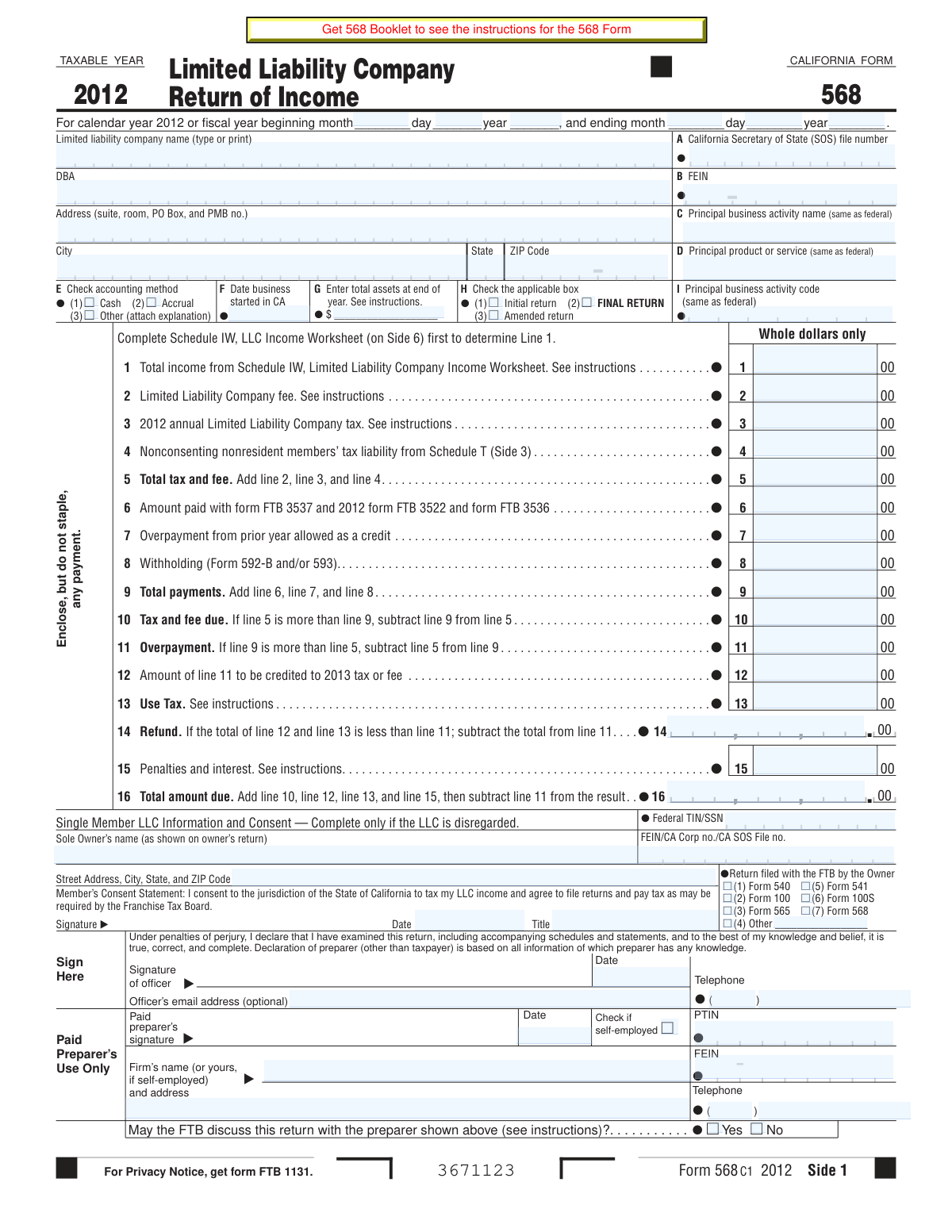
Yes! You can use AI to fill out California Form 568, Limited Liability Company Return of Income

Form 568, the Limited Liability Company Return of Income, is a tax document required by the California Franchise Tax Board (FTB) for all LLCs that are organized, registered, or doing business in California. It is used to report the LLC's income, deductions, credits, and to calculate the annual LLC tax and fee. Today, this form can be filled out quickly and accurately using AI-powered services like Instafill.ai, which can also convert non-fillable PDF versions into interactive fillable forms.
Our AI automatically handles information lookup, data retrieval, formatting, and form filling.
It takes less than a minute to fill out Form 568 using our AI form filling.
Securely upload your data. Information is encrypted in transit and deleted immediately after the form is filled out.

Form specifications

Form name: California Form 568, Limited Liability Company Return of Income
Number of pages: 6
Language: English
Categories: income forms, company forms
main-image

Instafill Demo: How to fill out PDF forms in seconds with AI

How to Fill Out Form 568 Online for Free in 2026

Are you looking to fill out a FORM 568 form online quickly and accurately? Instafill.ai offers the #1 AI-powered PDF filling software of 2026, allowing you to complete your FORM 568 form in just 37 seconds or less.
Follow these steps to fill out your FORM 568 form online using Instafill.ai:
  1. 1 Navigate to Instafill.ai and upload or select Form 568, the Limited Liability Company Return of Income.
  2. 2 Provide the LLC's identification details, including its legal name, California SOS file number, FEIN, and principal business activity information.
  3. 3 Use the AI-assisted interface to complete the financial schedules, such as Schedule IW (Income Worksheet), Schedule B (Income and Deductions), and Schedule A (Cost of Goods Sold).
  4. 4 Enter details about members' shares of income, deductions, and credits on Schedule K, and provide balance sheet information on Schedule L.
  5. 5 Answer the series of questions on Side 2 regarding the LLC's structure, ownership changes, and business activities during the tax year.
  6. 6 Allow the AI to automatically calculate the total tax and fee, payments, credits, and the final amount due or overpayment on Side 1 of the form.
  7. 7 Carefully review the entire completed form for accuracy, then have an authorized officer sign it before filing with the California Franchise Tax Board.

Our AI-powered system ensures each field is filled out correctly, reducing errors and saving you time.

Why Choose Instafill.ai for Your Fillable Form 568 Form?

Speed

Complete your Form 568 in as little as 37 seconds.

Up-to-Date

Always use the latest 2026 Form 568 form version.

Cost-effective

No need to hire expensive lawyers.

Accuracy

Our AI performs 10 compliance checks to ensure your form is error-free.

Security

Your personal information is protected with bank-level encryption.

Frequently Asked Questions About Form Form 568

Form 568 is the California Limited Liability Company (LLC) Return of Income. It must be filed by all LLCs that are organized in California, registered to do business in California, or have California-source income, even if the LLC is inactive or not profitable.

The annual LLC tax (Line 3) is a fixed amount every LLC must pay for the privilege of doing business in California. The LLC fee (Line 2) is a separate, variable amount based on your total California income, which is calculated on Schedule IW.

You must first complete the Schedule IW (LLC Income Worksheet) located on Side 6 of the form. The total California income calculated on line 17 of Schedule IW is the amount you enter on Line 1 of Form 568.

Yes, even if your SMLLC is a disregarded entity for federal tax purposes, you must file Form 568 in California. Be sure to complete the 'Single Member LLC Information and Consent' section on Side 1.

Schedule T is used to calculate and report the tax owed by any nonresident members who have not signed a consent form agreeing to California's tax jurisdiction. The total tax from this schedule is entered on Line 4 of the main form.

For a multi-member LLC, you must attach a completed California Schedule K-1 (568) for each person who was a member during the tax year. This schedule details each member's share of the LLC's income, deductions, and credits.

Yes, every LLC registered in California must file Form 568 and pay the annual LLC tax, regardless of business activity or income. However, you may not owe the separate LLC fee if your total income is below the minimum threshold.

You must provide the Principal Business Activity (PBA) name, code, and a description of the principal product or service. This information should be the same as what you reported on your federal tax return.

You must answer the questions in section P on Side 2 regarding nonresident members. If you have nonconsenting nonresident members, you must calculate their tax on Schedule T and may have withholding obligations.

Schedule L provides a snapshot of the LLC's financial position by listing its assets, liabilities, and capital accounts at the beginning and end of the taxable year. This information should generally agree with the LLC's books and records.

Yes, services like Instafill.ai use AI to accurately auto-fill form fields from your existing records, which can save you significant time and reduce errors. This is especially helpful for complex returns with multiple schedules like Form 568.

Simply upload your Form 568 PDF to the Instafill.ai platform. The AI will identify all the form fields, allowing you to connect your data sources to automatically populate the form with your LLC's information before downloading the completed document.

You can use a service like Instafill.ai, which is designed to convert flat, non-fillable PDFs into interactive, fillable forms. This allows you to easily type your information directly into the fields online without needing to print and write by hand.

Compliance Form 568
Validation Checks by Instafill.ai

1
FEIN Format and Presence
This check verifies that the Federal Employer Identification Number (FEIN) in box B is present and follows the correct 9-digit format (XX-XXXXXXX). The FEIN is a critical unique identifier for the business entity with tax authorities. A missing or incorrectly formatted FEIN will cause the return to be rejected or lead to significant processing delays.
2
California SOS File Number Presence
This validation ensures that the California Secretary of State (SOS) file number in box A has been provided. This number is required for all LLCs registered in California and is used by the Franchise Tax Board to match the tax return with the entity's official state registration. Failure to provide this number can result in compliance notices and processing delays.
3
Taxable Year Period Logic
This check validates that the provided tax year period is logical. The ending date must be after the beginning date, and the period should not exceed 12 months. An illogical or invalid tax period will lead to incorrect tax calculations and will likely cause the return to be rejected by the tax authority.
4
Line 5 Total Tax and Fee Calculation
This validation confirms that the amount on Line 5 is the correct arithmetic sum of Line 2 (LLC fee), Line 3 (Annual LLC tax), and Line 4 (Nonconsenting nonresident members’ tax). This is a crucial calculation to determine the total liability before applying any payments or credits. An incorrect sum will make all subsequent calculations for tax due or overpayment incorrect.
5
Mutually Exclusive Tax Due and Overpayment
This check ensures that a value appears on either Line 10 (Tax and fee due) or Line 11 (Overpayment), but not both. A return cannot simultaneously have an amount due and an overpayment. The presence of values in both fields indicates a fundamental calculation error that must be resolved before the form can be processed.
6
Credit to Future Year Consistency
This validation verifies that the amount on Line 12 (Amount of line 11 to be credited to 2013 tax or fee) is not greater than the total overpayment amount on Line 11. An entity cannot credit more to a future tax year than the overpayment it has available. This check prevents invalid claims and ensures the final refund amount is calculated correctly.
7
Schedule IW to Line 1 Income Consistency
This check validates that the total income reported on Side 1, Line 1, exactly matches the 'Total California income' calculated on Schedule IW, Line 17. The LLC fee on Line 2 is directly calculated based on this income figure, making this a critical check for accuracy. A mismatch will result in an incorrect LLC fee and an inaccurate tax assessment.
8
Schedule L Balance Sheet Equality
This validation confirms that on Schedule L, the 'Total assets' on Line 14 equals the 'Total liabilities and capital' on Line 22 for both the beginning and end of the year columns. This reflects the fundamental accounting equation and is a key indicator of the return's internal financial consistency. A failure suggests significant errors in the LLC's accounting or tax preparation.
9
Disregarded Entity Conditional Logic
This check verifies that if Question U(1) is answered 'Yes' (the LLC is a disregarded entity), then the 'Single Member LLC Information and Consent' section on Side 1 is filled out. This section is required to identify the sole owner and establish their consent to California taxation. If this section is incomplete for a disregarded entity, the return cannot be properly processed.
10
Member Count and Schedule K-1 Requirement
This validation checks the number of members entered in Question J. If the number is greater than one, the system flags that a California Schedule K-1 (568) should be attached for each member. This is essential for ensuring that income, deductions, and credits are properly allocated to all members as required by law.
11
Final Return Balance Sheet Validation
If the 'FINAL RETURN' box in Question H(2) is checked, this validation verifies that the ending balances on Schedule L (Balance Sheet) are zero. A final return signifies that the LLC has dissolved and distributed all of its assets and liabilities. Non-zero ending balances would contradict the final status of the return and may require additional documentation or correction.
12
Cost of Goods Sold Data Flow
This check ensures that the 'Cost of goods sold' amount from Schedule A, Line 8, is correctly transferred to Schedule B, Line 2. This data transfer is essential for the correct calculation of Gross Profit on Schedule B, Line 3. An error in this transfer would invalidate all subsequent income calculations on the return.

Common Mistakes in Completing Form 568

Incorrectly Calculating the LLC Fee

The LLC fee on Line 2 is based on the total California income calculated on Schedule IW and reported on Line 1. Filers often miscalculate this income by failing to properly apportion it or by incorrectly netting losses against gains, leading to an underpayment or overpayment of the fee. An incorrect fee can result in notices from the FTB, penalties, and interest charges. To avoid this, carefully follow the instructions for Schedule IW, ensuring only California-sourced income is included and losses are excluded where specified.

Errors on Schedule IW (Income Worksheet)

Schedule IW is the foundation for determining the LLC fee, yet it is frequently completed incorrectly. Common errors include failing to add back cost of goods sold where required, improperly apportioning income for businesses operating both inside and outside California, or omitting income from disregarded entities. These mistakes directly impact the total income on Line 1 and the subsequent fee calculation on Line 2, potentially leading to significant tax discrepancies and audit risk. Always review the specific instructions for each line of Schedule IW before transferring the final amount to Side 1.

Missing or Incorrect Entity Identification Numbers

Entering an incorrect Federal Employer Identification Number (FEIN) in Box B or California Secretary of State (SOS) file number in Box A is a common data entry error. This mistake can cause the Franchise Tax Board (FTB) to reject the return or fail to match it with the LLC's account, leading to processing delays, delinquency notices, and potential penalties. Always double-check these numbers against official IRS and SOS documentation. AI-powered tools like Instafill.ai can help prevent this by storing and accurately populating these critical identifiers.

Forgetting to Attach Required Schedules and Statements

This form frequently requires additional attachments, such as Schedule K-1 for each member, schedules for 'Other income' or 'Other deductions,' and explanations for certain accounting methods. Filers often overlook these requirements, submitting an incomplete return. An incomplete filing can be rejected or trigger correspondence from the FTB, delaying processing and potentially leading to penalties. Carefully review each line item and question for any mention of 'Attach schedule' to ensure all necessary documents are included.

Incomplete Single Member LLC (SMLLC) Information

If the LLC is a disregarded entity, the 'Single Member LLC Information and Consent' section must be completed. Filers often forget this section or provide information (like the owner's name or SSN/TIN) that does not exactly match the owner's personal tax return, causing matching errors. The owner must also sign the consent statement; failure to do so can create issues regarding California's jurisdiction to tax the LLC's income. Ensure this section is fully and accurately completed if the LLC is a disregarded entity.

Misinterpreting Complex Yes/No Questions on Side 2

Side 2 contains numerous complex questions (e.g., Question O on property transfers, Question P on nonresident members, Question U on disregarded entities) that have significant tax implications. Answering incorrectly due to misunderstanding can lead to missed filing obligations, such as failing to report a change in control or not withholding tax for nonresident members. These errors can result in substantial penalties. It is crucial to read the detailed instructions for each question to understand its meaning and consequences before answering.

Failure to Attach a Schedule K-1 for Each Member

For multi-member LLCs, Question J requires the attachment of a California Schedule K-1 (568) for every individual or entity that was a member at any time during the year. A common oversight is failing to prepare and attach a K-1 for each member, which is essential for members to correctly report their share of income, deductions, and credits on their own tax returns. This omission results in an incomplete return and can cause compliance issues for both the LLC and its members.

Mismatch Between Federal and California Amounts

Many schedules, particularly Schedule K, require filers to start with federal amounts and then enter California-specific adjustments to arrive at the final California figure. A frequent mistake is to simply copy the numbers from the federal return (Form 1065) without making the necessary adjustments for differences between federal and California tax law. This leads to an incorrect reporting of California income and deductions. Always consult the form instructions to identify and apply all required California adjustments.

Mathematical Errors in Calculations

Simple arithmetic errors are common on a complex, multi-page form like the Form 568. Mistakes in adding or subtracting lines on the main return (e.g., calculating 'Total tax and fee' on Line 5 or 'Total amount due' on Line 16) or on supporting schedules like Schedule B can lead to an incorrect tax liability. This can result in FTB notices, payment discrepancies, and penalties. Using tax software or an AI-powered tool like Instafill.ai, which can perform calculations automatically, helps eliminate these manual errors. If the form is a non-fillable PDF, Instafill.ai can convert it to a fillable version with calculation capabilities.

Incorrectly Reporting Fiscal Year Dates

For LLCs that do not use a calendar year, filers must specify the fiscal year beginning and ending dates at the top of the form. Common mistakes include leaving this section blank, entering incorrect dates, or using a calendar year format when a fiscal year applies. This error can cause the FTB's system to misclassify the filing period, leading to confusion, incorrect penalty assessments for late filing, and processing delays. Ensure the correct fiscal year period is entered if the LLC does not follow the standard calendar year.
Saved over 80 hours a year

“I was never sure if my IRS forms like W-9 were filled correctly. Now, I can complete the forms accurately without any external help.”

Kevin Martin Green

Your data stays secure with advanced protection from Instafill and our subprocessors

Robust compliance program

Transparent business model

You’re not the product. You always know where your data is and what it is processed for.

ISO 27001, HIPAA, and GDPR

Our subprocesses adhere to multiple compliance standards, including but not limited to ISO 27001, HIPAA, and GDPR.

Security & privacy by design

We consider security and privacy from the initial design phase of any new service or functionality. It’s not an afterthought, it’s built-in, including support for two-factor authentication (2FA) to further protect your account.

Fill out Form 568 with Instafill.ai

Worried about filling PDFs wrong? Instafill securely fills california-form-568-limited-liability-company-return-of-income forms, ensuring each field is accurate.