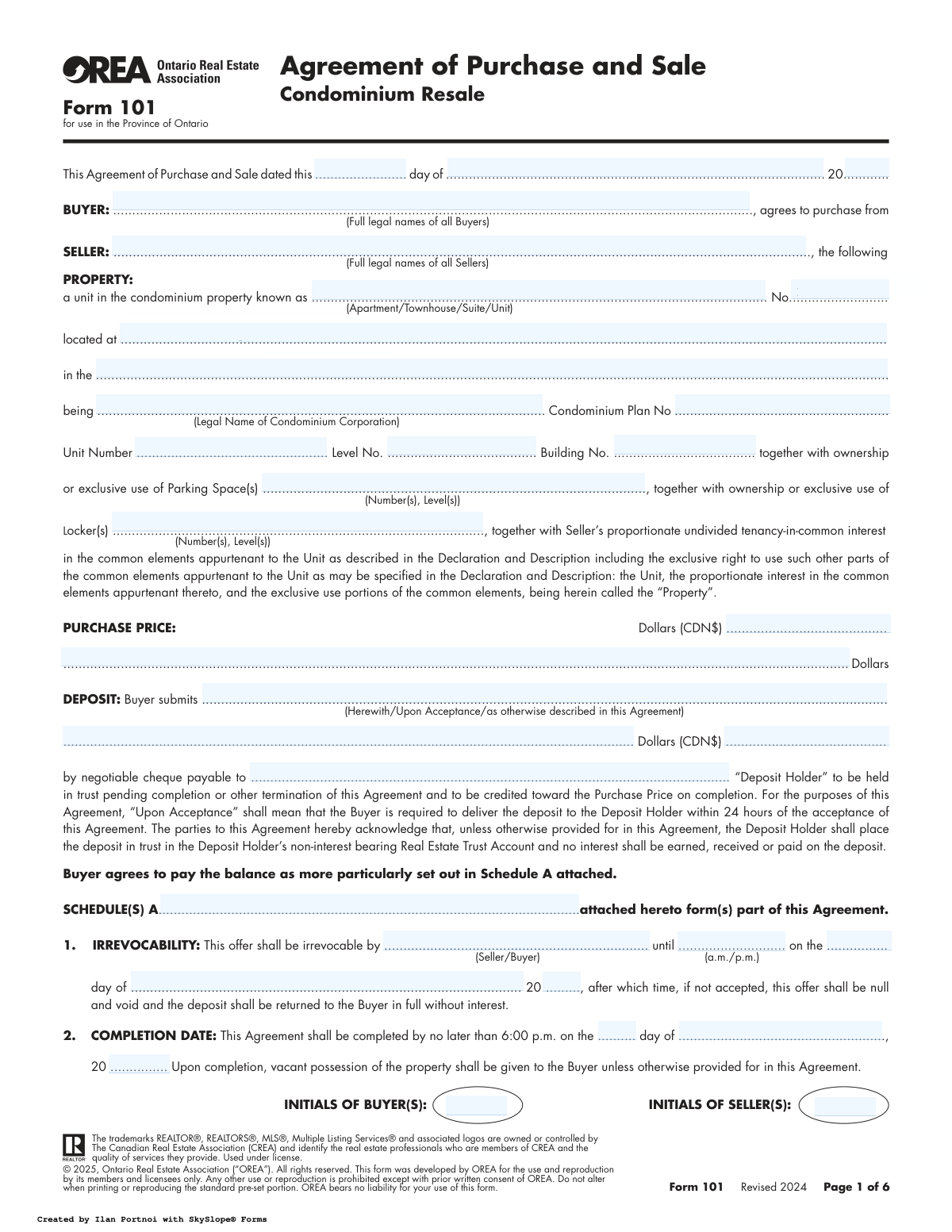
Yes! You can use AI to fill out Form 101, Agreement of Purchase and Sale Condominium Resale
OREA Form 101 is a legally binding contract used for the purchase and sale of a resale condominium unit in the province of Ontario. It outlines all the critical terms and conditions of the transaction, including the purchase price, deposit, closing date, and specific details about the property and included items. This comprehensive document ensures that both the buyer and seller have a clear, enforceable agreement. Today, this form can be filled out quickly and accurately using AI-powered services like Instafill.ai, which can also convert non-fillable PDF versions into interactive fillable forms.
OREA Form 101 is part of the
purchase agreement forms and purchase and sale forms categories on Instafill.
Our AI automatically handles information lookup, data retrieval, formatting, and form filling.
It takes less than a minute to fill out OREA Form 101 using our AI form filling.
Securely upload your data. Information is encrypted in transit and deleted immediately after the form is filled out.
Form specifications
| Form name: | Form 101, Agreement of Purchase and Sale Condominium Resale |
| Number of fields: | 115 |
| Number of pages: | 6 |
| Language: | English |
Instafill Demo: How to fill out PDF forms in seconds with AI
How to Fill Out OREA Form 101 Online for Free in 2026
Are you looking to fill out a OREA FORM 101 form online quickly and accurately? Instafill.ai offers the #1 AI-powered PDF filling software of 2026, allowing you to complete your OREA FORM 101 form in just 37 seconds or less.
Follow these steps to fill out your OREA FORM 101 form online using Instafill.ai:
- 1 Navigate to Instafill.ai and upload the OREA Form 101 or select it from the template library.
- 2 Provide the full legal names of the Buyer(s) and Seller(s), and enter the detailed property information, including the address, unit number, and legal name of the condominium corporation.
- 3 Input the financial details of the agreement, such as the purchase price, deposit amount, and instructions for the deposit holder.
- 4 Specify all critical dates, including the agreement date, the irrevocability period, the completion date for the sale, and the title search requisition date.
- 5 Clearly list all included chattels (e.g., appliances), excluded fixtures, and any rental items the buyer will assume.
- 6 Review all the auto-filled information for accuracy, then use the platform to have all parties, including buyers, sellers, and witnesses, apply their digital signatures.
- 7 Securely download, save, and distribute the completed and signed Form 101 to all relevant parties, such as lawyers and brokerages.
Our AI-powered system ensures each field is filled out correctly, reducing errors and saving you time.
Why Choose Instafill.ai for Your Fillable OREA Form 101 Form?
Speed
Complete your OREA Form 101 in as little as 37 seconds.
Up-to-Date
Always use the latest 2026 OREA Form 101 form version.
Cost-effective
No need to hire expensive lawyers.
Accuracy
Our AI performs 10 compliance checks to ensure your form is error-free.
Security
Your personal information is protected with bank-level encryption.
Frequently Asked Questions About Form OREA Form 101
Form 101 is the Agreement of Purchase and Sale for resale condominium units in Ontario. It is used by buyers and sellers to create a legally binding contract that outlines the terms and conditions for the property's sale.
Typically, the buyer's real estate agent prepares the initial offer on Form 101. The form is then reviewed, and potentially modified, by the buyer, seller, and their respective agents and lawyers before being finalized and signed.
Your full legal name, as it appears on government-issued identification, is required to ensure the contract is legally valid and that the property title is transferred and registered correctly.
This clause specifies a deadline by which the party receiving the offer must accept it. The party making the offer cannot withdraw it before this time, making the offer firm and binding for that period.
The deposit is held in a trust account by the designated Deposit Holder, usually the listing brokerage. It is credited towards the purchase price on closing or returned to the buyer if the agreement is terminated under specific conditions.
Chattels are movable items (like appliances) that must be listed to be included in the sale. Fixtures are items attached to the property (like light fixtures) that are automatically included unless specifically listed in the 'Fixtures Excluded' section.
A Status Certificate is a key document from the condominium corporation detailing the financial and legal status of the unit and the building. Your lawyer reviews it to check for issues like special assessments, lawsuits, or unpaid fees before you finalize the purchase.
The Completion Date, or closing day, is the date when ownership is officially transferred from the seller to the buyer. On this day, the seller receives payment, and the buyer receives the keys to the property.
Most residential resale properties in Ontario are exempt from HST. The seller must certify on or before closing that the sale is not subject to HST, as noted in Section 9 of the agreement.
Adjustments are funds exchanged between the buyer and seller on closing day to fairly apportion costs like property taxes and common expenses. This ensures each party only pays for these items for the period they own the property.
Schedule A is used to add clauses and conditions that are not part of the standard form, such as conditions for financing, inspection, or the sale of a buyer's existing property. Any provisions in Schedule A can override the standard text of the agreement.
Yes, services like Instafill.ai use AI to auto-fill form fields accurately and save time. While helpful for data entry, it is essential that a licensed real estate professional or lawyer reviews the completed agreement before signing.
You can use a platform like Instafill.ai to upload the form and complete it interactively online. This allows you to easily enter all required information, save your progress, and securely share the document with your agent or lawyer.
If you have a flat, non-fillable PDF, you can upload it to a service like Instafill.ai. The platform can convert it into an interactive, fillable form that you can easily complete on your computer.
Compliance OREA Form 101
Validation Checks by Instafill.ai
1
Purchase Price Consistency Check
This validation ensures that the numeric value entered for the 'Purchase Price' exactly matches the amount written out in words. This is critical for preventing ambiguity and legal disputes over the agreed-upon price. If the values do not match, the submission should be flagged for manual review and correction to ensure the contract reflects the true intent of the parties.
2
Logical Date Chronology
Verifies that the key dates on the agreement follow a logical sequence: Agreement Date must be on or before the Irrevocability Date, which must be on or before the Requisition Date, which must be on or before the Completion Date. This check prevents impossible or contradictory timelines that would render the contract invalid or unenforceable. A failure would require the user to correct the dates to reflect a valid progression of events.
3
Irrevocability Deadline Validity
Ensures the 'Irrevocability' date and time are in the future relative to the Agreement Date. This is the deadline by which the offer must be accepted, and it cannot be in the past. This check is crucial for the offer's legal validity, as a past deadline would mean the offer is expired upon creation. If the date is in the past, the form cannot be submitted until a future date and time are provided.
4
Completion Date Logic
This check confirms that the 'Completion Date' is a future date that occurs after the 'Agreement Date'. The completion date is the closing day when ownership is transferred, so it must logically happen after the agreement is made. An invalid date would make the contract's core obligation impossible to fulfill. The system should reject any completion date that is on or before the agreement date.
5
Buyer and Seller Name Completeness
Validates that the 'Full legal names of all Buyers' and 'Full legal names of all Sellers' fields are not empty. These names are fundamental to identifying the legal parties bound by the contract. Leaving these fields blank would make the agreement unenforceable and invalid. The system must require at least one name for both the buyer and seller side.
6
Deposit Amount Rationality
This check verifies that the 'Deposit' amount is a positive number and is less than the total 'Purchase Price'. A deposit cannot logically be zero, negative, or exceed the total value of the property. This validation prevents data entry errors that could cause significant financial and legal complications. An invalid entry would trigger an error message requiring the user to input a correct and logical deposit amount.
7
HST Clause Selection
Ensures that a selection has been made in Section 9 for whether the Harmonized Sales Tax (HST) is 'included in' or 'in addition to' the Purchase Price. This is a critical financial term that significantly impacts the total amount the buyer must pay. Failure to specify this would create major ambiguity and potential disputes at closing, so the field must be mandatory.
8
Requisition Date Placement
Validates that the 'Requisition Date' in Section 10 is set for a date before the 'Completion Date'. The Requisition Date is the buyer's deadline to examine the property title, and this must happen before the final closing. An illogical date order would disrupt the legal due diligence process. The system should enforce that the Requisition Date precedes the Completion Date.
9
Page Initials Completeness
This validation checks that the initial fields for both Buyer(s) and Seller(s) at the bottom of each page are filled. These initials signify that all parties have reviewed and acknowledged the contents of every page of the agreement. Missing initials can be used to dispute whether a party was aware of the terms on a specific page, weakening the contract's integrity.
10
Confirmation of Acceptance Date Logic
Verifies that the 'Confirmation of Acceptance' date is on or after the signature dates of all parties and on or before the 'Irrevocability' deadline. This date formalizes when the agreement became binding. An acceptance date before the offer was even signed, or after it expired, would be logically and legally inconsistent. This ensures the acceptance is recorded within the valid offer period.
11
Property Identification Completeness
This check ensures that essential property identification fields, such as the full address, unit number, and Condominium Plan Number, are filled out. A contract is not valid without a clear and unambiguous description of the property being sold. Missing this information would make it impossible to legally identify the subject of the sale, rendering the agreement void for uncertainty.
12
Contact Information Format Validation
Validates that any provided email addresses and fax/telephone numbers for notices and lawyers adhere to standard formats (e.g., '[email protected]' for email, and a valid number of digits for phone numbers). This is important for ensuring that legal notices ('Notices', Section 3) can be successfully delivered as stipulated in the agreement. An invalid format could lead to a party not receiving a critical notice, causing a breach of contract.
13
Spousal Consent Date Consistency
If the 'Spousal Consent' section is signed, this check ensures the signature date is present and is reasonably close to the Seller's signature date. The consent is a critical component for a valid title transfer under the Family Law Act. A missing or illogical date could call the validity of the consent into question, potentially jeopardizing the entire transaction.
14
Schedule A Attachment Consistency
This validation checks if the 'SCHEDULE(S) A' field indicates a schedule is attached and, if so, confirms that data for Schedule A is present. The schedule contains critical payment details for the balance of the purchase price. If the main agreement references the schedule, but the schedule is missing or incomplete, the contract is incomplete and payment terms are undefined.
Common Mistakes in Completing OREA Form 101
People often enter nicknames, initials, or incomplete names for the Buyer and Seller instead of their full legal names. This mistake can create significant issues with title transfer, mortgage financing, and legal documentation, potentially delaying or even jeopardizing the closing. To avoid this, always use the full legal name as it appears on government-issued identification and the property's title documents.
The property section requires multiple, precise details, including the legal name of the Condominium Corporation and the Condominium Plan Number. Fillers often rely on memory or marketing materials, leading to errors. An incorrect legal description can create ambiguity about what is being purchased, potentially voiding the agreement or causing major legal complications. Always refer to the seller's deed or a recent property tax bill to ensure 100% accuracy.
When entering the purchase price and deposit, a common error is having a discrepancy between the amount written out in words and the amount entered in numerals. This creates legal ambiguity regarding the true offer price. In most legal interpretations, the written amount supersedes the numeric one, which could bind you to a price you did not intend. Carefully double-check that both entries match perfectly before submitting the offer.
The irrevocability clause sets a binding deadline for the offer's acceptance, but people frequently forget to specify 'a.m.' or 'p.m.' or set a deadline that is unrealistically short. This can cause an offer to expire unintentionally before the other party has a reasonable chance to respond, effectively killing the deal. Always be precise with the time and date, and ensure the period is reasonable for a considered response.
Parties often use generic terms like 'all appliances' or 'window coverings' instead of listing specific items. This ambiguity leads to disputes at closing when a buyer expects an item the seller has removed, such as a high-end refrigerator or a specific light fixture. To prevent conflicts, create a detailed list of each item, including brand and model numbers where possible, to leave no room for misinterpretation.
A frequent mistake is selecting a Completion Date or Requisition Date that falls on a weekend or a statutory holiday. Since banks and land registry offices are closed on these days, the transaction cannot be completed, forcing a last-minute amendment to the agreement. This causes unnecessary stress and can delay the closing. Always consult a calendar to ensure these critical dates are scheduled for a regular business day.
This multi-page legal document requires all parties to initial the bottom of each page to acknowledge its terms. It is very easy to accidentally skip a page, especially when reviewing the document in a hurry. A missing initial can be used by one party to claim they did not see or agree to the terms on that page, potentially weakening the contract's enforceability or causing delays while the omission is corrected.
Sellers often misunderstand or ignore this section, especially if they are the sole owner on title but are legally married. If the property is a matrimonial home, the Family Law Act requires the non-titled spouse to consent to the sale. Failing to secure this signature can render the agreement voidable, allowing the spouse to block the sale and creating severe legal and financial consequences for everyone involved.
The agreement often relies on attached schedules (e.g., Schedule A for financing details) that contain critical terms. A common error is forgetting to list the attached schedules on the first page or failing to include the documents themselves. This can lead to serious disputes about whether the terms in the unreferenced schedule are legally part of the binding agreement. Ensure all schedules are explicitly named on page one and physically attached.
These legal forms are often provided as flat, non-fillable PDFs, requiring manual completion by hand or with clunky software. This process is highly susceptible to typos, illegible handwriting, and formatting errors that can create legal ambiguities or an unprofessional appearance. AI-powered tools like Instafill.ai can convert these documents into smart, fillable forms, which helps prevent such data entry errors and ensures the final agreement is clean and accurate.
Saved over 80 hours a year
“I was never sure if my IRS forms like W-9 were filled correctly. Now, I can complete the forms accurately without any external help.”
Kevin Martin Green
Your data stays secure with advanced protection from Instafill and our subprocessors

Robust compliance program
Transparent business model
You’re not the product. You always know where your data is and what it is processed for.
ISO 27001, HIPAA, and GDPR
Our subprocesses adhere to multiple compliance standards, including but not limited to ISO 27001, HIPAA, and GDPR.
Security & privacy by design
We consider security and privacy from the initial design phase of any new service or functionality. It’s not an afterthought, it’s built-in, including support for two-factor authentication (2FA) to further protect your account.
Fill out OREA Form 101 with Instafill.ai
Worried about filling PDFs wrong? Instafill securely fills form-101-agreement-of-purchase-and-sale-condominium-resale forms, ensuring each field is accurate.