Fill out motor vehicle forms
with AI.
Motor vehicle forms are essential for maintaining the legal chain of ownership and ensuring compliance with state and federal regulations. This category includes a variety of documents required for buying, selling, leasing, or registering vehicles across different jurisdictions. Whether you are documenting a private sale with a Bill of Sale or applying for a new Certificate of Title, these forms ensure that the Department of Motor Vehicles (DMV) and tax authorities have accurate records of the transaction and the parties involved.
By continuing, you acknowledge Instafill's Privacy Policy and agree to get occasional product update and promotional emails.
About motor vehicle forms
These forms are typically used by individual car buyers and sellers, professional auto dealers, and businesses managing corporate fleets. Common scenarios include transferring a title after a sale, disclosing odometer readings to prevent fraud, or submitting tax statements for leased vehicles, such as Colorado’s DR 0026. Because many of these documents are signed under penalty of perjury, accuracy is critical to avoid delays in registration or potential legal issues. Navigating these requirements can be complex, especially when dealing with out-of-state transfers or specialized tax credits for alternative vehicles.
Tools like Instafill.ai use AI to fill these motor vehicle forms in under 30 seconds, ensuring data is handled accurately and securely. This technology simplifies the often tedious process of manual entry, allowing you to move from paperwork to the road more quickly.
Every form on this page can be completed without typing. Instafill is form filling software that reads a PDF and fills it for you — including flat and scanned documents that carry no fillable fields at all.
Forms in This Category
The forms in this category have a median Form Complexity Index of 52/100 (Moderate), measured across 22 forms by field count, input difficulty, length, conditional logic and structure. See how it is calculated.
- Enterprise-grade security & data encryption
- 99%+ accuracy powered by AI
- 1,000+ forms from all industries
- Complete forms in under 60 seconds
How to Choose the Right Form
Navigating motor vehicle paperwork depends heavily on your state and the specific nature of your transaction. Whether you are transferring ownership, registering a new car, or handling tax obligations, choosing the correct document is essential for legal compliance.
Buying or Selling a Vehicle
If you are transferring ownership between private parties, you will likely need a Bill of Sale. These forms serve as a legal receipt of the transaction and are required by state DMVs to prove the purchase price and date:
- California: Use Form REG 135 (Bill of Sale).
- Oregon: Use Form 735-501 (Vehicle Bill of Sale).
- Georgia: Use Form T-7 (Bill of Sale).
- Florida: If the odometer reading isn't recorded on the title, you must use Form HSMV 82993 (Separate Odometer Disclosure Statement) to certify the mileage.
Applying for Title and Registration
To establish legal ownership or register a vehicle in a new state, use the application specific to your jurisdiction:
- New York: Use Form MV-82TON to apply for a Certificate of Title for vehicles, boats, or trailers.
- California: Use Form REG 343 for title, new registration, or out-of-state transfers.
- Maryland: Use Form VR-005 to establish ownership and record purchase details for tax purposes.
Colorado Tax and DMV Forms
Colorado has specific requirements for dealers and individuals regarding sales tax and record resolution:
- Dealers: Use Form DR 0024 (Standard Sales Tax Receipt) to document a vehicle sale and calculate state/local taxes.
- Leasing: For leased vehicles where the lessor collects tax, use Form DR 0026 (Tax Statement for Leased Motor Vehicle).
- Discrepancies: If you have a unique issue with your driving record or ID documents, file Form DR 2020SP (Exception Processing Application).
Specialized Use Cases
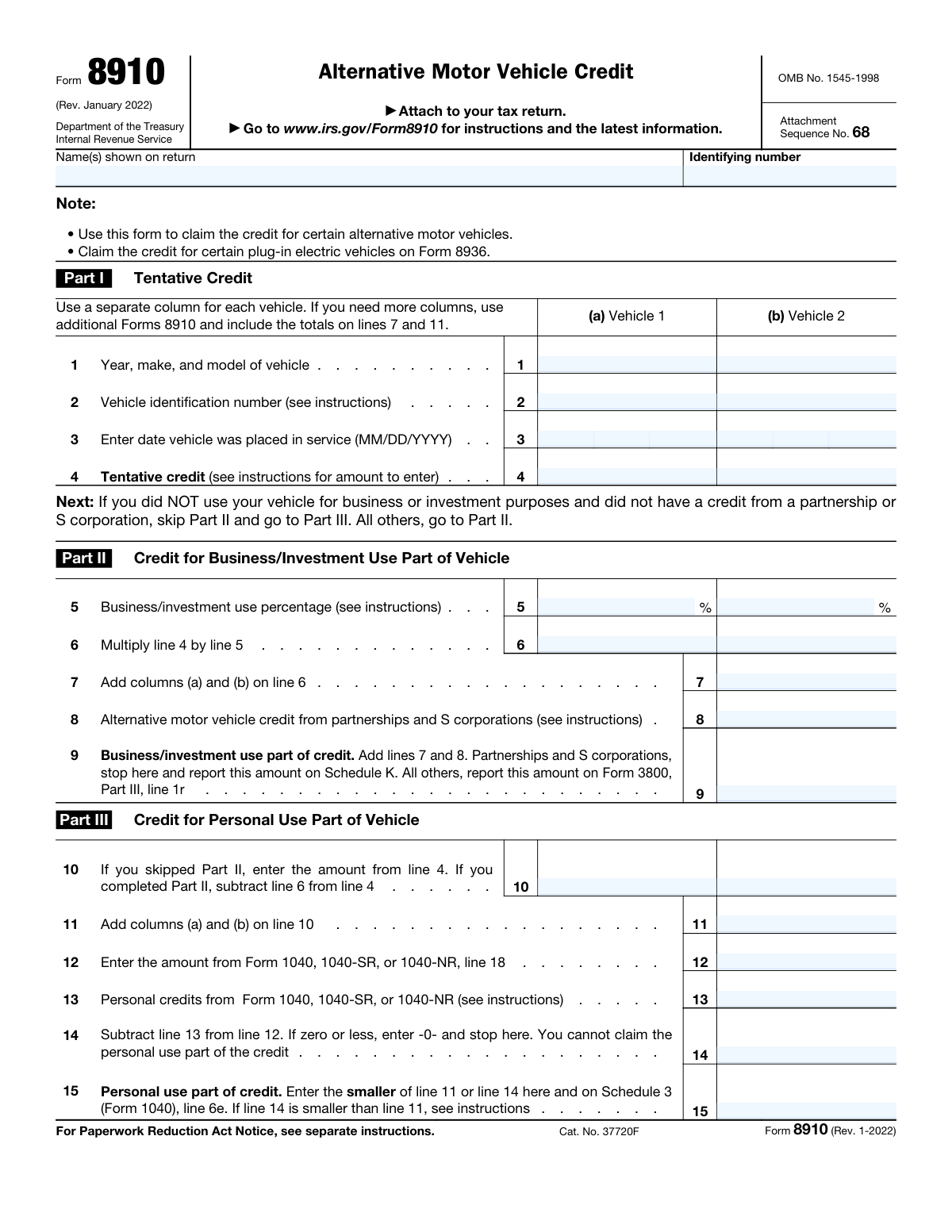
- Tax Credits: If you purchased an eligible alternative vehicle, use IRS Form 8910 (Alternative Motor Vehicle Credit) to claim federal tax credits.
- License Changes: Use California DL 142 to officially cancel or surrender a driver’s license or ID card.
- Business Authorization: Companies in Hawaii should use the Letter of Authorization - County of Kauai to designate individuals who can sign motor vehicle documents on the company's behalf.
Form Comparison
| Form | Purpose | Jurisdiction | Who Files It |
|---|---|---|---|
| Form 8910, Alternative Motor Vehicle Credit | Claims tax credits for qualifying alternative motor vehicles. | Federal (United States IRS) | Taxpayers who purchased eligible alternative vehicles. |
| California Department of Motor Vehicles (DMV) Form REG 135, Bill of Sale | Documents the sale and transfer of vehicle ownership. | California (DMV) | Sellers and buyers recording a private sale. |
| Colorado Form DR 0026, Tax Statement for Leased Motor Vehicle | Reports sales tax for leased motor vehicle transactions. | Colorado (Department of Revenue) | Dealers selling vehicles to a third-party lessor. |
| DL 142, Request for Cancellation or Surrender of a Driver License or Identification Card (State of California Department of Motor Vehicles) | Requests the formal cancellation or surrender of licenses. | California (DMV) | License holders or parents of minor drivers. |
| Form 735-501, Vehicle Bill of Sale | Legal record of vehicle sale and purchase details. | Oregon (DMV) | Parties involved in an Oregon vehicle sale. |
| Form DR 0024, Standard Sales Tax Receipt for Vehicle Sales | Standard receipt for calculating vehicle sales tax. | Colorado (Department of Revenue) | Auto dealers documenting sales tax for registration. |
| Form DR 2020SP, Exception Processing Application | Handles exceptions for driving records or identification documents. | Colorado (Division of Motor Vehicles) | Applicants needing special handling for identification records. |
| Form MV-82TON, Application for Title | Application for a certificate of vehicle or boat title. | New York (DMV) | Property owners seeking legal proof of ownership. |
| Form REG 343, Application for Title or Registration | Comprehensive application for vehicle title or registration. | California (DMV) | Owners registering new or out-of-state vehicles. |
| Form VR-005, Application for Certificate of Title | Establishes legal ownership and collects purchase tax info. | Maryland (MVA) | Vehicle owners establishing legal ownership in Maryland. |
| Georgia Department of Revenue Form T-7, Bill of Sale | Official bill of sale for transferring vehicle ownership. | Georgia (Department of Revenue) | Purchasers transferring ownership at county tag offices. |
| State of Florida Department of Highway Safety and Motor Vehicles (FLHSMV) Form HSMV 82993, Separate Odometer Disclosure Statement and Acknowledgment | Discloses odometer reading to certify actual vehicle mileage. | Florida (FLHSMV) | Sellers and buyers documenting mileage during sale. |
Tips for motor vehicle forms
The Vehicle Identification Number (VIN) and odometer reading are the most critical data points on any motor vehicle form. A single typo can lead to title rejection, registration delays, or legal disputes. Always verify these numbers directly from the vehicle's physical dashboard or door jamb rather than relying on memory.
Managing multiple motor vehicle documents can be time-consuming, but AI-powered tools like Instafill.ai can complete these forms in under 30 seconds with high accuracy. Your data stays secure during the process, providing a fast and reliable way to handle complex paperwork like dealer tax statements or title applications.
Motor vehicle regulations are governed at the state level, meaning a California REG form cannot be used for a transaction in Georgia or Colorado. Always check the header of the form to ensure it matches the jurisdiction where the vehicle will be titled or registered to avoid immediate rejection by the DMV.
For leased vehicles or dealer sales, accurately reporting sales tax is vital to avoid unexpected fees at the county clerk's office. Ensure that forms like the Colorado DR 0024 or DR 0026 clearly specify the breakdown of state, county, and local taxes so the registration process proceeds smoothly.
Both buyers and sellers should keep a copy of the signed Bill of Sale immediately after a transaction. This document, such as the Georgia T-7 or Oregon 735-501, serves as your primary legal proof of ownership transfer and protects the seller from liability for any issues that occur after the vehicle is sold.
When filling out title applications like the VR-005 or MV-82TON, ensure the name and address provided match your driver's license or state ID exactly. Discrepancies between your application and your government-issued ID can cause the DMV to flag the form for manual review, significantly delaying your paperwork.
Frequently Asked Questions
Motor vehicle forms cover a wide range of legal and administrative needs, including title applications, registration, and tax reporting. They are essential for documenting the ownership, sale, and operation of vehicles in compliance with state and federal laws.
A Bill of Sale, such as California’s REG 135 or Georgia’s T-7, is necessary whenever a vehicle or vessel is sold, gifted, or transferred between parties. It acts as a legal receipt that records the transaction details, purchase price, and identifying information for both the buyer and the seller.
To apply for a title in a new state, you typically need to submit an application for a Certificate of Title, such as New York's MV-82TON or Maryland's VR-005. You will generally need to provide proof of ownership, valid identification, and payment for any applicable taxes or registration fees at your local DMV office.
Yes, you can fill out various motor vehicle forms using AI tools. Services like Instafill.ai allow you to complete these documents in under 30 seconds by accurately extracting data from your source documents and placing it directly into the required fields.
An odometer disclosure statement, like Florida's HSMV 82993, is a legal requirement used to certify the actual mileage of a vehicle at the time of sale. This document helps prevent fraud by ensuring the buyer is fully aware of the vehicle's usage history before the title is transferred.
Colorado DR forms are used for specific tax and administrative processes within the state, such as documenting sales tax receipts (DR 0024) or handling exception processing for identification issues (DR 2020SP). These forms ensure that the Colorado Department of Revenue and the DMV have accurate records for vehicle taxation and registration.
Most motor vehicle forms should be submitted to your local DMV office, county clerk, or specific state revenue department, depending on the form's purpose. For federal tax-related forms like the Alternative Motor Vehicle Credit (Form 8910), you would submit the document to the IRS along with your annual tax return.
Using traditional methods, filling out complex DMV or tax forms can take significant time and effort. However, with AI-powered tools like Instafill.ai, you can complete these forms in under 30 seconds, ensuring high accuracy and reducing the risk of manual entry errors.
In many jurisdictions, such as Colorado, a specific tax statement like Form DR 0026 is required for leased vehicles when the lessor is responsible for collecting sales tax. This form ensures that state and local taxes are properly accounted for before the vehicle can be officially titled and registered.
If you need to surrender or cancel a driver's license or ID card, you can use forms like California's DL 142. This process is often necessary when moving out of state, returning a document for a minor, or formally closing a record for a lost or destroyed card.
Generally, the buyer is responsible for submitting the Bill of Sale to the DMV to finalize the title transfer and registration. However, the seller should also keep a signed copy as proof of the transaction to protect themselves from future liability associated with the vehicle.
Glossary
- Form Complexity Index
- Instafill’s 0–100 measure of how much effort a form takes to complete, calculated deterministically from the form’s own structure rather than estimated. It combines the number of fillable fields (the largest factor), how difficult those fields are to complete based on their type, the number of pages that contain fields, the amount of conditional “fill-only-if” logic, and how many sections the form is divided into, then adds modifiers for tables and repeating lists, bundled instruction pages, and dense page layouts. A higher score means the form is harder to fill out by hand. The forms in this category have a median Form Complexity Index of 52/100 (Moderate). See exactly how it is calculated.
- VIN (Vehicle Identification Number)
- A unique 17-character code assigned to every motor vehicle that serves as its fingerprint, used for tracking registrations, recalls, and title history.
- Certificate of Title
- A legal document issued by a state agency, such as the DMV, that serves as official proof of ownership for a vehicle or vessel.
- Lienholder
- A person or financial institution that has a legal claim on a vehicle because they provided the loan to purchase it; they typically hold the title until the debt is paid.
- Odometer Disclosure Statement
- A mandatory declaration signed by both the buyer and seller that certifies the vehicle's current mileage at the time of transfer to prevent mileage fraud.
- Bill of Sale
- A document that records the transaction between a seller and a buyer, detailing the purchase price, date, and condition of the vehicle.
- Lessor and Lessee
- In a vehicle lease, the lessor is the legal owner (often a dealership or bank) who grants use of the vehicle to the lessee (the driver) in exchange for periodic payments.
- Alternative Motor Vehicle Credit
- A federal tax credit available to taxpayers who purchase or lease qualifying energy-efficient vehicles, such as fuel cell or hybrid models.
- Exception Processing
- A specific procedure used by the Division of Motor Vehicles to resolve unique cases where an applicant lacks the standard documentation required for a license or title.