Yes! You can use AI to fill out Claim for ABSTUDY

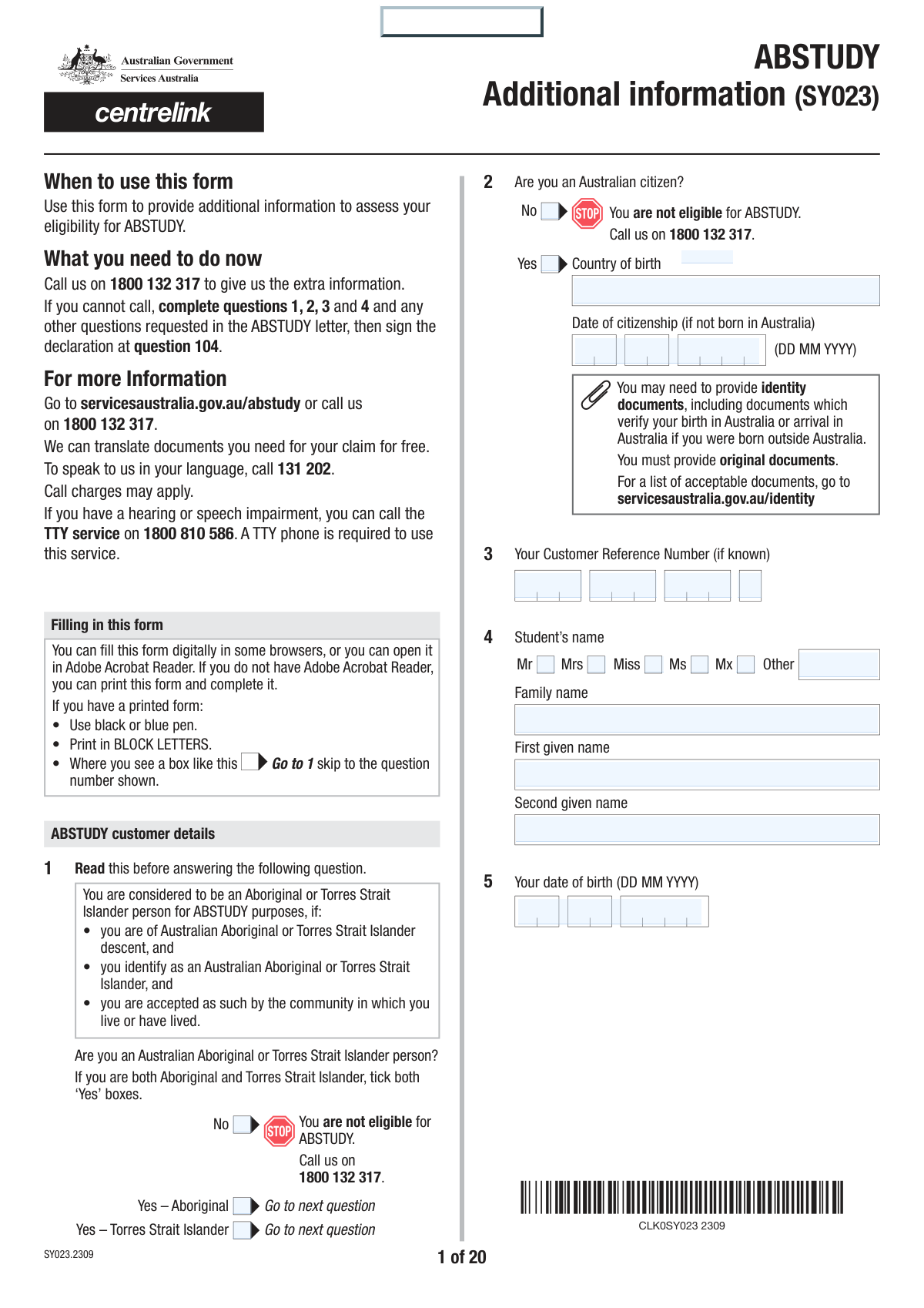
The Claim for ABSTUDY is a detailed application submitted to Services Australia (Centrelink) by Aboriginal and Torres Strait Islander students and apprentices to determine their eligibility for financial support. Completing this form accurately is crucial for accessing these vital payments, which help cover the costs of education, training, and living expenses. Today, this form can be filled out quickly and accurately using AI-powered services like Instafill.ai, which can also convert non-fillable PDF versions into interactive fillable forms.
ABSTUDY Claim Form is part of the VA claim forms category on Instafill.
Our AI automatically handles information lookup, data retrieval, formatting, and form filling.
It takes less than a minute to fill out ABSTUDY Claim Form using our AI form filling.
Securely upload your data. Information is encrypted in transit and deleted immediately after the form is filled out.

Form specifications

Form name: Claim for ABSTUDY
Number of fields: 688
Number of pages: 20
Language: English
main-image

Instafill Demo: How to fill out PDF forms in seconds with AI

How to Fill Out ABSTUDY Claim Form Online for Free in 2026

Are you looking to fill out a ABSTUDY CLAIM FORM form online quickly and accurately? Instafill.ai offers the #1 AI-powered PDF filling software of 2026, allowing you to complete your ABSTUDY CLAIM FORM form in just 37 seconds or less.
Follow these steps to fill out your ABSTUDY CLAIM FORM form online using Instafill.ai:
  1. 1 Navigate to Instafill.ai and upload or select the Claim for ABSTUDY form. The AI will process the document, making it ready to fill.
  2. 2 Provide your personal details, including your name, date of birth, Customer Reference Number (CRN), and citizenship information.
  3. 3 Complete the sections on your living arrangements, accommodation details, and relationship status. The AI can guide you through complex questions about rent, board, and sharing arrangements.
  4. 4 Detail your study or apprenticeship information, including your course, institution, and study load. Instafill.ai helps ensure all required fields are completed correctly.
  5. 5 Enter your financial information, including income from employment and other sources, as well as details about your assets like bank accounts and vehicles.
  6. 6 Answer the questions regarding your independence status to determine if you need to provide parental income details. The AI can help clarify these criteria.
  7. 7 Review all the information pre-filled by the AI, make any necessary corrections, digitally sign the form, and download the completed document, ready for submission to Centrelink.

Our AI-powered system ensures each field is filled out correctly, reducing errors and saving you time.

Why Choose Instafill.ai for Your Fillable ABSTUDY Claim Form Form?

Speed

Complete your ABSTUDY Claim Form in as little as 37 seconds.

Up-to-Date

Always use the latest 2026 ABSTUDY Claim Form form version.

Cost-effective

No need to hire expensive lawyers.

Accuracy

Our AI performs 10 compliance checks to ensure your form is error-free.

Security

Your personal information is protected with bank-level encryption.

Frequently Asked Questions About Form ABSTUDY Claim Form

This form is an application for Australian government financial assistance, such as ABSTUDY, for students and apprentices. You should fill it out if you are a student or apprentice seeking financial support for your studies or training.

A Customer Reference Number (CRN) is your unique identifier for Centrelink services. You can find your CRN on any letters from Centrelink or by logging into your myGov account that is linked to Centrelink.

The required documents depend on your circumstances but may include identity documents, proof of enrolment, a lease agreement, and financial statements. The checklist at the end of the form specifies which documents you need based on your answers.

Your 'Permanent Home Address' is your main family home, while your 'Term Address' is where you live during the semester for your studies, if it's a different location. You only need to fill this out if you live away from your permanent home to study.

You should select the accommodation type that best describes your situation, such as 'Single, younger than 22, living with parent, paying rent'. You will then be prompted to provide details about the rent amount you pay.

Being 'independent' means your payment eligibility is determined by your own income and assets, not your parents'. The form asks questions about your age, work history, relationship status, and other factors to see if you meet the criteria for independence.

If you are unsure of your study load percentage, the form provides a 'Not Sure' option. If you select this, you will likely need to provide a list of your subjects so your study load can be calculated.

Your previous study history is used to determine your eligibility and ensure you haven't exceeded the limits for receiving student payments. You must declare all tertiary courses you have attempted or completed in the last 10 years.

Typically, you can submit this form online via your myGov account linked to Centrelink, by mail, or in person at a service centre. Always ensure you have attached all the required supporting documents as indicated on the checklist.

You are required to report any changes in your circumstances, such as a change of address, income, or study load, to Centrelink as soon as possible. Failing to do so could result in an overpayment that you will have to pay back.

Yes, services like Instafill.ai use AI to help you fill out forms faster and more accurately. You can save your personal information and the tool will auto-fill the relevant fields for you, which is a great time-saver for detailed forms like this.

To use Instafill.ai, you just need to upload the form's PDF to the platform. The AI will make the form interactive, allowing you to either type in your answers or use the auto-fill feature to populate your saved information instantly.

If you have a non-fillable or 'flat' PDF, you can use a tool like Instafill.ai to convert it into an interactive, fillable form. This allows you to easily type your information into the fields on your computer before printing or submitting it electronically.

Compliance ABSTUDY Claim Form
Validation Checks by Instafill.ai

1
Citizenship and Date of Citizenship Logic
This validation ensures that if a user indicates they are an Australian citizen but were not born in Australia, they must provide a 'Date of Citizenship'. The 'Date of Citizenship' field should only be enabled and required if 'Yes' is selected for citizenship and 'Country of Birth' is a country other than Australia. This is crucial for verifying eligibility and the applicant's history, and failure to provide a date when required will block submission until the field is completed.
2
Date of Birth Validity and Age Calculation
This check validates that the 'Date of Birth' is a real date, is in the past, and represents a plausible age for an applicant (e.g., older than 14 and younger than 100). It is critical for determining eligibility for age-related benefits, such as the Disability Supplement for those 'younger than 22'. If the date is invalid, in the future, or implies an impossible age, the form will show an error and require correction.
3
Relationship Status Exclusivity and Date Requirement
This validation ensures that a user can only select one option from the 'Relationship Status' section (e.g., Married, Divorced, Separated, etc.). Furthermore, if a status that requires a date is selected (e.g., 'Married', 'Divorced'), the corresponding date field ('Married/Reconciled Date', 'Date of Divorce') must be completed with a valid past date. This prevents contradictory data and ensures completeness for eligibility assessment. A failure would prompt the user to select only one status and provide the required date.
4
Australian Postcode Format
This check verifies that all postcode fields (e.g., 'Term Postcode', 'Permanent Home Postcode', 'Postal Postcode') contain a valid 4-digit number. This is essential for mail delivery, address verification, and determining eligibility based on location. If a postcode is not 4 digits or contains non-numeric characters, the user will be prompted to enter a valid Australian postcode.
5
Australian Business Number (ABN) Structure and Checksum
This validation ensures that the combined ABN parts ('Employer ABN Part 1' through 4) form a valid 11-digit number that passes the official ABN checksum algorithm. Correct ABNs are necessary for verifying employer details and processing related information. An invalid ABN would trigger an error message asking the user to check and re-enter the number provided by their employer.
6
Conditional 'Other Names' Requirement
This check ensures that if a user answers 'Yes' to the 'Other Names Question', they must provide details in the subsequent fields, specifically 'First Other Name' and 'Type of First Other Name'. These fields are required to maintain a complete identity record for the applicant. If 'Yes' is selected but no name is provided, the system will flag these as mandatory fields and prevent progression until they are filled.
7
Work Period Date Chronology
This validation checks that the 'Work Period End Date' is not earlier than the 'Work Period Start Date'. This ensures logical consistency in the employment history provided by the applicant. An illogical date range would make income calculations impossible. If the end date precedes the start date, an error will be displayed requiring the user to correct one or both dates.
8
Age and Accommodation Category Consistency
This validation cross-references the applicant's calculated age from their 'Date of Birth' with their selection in the 'Accommodation Type' section. For example, if a user selects 'Single, younger than 22, living with parent', the system will verify their age is indeed under 22. This is critical for assessing eligibility for specific living allowances. A mismatch would result in an error, prompting the user to correct either their date of birth or their accommodation selection.
9
Document Checklist Trigger
This validation ensures that if a user answers 'Yes' to a question that requires a supporting document (e.g., 'Yes' to 'Impairment Duration' at Q19), the corresponding item in the 'Document Checklist' (e.g., 'Medical Certificate') is flagged. This serves as a reminder to the user of what they must submit with the form. While not blocking submission, it helps ensure a complete application package, reducing processing delays.
10
Bank Account BSB and Account Number Format
This check validates the format of the 'Branch Number (BSB)' and 'Account Number' fields. The BSB must be a 6-digit number, and the Account Number must be a numeric string of a valid length (e.g., 6-10 digits), without any letters or special characters. This is absolutely critical to ensure that payments can be successfully processed and sent to the correct account. An invalid format will prevent submission until corrected.
11
Parent/Guardian Signature Requirement for Minors
This validation checks the applicant's age based on their 'Date of Birth'. If the applicant is 15 years old or younger, the 'Parent/Guardian Signature Date' field becomes mandatory. This is a legal requirement to ensure parental consent for minors. If the student is a minor and the parent/guardian signature date is missing, the form cannot be considered valid.
12
Date of Divorce vs. Marriage Date
This is a logical consistency check that ensures the 'Date of Divorce' is after the 'Married/Reconciled Date'. It is impossible for a divorce to occur before a marriage. This validation prevents data entry errors and ensures the timeline of relationship events is logical. If the divorce date is before the marriage date, the system will display an error and require the user to correct the dates.
13
Exclusivity of Indigenous Status Selection
This validation ensures that only one of the three options for 'Aboriginal or Torres Strait Islander Status' can be selected at a time ('No', 'Yes - Aboriginal', 'Yes - Torres Strait Islander'). These options are mutually exclusive and function like a radio button group. This is a fundamental data integrity check to prevent ambiguous or contradictory information about the applicant's identity. If more than one is selected, an error should prompt the user to choose only one.
14
Conditional Display of Citizen-Only Sections
This high-level validation governs the visibility and requirement of numerous sections based on the answer to 'Are you an Australian citizen?'. If the user selects 'No', all subsequent sections marked with 'Fill only if 'Are you an Australian citizen?' is 'Yes'' should be hidden and their data ignored. This simplifies the form for non-citizens and prevents them from filling out irrelevant information, improving user experience and data quality.

Common Mistakes in Completing ABSTUDY Claim Form

Misinterpreting Relationship Status and Dates

Applicants often struggle with the specific definitions of 'de facto', 'separated', and 'registered relationship', leading them to select the wrong status. Furthermore, they frequently forget or enter incorrect dates for marriage, separation, or the start of a de facto relationship, which are critical for calculating entitlements. These errors can cause significant delays, incorrect payment assessments, and may require follow-up interviews to clarify the applicant's living situation. To avoid this, carefully read the definitions provided and have key documents like marriage certificates or separation agreements handy to confirm dates.

Incorrectly Splitting Reference Numbers

The form requires splitting the Customer Reference Number (CRN), Tax File Number (TFN), and Employer ABN into multiple separate boxes. A very common mistake is transposing digits or entering parts of the number into the wrong boxes, which leads to data validation failure. This can prevent the form from being processed or linked to the correct government records, causing major delays. Double-checking each segment of the number before moving on is crucial for accuracy.

Inaccurate Accommodation and Rent Declaration

The accommodation section is highly complex, and applicants often make mistakes distinguishing between 'private rent', 'boarding', 'public housing', and 'lodgings'. A frequent error is incorrectly separating or failing to separate costs for board (meals) and lodgings (accommodation), especially when a single payment is made. This directly impacts eligibility for Rent Assistance and the amount payable, so an error can lead to underpayment or an overpayment debt. It is essential to provide precise details about who is on the lease and how much each person contributes.

Failing to Follow Conditional Logic

This form is filled with conditional questions where an answer determines which subsequent fields to complete (e.g., 'Fill only if 'Yes' is selected'). Applicants often miss these instructions, either by filling out sections that don't apply to them or by skipping required sections. This results in an incomplete or contradictory application that cannot be processed without clarification. To prevent this, it's vital to read each question's instructions carefully. AI-powered tools like Instafill.ai can help by automatically showing or hiding relevant fields based on your answers, ensuring you only fill out what's necessary.

Incomplete Declaration of Income and Assets

Applicants frequently underestimate or forget to declare all sources of income and assets, such as casual work, small savings accounts, or the market value of vehicles. The form asks for gross (before tax) income, but people often provide their net (take-home) pay, leading to incorrect calculations. Forgetting to declare assets like superannuation funds or a share in a property can lead to ineligibility or accusations of fraud. It is critical to gather all financial documents beforehand and declare everything, even if it seems minor.

Forgetting to Attach Required Documentation

The form has a long checklist of supporting documents that may be required, such as identity documents, medical certificates, lease agreements, and proof of income. The single most common reason for processing delays is the failure to provide all the necessary evidence with the initial submission. Applicants often forget to attach a document or misunderstand which documents are needed based on their answers. Creating a personal checklist as you fill out the form and gathering all documents before submission is the best way to avoid this critical error.

Confusing Address Types

The form asks for multiple addresses: 'Term Address', 'Permanent Home Address', and 'Postal Address'. Students, who often have a family home and a separate address for study, can easily confuse these fields. Entering the wrong information can lead to important correspondence being sent to the incorrect location, potentially causing the applicant to miss crucial deadlines or requests for information. It's important to clearly distinguish between where you live during semester, your permanent family home, and where you want your mail sent.

Inaccurate Study Load and History Reporting

The section on study details requires precise information about course load percentages and a complete history of all studies undertaken in the last 10 years, including full-time/part-time status for each semester. Students often guess these details or provide incomplete information, which can affect their eligibility for a full-time or part-time payment rate. An incorrect study history can also impact rules around 'allowable time' for study. Applicants should consult their institution's records to ensure this information is accurate.

Misunderstanding the 'Independence' Criteria

The questions to determine if a student is 'independent' are numerous and based on complex legal criteria, such as work history, earnings thresholds, or specific personal circumstances (e.g., being an orphan). Applicants often misinterpret these questions, leading them to incorrectly claim independence or fail to claim it when they are eligible. This has a major impact on the assessment, as it determines whether parental income is taken into account. If the form is a non-fillable PDF, a tool like Instafill.ai can convert it into a fillable version with helpful guides to navigate these complex sections.

Omitting 'Other Names' or Previous Names

The 'Other Names' section is often overlooked or filled out incompletely. Applicants may forget to include their name at birth (maiden name), previous married names, or legal name changes. This omission can cause significant problems with identity verification, as the information provided may not match records held by other government agencies. This mismatch can halt the entire application process until the identity discrepancy is resolved, causing long delays.
Saved over 80 hours a year

“I was never sure if my IRS forms like W-9 were filled correctly. Now, I can complete the forms accurately without any external help.”

Kevin Martin Green

Your data stays secure with advanced protection from Instafill and our subprocessors

Robust compliance program

Transparent business model

You’re not the product. You always know where your data is and what it is processed for.

ISO 27001, HIPAA, and GDPR

Our subprocesses adhere to multiple compliance standards, including but not limited to ISO 27001, HIPAA, and GDPR.

Security & privacy by design

We consider security and privacy from the initial design phase of any new service or functionality. It’s not an afterthought, it’s built-in, including support for two-factor authentication (2FA) to further protect your account.

Fill out ABSTUDY Claim Form with Instafill.ai

Worried about filling PDFs wrong? Instafill securely fills claim-for-abstudy-1 forms, ensuring each field is accurate.