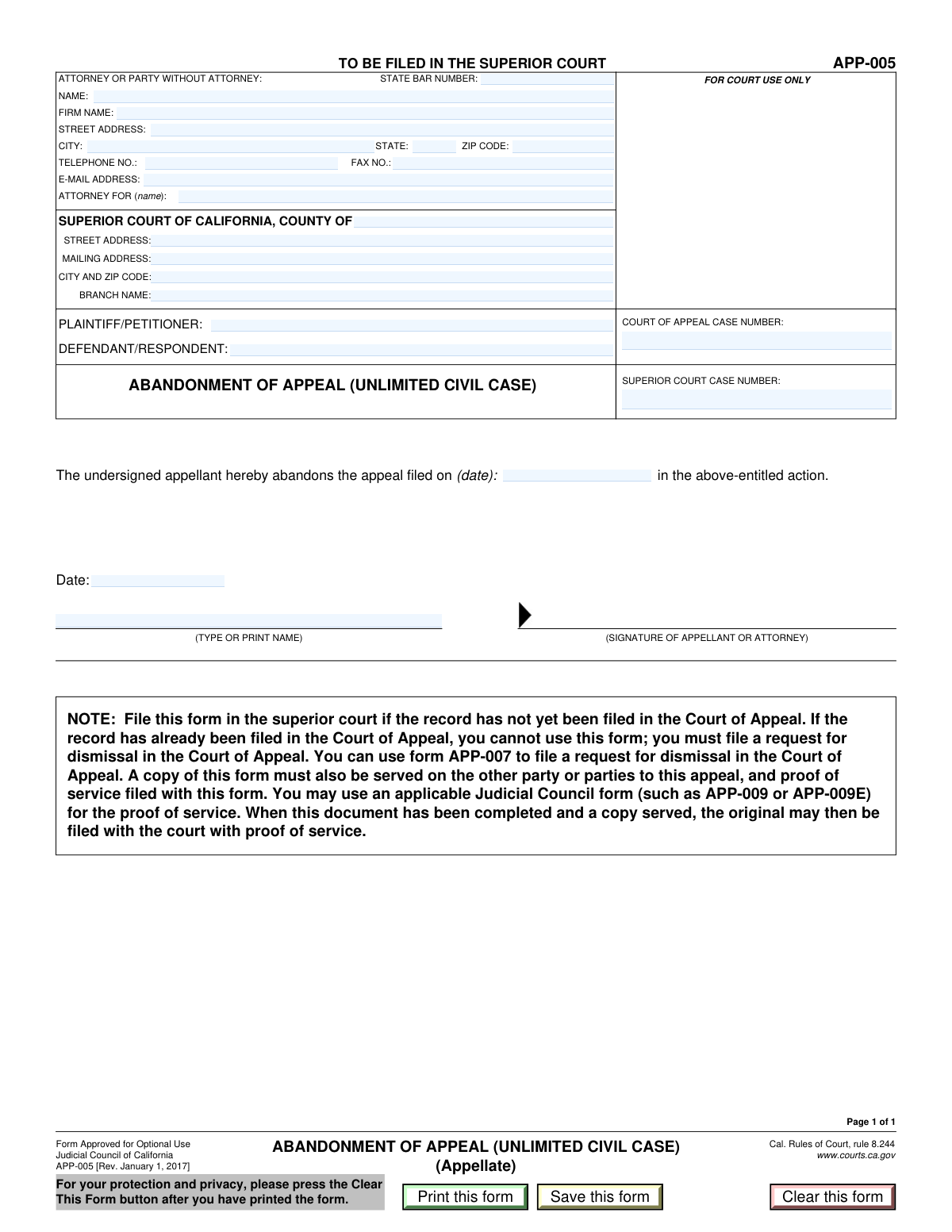
Yes! You can use AI to fill out Form APP-005, Abandonment of Appeal (Unlimited Civil Case)
Form APP-005, Abandonment of Appeal (Unlimited Civil Case), is a legal document filed with the California Court of Appeal to notify the court that the appellant is no longer pursuing their appeal. Filing this form is important as it officially terminates the appellate proceedings, allowing the superior court's judgment to become final. Today this form can be filled out quickly and accurately using AI-powered services like Instafill.ai, which can also convert non-fillable PDF versions into interactive fillable forms.
Our AI automatically handles information lookup, data retrieval, formatting, and form filling.
It takes less than a minute to fill out APP-005 using our AI form filling.
Securely upload your data. Information is encrypted in transit and deleted immediately after the form is filled out.
Form specifications
| Form name: | Form APP-005, Abandonment of Appeal (Unlimited Civil Case) |
| Number of fields: | 26 |
| Number of pages: | 1 |
| Language: | English |
| Categories: | ABA forms, civil appeal forms |
Instafill Demo: How to fill out PDF forms in seconds with AI
How to Fill Out APP-005 Online for Free in 2026
Are you looking to fill out a APP-005 form online quickly and accurately? Instafill.ai offers the #1 AI-powered PDF filling software of 2026, allowing you to complete your APP-005 form in just 37 seconds or less.
Follow these steps to fill out your APP-005 form online using Instafill.ai:
- 1 Navigate to Instafill.ai and upload your Form APP-005 or select it from the template library.
- 2 Provide your information as the attorney or self-represented party, including your name, State Bar number (if applicable), address, and contact details.
- 3 Enter the case details, including the Court of Appeal and Superior Court case numbers, and identify the specific Superior Court by county and branch.
- 4 Clearly identify the parties involved by entering the full names of the Plaintiff/Petitioner and the Defendant/Respondent.
- 5 Complete the abandonment declaration section by providing the date the appeal was originally filed.
- 6 Date the declaration and provide your printed name. Instafill.ai allows for easy digital signing before you download the completed form.
- 7 Review all the information for accuracy, then download the completed, ready-to-file Form APP-005.
Our AI-powered system ensures each field is filled out correctly, reducing errors and saving you time.
Why Choose Instafill.ai for Your Fillable APP-005 Form?
Speed
Complete your APP-005 in as little as 37 seconds.
Up-to-Date
Always use the latest 2026 APP-005 form version.
Cost-effective
No need to hire expensive lawyers.
Accuracy
Our AI performs 10 compliance checks to ensure your form is error-free.
Security
Your personal information is protected with bank-level encryption.
Frequently Asked Questions About Form APP-005
This form is used to officially declare that you are voluntarily withdrawing, or 'abandoning,' an appeal that you have filed with the California Court of Appeal.
The appellant, who is the party that originally filed the appeal, or their attorney must complete and sign this form to formally end the appeal process.
These numbers are located on previous court notices and documents related to your case. The Court of Appeal case number is assigned after the appeal is filed, while the Superior Court number is from the original trial.
If you are representing yourself, enter your own personal information (name, address, phone number) in this section. You can leave the 'State Bar Number' and 'Firm Name' fields blank.
The Plaintiff or Petitioner is the party who initiated the original lawsuit in the Superior Court. The Defendant or Respondent is the party who was sued or responded to the initial case.
Enter the exact date that your Notice of Appeal was officially filed with the court, which started the appeal.
The 'Declaration Date' is the current date on which you are signing this form to abandon your appeal.
You must file the completed and signed form with the clerk of the Court of Appeal where your case is pending. You should also send a copy to all other parties involved in the case.
Generally, no. Once an appeal is voluntarily abandoned and dismissed by the court, it is considered final and cannot be easily reinstated.
Yes, services like Instafill.ai use AI to help you accurately auto-fill form fields from your saved information, which saves time and reduces the chance of errors.
You can upload the form to the Instafill.ai platform, which allows you to fill in all the fields interactively online. Once completed, you can download the document for printing and filing.
If you have a non-fillable or 'flat' PDF, you can use a service like Instafill.ai. It can convert the document into an interactive, fillable form that you can complete on your computer.
Compliance APP-005
Validation Checks by Instafill.ai
1
Validates Court of Appeal Case Number Format
This check ensures the 'Court of Appeal Case Number' adheres to the specific alphanumeric format required by the court system. Proper formatting is critical for automated processing and correct case retrieval by court clerks. A failure in this validation would prevent the form from being filed or cause it to be misrouted, delaying the legal process.
2
Ensures State Bar Number is a Valid Numeric Identifier
This validation verifies that the 'State Bar Number' field contains only numeric digits and matches the expected length for a valid bar number. This is crucial for accurately identifying and verifying the credentials of the filing attorney. An invalid number could lead to the rejection of the filing or questions about the attorney's authority to act.
3
Requires Full Name for Attorney or Party
This check confirms that the 'Name' field under 'Attorney or Party Information' is not empty. The full name of the individual submitting the form is a fundamental requirement for legal documents to identify the responsible party. If this field is left blank, the form is considered incomplete and cannot be processed, as the identity of the filer is unknown.
4
Validates Attorney/Party Zip Code Format
This validation ensures the 'Zip Code' provided for the attorney or party is in a valid 5-digit or 9-digit (ZIP+4) format. A correct zip code is essential for mail delivery and verifying the provided address. An incorrect format can lead to returned mail and communication failures, jeopardizing timely notice and correspondence.
5
Verifies Standard Email Address Format
This check confirms that the 'Email Address' field contains a value that follows the standard '[email protected]' format. As email is a primary method for official court communication and electronic service, a valid address is mandatory for case notifications. An invalid email format would prevent the filer from receiving critical updates and documents.
6
Checks for Logical Date Sequence
This validation compares the 'Appeal Filed Date' with the 'Declaration Date' to ensure the declaration date is on or after the appeal filed date. An appeal cannot be abandoned before it has been filed, so this check prevents logical impossibilities and typographical errors. A failure indicates a data entry error that must be corrected before the declaration can be considered valid.
7
Validates 'Appeal Filed Date' Format
This check ensures that the 'Appeal Filed Date' is entered in a recognizable date format (e.g., MM/DD/YYYY). A standardized date format is necessary for the court's record-keeping and docketing systems to correctly interpret the timeline of the case. An invalid format would cause a processing error and likely result in the form's rejection.
8
Validates 'Declaration Date' Format
This validation verifies that the 'Declaration Date' is a valid date entered in a standard format. This date is legally significant as it marks when the declaration of abandonment was made. If the date is invalid or improperly formatted, it can create ambiguity and lead to the document being rejected by the court.
9
Ensures State is a Valid Two-Letter Abbreviation
This check validates that the 'State' field for the attorney or party contains a valid, two-letter U.S. state or territory abbreviation. Using standardized abbreviations prevents ambiguity and ensures the address data is clean and usable for mailing and record-keeping. An invalid entry could cause address validation to fail and disrupt mail delivery.
10
Requires Both Plaintiff and Defendant Names
This validation ensures that both the 'Plaintiff/Petitioner Name' and 'Defendant/Respondent Name' fields are filled out. These names are the primary identifiers for the case and are essential for the court to correctly file the document under the proper record. Omitting either name would make the form incomplete and un-fileable.
11
Conditional Requirement for 'Attorney For Name'
This check makes the 'Attorney For Name' field required only if a 'State Bar Number' has been provided. If an attorney is filing the form, it is legally necessary to specify which party they represent. This conditional logic ensures completeness without burdening parties who are representing themselves (pro se).
12
Verifies Printed Name Matches Attorney/Party Name
This validation compares the 'Printed Name' in the declaration section with the 'Name' from the Attorney/Party Information section. This ensures the person signing the declaration is the same individual identified as the filer at the beginning of the form. A mismatch could indicate an unauthorized signature and invalidate the declaration.
13
Validates Telephone Number Format
This check ensures the 'Telephone Number' is entered in a standard, recognizable format (e.g., 10 digits, possibly with parentheses, spaces, or hyphens). A valid phone number is a critical piece of contact information for the court and opposing counsel. An improperly formatted number could hinder communication and cause delays if the court needs to contact the filer urgently.
Common Mistakes in Completing APP-005
Filers often confuse the two distinct case number fields and enter the Superior Court number in the Court of Appeal field, or vice versa. This happens due to haste or misunderstanding the different stages of the legal process. Such an error can lead to the document being misfiled or rejected outright, causing significant delays in the legal proceedings. To avoid this, carefully cross-reference the numbers with official court documents for each respective court before entering them.
People frequently enter a generic county courthouse address instead of the specific branch where the case was heard, or they omit the branch name entirely. This information is critical for correctly routing the abandonment notice. An incorrect court location can cause the filing to be sent to the wrong place, leading to rejection and missed deadlines. Always verify the exact branch name and address from the original case filings or the court's official website.
Users may misspell the names of the Plaintiff/Petitioner or Defendant/Respondent, or even reverse their roles on the form. These errors often occur when filling from memory rather than referencing the official case caption. Incorrect party information can create legal ambiguity and may result in the court clerk rejecting the form, requiring a corrected version to be resubmitted. Always copy the names exactly as they appear on previous official court documents.
Parties representing themselves (in pro per) are often unsure what to enter in the 'Attorney For' field, which asks for the name of the party the attorney represents. They might incorrectly re-enter their own name or leave it blank when the court expects a specific designation like 'Self-Represented' or 'In Pro Per'. This ambiguity can cause processing confusion. The best practice is to check local court rules or clearly state your self-represented status as required.
A simple typographical error in an email address, such as typing '.con' instead of '.com' or misspelling a name, is a very common mistake. Since the court and other parties use this email for official notices and correspondence, an incorrect address means you will miss critical updates about your case. Always double-check your email address character by character, as AI-powered form fillers like Instafill.ai can help validate the format but cannot catch spelling errors in the name portion.
Filers may enter dates in an inconsistent format (e.g., DD-MM-YYYY instead of MM/DD/YYYY), or mistakenly enter the current date in the 'Appeal Filed Date' field. The 'Appeal Filed Date' must be the historical date the appeal was initiated, not the date of the current form. These errors can invalidate the declaration or cause confusion, potentially jeopardizing the abandonment process. Carefully check all dates against your records for accuracy and use the required format.
Attorneys sometimes forget to enter their State Bar number or make a typo, while self-represented parties may be confused about whether to write 'N/A' or leave it blank. For attorneys, a missing or incorrect number can lead to rejection as it's a primary identifier for the court. This simple oversight can halt the processing of the document. Attorneys should verify their number, and AI-powered tools like Instafill.ai can often auto-populate this information to prevent such errors.
The person signing the declaration may forget to type or print their name below the signature line, or the printed name may not exactly match the name listed in the 'Attorney or Party Information' section at the top. This inconsistency can raise questions about the identity of the declarant and the validity of the document. Ensure the printed name is present and is identical to the name provided in the contact information section to avoid any processing issues.
Often, filers print a non-fillable or 'flat' PDF and complete it by hand, but illegible handwriting can make critical information like case numbers or names unreadable to the court clerk. This almost always results in the form being rejected, forcing the filer to start over and risk missing deadlines. To prevent this, use a tool like Instafill.ai, which can convert non-fillable PDFs into fillable versions, allowing you to type directly into the fields for perfect clarity.
In an effort to save time, individuals may use abbreviations for firm names (e.g., 'S&C' for 'Smith & Cromwell'), party names (e.g., 'Jon' for 'Jonathan'), or street addresses (e.g., 'St' for 'Street'). Legal documents require full, official names and words to maintain clarity and avoid ambiguity. Using unofficial abbreviations can lead to filing rejections or confusion down the line. Always write out full names and words as they appear on official records.
Saved over 80 hours a year
“I was never sure if my IRS forms like W-9 were filled correctly. Now, I can complete the forms accurately without any external help.”
Kevin Martin Green
Your data stays secure with advanced protection from Instafill and our subprocessors

Robust compliance program
Transparent business model
You’re not the product. You always know where your data is and what it is processed for.
ISO 27001, HIPAA, and GDPR
Our subprocesses adhere to multiple compliance standards, including but not limited to ISO 27001, HIPAA, and GDPR.
Security & privacy by design
We consider security and privacy from the initial design phase of any new service or functionality. It’s not an afterthought, it’s built-in, including support for two-factor authentication (2FA) to further protect your account.
Fill out APP-005 with Instafill.ai
Worried about filling PDFs wrong? Instafill securely fills form-app-005-abandonment-of-appeal-unlimited-civil-case forms, ensuring each field is accurate.