Fill out 529 forms
with AI.
529 forms are essential documents for managing tax-advantaged education savings accounts designed to help families pay for future higher education, K-12 tuition, or apprenticeship programs. Because these plans offer significant tax benefits, the IRS and plan providers require specific documentation to track contributions, verify qualified withdrawals, and manage account ownership. Properly completing these forms is vital for maintaining the tax-exempt status of your investment and ensuring that funds are available and correctly allocated when it comes time to pay for schooling.
By continuing, you acknowledge Instafill's Privacy Policy and agree to get occasional product update and promotional emails.
About 529 forms
Most often, account owners—such as parents, grandparents, or legal guardians—need these forms when life circumstances change or when a student is ready to enroll. This includes common tasks like submitting an account application to start a new fund or using beneficiary change forms when one child finishes school and the remaining assets are passed to a sibling. You might also encounter these documents during more complex transitions, such as managing specific Bright Directions forms for state-sponsored plans, requesting a rollover between different providers, or handling account transfers during a legal separation.
Navigating these financial documents can be time-consuming, but tools like Instafill.ai use AI to fill these forms in under 30 seconds while ensuring your data is handled accurately and securely. This streamlined approach allows you to focus on education planning and financial goals rather than the complexities of manual paperwork.
Every form on this page can be completed without typing. Instafill is form filling software that reads a PDF and fills it for you — including flat and scanned documents that carry no fillable fields at all.
Forms in This Category
The forms in this category have a median Form Complexity Index of 41/100 (Basic), measured across 24 forms by field count, input difficulty, length, conditional logic and structure. See how it is calculated.
- Enterprise-grade security & data encryption
- 99%+ accuracy powered by AI
- 1,000+ forms from all industries
- Complete forms in under 60 seconds
How to Choose the Right Form
Selecting the correct 529 form depends primarily on your specific college savings provider (such as Vanguard, Fidelity, or Bright Directions) and the transaction you need to perform. Most forms fall into these five categories:
Opening or Managing an Account
If you are just starting your savings journey, use the 529 Plan Account Application or provider-specific versions like the Fidelity Institutional CHET Advisor 529 Plan New Account Application. For residents in specific states, you may need regional documents such as the Account Application for Merrill West Virginia Residents - The Hartford SMART529. If you need to authorize a financial advisor or agent, look for the The Vanguard 529 College Savings Plan Agent Authorization/Limited Power of Attorney.
Changing the Beneficiary
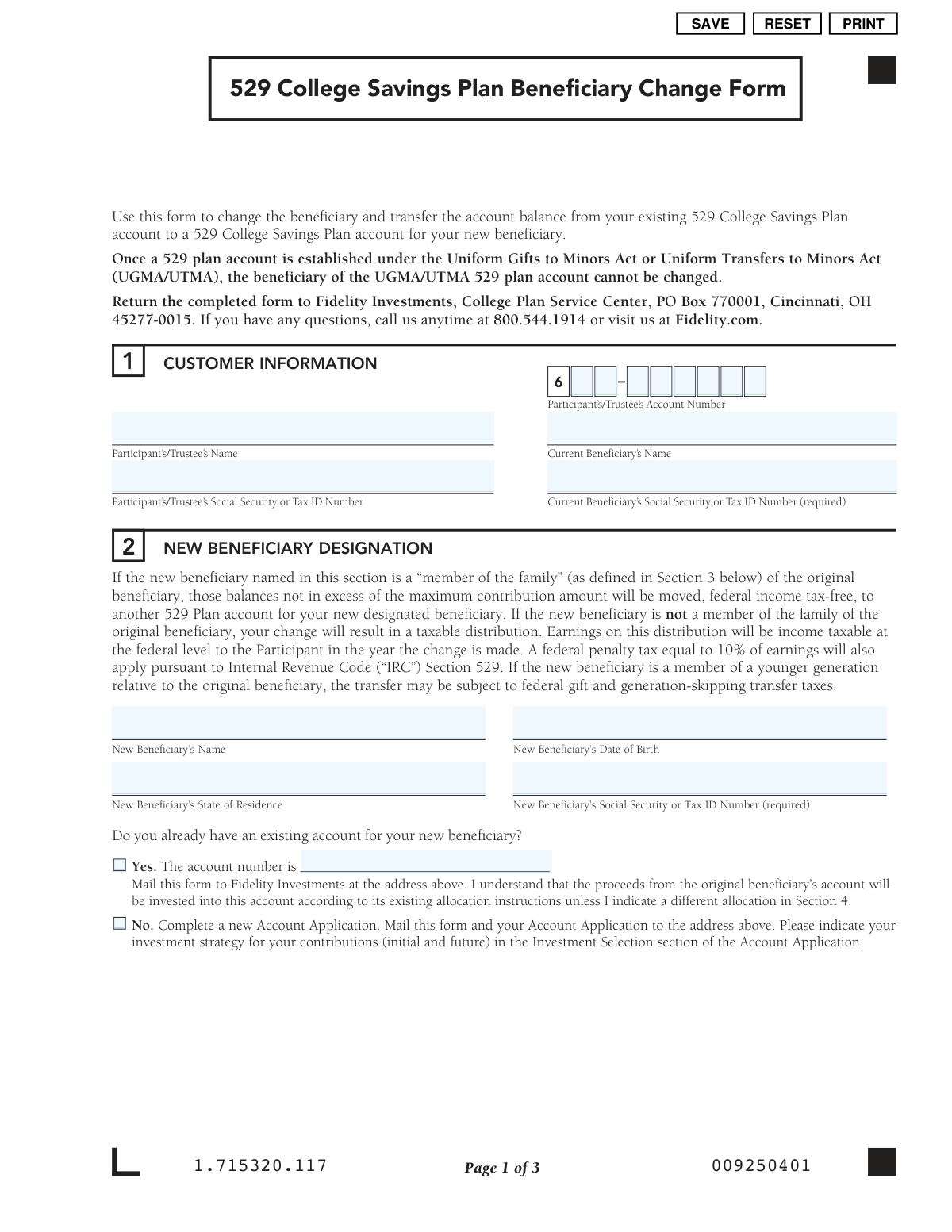
When a student graduates or their plans change, you can often transfer funds to another family member. Use the form specific to your plan manager, such as the Bright Directions 529 Beneficiary Change Form, the Nest 529 Beneficiary Change Form, or the CollegeAdvantage Direct 529 Savings Plan Beneficiary Change Form. These forms ensure the transfer is documented correctly to avoid unintended tax penalties.
Rollovers and Transfers
To move money between different 529 plans or into a Roth IRA, you will need rollover documentation. Use the Rollover Request — 529 College Savings Plan for general moves, or the The Vanguard 529 College Savings Plan Direct Rollover Out to Roth IRA Form if you are utilizing the newer SECURE 2.0 Act provisions. To consolidate assets into one place, the 529 Plan Account Transfer Form is typically the right choice.
Withdrawals and Distributions
When it is time to pay for tuition or room and board, use a withdrawal request. Options include the Fidelity Investments Withdrawals—529 College Savings Plan or the NextGen 529 Client Direct Series Withdrawal Request Form. These forms help you categorize the distribution as a qualified education expense.
Legal and Life Events
Special circumstances require specific legal filings. For dividing assets during a legal separation, use the Transfer Due to Divorce — IRA/HSA/529. If an account owner passes away, the The Vanguard 529 College Savings Plan Transfer Due to Death of Account Owner Form is required to transition the account to a successor.
Tips for 529 forms
Double-check all personal identification numbers for the beneficiary before submitting any form. Even a small typo in a Social Security number can cause the plan provider to reject the document or misallocate funds, leading to significant administrative delays.
When using a Beneficiary Change Form, ensure the new recipient meets the IRS definition of a 'member of the family' of the original beneficiary. Transferring funds to an individual who does not meet these criteria can be treated as a non-qualified withdrawal, potentially triggering income taxes and penalties.
Dealing with multiple 529 forms can be time-consuming, but AI-powered tools like Instafill.ai can complete these forms in under 30 seconds with high accuracy. This technology ensures your sensitive financial data stays secure during the process, making it a major time-saver for account owners.
When submitting a Withdrawal Request Form, always maintain a dedicated file of tuition bills, room and board receipts, and required course materials. While the form itself initiates the distribution, you must be prepared to provide this documentation to the IRS to prove the withdrawal was for qualified higher education expenses.
When moving funds between different 529 plans or providers, opt for a direct trustee-to-trustee transfer whenever possible. This method eliminates the risk of missing the 60-day indirect rollover deadline and ensures you do not accidentally trigger a taxable event by receiving the funds personally.
Review the 'Authorization' section of your form early to see if it requires a notary or a Medallion Signature Guarantee. Many forms involving divorce transfers, power of attorney, or high-value withdrawals cannot be processed without these specific types of authentication from a financial institution.
Frequently Asked Questions
529 forms are the legal documents required to manage tax-advantaged education savings accounts. They are used for a variety of tasks, including opening new accounts, changing beneficiaries, requesting withdrawals for tuition, and rolling over funds between different investment plans.
Generally, the account owner (the person who opened the account) is responsible for completing and signing all 529-related forms. While the beneficiary is the person who will eventually use the funds for education, they typically do not have the authority to make changes to the account or authorize distributions.
You should use this form if the original student no longer needs the funds—for example, if they have graduated or received a full scholarship—and you wish to transfer the balance to another family member. It is important to ensure the new beneficiary is a qualifying relative to avoid potential tax consequences or penalties.
Yes, AI tools like Instafill.ai can fill these forms in under 30 seconds by accurately extracting data from your source documents and placing it into the correct fields. This helps eliminate manual entry errors and ensures that complex financial information is recorded correctly for the plan administrator.
While traditional manual completion can take 20 minutes or more, using an AI-powered service can reduce that time to less than 30 seconds. These services can also convert non-fillable PDF versions of 529 forms into interactive, digital documents for easier processing.
To move your savings to a different financial institution, you typically need to submit a Rollover or Transfer form to the new plan provider. You will need to provide details about the existing account, including the current plan's name, account number, and the specific amount you wish to transfer.
To access your funds, you must complete a Withdrawal Request Form and specify whether the distribution is for a qualified education expense, such as tuition, books, or room and board. Most forms allow you to choose whether the check is sent to the account owner, the beneficiary, or directly to the educational institution.
Yes, many states have their own specific forms and plan administrators, such as Bright Directions in Illinois or SMART529 in West Virginia. It is crucial to use the forms provided by your specific plan to ensure that state-level tax benefits and administrative requirements are properly met.
In the event of a divorce, a Transfer Due to Divorce form may be used to divide or transfer account ownership as required by a court decree. These forms are designed to ensure the transfer follows IRS regulations so that the move is not treated as a taxable distribution.
Completed forms should be submitted directly to the plan manager, such as Vanguard, Fidelity, or the specific state agency overseeing the plan. While many providers allow for digital uploads through their secure portals, some may still require you to mail a physical copy with an original signature.
Glossary
- Form Complexity Index
- Instafill’s 0–100 measure of how much effort a form takes to complete, calculated deterministically from the form’s own structure rather than estimated. It combines the number of fillable fields (the largest factor), how difficult those fields are to complete based on their type, the number of pages that contain fields, the amount of conditional “fill-only-if” logic, and how many sections the form is divided into, then adds modifiers for tables and repeating lists, bundled instruction pages, and dense page layouts. A higher score means the form is harder to fill out by hand. The forms in this category have a median Form Complexity Index of 41/100 (Basic). See exactly how it is calculated.
- Beneficiary
- The individual designated by the account owner to use the 529 plan funds for their education; this is usually a student, but can be changed to other eligible family members.
- Qualified Higher Education Expenses (QHEE)
- IRS-approved costs that can be paid for using 529 funds without taxes or penalties, including tuition, fees, books, supplies, and certain room and board costs.
- Rollover
- The transfer of assets from one 529 plan or education savings account to another, which must generally follow specific IRS rules regarding frequency and the 60-day completion window.
- Successor Owner
- A person designated to take over the management and ownership of a 529 account if the original account owner passes away.
- Non-Qualified Withdrawal
- A distribution taken from a 529 account for any reason other than paying for qualified education expenses, typically resulting in income taxes and a 10% federal penalty on the earnings.
- Coverdell Education Savings Account (ESA)
- A separate type of tax-advantaged education savings account that can be rolled over into a 529 plan to consolidate funds for a single beneficiary.
- Member of the Family
- An IRS-defined group of relatives, including siblings, children, and cousins, to whom a 529 account can be transferred without incurring taxes or penalties.
- Limited Power of Attorney (LPOA)
- A legal designation that grants a specific person or financial professional the authority to perform certain actions on a 529 account, such as making inquiries or requesting distributions.