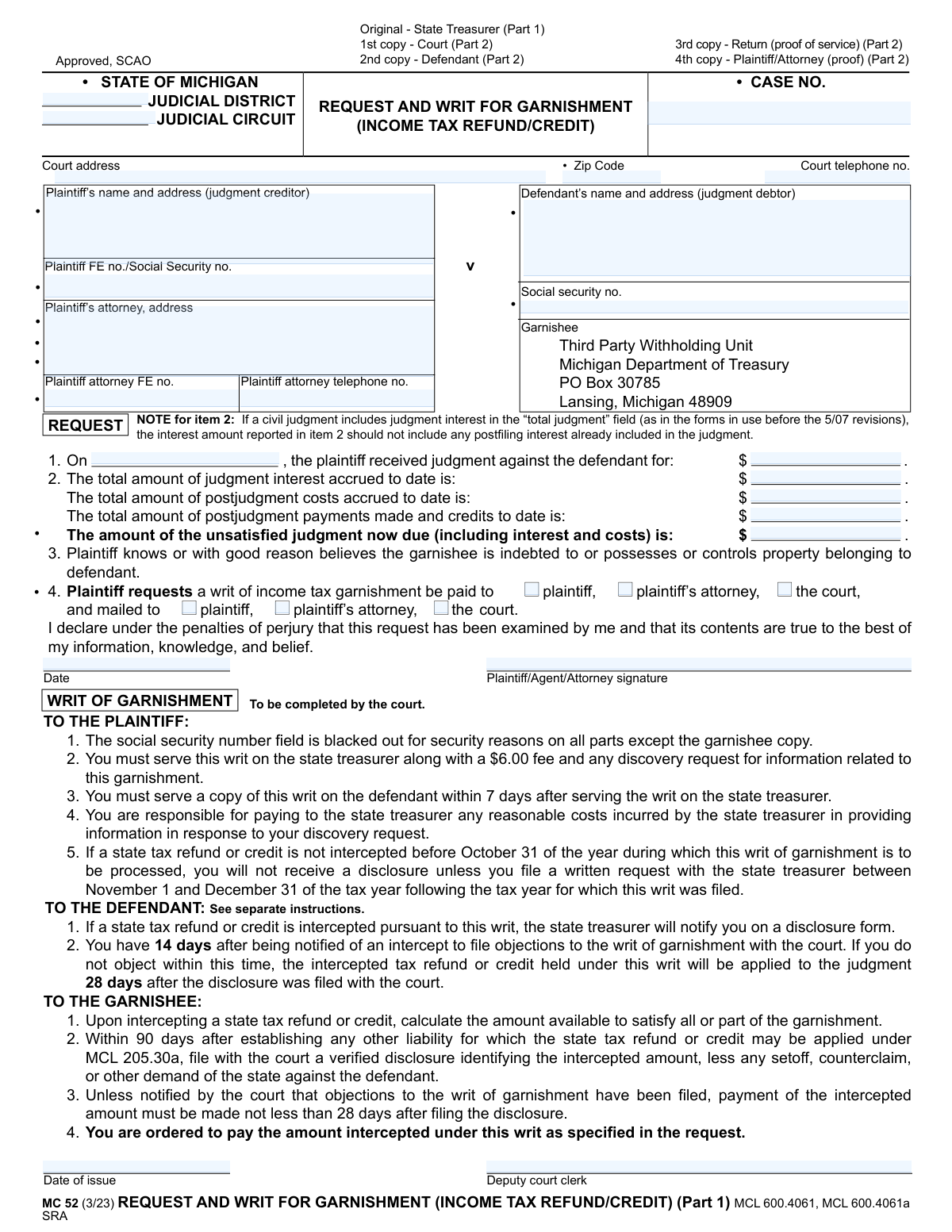
Yes! You can use AI to fill out State of Michigan, Form MC 52, Request and Writ for Garnishment (Income Tax Refund/Credit)

Form MC 52 is a legal instrument used in the State of Michigan by a judgment creditor to request a court-ordered garnishment of a debtor's state income tax refund or credit. This action allows the creditor to intercept these funds to satisfy an unpaid judgment. Completing this form accurately is crucial for enforcing the judgment and requires detailed information about the case, the parties involved, and the outstanding debt. Today, this form can be filled out quickly and accurately using AI-powered services like Instafill.ai, which can also convert non-fillable PDF versions into interactive fillable forms.
Our AI automatically handles information lookup, data retrieval, formatting, and form filling.
It takes less than a minute to fill out MC 52 using our AI form filling.
Securely upload your data. Information is encrypted in transit and deleted immediately after the form is filled out.

Form specifications

Form name: State of Michigan, Form MC 52, Request and Writ for Garnishment (Income Tax Refund/Credit)
Number of fields: 87
Number of pages: 1
Language: English
main-image

Instafill Demo: How to fill out PDF forms in seconds with AI

How to Fill Out MC 52 Online for Free in 2026

Are you looking to fill out a MC 52 form online quickly and accurately? Instafill.ai offers the #1 AI-powered PDF filling software of 2026, allowing you to complete your MC 52 form in just 37 seconds or less.
Follow these steps to fill out your MC 52 form online using Instafill.ai:
  1. 1 Navigate to Instafill.ai and upload your MC 52 form or select it from the template library.
  2. 2 Provide the court and case information, such as the judicial district/circuit, court address, and case number.
  3. 3 Enter the full details for the plaintiff (judgment creditor) and the defendant (judgment debtor), including names, addresses, and identification numbers.
  4. 4 Input the financial details of the judgment, including the original amount, accrued interest, post-judgment costs, and any payments made to calculate the total amount due.
  5. 5 Specify where the garnished funds should be paid and mailed to, and indicate who is signing the request.
  6. 6 Review all the information auto-populated by the AI for accuracy, making any necessary adjustments to ensure all fields are correct.
  7. 7 Sign the form digitally and download the completed Request and Writ for Garnishment, ready for filing with the court and service to the relevant parties.

Our AI-powered system ensures each field is filled out correctly, reducing errors and saving you time.

Why Choose Instafill.ai for Your Fillable MC 52 Form?

Speed

Complete your MC 52 in as little as 37 seconds.

Up-to-Date

Always use the latest 2026 MC 52 form version.

Cost-effective

No need to hire expensive lawyers.

Accuracy

Our AI performs 10 compliance checks to ensure your form is error-free.

Security

Your personal information is protected with bank-level encryption.

Frequently Asked Questions About Form MC 52

This form is used by a person who has won a court judgment (the plaintiff) to legally intercept a defendant's Michigan state income tax refund or credit to pay off the unpaid debt.

The plaintiff (judgment creditor) or their attorney fills out the 'Request' portion of the form. It is then submitted to the court, where a clerk completes the 'Writ of Garnishment' section to make it an official court order.

You must provide the court case number, plaintiff and defendant details, and the specific amounts for the judgment, interest, costs, and payments. The defendant's Social Security number is mandatory for the Michigan Department of Treasury to identify the correct taxpayer.

You must serve the writ on the Michigan Department of Treasury along with a $6.00 fee. You must also serve a copy of the writ on the defendant within 7 days of serving the Treasury.

You have 14 days after being notified of the tax refund interception to file an objection with the court. Valid reasons for objecting include having already paid the judgment, a pending bankruptcy, or if the garnishment was not issued properly.

To calculate this amount, take the original judgment amount, add any post-judgment interest and costs, and then subtract any payments the defendant has already made. The result is the current balance owed.

If no tax refund is intercepted by October 31, the writ may not result in a payment for that year. The plaintiff must file a separate written request with the state treasurer to get a disclosure confirming no funds were available.

Yes, services like Instafill.ai use AI to help you accurately auto-fill form fields with your case and personal information, which saves time and helps prevent errors.

You can upload the PDF of Form MC 52 to the Instafill.ai website. The platform's AI will make the document interactive, allowing you to easily type in your information and even auto-filling details it already knows.

You can use a service like Instafill.ai, which is designed to convert non-fillable PDFs into interactive forms. This allows you to type your information directly into the fields before printing the completed document.

The 'Garnishee' is the entity holding the defendant's funds. For this specific form (MC 52), the garnishee is always the Michigan Department of Treasury, Third Party Withholding Unit.

For security and privacy, the defendant's SSN is hidden on copies provided to the plaintiff and the defendant. The original copy sent to the State Treasurer must contain the full, visible SSN for them to process the garnishment correctly.

After intercepting a refund, the Treasury files a disclosure with the court. If the defendant doesn't file an objection, the payment will be made to the plaintiff no less than 28 days after the disclosure was filed.

Compliance MC 52
Validation Checks by Instafill.ai

1
Defendant's SSN Format and Presence
Checks that the Defendant's Social Security Number is provided and follows the 9-digit format (XXX-XX-XXXX or XXXXXXXXX). This number is the primary identifier used by the Michigan Department of Treasury to locate the correct individual's tax refund. Without a valid SSN, the garnishment cannot be processed, and the request will be rejected by the garnishee.
2
Case Number Presence
Validates that the 'CASE NO.' field is not empty. The case number is a unique identifier for the legal proceeding in the court system and is required for all parties, including the court and the garnishee, to file and track the writ correctly. A missing case number would make it impossible to associate the garnishment with the underlying judgment, leading to rejection.
3
Judgment and Cost Calculation Consistency
Verifies the mathematical accuracy of the amounts in item 2. The validation ensures that the 'Amount of the unsatisfied judgment now due' correctly equals the (Original Judgment Amount + Judgment Interest + Postjudgment Costs) - Postjudgment Payments. This is critical for ensuring the garnishment seeks the legally correct amount; an incorrect calculation could invalidate the writ or lead to legal challenges from the defendant.
4
Original Judgment Date Validity
Ensures the date provided in item 1 ('On [Date], the plaintiff received judgment...') is a valid date and is not in the future. This date establishes the legal basis for the garnishment and the starting point for accruing interest. A request based on a future or invalid judgment date would be legally void and must be rejected.
5
Request Date Chronology
Validates that the signature date next to the 'Plaintiff/Agent/Attorney signature' is on or after the original judgment date from item 1. A request for garnishment cannot predate the judgment it is meant to enforce. This check prevents logically impossible submissions and ensures the procedural timeline is correct.
6
Plaintiff and Defendant Information Completeness
Checks that the name and address fields for both the Plaintiff (judgment creditor) and Defendant (judgment debtor) are fully completed. This information is essential for proper identification of the parties involved and for serving legal notices, particularly to the defendant. Incomplete information could lead to service failures and legal challenges regarding due process.
7
Unsatisfied Judgment Amount Presence
Confirms that the final field, 'The amount of the unsatisfied judgment now due,' contains a positive monetary value. This is the specific amount being requested for garnishment from the tax refund. A zero, negative, or empty value would indicate there is no debt to collect, making the garnishment request moot and invalid.
8
Payee and Mailing Instruction Selection
Verifies that at least one checkbox is selected in item 4 for both who the payment should be 'paid to' and where it should be 'mailed to' (plaintiff, plaintiff's attorney, or the court). These instructions are mandatory for the garnishee (Department of Treasury) to know where to send the intercepted funds. Failure to specify a payee and mailing address will result in the funds being held or the request being returned for clarification.
9
Plaintiff Signature and Date Presence
Ensures that the 'Plaintiff/Agent/Attorney signature' field is signed (or digitally captured) and the adjacent 'Date' field is filled out. The signature, made under penalty of perjury, legally attests to the truthfulness of the request's contents. An unsigned or undated request is not legally valid and will be rejected by the court.
10
Court Telephone Number Format
Validates that the 'Court telephone no.' field contains a valid 10-digit phone number, potentially allowing for common formatting like parentheses and hyphens. This number is important for the plaintiff, defendant, or garnishee if they need to contact the court for information regarding the case. An invalid number hinders communication and can delay the process if issues arise.
11
Plaintiff Identifier Presence
Checks that either a Federal Employment (FE) number or a Social Security number is provided for the plaintiff. This identifier is required for the court and the garnishee to properly identify the judgment creditor for payment and record-keeping purposes. A missing identifier can cause processing delays or payment errors.
12
Proof of Service Consistency
Validates that if the 'I served' checkbox is selected in the Proof of Service section, then a service method (e.g., 'registered or certified mail') and a 'Date and time of service' are also provided. This ensures that a claim of service is substantiated with the necessary details as required by court rules. An incomplete service declaration can invalidate the proof of service, jeopardizing the garnishment process.
13
Monetary Field Format
Ensures all monetary fields (Judgment Amount, Interest, Costs, Payments, etc.) contain only valid numeric characters and at most one decimal point with two decimal places. The values must be formatted as valid currency amounts. This prevents data entry errors and ensures that the financial calculation in item 2 can be performed correctly by the system.
14
Judicial District or Circuit Selection
Verifies that either the 'JUDICIAL DISTRICT' or 'JUDICIAL CIRCUIT' field is filled, corresponding to the court handling the case. This information is fundamental to identifying the correct legal venue for the case. Omitting this information would make it unclear which court has jurisdiction, causing the form to be rejected.

Common Mistakes in Completing MC 52

Miscalculating the Unsatisfied Judgment Amount

Item 2 requires a precise calculation of the current amount owed, including accrued interest, postjudgment costs, and subtracting any payments made. Filers often make errors in calculating daily interest or forget to include all applicable costs, leading to an incorrect total. An inaccurate amount can lead to the writ being challenged by the defendant or rejected by the court, delaying the collection process.

Entering an Incorrect or Incomplete Defendant Social Security Number

The defendant's Social Security Number is the primary identifier used by the Michigan Department of Treasury to locate the correct tax refund. A missing, partial, or incorrect SSN will make it impossible for the garnishee to process the writ, causing the garnishment to fail. It is critical to verify this number from the original case file or other reliable legal documents before submission.

Incorrectly Handling Pre-2007 Judgment Interest

The form includes a specific note about judgments issued before May 2007, which often included interest in the total judgment amount. A common mistake is to calculate and add post-filing interest on top of a judgment that already includes it, effectively double-counting the interest. This inflates the amount due, can lead to legal objections, and requires the form to be refiled correctly.

Omitting the Case Number or Court Information

The Case Number and specific court (Judicial District/Circuit) are essential for linking the garnishment request to the original judgment. Filers sometimes forget to enter this information or transcribe it incorrectly from the original court documents. Without the correct case number, the court clerk cannot file the writ, leading to an automatic rejection and a delay in proceedings.

Forgetting to Sign and Date the Request

A legal request like a writ of garnishment is invalid without a proper signature and date from the plaintiff, their agent, or attorney. This simple oversight is a frequent cause for immediate rejection by the court clerk. Before filing, it is crucial to perform a final review to ensure the signature and date fields are completed, confirming the filer attests to the accuracy of the information provided.

Failing to Specify Payee and Mailing Address in Item 4

Item 4 asks where the garnished funds should be sent. Filers often leave this section incomplete or ambiguous, not clearly stating the payee's name (e.g., the plaintiff or their attorney) and the full, correct mailing address. This omission forces the Department of Treasury or the court to seek clarification, significantly delaying the payment of collected funds.

Incomplete Plaintiff or Defendant Address Information

The form requires the full name and current address for both the plaintiff (creditor) and defendant (debtor). Incomplete information, such as a missing apartment number, zip code, or using an old address for the defendant, can cause major issues. It can lead to service of process failures and prevent the court and garnishee from properly identifying and communicating with the parties involved.

Failure to Follow Proper Service Procedures

The form's instructions detail a multi-step service process: serving the State Treasurer with a $6.00 fee and serving the defendant within 7 days. A common mistake is failing to complete one of these steps, serving them in the wrong order, or failing to file the Proof of Service with the court. Improper service can invalidate the entire garnishment, forcing the plaintiff to start the process over.

Confusing the Plaintiff and Defendant Fields

In the process of filling out the form, individuals can accidentally switch the information for the plaintiff (the one owed money) and the defendant (the one who owes money). This fundamental error renders the document nonsensical and legally void. The writ will be immediately rejected, as it would incorrectly direct the garnishment against the creditor.

Using an Outdated Version of the Form

Court forms are periodically updated to reflect changes in laws and procedures, as indicated by the revision date (e.g., 'MC 52 (3/23)'). Using an old version of the form is a common mistake that leads to rejection. Courts and government agencies often require the most current version to ensure compliance, so filers must always source their forms from the official State Court Administrative Office (SCAO) website.
Saved over 80 hours a year

“I was never sure if my IRS forms like W-9 were filled correctly. Now, I can complete the forms accurately without any external help.”

Kevin Martin Green

Your data stays secure with advanced protection from Instafill and our subprocessors

Robust compliance program

Transparent business model

You’re not the product. You always know where your data is and what it is processed for.

ISO 27001, HIPAA, and GDPR

Our subprocesses adhere to multiple compliance standards, including but not limited to ISO 27001, HIPAA, and GDPR.

Security & privacy by design

We consider security and privacy from the initial design phase of any new service or functionality. It’s not an afterthought, it’s built-in, including support for two-factor authentication (2FA) to further protect your account.

Fill out MC 52 with Instafill.ai

Worried about filling PDFs wrong? Instafill securely fills state-of-michigan-form-mc-52-request-and-writ-for-garnishment-income-tax-refundcredit forms, ensuring each field is accurate.