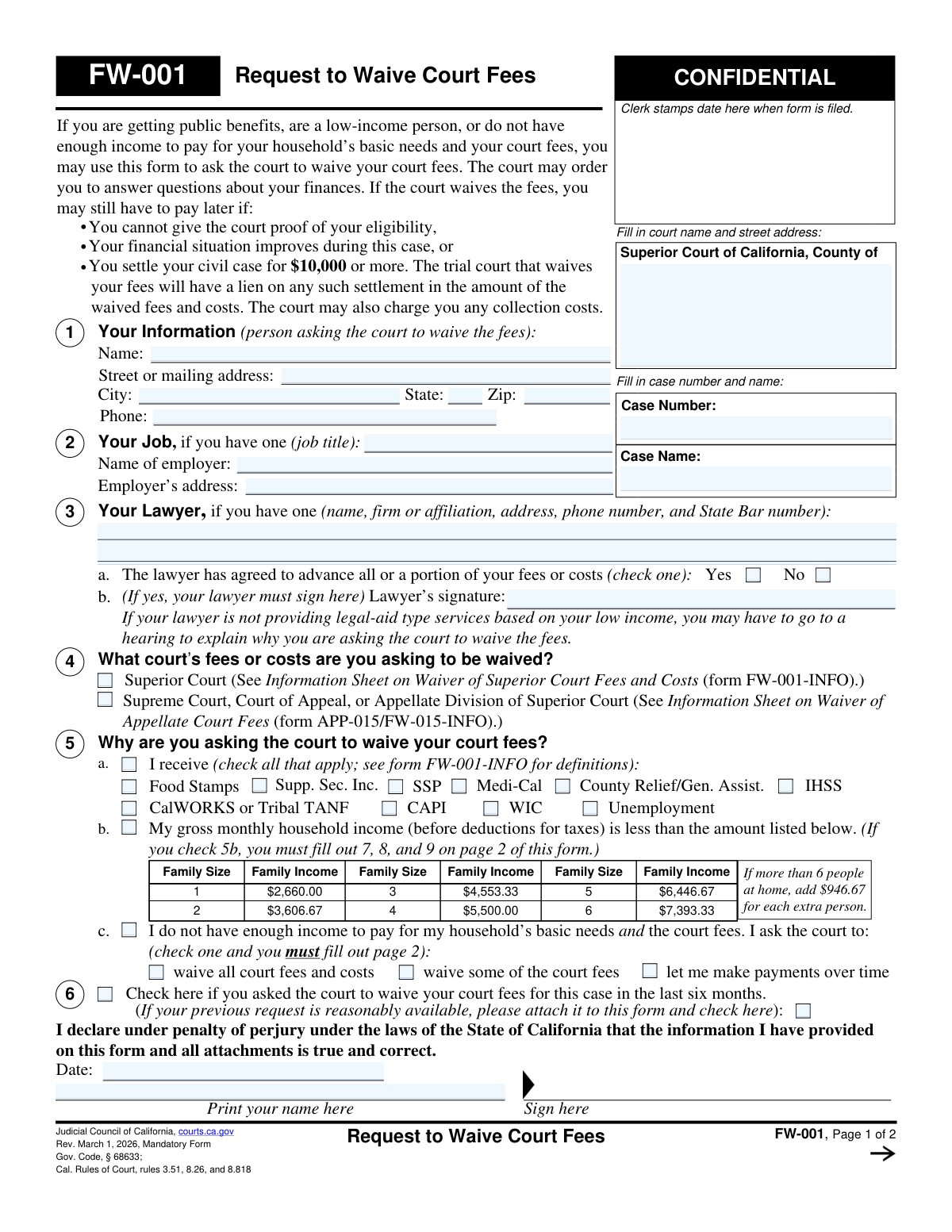
Yes! You can use AI to fill out Form FW-001, Request to Waive Court Fees
Form FW-001, Request to Waive Court Fees, is a legal document submitted to a California court by individuals who cannot afford to pay required court fees. It allows people receiving public benefits, those with low income, or those whose expenses exceed their income to request that the court waive some or all of the costs associated with their case. Today, this form can be filled out quickly and accurately using AI-powered services like Instafill.ai, which can also convert non-fillable PDF versions into interactive fillable forms.
Our AI automatically handles information lookup, data retrieval, formatting, and form filling.
It takes less than a minute to fill out FW-001 using our AI form filling.
Securely upload your data. Information is encrypted in transit and deleted immediately after the form is filled out.
Form specifications
| Form name: | Form FW-001, Request to Waive Court Fees |
| Number of pages: | 2 |
| Language: | English |
| Categories: | court forms, UK court forms |
Instafill Demo: How to fill out PDF forms in seconds with AI
How to Fill Out FW-001 Online for Free in 2026
Are you looking to fill out a FW-001 form online quickly and accurately? Instafill.ai offers the #1 AI-powered PDF filling software of 2026, allowing you to complete your FW-001 form in just 37 seconds or less.
Follow these steps to fill out your FW-001 form online using Instafill.ai:
- 1 Navigate to Instafill.ai and upload your FW-001 form or select it from their template library.
- 2 Provide your personal details, including your name, address, and the relevant court and case information.
- 3 Select the reason for your waiver request by checking the appropriate boxes, such as receipt of public benefits or having an income below the state's threshold.
- 4 If required based on your selection, provide detailed financial information about your monthly income, assets, and expenses for yourself and your household.
- 5 Review all the information automatically populated by the AI to ensure it is accurate and complete.
- 6 Electronically sign and date the declaration under penalty of perjury.
- 7 Download the completed FW-001 form and file it with the appropriate California court as instructed.
Our AI-powered system ensures each field is filled out correctly, reducing errors and saving you time.
Why Choose Instafill.ai for Your Fillable FW-001 Form?
Speed
Complete your FW-001 in as little as 37 seconds.
Up-to-Date
Always use the latest 2026 FW-001 form version.
Cost-effective
No need to hire expensive lawyers.
Accuracy
Our AI performs 10 compliance checks to ensure your form is error-free.
Security
Your personal information is protected with bank-level encryption.
Frequently Asked Questions About Form FW-001
This form is used to ask a California court to waive your court fees because you cannot afford to pay them. You can use it if you receive public benefits, have a low income, or don't have enough money to cover both your basic needs and the court fees.
You may be eligible if you receive certain public benefits like Medi-Cal or Food Stamps, if your gross monthly household income is below the limits shown on the form, or if you can prove you don't have enough income to pay for your household’s basic needs and the court fees.
You only need to fill out page 2 if you are qualifying based on low income (box 5b) or because you cannot afford basic needs and fees (box 5c). If you receive public benefits and check a box in 5a, you do not need to complete page 2.
Section 5a is for those receiving public benefits, which is the simplest way to qualify. Section 5b is for those whose household income is below a specific threshold. Section 5c is for anyone else who feels they cannot afford both their basic living expenses and the court fees.
If your income is not consistent, check the box in section 7. You should then calculate and report your average income over the past 12 months to give the court an accurate picture of your finances.
After you file the form, a judge will review your request and issue an order either granting or denying the fee waiver. The court may also ask for more information or schedule a hearing to discuss your financial situation.
If your ability to pay court fees improves, you are required by law to notify the court within five days. You must use form FW-010, Notice to Court of Improved Financial Situation or Settlement.
Yes, if you settle a civil case for $10,000 or more, you may have to pay back the waived fees. The court will have a lien on the settlement for the amount of the fees that were waived.
Generally, you do not need to attach proof of your income or benefits with the initial request, but the court may order you to provide proof later. If you have filed a fee waiver request in the last six months, you should attach a copy of that previous request if it's available.
You must file the completed and signed form with the court clerk in the courthouse where your case is being heard. Be sure to fill in the court name and address at the top of the form.
Yes, services like Instafill.ai use AI to help you accurately auto-fill form fields, which can save you time and reduce errors. This ensures all required information is entered correctly before you submit the form.
Simply upload the FW-001 form to the Instafill.ai platform. The AI will identify the form fields, and you can answer simple questions to have your information automatically and accurately placed into the correct sections.
You can use a service like Instafill.ai, which can convert flat, non-fillable PDFs into interactive, fillable forms. This allows you to easily type your information directly onto the form online before printing.
Household income includes the gross monthly income of all people living in your home who you support or who help support you. You must list their name, age, relationship to you, and their total monthly income before taxes.
Compliance FW-001
Validation Checks by Instafill.ai
1
Conditional Requirement for Financial Information (Page 2)
This check ensures that the financial information on page 2 is filled out according to the reason selected in section 5. If box 5b is checked, sections 7, 8, and 9 must be completed. If box 5c is checked, the entire page 2 must be completed. This is critical for ensuring the court has the necessary information to evaluate the request based on the applicant's claimed reason for waiver. If the required sections are not completed, the form is considered incomplete and cannot be processed.
2
Ensures a Valid Reason for Waiver is Selected
Validates that the applicant has selected at least one of the primary reasons for the fee waiver request in section 5 (5a, 5b, or 5c). This is the core justification for the request, and without it, the court has no basis to grant the waiver. A failure in this check would mean the form is fundamentally incomplete and must be returned to the applicant for correction.
3
Public Benefits Specification
If the applicant checks box 5a, indicating they receive public benefits, this validation ensures that at least one of the specific benefit checkboxes (e.g., Food Stamps, Medi-Cal, WIC) is also checked. This provides the specific grounds for the waiver under the public benefits category. An incomplete selection prevents the clerk from verifying eligibility and would require clarification from the applicant.
4
Low-Income Threshold Verification
If box 5b is checked, this validation compares the calculated 'Total monthly income and household income' from page 2 against the income limits provided in the table in section 5b. The household size is calculated as 1 (the applicant) plus the number of dependents listed in section 9. This check is crucial to confirm that the applicant's stated income actually qualifies them under the low-income guideline. If their income exceeds the limit, they do not qualify under this reason.
5
Insufficient Income Relief Request
When an applicant checks box 5c, indicating they do not have enough income for basic needs and court fees, this validation ensures they have also checked one of the three sub-options. The applicant must specify whether they are asking the court to 'waive all court fees,' 'waive some of the court fees,' or 'let me make payments over time.' Failure to select a specific request leaves the court uncertain of the desired outcome and makes the application incomplete.
6
Lawyer Fee Advancement Signature Requirement
This check verifies that if the 'Yes' box is checked in section 3a, indicating the lawyer has agreed to advance fees, the 'Lawyer's signature' field is not empty. The lawyer's signature is a required attestation for this arrangement. An absent signature when 'Yes' is checked invalidates that part of the form and may require a hearing or rejection of the form until it is properly signed.
7
Declaration Date and Name Validation
Ensures the 'Date' and 'Print your name here' fields in the declaration section are both filled out. It also validates that the date provided is a valid calendar date and is not in the future. This is a mandatory legal requirement, as the signature and date confirm the applicant is declaring the information true and correct under penalty of perjury. An invalid or missing date or name invalidates the entire submission.
8
Page 2 Header Consistency Check
This validation confirms that the 'Your name' and 'Case Number' fields at the top of page 2 are filled out and match the corresponding information provided on page 1. This is essential for document integrity, ensuring that the financial details on page 2 are correctly associated with the applicant and case. A mismatch could lead to processing errors or incorrect filing.
9
Applicant's Gross Monthly Income Calculation
Verifies that the value in field 8b ('Your total monthly income') is the correct sum of all individual income amounts listed in fields 8a(1) through 8a(4). This ensures mathematical accuracy and prevents simple addition errors from affecting the eligibility determination. If the total is incorrect, the court cannot accurately assess the applicant's personal income.
10
Total Household Income Calculation
This check ensures the value in the 'Total monthly income and household income' field is the correct sum of the applicant's income (field 8b) and the other household members' income (field 9b). This grand total is the primary figure used for income-based eligibility checks. An incorrect sum would lead to a flawed assessment of the household's financial situation.
11
Total Monthly Expenses Calculation
Validates that the 'Total monthly expenses' field at the end of section 11 is the correct sum of all itemized monthly deductions and expenses listed from 11a through 11n. This check confirms the accuracy of the applicant's claimed expenses, which is critical for determining disposable income when the request is based on insufficient funds (reason 5c). An incorrect total could misrepresent the applicant's financial hardship.
12
Asset Value and Debt Consistency
For each asset listed in section 10 (vehicles, real estate, other property), this validation checks that the 'How Much You Still Owe' amount is not greater than the 'Fair Market Value'. While an 'underwater' asset is possible, a significant discrepancy can be a red flag for a data entry error or require further scrutiny. This check helps ensure the applicant's net worth is represented logically.
13
ZIP Code Format Validation
This check ensures that the 'Zip' code field in section 1 contains a valid 5-digit or 9-digit (ZIP+4) numeric format. A valid ZIP code is essential for all mail correspondence from the court to the applicant. An invalid format could result in returned mail and missed deadlines or hearings.
14
Phone Number Format Validation
Verifies that the 'Phone' number provided in section 1 is in a valid format, typically consisting of 10 digits, while allowing for common separators like hyphens or parentheses. A valid phone number is crucial for the court clerk to be able to contact the applicant for any questions or clarifications. An invalid number hinders communication and can delay the case.
15
Monetary Field Numeric Validation
This validation rule applies to all fields on the form that require a dollar amount (e.g., income, expenses, asset values). It checks that the entry is a valid, non-negative number and does not contain text or invalid characters. This ensures that all financial data is machine-readable and can be used in calculations for determining eligibility. Non-numeric entries would cause calculation failures and render the financial sections unusable.
Common Mistakes in Completing FW-001
Applicants often misunderstand the instructions linking their choice in Section 5 to the required sections on page 2. For example, checking box 5b requires filling out sections 7, 8, and 9, while checking 5c requires filling out the entire page. Submitting an incomplete page 2 based on your selection will cause delays or denial of the waiver. To avoid this, carefully read the instructions at the top of page 2 and complete all sections required by your answer in Section 5.
The form explicitly asks for 'gross monthly income' (before taxes and other deductions) in sections 8 and 9. Many people mistakenly enter their net or 'take-home' pay, which underreports their income and can be seen as inaccurate information. This can lead to the request being questioned or rejected. Always use your pre-tax income figures from pay stubs or other official documents to ensure accuracy.
Forgetting to sign and date the declaration on page 1 is one of the most common and easily avoidable errors. An unsigned form is legally invalid and will be immediately rejected by the court clerk, forcing you to refile. Always double-check that you have printed your name, signed, and dated the form in the designated spaces before submitting it.
The form requires several manual calculations, such as total monthly income (8b), total household income (9b), the combined total, and total monthly expenses. Simple arithmetic errors are frequent and can lead to the court questioning the entire application's accuracy, potentially resulting in a denial. To prevent this, use a calculator and double-check all your totals before finalizing the form. AI-powered tools like Instafill.ai can perform these calculations automatically, eliminating the risk of human error.
In Section 3, if you check 'Yes' to indicate your lawyer has agreed to advance fees, the lawyer's signature is mandatory. Applicants or their lawyers often overlook this signature requirement, which makes the section incomplete and can complicate the fee waiver process. If your lawyer is advancing costs, ensure they sign the form in the specified box before you file it.
Section 9 requires listing the income of all other persons in the home who you support or who support you. People often get confused about who to include, sometimes omitting a spouse's income or the income of an adult child who contributes to household expenses. This omission provides an incomplete financial picture and can lead to rejection. Carefully read the definition and include all relevant household members and their gross monthly income.
When listing assets like cars and real estate in Section 10, applicants must provide both the 'Fair Market Value' and the 'How Much You Still Owe'. A common mistake is to confuse these two figures, list only one, or enter the same number in both columns. This inaccuracy can misrepresent your net worth and may cause the court to deny your request. Research the current market value of your assets separately from your loan balance and enter both figures correctly.
The top of page 2 requires you to re-enter your name and case number, but this is frequently forgotten. If the pages of your application get separated, the clerk will have no way to connect your detailed financial information to your case, causing significant processing delays or rejection. To avoid this, make sure to fill in your name and case number on every page of the form as required. Using a tool like Instafill.ai can automatically populate this information across all pages.
If you check box 5c, indicating you don't have enough income for basic needs and court fees, you must also check one of the three sub-options: 'waive all court fees,' 'waive some,' or 'let me make payments.' Applicants sometimes check 5c but forget to specify what they are asking the court to do. This ambiguity forces the court to guess your intent and will likely result in the form being returned for clarification.
The very first section of the form asks for the court name, address, case number, and case name. Applicants sometimes leave this section blank or provide incomplete information, especially the specific case number. Without this information, the court clerk cannot file the document in the correct case file, rendering your submission useless until it is corrected and resubmitted. Always copy this information exactly as it appears on other official court documents for your case.
Saved over 80 hours a year
“I was never sure if my IRS forms like W-9 were filled correctly. Now, I can complete the forms accurately without any external help.”
Kevin Martin Green
Your data stays secure with advanced protection from Instafill and our subprocessors

Robust compliance program
Transparent business model
You’re not the product. You always know where your data is and what it is processed for.
ISO 27001, HIPAA, and GDPR
Our subprocesses adhere to multiple compliance standards, including but not limited to ISO 27001, HIPAA, and GDPR.
Security & privacy by design
We consider security and privacy from the initial design phase of any new service or functionality. It’s not an afterthought, it’s built-in, including support for two-factor authentication (2FA) to further protect your account.
Fill out FW-001 with Instafill.ai
Worried about filling PDFs wrong? Instafill securely fills form-fw-001-request-to-waive-court-fees forms, ensuring each field is accurate.