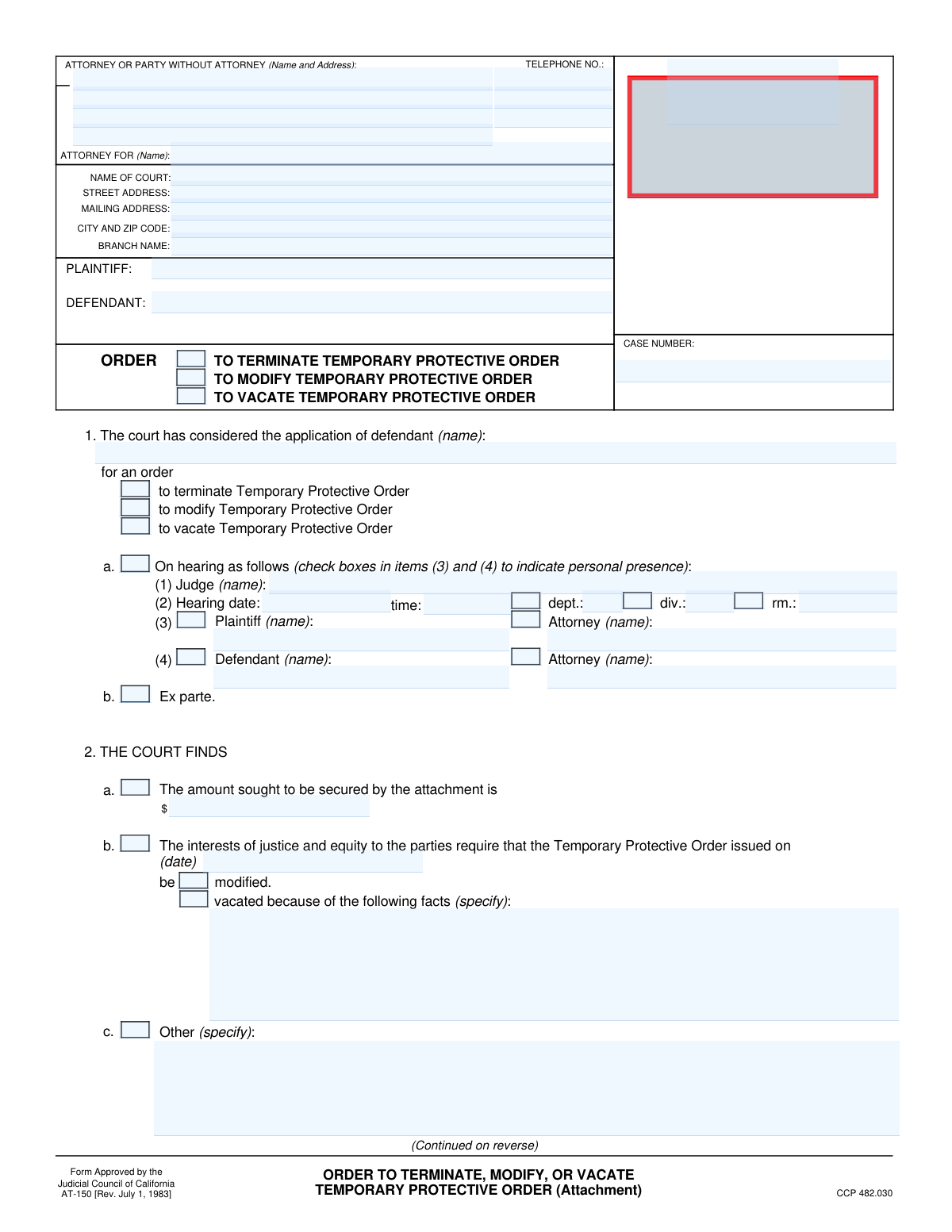
Yes! You can use AI to fill out Order to Terminate, Modify, or Vacate Temporary Protective Order
Form AT-175 is a judicial order issued by a California court in response to an application to change a Temporary Protective Order (TPO). It documents the court's decision to either terminate, vacate, or modify the TPO, detailing the legal grounds and specific changes, such as requiring an undertaking or specifying new terms. This order is crucial for all parties involved as it legally alters the restrictions and protections established by the original TPO. Today, this form can be filled out quickly and accurately using AI-powered services like Instafill.ai, which can also convert non-fillable PDF versions into interactive fillable forms.
Our AI automatically handles information lookup, data retrieval, formatting, and form filling.
It takes less than a minute to fill out AT-175 using our AI form filling.
Securely upload your data. Information is encrypted in transit and deleted immediately after the form is filled out.
Form specifications
| Form name: | Order to Terminate, Modify, or Vacate Temporary Protective Order |
| Number of fields: | 68 |
| Number of pages: | 2 |
| Language: | English |
Instafill Demo: How to fill out PDF forms in seconds with AI
How to Fill Out AT-175 Online for Free in 2026
Are you looking to fill out a AT-175 form online quickly and accurately? Instafill.ai offers the #1 AI-powered PDF filling software of 2026, allowing you to complete your AT-175 form in just 37 seconds or less.
Follow these steps to fill out your AT-175 form online using Instafill.ai:
- 1 Navigate to Instafill.ai and upload your Form AT-175 or select it from the template library.
- 2 Provide the attorney, court, and case information in the designated fields. The AI can assist by auto-filling saved information.
- 3 Identify the plaintiff and defendant and specify the action being ordered for the Temporary Protective Order (terminate, modify, or vacate).
- 4 Detail the court's findings and the specifics of the order, including hearing details, presence of parties, and any financial undertakings or modifications.
- 5 Carefully review all auto-filled and manually entered data for accuracy, ensuring all required boxes are checked and details are correct.
- 6 Finalize and download the completed, ready-to-file Form AT-175.
Our AI-powered system ensures each field is filled out correctly, reducing errors and saving you time.
Why Choose Instafill.ai for Your Fillable AT-175 Form?
Speed
Complete your AT-175 in as little as 37 seconds.
Up-to-Date
Always use the latest 2026 AT-175 form version.
Cost-effective
No need to hire expensive lawyers.
Accuracy
Our AI performs 10 compliance checks to ensure your form is error-free.
Security
Your personal information is protected with bank-level encryption.
Frequently Asked Questions About Form AT-175
This form is a court order used to officially terminate, modify, or vacate a previously issued Temporary Protective Order (TPO). It documents the court's decision following a hearing or an ex parte application.
This form is typically completed by an attorney or court personnel to reflect a judge's ruling. It is the official court order, not the initial application or motion filed by a party.
You will need the full court name, case number, names of the plaintiff and defendant, and the specific details of the judge's order. If a hearing was held, you'll also need the date, time, location, and a list of who was present.
The 'Order Type' checkboxes at the top indicate the request being made to the court (e.g., 'To Terminate...'). The 'Order Action' checkboxes reflect the court's final decision after considering that request.
Checking the 'Ex parte' box signifies that the application for the order was considered by the court with only one party present or notified. This is an exception to the usual process where all parties are present for a hearing.
An undertaking is a form of security, like a bond, paid to the court. In this context, the Temporary Protective Order can be terminated if the defendant files an undertaking for the specified amount.
This field is for specifying the legal and factual reasons the judge has decided to vacate the Temporary Protective Order. You should clearly and concisely state the court's findings that justify this action.
No, you only need to complete the hearing details (judge's name, date, time, attendees) if a hearing actually took place. If the order was made ex parte or without a formal hearing, you would leave this section blank.
No, this form is the final court order, not the application itself. To ask the court to end the TPO, you must file a separate application or motion; this form is then used to document the judge's decision on your request.
Terminating an order usually happens by its own terms or by agreement, such as when an undertaking is filed. Vacating an order means the court has found it was improperly granted or is no longer necessary based on new facts, effectively nullifying it.
Yes, services like Instafill.ai use AI to accurately auto-fill form fields from your saved data, which can save significant time and reduce errors. This is especially useful for repetitive information like attorney and court details.
To fill this form online, you can upload the PDF to Instafill.ai. The platform will make the document interactive, allowing you to type your information directly into the fields and save your progress.
If you have a non-fillable or 'flat' PDF, you can use a tool like Instafill.ai. It can convert the document into an interactive, fillable form that you can complete, save, and print from your computer.
Compliance AT-175
Validation Checks by Instafill.ai
1
Attorney Phone Number Format
This check ensures that the combined 'Attorney Phone Number' parts form a valid 10-digit telephone number. It concatenates the three parts and verifies they are all numeric and total 10 digits. This is crucial for ensuring the attorney can be contacted, and failure would prevent submission until a valid number is entered.
2
Case Number Consistency
Validates that the 'Case Number' entered in the Parties section ('FillText16') is identical to the 'Case Number' entered in the footer section. Case numbers are critical unique identifiers for legal filings, and any discrepancy can lead to misfiling or rejection of the document. If the numbers do not match, the user must correct the entry before proceeding.
3
Mandatory Order Type Selection
Ensures that at least one of the 'Order Type' checkboxes ('To Terminate', 'To Modify', 'To Vacate') is selected. This field defines the primary purpose of the form. If no box is checked, the form's intent is unclear, and it cannot be processed correctly.
4
Conditional Hearing Details Requirement
This check verifies that if the 'On Hearing' checkbox ('CB.0.2.3.1') is selected, then the 'Judge Name', 'Hearing Date', and 'Hearing Time' fields are all filled out. This information is essential for documenting the context of the court's decision. Failure to provide these details when a hearing occurred would result in an incomplete and potentially invalid order.
5
Hearing Date Validity
Validates that the 'Hearing Date' is a real calendar date and is not set in the future. Since this form records an order resulting from a hearing, the date must be in the past or the present day. An invalid or future date would make the legal record nonsensical and requires correction.
6
Conditional Plaintiff Name Presence
This validation ensures that if the 'Plaintiff Presence' checkbox is marked as 'Yes', the corresponding 'Plaintiff Name' field is not empty. This confirms the identity of the party who was present at the hearing. An empty name field when presence is indicated would create an ambiguous and incomplete record of the proceedings.
7
Conditional Attachment Amount Entry
Checks that if the 'Amount Secured by Attachment' box is checked, the 'Attachment Amount' field must contain a valid, positive numerical value. This ensures that a specific monetary amount is recorded when the court makes such a finding. The form would be considered incomplete if the box is checked but no amount is specified.
8
Conditional Justification for Vacating Order
This validation requires the 'Facts for Vacating Order' text field to be filled if the 'Protective Order Vacated' checkbox is selected. The court's reasoning is a mandatory part of the legal record when vacating an order. An empty justification field would invalidate the action and prompt the user to provide the necessary details.
9
Logical Consistency for Order Modification
Ensures that if the 'to modify Temporary Protective Order' checkbox is selected in the 'Order Type' section, then the 'Modified' checkbox in the 'Order Details' section must also be selected and the 'Modification Details' text field must be filled. This cross-field check maintains logical integrity throughout the form. A mismatch indicates an incomplete or contradictory submission that must be resolved.
10
Calculated Checkbox Total Verification
Verifies that the number entered in the 'Total Boxes Checked In Item 3' field accurately reflects the count of checkboxes selected in the 'Order Details' section. This serves as a manual cross-check to prevent accidental omissions or additions in the final order specifications. If the count is incorrect, the user is alerted to review their selections.
11
Court Information Completeness
This check ensures that the 'Name of Court', 'Court Street Address', and 'Court City and Zip Code' fields are all populated. This information is fundamental for identifying the correct jurisdiction and venue for the legal document. Submitting a form without complete court information would lead to immediate rejection.
12
Court Zip Code Format
Validates that the zip code portion of the 'Court City and Zip Code' field is a valid 5-digit or 9-digit (e.g., 12345 or 12345-6789) format. Correct formatting is essential for mail delivery and proper record-keeping within the court system. An invalid format would trigger an error requiring the user to correct the entry.
13
Conditional Undertaking Amount Requirement
This check ensures that if the 'Terminated by Undertaking' checkbox is selected, the 'Undertaking Amount' field must be populated with a valid currency amount. The undertaking amount is a critical detail of the order to terminate. The form is invalid if this condition is set without specifying the required financial amount.
14
Logical Consistency for Order Vacation
Ensures that if the 'to vacate Temporary Protective Order' checkbox is selected in the 'Order Type' section, then the 'Vacated' checkbox in the 'Order Details' section must also be selected. This validation enforces consistency between the stated intent of the form and the final order details. A discrepancy would indicate a user error that needs to be corrected before submission.
Common Mistakes in Completing AT-175
Users frequently confuse the initial request section ('Order Type') with the court's decision section ('Order Action' or 'Order Details'). For example, an attorney filing the application might incorrectly check a box in the 'Order Action' section, which is reserved for the judge's findings. This can invalidate the document or cause it to be misinterpreted by the court clerk, leading to rejection or incorrect processing. To avoid this, carefully read the section headings and only fill out the portions relevant to your role (applicant vs. court).
The form contains many conditional fields, such as the hearing details that are only required if the 'On Hearing' box is checked. A common error is to check the primary box but then forget to fill out the dependent information like the Judge's Name, Hearing Date, and Time. This leaves the form incomplete and ambiguous, which can result in processing delays or the document being returned. Always double-check that for every box you tick, you have provided all the required follow-up information.
People often check a box indicating an action, such as 'Modified' or 'Protective Order Vacated', but then fail to provide the mandatory details in the corresponding text field. For instance, checking 'Modified' without specifying the 'Modification Details' makes the order unenforceable. This omission renders the form legally insufficient and will likely require an amendment. To prevent this, treat the detail fields as mandatory whenever their corresponding checkbox is selected.
Filers often use informal names, abbreviations, or incomplete information when entering the 'Name of Court' and 'Court Branch Name'. For example, writing 'County Courthouse' instead of the full legal name like 'The Superior Court of [State], County of [County Name], [Branch Name] Division'. This mistake can cause the document to be misrouted or rejected by the clerk's office, delaying critical legal proceedings. Always use the official, full name of the court and branch as it appears on other case documents.
A frequent error is entering the wrong date in a specific context, such as putting the current date or the hearing date into the 'Order Issuance Date' field. This field specifically requires the date the original Temporary Protective Order was issued, and entering the wrong date creates an incorrect legal record. To avoid this, carefully read the label for each date field and ensure the date entered corresponds to the event described. AI-powered tools like Instafill.ai can help by cross-referencing case data to populate these fields correctly.
In the 'Attorney For Name' field, attorneys sometimes mistakenly enter their own name or the name of their law firm instead of the client they are representing. The form requires the name of the party (e.g., the plaintiff or defendant) to clearly establish who the attorney is acting on behalf of. This error can cause confusion and may require clarification or correction, delaying the filing. Always enter the full name of the client in this field.
The 'Case Number' is a critical identifier, but it is prone to data entry errors like transposed digits, missing characters, or incorrect formatting. An inaccurate case number is one of the most common reasons for a document to be rejected by the court clerk, as it cannot be matched to the correct file. To prevent this, meticulously copy the case number from an official court document and double-check it for accuracy before submission. Using a tool like Instafill.ai can autofill this from a central case file, eliminating manual errors.
Users may inadvertently select conflicting options in different sections of the form. For example, checking the box 'To Terminate Temporary Protective Order' in the request section, but then checking 'Modified' and providing modification details in the final order section. Such contradictions make the filer's intent and the court's order unclear, leading to rejection or the need for a corrected filing. Review the entire form after completion to ensure all selected options are consistent and logical.
When a phone number is split into three separate fields ('Part 1', 'Part 2', 'Part 3'), users often make mistakes. They might enter the entire number in the first box or mix up the order of the area code, prefix, and line number. This can prevent the court or opposing counsel from being able to contact the attorney. To avoid this, enter only the area code in the first part, the next three digits in the second, and the final four digits in the third. If the form is a non-fillable PDF, a tool like Instafill.ai can convert it and create properly formatted fields to guide data entry.
The field 'Total Boxes Checked In Item 3' requires the user to manually count and enter a number. It is very easy to miscount, especially on a complex multi-part item. An incorrect count can raise a red flag for the court clerk, who may have to pause processing to manually verify the form's contents, causing unnecessary delays. To avoid this, carefully recount all checked boxes within the specified item immediately before finalizing the form.
Saved over 80 hours a year
“I was never sure if my IRS forms like W-9 were filled correctly. Now, I can complete the forms accurately without any external help.”
Kevin Martin Green
Your data stays secure with advanced protection from Instafill and our subprocessors

Robust compliance program
Transparent business model
You’re not the product. You always know where your data is and what it is processed for.
ISO 27001, HIPAA, and GDPR
Our subprocesses adhere to multiple compliance standards, including but not limited to ISO 27001, HIPAA, and GDPR.
Security & privacy by design
We consider security and privacy from the initial design phase of any new service or functionality. It’s not an afterthought, it’s built-in, including support for two-factor authentication (2FA) to further protect your account.
Fill out AT-175 with Instafill.ai
Worried about filling PDFs wrong? Instafill securely fills order-to-terminate-modify-or-vacate-temporary-protective-order forms, ensuring each field is accurate.