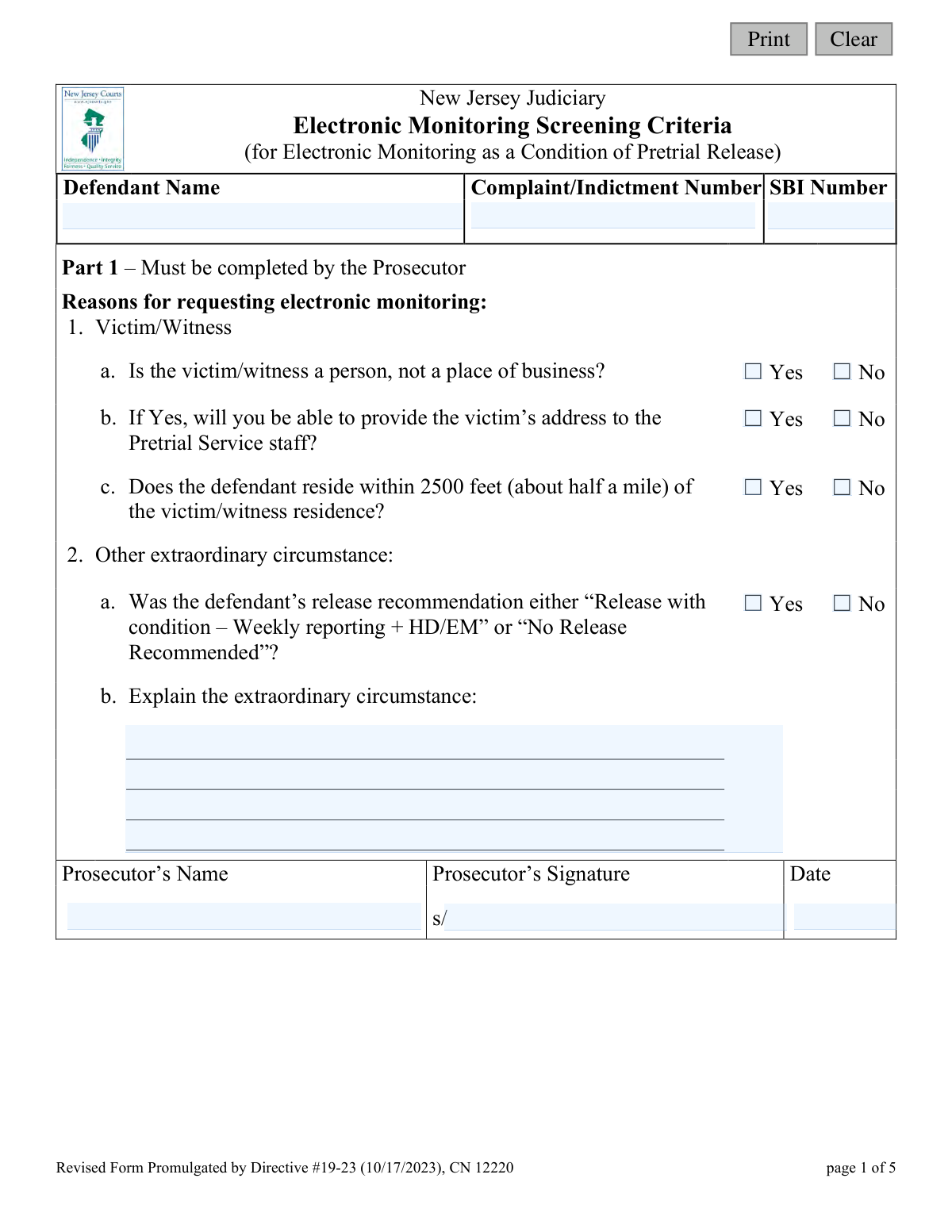
Yes! You can use AI to fill out Electronic Monitoring Screening Criteria (for Electronic Monitoring as a Condition of Pretrial Release)

This form is a critical document in the New Jersey legal system, used by prosecutors and defense attorneys to provide the court with necessary information to decide on electronic monitoring for a defendant awaiting trial. It assesses factors like the defendant's residence stability, employment details, and potential risks to victims or witnesses to ensure monitoring is a viable condition for pretrial release. Today, this form can be filled out quickly and accurately using AI-powered services like Instafill.ai, which can also convert non-fillable PDF versions into interactive fillable forms.
CN 12220 is part of the New Jersey forms category on Instafill.
Our AI automatically handles information lookup, data retrieval, formatting, and form filling.
It takes less than a minute to fill out CN 12220 using our AI form filling.
Securely upload your data. Information is encrypted in transit and deleted immediately after the form is filled out.

Form specifications

Form name: Electronic Monitoring Screening Criteria (for Electronic Monitoring as a Condition of Pretrial Release)
Number of fields: 112
Number of pages: 1
Language: English
main-image

Instafill Demo: How to fill out PDF forms in seconds with AI

How to Fill Out CN 12220 Online for Free in 2026

Are you looking to fill out a CN 12220 form online quickly and accurately? Instafill.ai offers the #1 AI-powered PDF filling software of 2026, allowing you to complete your CN 12220 form in just 37 seconds or less.
Follow these steps to fill out your CN 12220 form online using Instafill.ai:
  1. 1 Navigate to Instafill.ai and upload or select the Electronic Monitoring Screening Criteria form (CN 12220).
  2. 2 Identify your role (Prosecutor or Defense Attorney) and navigate to the correct part of the form (Part 1 for Prosecutor, Part 2 for Defense).
  3. 3 Use the AI assistant to answer the questions in your designated section, providing details about the case, the defendant's residence, employment, and medical needs.
  4. 4 If you are the defense attorney, consult with the defendant to accurately complete all sections regarding their living situation, work, and other required information.
  5. 5 Carefully review all auto-filled information for accuracy and completeness before proceeding.
  6. 6 Electronically sign and date the form in the appropriate fields for the prosecutor, defense attorney, and defendant.
  7. 7 Download, print, or securely submit the completed form as required by the court or Pretrial Services.

Our AI-powered system ensures each field is filled out correctly, reducing errors and saving you time.

Why Choose Instafill.ai for Your Fillable CN 12220 Form?

Speed

Complete your CN 12220 in as little as 37 seconds.

Up-to-Date

Always use the latest 2026 CN 12220 form version.

Cost-effective

No need to hire expensive lawyers.

Accuracy

Our AI performs 10 compliance checks to ensure your form is error-free.

Security

Your personal information is protected with bank-level encryption.

Frequently Asked Questions About Form CN 12220

This form is used by the New Jersey Judiciary to gather information and assess a defendant's suitability for electronic monitoring as a condition of pretrial release.

The form is completed in two parts. Part 1 must be filled out by the Prosecutor, and Part 2 must be completed by the Defense Attorney in consultation with the defendant.

The Prosecutor provides the reasons for requesting electronic monitoring, such as the proximity of the defendant to a victim or other extraordinary circumstances related to the case.

If you are not the homeowner or lessee, you must provide the owner's name and phone number and confirm you have their permission to live there. This ensures the court that your residence is stable and approved.

You must disclose if you reside in a shelter or temporary housing. While a stable, permanent residence is ideal, this information helps the court evaluate the feasibility of monitoring in your specific situation.

You must indicate if your work hours are unstable and confirm if you can notify Pretrial Staff of schedule changes at least 5 business days in advance. Be aware that last-minute shifts are generally not permitted on home detention.

Do not provide specific medical diagnoses. You should only list the frequency and schedule of any appointments that require you to leave your home, as this is needed to establish your release conditions.

For new medical appointments, a formal application must be made to the Court at least 5 business days prior. For attorney visits, your counsel must get approval from Pretrial Services at least 48 hours in advance.

By signing, you are certifying that living at the address you provided does not violate any existing court orders, such as a restraining order or a no-contact order.

You must enter the Defendant's Name, Complaint/Indictment Number, and SBI Number at the top of each of the five pages to ensure the document remains complete and correctly identified.

Yes, services like Instafill.ai use AI to accurately auto-fill form fields, which can save time and help reduce errors for the defense attorney completing the detailed sections.

You can use a service like Instafill.ai to upload the PDF and fill it out electronically. The platform allows you to easily type information into the fields and prepare the document for signatures.

If you have a non-fillable or 'flat' PDF, you can upload it to a platform like Instafill.ai. It can convert the document into an interactive, fillable form that you can complete on your computer.

Compliance CN 12220
Validation Checks by Instafill.ai

1
Ensures Defendant Header Information is Complete
This check verifies that the 'Defendant Name', 'Complaint/Indictment Number', and 'SBI Number' fields at the top of the form are all filled out. This information is critical for uniquely identifying the case and the individual in question. A failure to provide this data would make the form impossible to process and associate with the correct legal file.
2
Validates SBI Number Format
This validation ensures the 'SBI Number' (State Bureau of Investigation Number) is entered in the correct format expected by the New Jersey Judiciary system. An incorrectly formatted SBI number can lead to data mismatches and failures when retrieving or filing case information. If the format is invalid, the user should be prompted to correct it before submission.
3
Conditional Requirement for Victim Address Availability
This check enforces a logical rule in Part 1. If the prosecutor answers 'Yes' to question 1a ('Is the victim/witness a person...'), then question 1b ('will you be able to provide the victim’s address...') must also be answered. This is important for Pretrial Services to assess risk and set up exclusion zones, so knowing if the address is available is a required follow-up.
4
Requires Residence Details if Stable Residence is Indicated
This validation ensures that if the defense attorney answers 'Yes' to question 1 in the Residence Parameters section ('Does the defendant have a stable residence...'), the corresponding 'Address' and 'Phone' fields must be filled in. Electronic monitoring is contingent on having a verifiable address, so this information is mandatory if a stable residence exists. The form would be incomplete and unusable without these details.
5
Validates Format of All Phone Number Fields
This check scans all phone number fields on the form (e.g., 'res1Phone', 'res4Contact', 'employ1Phone') to ensure they conform to a standard US phone number format. Proper formatting is essential for ensuring Pretrial Services staff can successfully contact individuals, homeowners, or employers. An invalid number would prevent necessary communication and verification.
6
Conditional Requirement for Homeowner/Lessee Information
This check is triggered if the answer to question 4 in the Residence section ('Is the defendant a homeowner, renter, or lessee...') is 'No'. If so, the system must verify that the name and phone number of the actual owner/renter/lessee are provided, and that question 5 (permission to live there) is answered. This is crucial for confirming the defendant has legal permission to reside at the location where the monitoring will occur.
7
Requires Employment Details if Defendant is Employed
This validation ensures that if the defense attorney answers 'Yes' to question 1 in the Employment Information section ('Is the defendant currently employed?'), then the 'Business Name', 'Business Address', 'Business Phone', and 'Current Work Schedule' fields are all completed. This information is necessary for establishing and monitoring compliance with work-related release conditions. Failure to provide these details would leave a critical gap in the defendant's supervision plan.
8
Conditional Requirement for Unstable Work Hour Details
This check enforces that if the answer to question 5 in the Employment section ('Does the defendant have stable work hours?') is 'No', the subsequent question about notifying Pretrial Staff of schedule changes must be answered. This is vital for determining the feasibility of monitoring a defendant with an irregular schedule. Answering this follow-up question is mandatory to assess whether the defendant can comply with notification requirements.
9
Requires Medical Schedule if Regular Appointments are Indicated
This validation ensures that if the answer to question 1 in the Medical Information section ('Will the defendant need to leave the residence for regularly scheduled medical appointments/treatment?') is 'Yes', the 'current schedule' text field must be filled out. This information is required to pre-approve scheduled leave from the residence in the release order. Without the schedule, the court cannot make an informed decision on these exceptions.
10
Requires Attorney Contact Information for Visit Verification
This check verifies that if the answer to question 2 in the Attorney Visits section is 'Yes' (indicating understanding of the verification process), then the defense counsel's contact information must be provided. This information is explicitly requested so that Pretrial Services can verify appointments before approving leave. The form is incomplete without this contact detail if the condition is met.
11
Validates All Signature Dates
This check ensures that all date fields associated with signatures ('proscSigDt', 'sigDefAttyDt', 'sigDefDt') contain a valid date that is not in the future. This confirms when the form was signed by each party, which is essential for legal documentation and establishing a timeline. An invalid or future date would compromise the document's integrity.
12
Ensures Consistency of Defendant's Name
This validation compares the 'Defendant Name' field in the header with the 'Defendant’s Name' field in the final signature block. The names must match exactly to ensure the person identified at the beginning of the form is the same person certifying its contents at the end. A mismatch could indicate a critical error and invalidate the entire submission.
13
Logical Check for Stable Residence Viability
This check verifies that the answer to question 1 in the Residence Parameters section ('Does the defendant have a stable residence/address...') is 'Yes'. Since home detention requires a fixed location for monitoring, an answer of 'No' would likely make the defendant ineligible for this program. The system should flag this as a potential ineligibility issue, as it fundamentally conflicts with the purpose of the screening.
14
Completeness of Prosecutor Signature Section
This check ensures that the prosecutor's section at the end of Part 1 is fully completed, including the 'Prosecutor’s Name', 'Prosecutor’s Signature', and 'Date'. The prosecutor's attestation is a required component for requesting electronic monitoring. An incomplete signature block would render the request invalid and halt the process.

Common Mistakes in Completing CN 12220

Inconsistent Information Across Pages

The defendant's name, complaint number, and SBI number are required on all five pages. It is common for this information to be entered incorrectly on one page or missed entirely on subsequent pages, especially when filling out a paper copy. This creates confusion and can delay the processing of the form as officials must reconcile the conflicting information. Using a tool that can propagate data across repeated fields can prevent this error.

Providing an Incomplete or Unverified Residence Address

In Part 2, defendants or their attorneys often provide a partial address, forgetting a unit or apartment number, or entering an incorrect ZIP code. This occurs due to haste or not having the full details on hand. An incomplete address prevents Pretrial Services from verifying the location's suitability for electronic monitoring, potentially delaying or jeopardizing the defendant's release.

Failing to Secure and Document Residence Permission

When the defendant is not the homeowner or lessee, the form requires confirmation that the actual owner/lessee has given permission for them to live there. People often assume permission is granted or forget to collect the owner's name and phone number as required. Without explicit, verifiable consent from the property owner, the proposed residence cannot be approved, which could nullify the request for home detention.

Inaccurately Describing Work Schedule and Stability

Defendants may provide an idealized or simplified work schedule, omitting frequent changes, mandatory overtime, or on-call requirements. This happens because they want to present their employment as stable, but it leads to discrepancies between the approved schedule and reality. Any deviation from the court-ordered schedule is a violation, which can lead to sanctions or the revocation of pretrial release.

Disclosing Specific Medical Information

The medical section explicitly warns not to provide the nature or type of medical appointments, only the frequency and schedule. However, individuals often over-share sensitive health details, believing it will strengthen their case. This creates a record of protected health information that is not required by the court and can introduce privacy complications, while distracting from the logistical information the form actually requests.

Omitting Regularly Scheduled Appointments

When listing medical or attorney appointments, a person might only recall their most frequent visits and forget about less common but still regular ones, like a monthly specialist visit. Any appointment not listed in the initial order requires a formal court application with at least 5 business days' notice. Forgetting to list an appointment upfront creates a significant administrative burden and risks the defendant either missing the appointment or violating their release conditions to attend.

Submitting Vague Requests for 'Other Leave'

In the final section for 'Other requests to leave the home,' applicants often use ambiguous terms like 'errands' for purpose, 'as needed' for frequency, or 'variable' for length. The court cannot approve such undefined requests, as all leave from home detention must be for a specific, justifiable reason with a clear schedule. These vague entries will be denied, preventing the defendant from attending to important, predictable needs like childcare or religious services.

Defense Attorney Forgetting Their Own Contact Information

In the 'Attorney Visits' section, after confirming they understand the verification process, the defense attorney is required to provide their contact information for Pretrial Services. It is a common oversight for the attorney to check the box but then fail to fill in their name and phone number in the space provided. This prevents Pretrial Services from verifying appointments, effectively blocking the defendant from being able to leave their home to meet with their counsel.

Misunderstanding the Strict Definition of Home Detention

Defendants are asked to confirm they understand that home detention means staying home at all times with very limited, pre-approved exceptions. Many check 'Yes' without fully grasping the rigidity of this condition, assuming small trips are permissible. This misunderstanding is a primary cause of violations, which can result in the revocation of pretrial release and a return to custody.

Missing Signatures or Dates

This multi-part form requires signatures from the Prosecutor, the Defense Attorney, and the Defendant, each in a different section. It is very easy to overlook one of these signature lines, especially when the form is passed between multiple parties. An unsigned or undated form is legally incomplete and cannot be filed with the court, causing significant processing delays until all required signatures are collected.
Saved over 80 hours a year

“I was never sure if my IRS forms like W-9 were filled correctly. Now, I can complete the forms accurately without any external help.”

Kevin Martin Green

Your data stays secure with advanced protection from Instafill and our subprocessors

Robust compliance program

Transparent business model

You’re not the product. You always know where your data is and what it is processed for.

ISO 27001, HIPAA, and GDPR

Our subprocesses adhere to multiple compliance standards, including but not limited to ISO 27001, HIPAA, and GDPR.

Security & privacy by design

We consider security and privacy from the initial design phase of any new service or functionality. It’s not an afterthought, it’s built-in, including support for two-factor authentication (2FA) to further protect your account.

Fill out CN 12220 with Instafill.ai

Worried about filling PDFs wrong? Instafill securely fills electronic-monitoring-screening-criteria-for-electronic-monitoring-as-a-condition-of-pretrial-release forms, ensuring each field is accurate.