Yes! You can use AI to fill out Form AT-135, Right to Attach Order and Order for Issuance of Writ of Attachment (After Hearing)
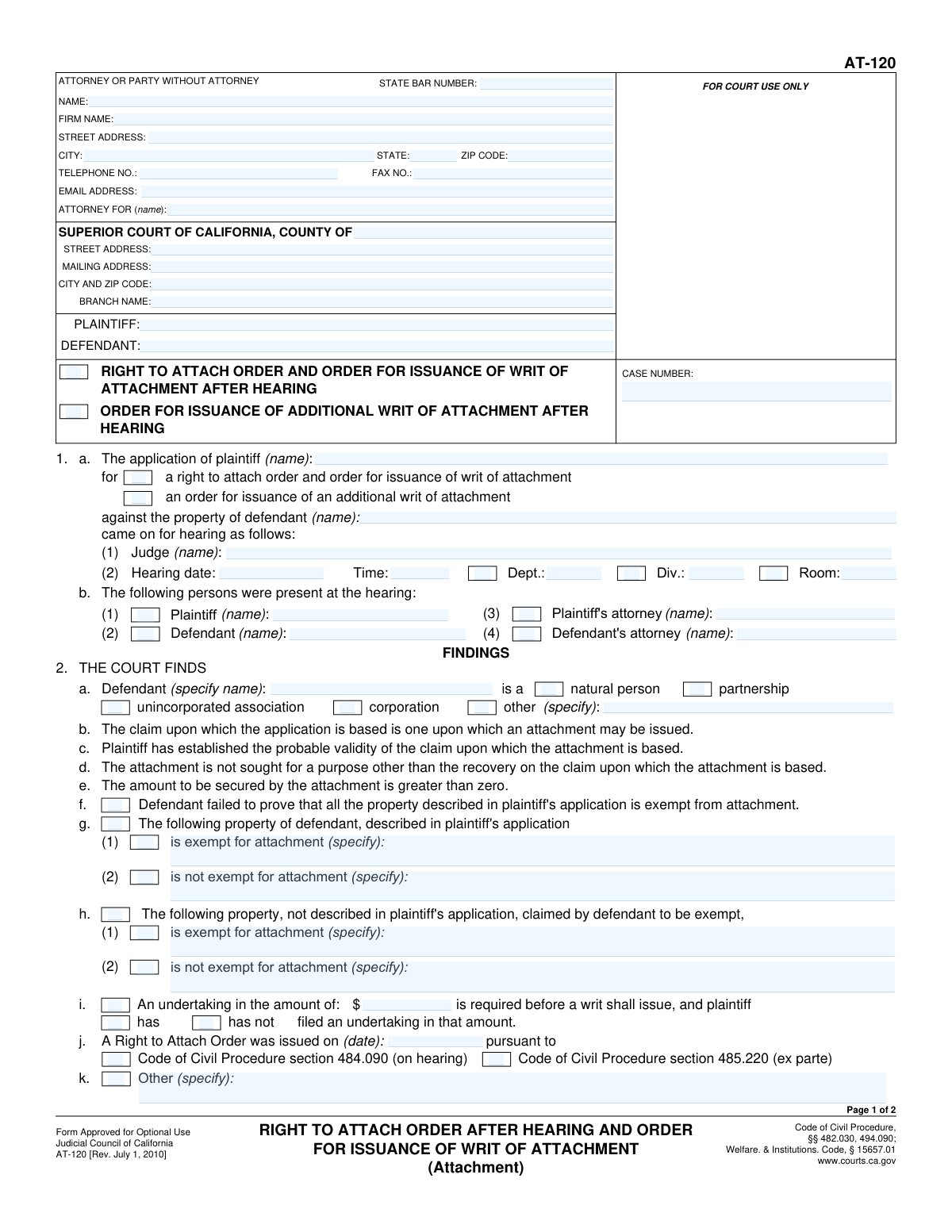
Form AT-135, Right to Attach Order and Order for Issuance of Writ of Attachment, is a legal order issued by a judge in a California Superior Court. It follows a hearing and officially authorizes a plaintiff to have a levying officer seize a defendant's specified property to secure a potential judgment. This order is vital for plaintiffs to ensure assets are available to satisfy their claim if they win the case. Today this form can be filled out quickly and accurately using AI-powered services like Instafill.ai, which can also convert non-fillable PDF versions into interactive fillable forms.
AT-135 is part of the
ACH forms category on Instafill.
Our AI automatically handles information lookup, data retrieval, formatting, and form filling.
It takes less than a minute to fill out AT-135 using our AI form filling.
Securely upload your data. Information is encrypted in transit and deleted immediately after the form is filled out.
Form specifications
| Form name: | Form AT-135, Right to Attach Order and Order for Issuance of Writ of Attachment (After Hearing) |
| Number of fields: | 99 |
| Number of pages: | 2 |
| Language: | English |
Instafill Demo: How to fill out PDF forms in seconds with AI
How to Fill Out AT-135 Online for Free in 2026
Are you looking to fill out a AT-135 form online quickly and accurately? Instafill.ai offers the #1 AI-powered PDF filling software of 2026, allowing you to complete your AT-135 form in just 37 seconds or less.
Follow these steps to fill out your AT-135 form online using Instafill.ai:
- 1 Navigate to Instafill.ai and upload your Form AT-135 or select it from the template library.
- 2 Use the AI assistant to accurately fill in the court information, case number, and the names of the plaintiff and defendant.
- 3 Enter the details of the hearing, including the date, time, location, and a list of all parties and attorneys who were present.
- 4 Document the court's findings by checking the appropriate boxes regarding the defendant's status and the exemption status of their property.
- 5 Specify the details of the court's order, including the total amount of the attachment and any required undertaking (bond).
- 6 Clearly describe the specific property to be attached and indicate if the defendant is ordered to transfer possession of any items to the levying officer.
- 7 Review all the information for completeness and accuracy before downloading the finalized document for the judge's signature and filing with the court clerk.
Our AI-powered system ensures each field is filled out correctly, reducing errors and saving you time.
Why Choose Instafill.ai for Your Fillable AT-135 Form?
Speed
Complete your AT-135 in as little as 37 seconds.
Up-to-Date
Always use the latest 2026 AT-135 form version.
Cost-effective
No need to hire expensive lawyers.
Accuracy
Our AI performs 10 compliance checks to ensure your form is error-free.
Security
Your personal information is protected with bank-level encryption.
Frequently Asked Questions About Form AT-135
This form is used to document a judge's decision after a hearing, officially granting a plaintiff the right to have a defendant's property seized (attached) to secure a potential judgment.
Typically, the plaintiff or their attorney prepares this form for the judge to review and sign. It reflects the orders made by the court during the attachment hearing.
A 'Right to Attach Order' is the initial court order granting the right to seize property. An 'Order for Issuance of Additional Writ' is requested later if the plaintiff needs to attach more of the defendant's property.
An undertaking is a bond or sum of money the plaintiff must provide as financial security. It is required to cover any damages the defendant might suffer if the court later determines the attachment was wrongful.
You will need the case number, court details, full names of all parties, and specific details from the hearing, including the date, judge's name, and the court's findings on property exemptions.
This section records the judge's official findings. You must check the appropriate boxes and describe the property exactly as the court ruled during the hearing regarding its legal protection from seizure.
The law has different rules for attaching property depending on whether the defendant is an individual or a business like a corporation. This information ensures the correct legal standards are applied to the property being attached.
Once signed by the judge, the form becomes an official court order. You can then take this order to the court clerk to have the actual Writ of Attachment issued, which authorizes a levying officer to seize the property.
Yes, services like Instafill.ai use AI to accurately auto-fill form fields with your case information, which saves time and helps prevent common errors.
You can upload the form to the Instafill.ai platform, which makes it an interactive online document. You can then easily type in your information, save your progress, and download the completed PDF.
If you have a non-fillable PDF, you can use a service like Instafill.ai. It can convert flat PDFs into interactive, fillable forms that you can complete on your computer.
This is the specific monetary amount that the judge has authorized for attachment. This figure is based on the probable validity of the plaintiff's claim as determined at the hearing.
This is a direct command from the judge requiring the defendant to turn over specific property or documents of title to the levying officer (like the Sheriff). This facilitates the seizure of assets that are not easily accessible.
The court address, branch name, and case number are listed on all previously filed documents for your case, such as the initial complaint or summons. Ensure this information is copied exactly.
Compliance AT-135
Validation Checks by Instafill.ai
1
Case Number Consistency
This check verifies that the 'Case Number' entered at the top of the form is identical to the 'Case Number (Case Information)' field in the footer. Maintaining consistency is critical for ensuring the document is correctly filed and associated with the proper court case. A mismatch could lead to filing errors, delays, or the document being rejected by the court clerk.
2
Party Name Consistency Across Sections
Validates that the 'Plaintiff Name' and 'Defendant Name' are consistent wherever they appear throughout the form, such as in 'Case Parties', 'Application Details', and 'Plaintiff's Right to Attach Property'. This ensures there is no ambiguity about the parties involved in the order. Inconsistent names can create legal confusion and may invalidate the document.
3
Hearing and Order Date Logical Sequence
This validation ensures that the 'Hearing Date' and 'Order Date' are in a valid date format and that the 'Order Date' is on or after the 'Hearing Date'. An order cannot be issued before the hearing for it has taken place. This check prevents logical impossibilities and ensures the timeline of events is legally sound, and failure would indicate a data entry error that needs correction.
4
Attorney State Bar Number Format
Verifies that the 'State Bar Number' field contains only numeric digits and conforms to the expected length for a California State Bar number. This number is a unique identifier for the attorney, and its accuracy is essential for verification and contact purposes. An invalid format would prevent the court from identifying the attorney of record.
5
Attorney Email Address Format
This check ensures that the value entered in the 'Email Address' field follows the standard '[email protected]' format. Proper email formatting is crucial for electronic communication and service of documents from the court and other parties. An invalid email address would result in failed communications and missed deadlines.
6
Conditional Field Dependency
Ensures that if a checkbox enabling a subsequent field is checked, that subsequent field is not left empty. For example, if the 'Other (specify):' checkbox under 'Additional Findings' is checked, the 'Finding K Details' text field must be filled. This prevents incomplete submissions where an option is selected but the required clarifying information is missing.
7
Mutually Exclusive Defendant Type Selection
This validation confirms that only one defendant type ('natural person', 'partnership', 'corporation', etc.) is selected in the 'Defendant Information' section. A defendant can only be one type of legal entity. Selecting multiple types is a logical contradiction that must be corrected before the form can be processed.
8
Calculated Field Verification for Item 3
This check automatically counts the number of boxes checked within the section labeled 'Item 3' and compares it to the number manually entered in the 'Total Boxes Checked in Item 3' field. This serves as an integrity check to ensure the filer has correctly summarized their selections. A mismatch indicates a clerical error that could cause confusion or misinterpretation of the order.
9
Undertaking Requirement Logic
If the 'Undertaking Required' checkbox is checked, this validation ensures the 'Undertaking Amount' field contains a valid monetary value. It also verifies that exactly one of the two subsequent options, 'Plaintiff Has Filed Undertaking' or 'Plaintiff Has Not Filed Undertaking', is selected. This logic ensures that when an undertaking is required, all necessary related information is provided completely and without contradiction.
10
Attachment Amount Format
Validates that the 'Attachment Amount' under 'Plaintiff's Right to Attach Property' is a valid, positive number formatted as currency. This amount is a critical part of the court's order, specifying the value of property to be attached. An invalid or missing value would render a key component of the order unenforceable.
11
Attorney Representation Link
This check verifies that the name entered in the 'Attorney For Name' field exactly matches either the 'Plaintiff Name' or 'Defendant Name' listed in the 'Case Parties' section. This is crucial for clearly establishing which party the filing attorney represents. A mismatch could lead to confusion about legal representation and potential rejection of the filing.
12
Mutually Exclusive Writ Issuance Timing
Ensures that the 'Forthwith' and 'Upon filing an undertaking' checkboxes under 'Writ of Attachment Issuance' are mutually exclusive. The court will order the writ to be issued either immediately or after a condition is met, but not both. Selecting both options is a logical conflict that must be resolved for the order to be clear.
13
Required Court Information Completeness
This validation ensures that the 'County', 'Court Street Address', and 'Court City and Zip Code' fields are all filled out. This information is essential for identifying the specific court where the order is being filed and is a fundamental requirement for any legal document. Missing information would result in the form being rejected for incompleteness.
14
Conditional Property Description Requirement
Verifies that if a checkbox indicating a property's status is checked (e.g., 'Is exempt for attachment' or 'Natural Person Property'), the corresponding description field (e.g., 'Property Item 1 Description' or 'Natural Person Property Description') is filled. This ensures that any property being discussed in the order is clearly and unambiguously identified. Failure to provide a description makes the finding or order related to that property void for vagueness.
15
Mutually Exclusive Order Type Selection
This check ensures that only one of the primary order type checkboxes is selected: either 'Right to Attach Order and Order for Issuance of Writ of Attachment After Hearing' or 'Order for Issuance of Additional Writ of Attachment After Hearing'. An application is typically for one or the other, not both simultaneously. This prevents ambiguity about the fundamental purpose of the court order being requested or issued.
Common Mistakes in Completing AT-135
Users often enter the case number, plaintiff name, or defendant name in multiple locations, and a typo in one field can create a discrepancy. This happens due to manual data entry and a lack of careful review. Such inconsistencies can lead to the form being rejected by the court clerk, causing significant delays in the attachment process. To avoid this, meticulously cross-reference all repeated fields before submission; AI-powered tools like Instafill.ai can prevent this by auto-populating recurring information consistently across the entire document.
The form contains numerous fields that are only required if a corresponding checkbox is marked (e.g., providing an 'Undertaking Amount' only after checking 'Undertaking Required'). People often check the box but forget to fill in the associated text field, or vice-versa. This renders the selection incomplete and can lead to the order being unenforceable or rejected. Always review each checked box to ensure the required follow-up information is provided. Tools like Instafill.ai can help by highlighting or automatically navigating to required fields based on your selections.
When describing property to be attached in fields like 'Natural Person Property Description', users may enter generic terms like 'car' instead of the required specific details like make, model, and VIN. This ambiguity can make the writ of attachment unenforceable, as the levying officer cannot identify the specific asset. To prevent this, provide as much detail as possible to uniquely identify each asset. If the form is a non-fillable PDF, a tool like Instafill.ai can convert it into a fillable version with expandable text boxes to ensure all necessary details fit.
The form requires the user to manually count and enter the 'Total Boxes Checked in Item 3'. This is a frequent source of error, as people can easily miscount, especially if they make last-minute changes to their selections. An incorrect count can cause the clerk to scrutinize the form more closely or even reject it for being improperly completed. To prevent this, carefully recount the boxes immediately before finalizing the form; some advanced form-filling tools can automate such calculations to eliminate human error.
Several sections offer an 'Other (specify)' option, such as in 'Additional Findings'. A common mistake is to check the 'Other' box without providing the mandatory written explanation in the adjacent field (e.g., 'Finding K Details'). This makes the selection meaningless and fails to provide the court with necessary information, which can result in the order lacking a key finding or directive. If you select 'Other,' you must always provide a clear and concise description in the space provided.
Users must correctly identify whether the defendant is a 'natural person', 'corporation', 'partnership', or other entity. This distinction is critical because the laws governing which assets are subject to attachment differ significantly based on the defendant's legal status. An incorrect classification can lead to an invalid attachment order or attempts to levy exempt property. Always verify the defendant's legal entity type through official records before completing this section.
When indicating who was present at the hearing, users must both check the box for the relevant party (e.g., 'Plaintiff's attorney') and write their full name in the corresponding text field. A frequent error is to perform only one of these two actions, leaving the record incomplete. This can create ambiguity in the official court record of the hearing. To avoid this, ensure that for every checked attendance box, the full name of the attendee is also entered.
The form asks for the type of order being sought in two different sections (the header and 'Application Details'). Users sometimes check 'Right to Attach Order' in one section and 'Order for Issuance of an Additional Writ' in the other, or they check a box in one section but not the other. This contradiction creates confusion about the filer's intent and will likely lead to the form's rejection. Ensure the selections for the order type are identical in all relevant sections of the form.
Attorneys or their staff may forget to enter the State Bar Number or accidentally input an incorrect one. This number is a unique identifier used by the court to verify the attorney's standing and link the document to the correct legal representative. An omission or error can cause filing delays while the clerk's office attempts to verify the attorney's identity. AI-powered tools like Instafill.ai can store and accurately auto-populate this information for recurring users to prevent such mistakes.
In the section regarding the undertaking (a financial guarantee), users may check that an 'Undertaking Required' but then fail to specify its status by checking either 'Plaintiff Has Filed Undertaking' or 'Plaintiff Has Not Filed Undertaking'. This omission leaves the court unclear on the procedural posture and can delay the issuance of the writ. If an undertaking is required, you must also indicate whether it has been filed to provide a complete picture to the court.
Saved over 80 hours a year
“I was never sure if my IRS forms like W-9 were filled correctly. Now, I can complete the forms accurately without any external help.”
Kevin Martin Green
Your data stays secure with advanced protection from Instafill and our subprocessors




Robust compliance program
Transparent business model
You’re not the product. You always know where your data is and what it is processed for.
ISO 27001, HIPAA, and GDPR
Our subprocesses adhere to multiple compliance standards, including but not limited to ISO 27001, HIPAA, and GDPR.
Security & privacy by design
We consider security and privacy from the initial design phase of any new service or functionality. It’s not an afterthought, it’s built-in, including support for two-factor authentication (2FA) to further protect your account.
Fill out AT-135 with Instafill.ai
Worried about filling PDFs wrong? Instafill securely fills form-at-135-right-to-attach-order-and-order-for-issuance-of-writ-of-attachment-after-hearing forms, ensuring each field is accurate.
