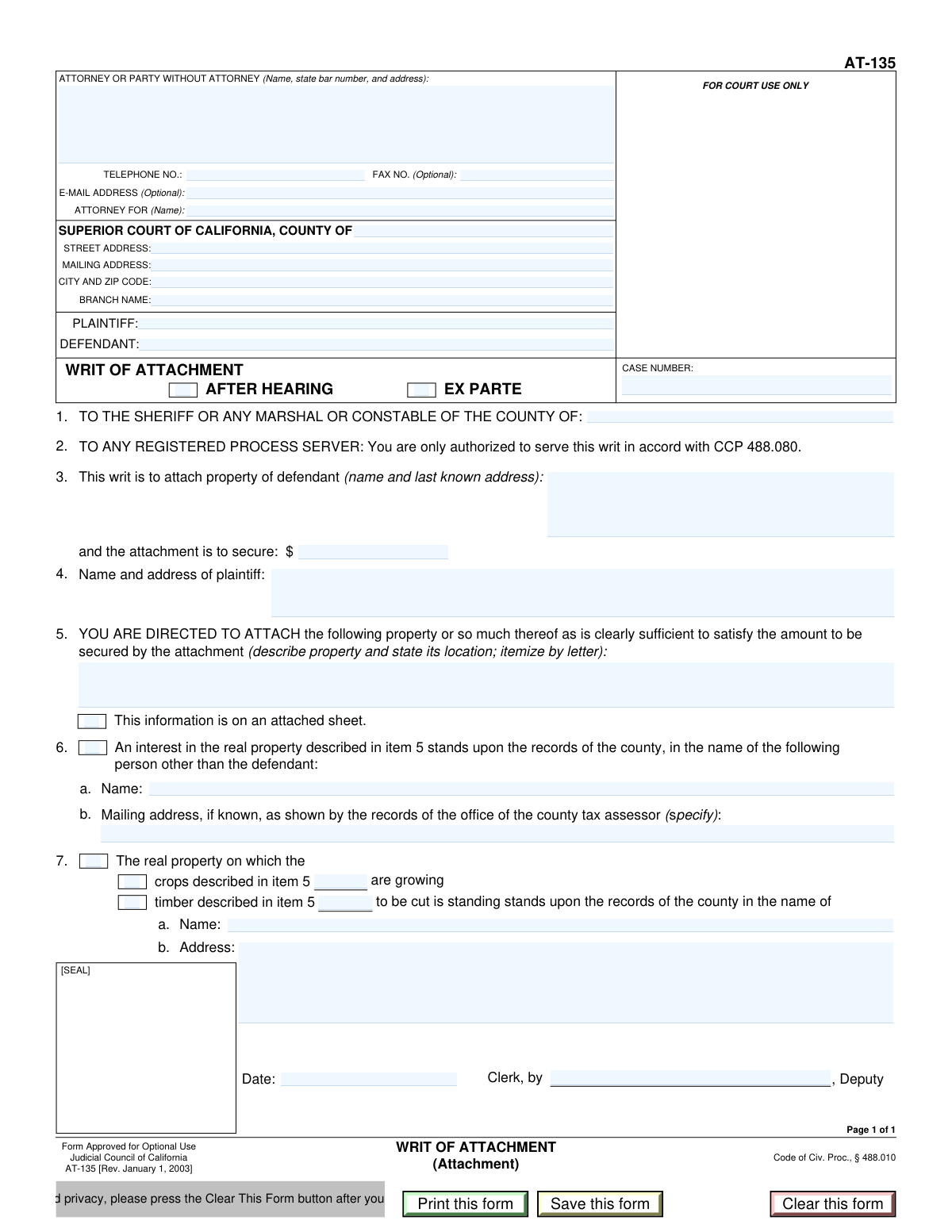
Yes! You can use AI to fill out Form AT-135, Writ of Attachment

Form AT-135, Writ of Attachment, is a court order issued in California civil cases that directs a law enforcement officer to seize a defendant's specified property. This pre-judgment action is vital for plaintiffs as it secures assets to satisfy a potential future judgment, preventing the defendant from hiding or disposing of them. Filling out this detailed legal document requires precision to ensure it is legally enforceable. Today, this form can be filled out quickly and accurately using AI-powered services like Instafill.ai, which can also convert non-fillable PDF versions into interactive fillable forms.
Our AI automatically handles information lookup, data retrieval, formatting, and form filling.
It takes less than a minute to fill out AT-135 using our AI form filling.
Securely upload your data. Information is encrypted in transit and deleted immediately after the form is filled out.

Form specifications

Form name: Form AT-135, Writ of Attachment
Number of fields: 37
Number of pages: 1
Language: English
Categories: ACH forms
main-image

Instafill Demo: How to fill out PDF forms in seconds with AI

How to Fill Out AT-135 Online for Free in 2026

Are you looking to fill out a AT-135 form online quickly and accurately? Instafill.ai offers the #1 AI-powered PDF filling software of 2026, allowing you to complete your AT-135 form in just 37 seconds or less.
Follow these steps to fill out your AT-135 form online using Instafill.ai:
  1. 1 Navigate to Instafill.ai and upload your Form AT-135, or select it from their template library.
  2. 2 Use the AI assistant to input the court information, including the county, court address, and case number.
  3. 3 Enter the full details for all parties, including the plaintiff, defendant, and their respective attorneys.
  4. 4 Specify the type of writ (After Hearing or Ex Parte) and enter the monetary amount the attachment is intended to secure.
  5. 5 Provide a detailed description of the property to be attached, including its location, or indicate that the information is on an attached sheet.
  6. 6 Complete the sections for any third-party interest holders or specific details about real property, such as growing crops or timber, if applicable.
  7. 7 Review all entered information for accuracy before printing the form for the court clerk's signature and issuance.

Our AI-powered system ensures each field is filled out correctly, reducing errors and saving you time.

Why Choose Instafill.ai for Your Fillable AT-135 Form?

Speed

Complete your AT-135 in as little as 37 seconds.

Up-to-Date

Always use the latest 2026 AT-135 form version.

Cost-effective

No need to hire expensive lawyers.

Accuracy

Our AI performs 10 compliance checks to ensure your form is error-free.

Security

Your personal information is protected with bank-level encryption.

Frequently Asked Questions About Form AT-135

This form is a court order directing a sheriff or marshal to seize a defendant's property. It is used by a plaintiff to secure a potential judgment in a lawsuit after the court has approved the attachment.

The plaintiff or their attorney completes the informational sections of the form. The official issuance, including the signature and date, is handled by the court clerk after the form is submitted.

Select 'After Hearing' if the attachment was approved by the court after a scheduled hearing with both parties. Select 'Ex Parte' if the court approved the attachment without prior notice to the defendant, which is less common and requires specific legal grounds.

You will need the court case number, the full names and addresses of the plaintiff and defendant, the specific amount of the attachment security, and a detailed description of the property to be seized.

The description must be specific enough for a sheriff to identify and locate the exact property. If the description is long, check the box indicating the details are on an attached sheet.

You must check the box for 'Third-Party Interest in Real Property' and provide the full name and mailing address of the person listed on the county's property records.

Only complete this section if the real property being attached includes crops or timber. You must describe them and provide the name and address of the official property owner on record.

The recipient is the sheriff, marshal, or constable in the county where the property is located. This is the law enforcement official who will carry out the seizure of the property.

This is the specific dollar amount that the court has authorized you to secure by attaching the defendant's property. This amount is determined by the court in the Right to Attach Order.

No, you should leave the 'Clerk Signature' section blank. This area is for the court clerk or deputy clerk to sign and date when they officially issue the writ.

This is a privacy feature to protect your sensitive information. After you have printed the completed form, clicking this button erases all the data you entered.

Yes, services like Instafill.ai use AI to accurately auto-fill form fields with your case information, which helps save time and reduce the chance of errors.

Upload the PDF form to the Instafill.ai platform. The service will make the fields interactive, allowing you to input your information and have the AI assist with auto-filling repetitive data before you download the completed document.

If you have a non-fillable or 'flat' PDF, you can use a tool like Instafill.ai. It can convert the document into an interactive, fillable form so you can easily type your information into the correct fields.

Compliance AT-135
Validation Checks by Instafill.ai

Common Mistakes in Completing AT-135

Incorrect Court Information

Filers often enter the wrong court branch, an outdated address, or confuse the mailing address with the physical street address. This happens when using old templates or failing to verify current information on the official court website. An incorrect court address can lead to the document being misfiled or rejected, causing significant delays in the legal proceeding. To avoid this, always confirm the specific branch name and addresses on the Superior Court's website for that county before filling out the form.

Vague or Incomplete Property Description

The description of the property to be attached is often too general, lacking the specific details required for legal identification, such as parcel numbers for real estate or serial numbers for vehicles. This ambiguity can render the writ unenforceable, as the sheriff or marshal cannot definitively identify the correct property. To prevent this, provide a legally sufficient description, itemize multiple properties clearly, and check the box to use an attached sheet for full details if the space is insufficient.

Mishandling Attached Sheets

A frequent error is checking the box for 'This information is on an attached sheet' but then forgetting to include the actual attachment with the filing. Conversely, filers may include an attachment without checking the corresponding box on the form, causing confusion. This oversight can lead to the court disregarding the attached information or deeming the form incomplete, potentially invalidating the attachment request. Always double-check that all referenced attachments are included and that the form is marked accordingly.

Using Incorrect or Incomplete Party Names

People sometimes use nicknames, initials, or incomplete versions of the plaintiff's or defendant's name instead of their full legal name as it appears on the original complaint. This discrepancy can create legal challenges regarding the identity of the parties and may lead to the writ being defective. Always use the full, official legal names for all parties involved, exactly as they are listed in the case caption, to ensure the document is legally sound.

Failure to Disclose Third-Party Property Interests

When attaching real property, filers often overlook the critical step of identifying if the property is recorded in the name of someone other than the defendant. Failing to check the 'Third-Party Interest' box and provide the third party's name and address when required is a serious error. This can lead to wrongful attachment claims, legal disputes with the actual property owner, and the potential voiding of the writ. Thoroughly research property records before filing to identify and correctly disclose all interest holders.

Incorrect Case Number Entry

Typos or formatting errors in the case number are extremely common data entry mistakes, especially when transcribing from a flat, non-fillable PDF. Even a single incorrect digit can cause the court clerk's office to reject the filing or misroute the document. To avoid this, carefully proofread the case number against official court documents. AI-powered tools like Instafill.ai can convert non-fillable PDFs into interactive forms and help prevent these errors by saving and accurately auto-filling case information.

Confusing Recipient County with Court County

Filers may mistakenly enter the county where the court is located in the 'Recipient County' field, instead of the county where the property is located and where the writ will be served. The writ must be directed to the sheriff or marshal of the county where the attachment will take place. This error sends the writ to the wrong enforcement agency, making it ineffective and causing major delays. Always verify the location of the property to be attached and enter that specific county for the recipient.

Improperly Filling Out the Clerk of Court's Section

The section for the clerk's signature, date, and deputy clerk's name is exclusively for court use. Parties or their attorneys sometimes mistakenly sign or write in this area, assuming it's another signature line for them. This can lead to the form being rejected, as it has been improperly altered. Leave all fields designated for the 'Clerk' or 'Deputy Clerk' completely blank.

Omitting the Attorney's State Bar Number

Attorneys filing the form on behalf of a client frequently forget to include their State Bar number in the 'Attorney or Party Information' section. This number is a required identifier for practicing attorneys and its omission can cause the clerk to question the filer's standing or delay processing while they verify credentials. Attorneys should ensure their full name, address, and State Bar number are all correctly entered. Using a form-filling tool like Instafill.ai can store this information and prevent such recurring omissions.

Misunderstanding 'Ex Parte' vs. 'After Hearing'

Choosing between an 'Ex Parte' or 'After Hearing' writ of attachment is a critical legal decision, not just a checkbox. Filers who do not understand the distinction may select the wrong option, for example, requesting an ex parte writ without the necessary legal justification. This mistake can lead to immediate rejection by the judge or a successful motion to quash the writ by the opposing party. It is crucial to understand the procedural posture of the case and select the appropriate basis for the writ.
Saved over 80 hours a year

“I was never sure if my IRS forms like W-9 were filled correctly. Now, I can complete the forms accurately without any external help.”

Kevin Martin Green

Your data stays secure with advanced protection from Instafill and our subprocessors

Robust compliance program

Transparent business model

You’re not the product. You always know where your data is and what it is processed for.

ISO 27001, HIPAA, and GDPR

Our subprocesses adhere to multiple compliance standards, including but not limited to ISO 27001, HIPAA, and GDPR.

Security & privacy by design

We consider security and privacy from the initial design phase of any new service or functionality. It’s not an afterthought, it’s built-in, including support for two-factor authentication (2FA) to further protect your account.

Fill out AT-135 with Instafill.ai

Worried about filling PDFs wrong? Instafill securely fills form-at-135-writ-of-attachment forms, ensuring each field is accurate.