Yes! You can use AI to fill out Form CR-119, Order For Income Deduction (Pen. Code, § 1202.42)
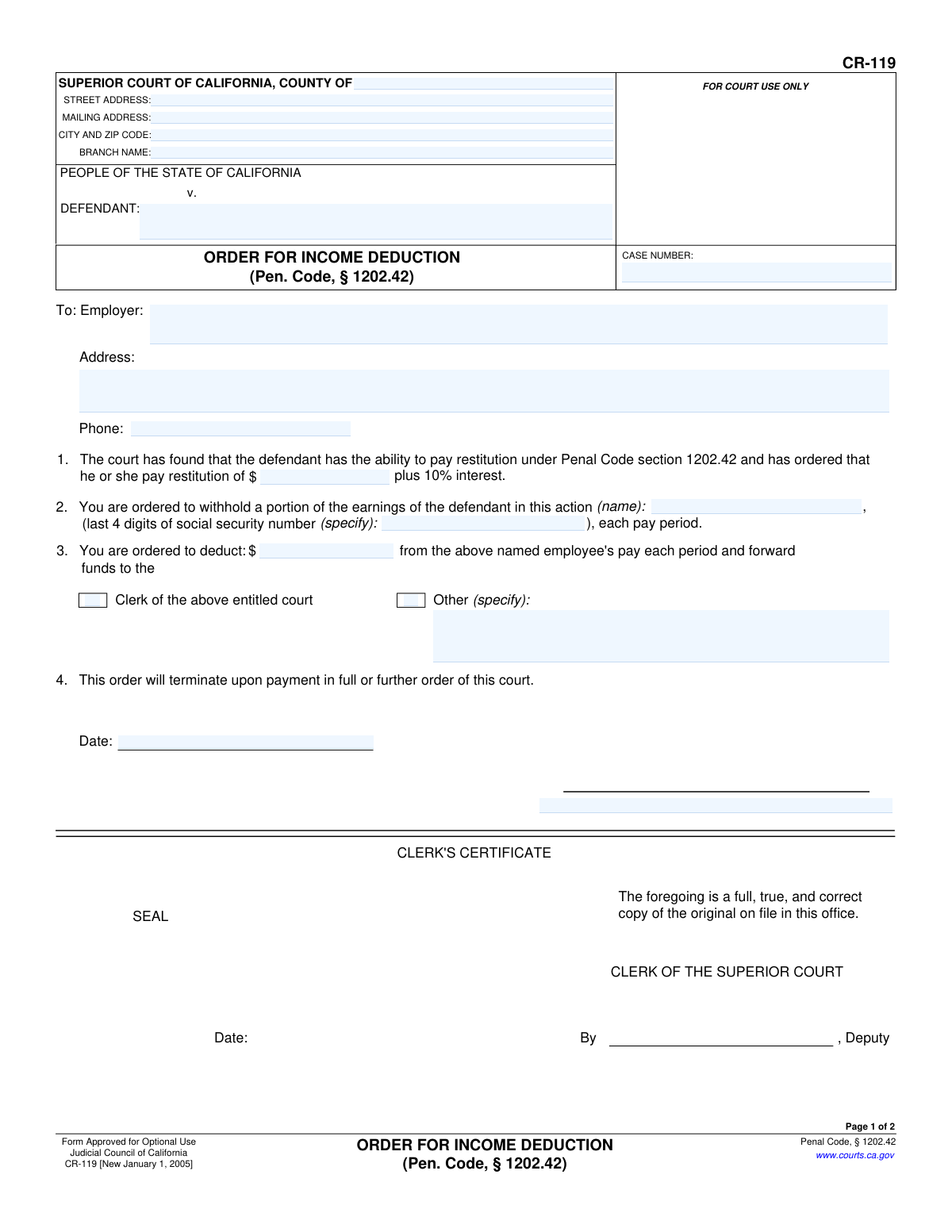
Form CR-119, Order for Income Deduction, is a legal instrument issued by a California Superior Court under Penal Code section 1202.42. It legally compels an employer to withhold a specified portion of a defendant's earnings to satisfy a court-ordered restitution obligation. This ensures that victims of a crime receive the financial compensation they are owed. Today, this form can be filled out quickly and accurately using AI-powered services like Instafill.ai, which can also convert non-fillable PDF versions into interactive fillable forms.
CR-119 is part of the
California court forms category on Instafill.
Our AI automatically handles information lookup, data retrieval, formatting, and form filling.
It takes less than a minute to fill out CR-119 using our AI form filling.
Securely upload your data. Information is encrypted in transit and deleted immediately after the form is filled out.
Form specifications
| Form name: | Form CR-119, Order For Income Deduction (Pen. Code, § 1202.42) |
| Number of fields: | 25 |
| Number of pages: | 1 |
| Language: | English |
Instafill Demo: How to fill out PDF forms in seconds with AI
How to Fill Out CR-119 Online for Free in 2026
Are you looking to fill out a CR-119 form online quickly and accurately? Instafill.ai offers the #1 AI-powered PDF filling software of 2026, allowing you to complete your CR-119 form in just 37 seconds or less.
Follow these steps to fill out your CR-119 form online using Instafill.ai:
- 1 Navigate to Instafill.ai and upload or select Form CR-119, Order For Income Deduction.
- 2 Use the AI assistant to input the Superior Court information, including the county, address, and branch name, along with the specific case number.
- 3 Enter the full name of the defendant and the last four digits of their Social Security number.
- 4 Provide the complete details of the defendant's employer, including their name, address, and phone number.
- 5 Specify the total restitution amount ordered by the court and the exact amount to be deducted from the employee's pay each period.
- 6 Indicate the recipient of the deducted funds, such as the Clerk of the Court or another specified entity.
- 7 Review all the information for accuracy before the form is dated and certified by the court clerk.
Our AI-powered system ensures each field is filled out correctly, reducing errors and saving you time.
Why Choose Instafill.ai for Your Fillable CR-119 Form?
Speed
Complete your CR-119 in as little as 37 seconds.
Up-to-Date
Always use the latest 2026 CR-119 form version.
Cost-effective
No need to hire expensive lawyers.
Accuracy
Our AI performs 10 compliance checks to ensure your form is error-free.
Security
Your personal information is protected with bank-level encryption.
Frequently Asked Questions About Form CR-119
This is a court order issued by a Superior Court of California that legally requires an employer to withhold, or deduct, a portion of an employee's wages to pay for court-ordered restitution.
You received this order because one of your employees has been identified as a defendant who owes restitution. The court has determined they have the ability to pay and is ordering you to facilitate payment directly from their earnings.
You must deduct the specific amount listed in section 3 of the order from the employee's income each pay period. You are then required to send that amount to the Clerk of the Court or the entity specified on the form.
You must implement the income deduction no later than the first payment date that occurs more than 14 days after you were served with this order.
The exact dollar amount to be deducted from the employee's pay each period is specified in section 3 of the order.
Yes, the notice allows you to collect up to five dollars ($5) from the employee's income for the first deduction and up to one dollar ($1) for each deduction after that to reimburse your administrative costs.
If the employee no longer receives income from you, you must notify the court listed on the form. You must also provide the employee's last known address and the name of their new employer, if known.
No, you are legally prohibited from discharging, refusing to employ, or taking any disciplinary action against an employee because of this order. Violating this can result in a civil penalty.
If you receive two or more income deduction orders for the same employee, you must contact the court that issued this order for further instructions on how to prioritize and handle the payments.
The order is binding and you must continue making deductions until you receive further notice from the court or until the total restitution amount is paid in full.
If you fail to deduct the proper amount from the employee's income, your company can be held liable for the amount you should have deducted, plus costs, interest, and reasonable attorney fees.
Yes, services like Instafill.ai use AI to auto-fill form fields, extract key data like deduction amounts and case numbers for your records, and help you manage compliance accurately, saving time.
You can upload the CR-119 PDF to Instafill.ai to automatically populate your internal records or accounting software. This helps ensure the correct case numbers and deduction amounts are used, reducing manual entry errors.
If you have a non-fillable or 'flat' PDF, you can use a service like Instafill.ai. It can convert the document into an interactive, fillable form, making it easier to manage and store the information digitally for your records.
Compliance CR-119
Validation Checks by Instafill.ai
1
Case Number Consistency Across Pages
This check ensures the 'CASE NUMBER' field on page 1 is identical to the 'CASE NUMBER' field on page 2. Maintaining consistency is crucial for document integrity and to prevent processing errors or rejection by the court clerk. If the numbers do not match, the user should be prompted to correct the discrepancy to ensure the entire document refers to the same legal case.
2
Defendant Name Consistency
Validates that the defendant's name is consistent across all instances on the form: the main header ('DEFENDANT'), the name specified in item 2, and the header on page 2. This is critical for legally identifying the correct individual for the income deduction. A mismatch could lead to the order being unenforceable or applied to the wrong person.
3
Required Court Information
Ensures that essential court identification fields, specifically the 'COUNTY OF' and 'CITY AND ZIP CODE', are not empty. This information is necessary to identify the originating jurisdiction and ensure the order is filed and processed by the correct court. Forms submitted without this information would be rejected for being incomplete.
4
Total Restitution Amount Format
Verifies that the total restitution amount entered in item 1 is a valid positive numeric value, formatted as currency (e.g., 1234.56). This is a fundamental figure for the order, and it must be a clear, unambiguous number. The validation prevents non-numeric characters or negative values, which would render the order invalid.
5
Per-Period Deduction Amount Format
Checks that the deduction amount specified in item 3 is a valid positive numeric value, formatted as currency. This amount dictates the employer's withholding obligation each pay period. An invalid format or non-numeric entry would make it impossible for the employer to comply with the order, requiring clarification and resubmission.
6
SSN Last 4 Digits Format
Ensures the 'last 4 digits of social security number' field in item 2 contains exactly four numeric digits. This partial identifier helps the employer confirm the employee's identity without exposing the full SSN. The validation should reject any input that is not four digits long or contains non-numeric characters.
7
Employer Phone Number Format
Validates that the employer's phone number follows a standard format (e.g., (XXX) XXX-XXXX or XXXXXXXXXX). A valid phone number is important for the court or other parties to contact the employer if there are questions about the income deduction. An invalid format could hinder communication and delay the process.
8
Required Employer Information
Verifies that the employer's name and address fields are not empty. This information is legally required to serve the order on the correct entity responsible for withholding income. Failure to provide complete and accurate employer details will make the order unenforceable.
9
Mutually Exclusive Payment Recipient
In item 3, this check ensures that only one of the two checkboxes ('Clerk of the above entitled court' or 'Other') is selected. The funds can only be directed to one recipient. If both or neither are selected, the form is ambiguous and cannot be processed, so the user must be forced to choose one option.
10
Conditional 'Other' Recipient Specification
This validation is linked to the payment recipient checkboxes in item 3. If the 'Other' checkbox is selected, the corresponding 'specify' text field must be filled out. Conversely, if the 'Clerk' checkbox is selected, the 'specify' field should be empty or disabled. This prevents incomplete or ambiguous payment instructions.
11
Order Date Validity
Checks that the 'Date' field is a valid, non-future date in a recognized format (e.g., MM/DD/YYYY). The date signifies when the order was made and is a critical legal component. A future date is logically impossible for a signed order, and an invalid format would cause rejection, so the system should flag these errors for correction.
12
Logical Deduction vs. Total Restitution
Compares the per-period deduction amount (item 3) against the total restitution amount (item 1). This check flags a potential error if the single deduction amount is greater than the total amount owed. While not strictly impossible, it is highly improbable and should trigger a warning to the user to confirm the amounts are correct.
13
Case Number Presence and Format
Verifies that the 'CASE NUMBER' field is not empty and optionally checks that it conforms to a standard format for the jurisdiction (e.g., contains letters, numbers, and hyphens). The case number is the primary identifier for the legal proceeding. A missing or malformed case number makes it impossible to associate the order with its case file, leading to immediate rejection.
14
Completeness of Defendant Identification
Ensures that both the defendant's name and the last 4 digits of their social security number are provided in item 2. Both pieces of information are requested on the form to ensure the employer can accurately identify the correct employee for the deduction. Missing either piece of information increases the risk of error and could lead to the employer rejecting the order for being unclear.
Common Mistakes in Completing CR-119
Users often mistype the case number or omit parts of it, such as prefixes or suffixes specific to the court. This happens due to simple data entry errors or referencing an incorrect document. An inaccurate case number can lead to the order being rejected by the court clerk, misfiled, or cause payments to be misapplied, delaying the restitution process significantly.
A frequent and serious error is entering the total restitution amount from Item 1 into the field for the periodic deduction in Item 3. This mistake occurs from misreading the form, leading the employer to attempt to withhold the entire judgment from a single paycheck, which is illegal and financially devastating for the employee. To avoid this, carefully distinguish between the total amount owed and the specific amount to be deducted 'each pay period'.
In Item 3, the filer must specify where the employer should send the money by checking 'Clerk of the above entitled court' or 'Other'. A common mistake is failing to check either box, or checking 'Other' without providing the specific name and address of the receiving agency. This leaves the employer with no clear instruction on where to remit payment, halting the process until clarification is received from the court.
The order is directed 'To: Employer' but the fields are open text. Filers may enter a partial business name, an incorrect address, or omit the phone number. This can make it impossible to properly serve the order on the correct legal entity, especially in large corporations with multiple locations or subsidiaries, causing significant delays in implementation.
The defendant's name and the last four digits of their Social Security number in Item 2 must exactly match the employer's payroll records. Mistakes include misspellings, using a legal name when the employer uses a common name, or transposing SSN digits. Such errors can lead the employer to apply the deduction to the wrong employee or be unable to identify the correct employee, rendering the order ineffective.
The form requires the full street address, mailing address, city, zip code, and branch name of the Superior Court. People often leave one of these fields blank, assuming the county name is sufficient. This can cause payments and correspondence from the employer to be lost or sent to the wrong court facility, creating accounting nightmares and delaying credit to the defendant's account.
The header on Page 2, which contains the Defendant's name and Case Number, is often overlooked. While it seems redundant, this information is crucial if the pages become separated. An employer receiving only the second page without this identifying information would have no context for the legal notice, leading to confusion and non-compliance.
An Order for Income Deduction is not legally binding until it is dated and certified by the Clerk of the Superior Court. A common process error is circulating a draft version of the form that lacks the official signature, date, and court seal. Employers will rightfully reject an unexecuted order, and no deductions can be made until a properly certified copy is provided.
Since this is an optional use form, it may be printed and filled out by hand. Illegible handwriting for critical numbers, names, or addresses is a frequent problem. This can make the order unenforceable, as an employer cannot be expected to guess the deduction amount or the payee. To prevent this, the form should be filled out electronically. If the original is a non-fillable PDF, tools like Instafill.ai can convert it into a fillable version to ensure clarity.
Item 1 specifies that restitution is for a certain amount 'plus 10% interest'. Filers sometimes only enter the principal dollar amount and forget that the interest clause is a key part of the order. While the employer may not calculate the interest, its inclusion in the order is legally significant for determining when the obligation is paid in full, and its omission can create future legal disputes.
Saved over 80 hours a year
“I was never sure if my IRS forms like W-9 were filled correctly. Now, I can complete the forms accurately without any external help.”
Kevin Martin Green
Your data stays secure with advanced protection from Instafill and our subprocessors
Robust compliance program
Transparent business model
You’re not the product. You always know where your data is and what it is processed for.
ISO 27001, HIPAA, and GDPR
Our subprocesses adhere to multiple compliance standards, including but not limited to ISO 27001, HIPAA, and GDPR.
Security & privacy by design
We consider security and privacy from the initial design phase of any new service or functionality. It’s not an afterthought, it’s built-in, including support for two-factor authentication (2FA) to further protect your account.
Fill out CR-119 with Instafill.ai
Worried about filling PDFs wrong? Instafill securely fills form-cr-119-order-for-income-deduction-pen-code-120242 forms, ensuring each field is accurate.