Yes! You can use AI to fill out Form CR-173, Order for Commitment (Sexually Violent Predator)
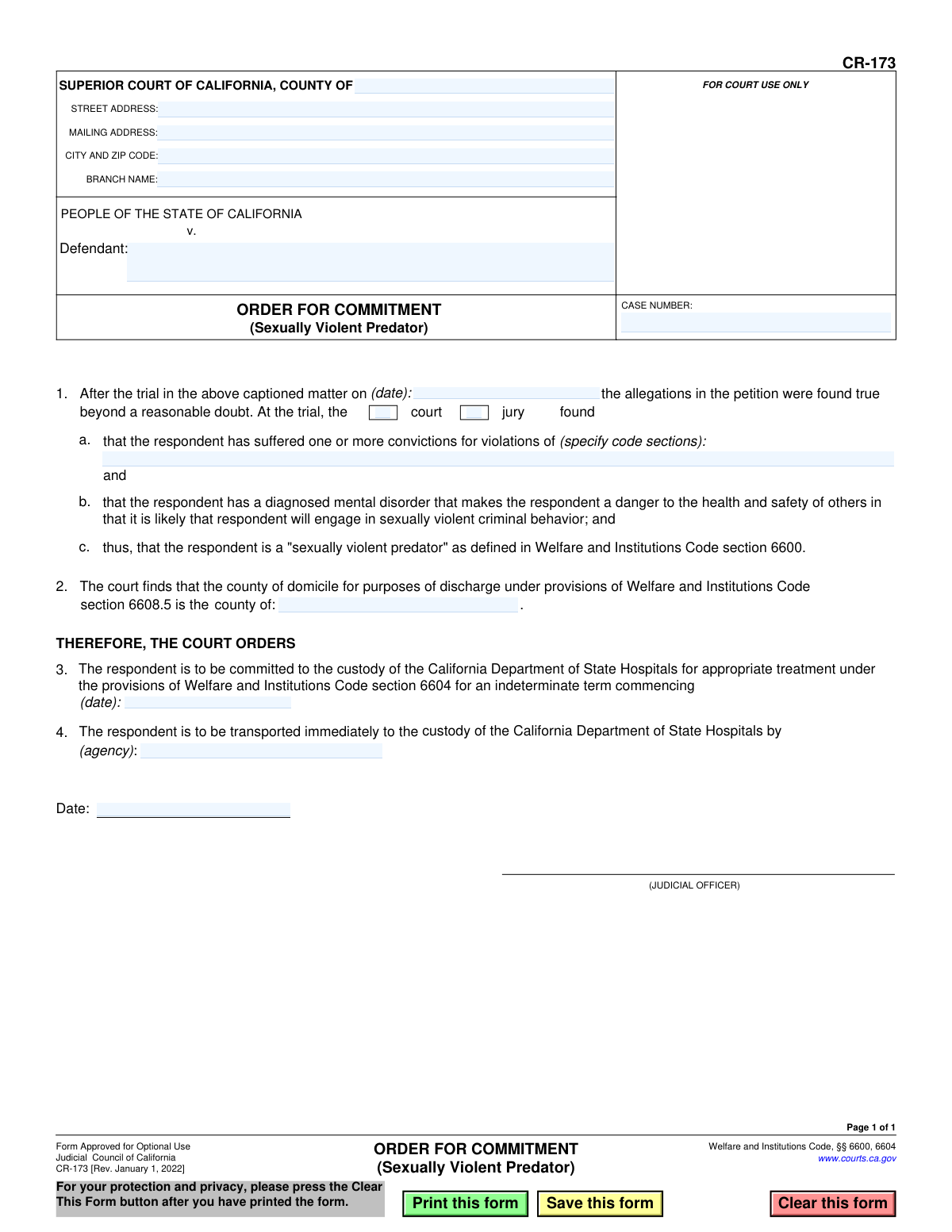
Form CR-173, Order for Commitment (Sexually Violent Predator), is a legal document issued by the Superior Court of California. It formalizes the court's decision to commit an individual, who has been found to be a 'sexually violent predator' under Welfare and Institutions Code section 6600, to the custody of the California Department of State Hospitals for an indeterminate term. This order is issued after a trial where it was proven beyond a reasonable doubt that the person meets the legal criteria for this designation. Today, this form can be filled out quickly and accurately using AI-powered services like Instafill.ai, which can also convert non-fillable PDF versions into interactive fillable forms.
CR-173 is part of the
California court forms category on Instafill.
Our AI automatically handles information lookup, data retrieval, formatting, and form filling.
It takes less than a minute to fill out CR-173 using our AI form filling.
Securely upload your data. Information is encrypted in transit and deleted immediately after the form is filled out.
Form specifications
| Form name: | Form CR-173, Order for Commitment (Sexually Violent Predator) |
| Number of fields: | 20 |
| Number of pages: | 1 |
| Language: | English |
Instafill Demo: How to fill out PDF forms in seconds with AI
How to Fill Out CR-173 Online for Free in 2026
Are you looking to fill out a CR-173 form online quickly and accurately? Instafill.ai offers the #1 AI-powered PDF filling software of 2026, allowing you to complete your CR-173 form in just 37 seconds or less.
Follow these steps to fill out your CR-173 form online using Instafill.ai:
- 1 Navigate to Instafill.ai and upload or select Form CR-173.
- 2 Enter the court information, including the county, address, and branch name, along with the case number.
- 3 Identify the defendant in the case.
- 4 Detail the trial findings, specifying the trial date, whether it was a court or jury trial, and the code sections violated.
- 5 Specify the county of domicile for discharge purposes as determined by the court.
- 6 Input the details of the commitment order, including the commencement date and the agency responsible for transporting the respondent.
- 7 Review all entered information for accuracy before the judicial officer signs and dates the order to finalize the commitment.
Our AI-powered system ensures each field is filled out correctly, reducing errors and saving you time.
Why Choose Instafill.ai for Your Fillable CR-173 Form?
Speed
Complete your CR-173 in as little as 37 seconds.
Up-to-Date
Always use the latest 2026 CR-173 form version.
Cost-effective
No need to hire expensive lawyers.
Accuracy
Our AI performs 10 compliance checks to ensure your form is error-free.
Security
Your personal information is protected with bank-level encryption.
Frequently Asked Questions About Form CR-173
This form is a court order used by a California judge to officially commit an individual to the custody of the Department of State Hospitals after they have been found to be a 'Sexually Violent Predator' (SVP) in a trial.
A judicial officer (a judge) completes and signs this form. It is not an application for the public, but rather a legal order documenting a court's decision.
Before this order is issued, a trial must be held where a court or jury finds beyond a reasonable doubt that the individual meets the legal definition of a Sexually Violent Predator.
An indeterminate term means the commitment does not have a set end date. The individual is committed for treatment until they are determined to no longer be a danger through a separate legal process.
Section 1 requires the date of the trial, whether the finding was made by a court or jury, and the specific code sections of the prior convictions that led to the SVP determination.
The county of domicile is recorded for the purpose of future proceedings related to the individual's potential discharge or conditional release, as specified in the Welfare and Institutions Code.
Once signed, the agency named in Section 4 is ordered to immediately transport the individual to the custody of the California Department of State Hospitals for treatment.
No, this is a civil commitment for treatment of a diagnosed mental disorder, not a criminal sentence for punishment. The commitment is to a state hospital, not a prison.
Copies of the signed order are typically provided to the court, the committed individual and their attorney, the district attorney, and the California Department of State Hospitals.
Yes, services like Instafill.ai can help court staff by using AI to accurately auto-fill standard information like the court address, case number, and party names, saving time and ensuring accuracy.
Court staff can upload Form CR-173 to Instafill.ai, which will make all fields interactive. They can then quickly populate the necessary case details before presenting the completed order to the judge for review and signature.
You can use a service like Instafill.ai, which can convert flat, non-fillable PDFs into interactive forms. This allows you to easily type information directly into the required fields online.
Compliance CR-173
Validation Checks by Instafill.ai
1
Ensures Case Number is Provided
This check verifies that the 'Case Number' field is not empty. The case number is a unique identifier for the legal proceeding and is essential for filing the order correctly and linking it to the case file in the court's record-keeping system. If the case number is missing, the form cannot be processed or filed.
2
Validates Defendant's Name is Entered
This validation ensures that the 'Defendant' field contains a name. An order of commitment is legally binding against a specific individual, so the defendant's name is a mandatory piece of information. Failure to provide a name renders the entire order unenforceable and invalid.
3
Requires Selection of Finder of Fact
This check confirms that either the 'court' or 'jury' checkbox in section 1 is selected. The order must specify whether the findings were made by a judge in a court trial or by a jury. Omitting this information creates legal ambiguity about the trial proceedings, and the form should prompt the user to make a selection.
4
Verifies Trial Date is a Valid Past or Present Date
This validation checks that the trial date in section 1 is a validly formatted date and that it is not in the future. The trial must have already occurred for an order to be issued based on its findings. This prevents logical impossibilities and ensures the chronological integrity of the legal record.
5
Ensures Conviction Code Sections are Specified
This check verifies that the text field in section 1a, for specifying code sections, is not empty. The finding that the respondent is a sexually violent predator is predicated on prior convictions. Listing the specific code sections for these convictions is a mandatory legal requirement for the order's validity.
6
Requires County of Domicile
This validation ensures the 'county of domicile' in section 2 is specified. This information is required under Welfare and Institutions Code section 6608.5 for determining future responsibilities regarding the individual's potential discharge. An omission would complicate future legal and administrative processes.
7
Verifies Commitment Commencement Date
This check ensures the commitment commencement date in section 3 is provided and is a validly formatted date. This date is critical for the California Department of State Hospitals to know when their custody and treatment responsibility begins. An invalid or missing date would cause significant operational and legal problems.
8
Logical Check for Commitment Date
This validation confirms that the commitment commencement date in section 3 is on or after the order's signature date. A person cannot be legally committed before the order authorizing the commitment has been signed by a judicial officer. This check prevents logical and legal errors in the order's timeline.
9
Requires Transporting Agency Name
This check verifies that the name of the transporting agency in section 4 is filled in. The order must clearly delegate the responsibility for transporting the respondent to the Department of State Hospitals. Leaving this field blank creates ambiguity and could delay the execution of the court's order.
10
Validates Signature Date
This validation ensures the 'Date' field in the signature block is filled with a valid date. The signature date marks the moment the order becomes official and legally effective. An undated order is considered incomplete and may be legally invalid.
11
Logical Check for Signature Date vs. Trial Date
This check compares the signature date with the trial date, ensuring the signature date is on or after the trial date. A judicial officer cannot sign an order based on the outcome of a trial that has not yet happened. This validation upholds the logical and chronological sequence of legal events.
12
Validates Court County Name
This check validates that the 'COUNTY OF' field in the header contains a valid California county name, potentially by checking against a predefined list. Correctly identifying the court's jurisdiction is fundamental for filing and legal validity. This prevents errors from typos or incorrect entries.
13
Court Header Completeness Check
This validation verifies that the court's address information, including street address, city, and zip code, is complete. A fully identified court location is necessary for proper record-keeping and to ensure the order is attributable to the correct judicial branch. Incomplete information can lead to filing rejections.
Common Mistakes in Completing CR-173
Users often mistype the case number or omit required prefixes or suffixes, which are crucial for court filing systems. This error can happen due to simple typographical mistakes or misunderstanding the full case number format. An incorrect case number can lead to the order being rejected by the court clerk, misfiled with the wrong case, or significant delays in processing, jeopardizing the legal timeline. To avoid this, meticulously double-check the case number against the official petition and other court documents. AI-powered tools like Instafill.ai can help by storing and auto-filling correct case information, reducing the risk of manual entry errors.
Filling out the street address but omitting the specific branch name of the Superior Court is a common oversight. Many counties have multiple court locations, and the branch name is essential for routing the document correctly. This mistake leads to documents being sent to the wrong courthouse, causing processing delays and potential misplacement. Always verify and include the full, official name of the court branch handling the case. If the form is a non-fillable PDF, tools like Instafill.ai can convert it into a fillable version and use saved court profiles to populate the complete and accurate address automatically.
Entering a misspelled name or a known alias instead of the defendant's full legal name as it appears on official court records is a critical error. This can create legal ambiguity regarding the identity of the person subject to the order. Such a mistake could be grounds for a future legal challenge and complicates record-keeping for state and hospital systems. To prevent this, use the exact full legal name from the charging documents or the case caption. Using a form-filling tool can ensure consistency by auto-populating the name across all related documents.
The form requires the user to specify whether the court (a bench trial) or a jury made the findings of fact. It is easy to overlook this simple checkbox, leaving the order incomplete. An order with this information missing is legally deficient and will likely be returned by the clerk for correction, delaying the commitment process. To avoid this, perform a final review of the form specifically to check that all required boxes are marked. AI-powered form fillers can often highlight required fields, including checkboxes, to ensure they are not missed before submission.
This field requires listing the specific code sections for the prior convictions that serve as the basis for the SVP finding. Users may list them incompletely, use incorrect numbering, or omit the code name (e.g., 'Penal Code'). This creates an inaccurate legal record and could weaken the order if challenged on appeal. The code sections must be transcribed with absolute precision from the official trial findings. To ensure accuracy, refer directly to the verdict form or the court's statement of decision when filling out this section.
Failing to specify the respondent's county of domicile is a significant error, as this information is legally required for managing future discharge proceedings. This oversight often happens because the information may not be immediately available or is simply forgotten during the drafting of the order. The consequence is major administrative and legal complications years later when discharge is considered, as jurisdiction for community placement is unclear. Ensure the court makes a specific finding on this matter and that it is explicitly recorded on the form before the judicial officer signs.
The order requires a specific date for when the indeterminate commitment term begins. Leaving this date blank creates ambiguity about when the commitment is legally effective and can cause problems for the Department of State Hospitals in calculating review dates and managing the case. This mistake often occurs when the form is prepared in advance of the final hearing. To prevent this, the judicial officer or their clerk must fill in the date of the order, or another specified date, to make the commitment legally sound and clear. Using form validation features can flag this empty required field before finalization.
The order must specify which agency is responsible for transporting the respondent to the Department of State Hospitals. Forgetting to fill in this field (e.g., 'County Sheriff's Department') creates immediate logistical confusion and can delay the transfer. Without a clear directive, there is no designated authority to execute the transport, potentially leaving the respondent in a local facility for an extended period. To avoid this, confirm the responsible agency during the proceedings and ensure its name is clearly written on the order. AI tools like Instafill.ai can use templates with pre-filled common agency names to speed up this process.
This field is for the date the trial concluded and the findings were made, not the date the form is being filled out. Entering the current date instead of the historical trial date creates an inaccurate record of the proceedings. This can cause confusion when reviewing the case history and may conflict with other court records. To avoid this error, carefully check the court record or minutes for the specific date on which the 'true' finding was officially entered and use that date in Item 1. Digital form-filling tools can help by using date pickers and clear field labels to reduce confusion between different date fields on the form.
Saved over 80 hours a year
“I was never sure if my IRS forms like W-9 were filled correctly. Now, I can complete the forms accurately without any external help.”
Kevin Martin Green
Your data stays secure with advanced protection from Instafill and our subprocessors
Robust compliance program
Transparent business model
You’re not the product. You always know where your data is and what it is processed for.
ISO 27001, HIPAA, and GDPR
Our subprocesses adhere to multiple compliance standards, including but not limited to ISO 27001, HIPAA, and GDPR.
Security & privacy by design
We consider security and privacy from the initial design phase of any new service or functionality. It’s not an afterthought, it’s built-in, including support for two-factor authentication (2FA) to further protect your account.
Fill out CR-173 with Instafill.ai
Worried about filling PDFs wrong? Instafill securely fills form-cr-173-order-for-commitment-sexually-violent-predator forms, ensuring each field is accurate.